

ICD-10 Code S53.013D: Anterior subluxation of unspecified radial head
ICD-10 Code S53.013D: Quick reference summary Use the table below as your first ...

Last Updated: Nov 6, 2026
Billable Code Specific Code
S52.265M is the billable ICD-10-CM code for a nondisplaced segmental fracture of the left ulnar shaft with nonunion. The fracture was open at injury and graded Gustilo-Anderson type I or II. The code is reported at a subsequent encounter, once the provider documents that the bone has failed to unite.
The 7th character separates it from close neighbors. S52.265D and S52.265E mark routine healing of a closed fracture and of an open type I or II fracture. S52.265H is delayed healing of the same open grade, and S52.265N is nonunion after a type IIIA, IIIB or IIIC injury. S52.265P and S52.265Q mark malunion instead.
Let Pabau's smart automation suggest the right codes, reduce claim denials, and keep your practice compliant—effortlessly.
Automate repetitive tasks and focus on what matters most—your patients.
Reduce coding errors and ensure compliance with the latest regulations.
Clean claims, fewer denials, and faster reimbursements.
Powerful insights and reporting to help your practice thrive.
HIPAA compliant SOC 2 certified GDPR-compliant Trusted by 4,000+ clinics worldwide

S52.265M codes a nondisplaced segmental fracture of the left ulnar shaft with nonunion, at a follow-up visit after an open type I or II injury.
The 7th character M carries two facts at once: The fracture was open, graded Gustilo-Anderson type I or II, and the provider has documented nonunion.
Nonunion after a type IIIA, IIIB or IIIC open fracture codes to S52.265N, and nonunion of a closed fracture codes to S52.265K.
The record must state segmental, nondisplaced and left arm, because a fracture with no displacement status documented defaults to displaced (S52.262M).
Practice management software like Pabau keeps the open fracture grade and the nonunion note in one patient record, so the claim matches the chart.
ICD-10 code S52.265M is a billable 7-character code in category S52, fracture of forearm. It describes a left ulnar shaft fracture with two separate fracture lines and an open wound at injury. The provider has documented that it failed to unite.
The code is reported at subsequent encounters only. Under the ICD-10-CM Official Guidelines for Coding and Reporting, a traumatic fracture keeps its acute fracture code through follow-up care, with a subsequent-encounter 7th character. Aftercare Z codes are not used for traumatic fractures.
Each character narrows the diagnosis. Change one and the code describes a different bone, side, fracture pattern or stage of healing.
A segmental fracture has two separate fracture lines in the same bone. That leaves a free segment of shaft between them, which can lose part of its blood supply. It is one reason segmental fractures are watched closely for nonunion.
Nondisplaced means the fragments stayed in alignment. A comminuted fracture, with several fragments rather than one clean segment, codes to S52.25- instead. Always confirm the pattern against the CDC/NCHS ICD-10-CM tabular list for the current fiscal year.
Category S52 uses an extended set of 16 7th characters. Each one combines three facts: The encounter phase, whether the fracture was open and how it was graded, and the healing status.
M sits where an open type I or II fracture meets nonunion. The open designation stays with the fracture for its whole course. A patient whose wound closed months ago still codes to M, not K, at a nonunion visit. The grid below maps the 12 follow-up characters by open grade and healing status.
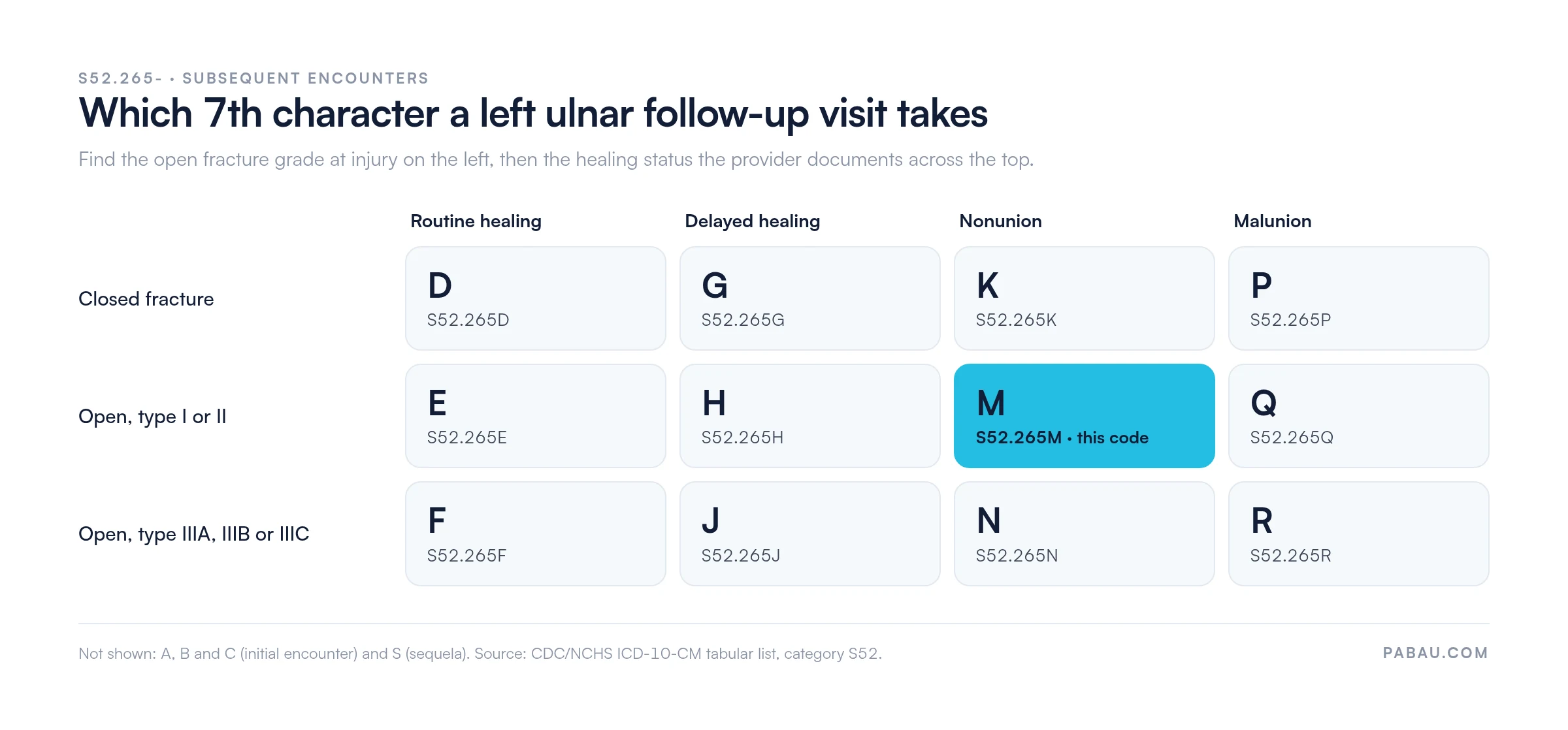
ICD-10-CM bases the open fracture 7th characters for the forearm, femur and lower leg on the Gustilo-Anderson classification. Type I is a clean wound under 1 cm. Type II is a wound over 1 cm without extensive soft-tissue damage.
Type III injuries carry extensive soft-tissue damage and split into IIIA, IIIB and IIIC. Any of those grades moves a nonunion from M to N. The grade comes from the initial treatment record, usually the emergency or operative note.
If no grade appears anywhere in the record, query the treating surgeon. Do not settle the choice between M and N by assumption.
The line between delayed healing (H) and nonunion (M) is a clinical judgment. Code nonunion only when the provider documents it. Elapsed weeks or a coder’s own reading of the X-ray never turn H into M.
The 6th character of a segmental ulnar shaft fracture carries both displacement and side. All six options share the M 7th character, so they are easy to swap by accident.
Reserve S52.266M for a record that omits the side, which is rare at a nonunion visit. If the arm is in the imaging report but not the note, ask the provider to confirm it.
Check the 6th character against the operative note and the imaging report before submission. A left ulnar fracture coded as S52.264M is still a valid code, so no format edit catches it. The mismatch only surfaces when the payer requests records.
Two default rules in the S52 notes matter here. A fracture not documented as open or closed codes to closed. A fracture not documented as displaced or nondisplaced codes to displaced.
Every element of the code has to be traceable to the chart. A payer reviewing an S52.265M claim will look for each of these in the record.
Keeping these elements in one encounter note makes an audit far simpler. Orthopedic follow-up documentation depends on a clear link between imaging, the nonunion assessment and the coded visit. Building a clean claim starts with confirming that link before the code is chosen.
S52.265M supports the evaluation, imaging and treatment of an ulnar nonunion. The pairings below are the usual ones. Check current NCCI edits and payer policy before submission, because bundling rules change each year.
The stimulator device itself is billed separately by the supplier, under HCPCS E0747 for a noninvasive electrical unit. The how medical billing works overview covers how diagnosis and procedure codes link on a CMS-1500 claim form.
Medicare covers noninvasive electrical bone growth stimulators for nonunion of long bone fractures under National Coverage Determination 150.2. The ulna counts as a long bone. Nonunion has to be shown by at least two sets of radiographs taken before treatment starts.
Those two sets must be at least 90 days apart. The DME osteogenesis stimulators LCD (L33796) also asks for multiple views of the fracture site in each set. A nonunion diagnosed on a single film will not meet that bar, whatever the 7th character says.
Commercial payers often require prior authorization for bone stimulation and for nonunion surgery such as 25400 or 25405. Expect a request for the imaging reports, the nonunion assessment and the original treatment record. If physical therapy follows the repair, track authorization per visit so those sessions never go out unapproved.
Pabau’s Claim.MD integration runs real-time eligibility checks (270/271) before the visit. A lapsed policy or a missing authorization then shows up while there is still time to act on it.
Most S52.265M denials trace back to one 7th character or one missing line in the chart. Match the CARC on the remittance advice to the cause before you correct or appeal.
Before you code an S52.265M visit, find the Gustilo-Anderson grade in the initial note and the word nonunion in today’s note. If either is missing, query the provider first. Both are faster to fix before submission than after a records request.
Denial management workflows that sort denials by CARC at ERA posting cut the time between a denial and a corrected claim. The medical billing denial codes reference explains the most frequent CARC values and what each one needs for a successful appeal.
An S52.265M claim depends on facts recorded months apart. The open fracture grade sits in the first emergency or operative note. The nonunion diagnosis appears in a follow-up visit long after. When those notes live in different places, the coder rebuilds the history by hand and the 7th character becomes a guess.
Pabau keeps the whole injury history in one patient record, from the first visit to the nonunion follow-up. For cleaner claims management, Pabau builds each claim from the visit and its invoice. Through Claim.MD, Pabau submits CMS-1500 claims electronically, checks eligibility in real time and flags denied claims for rework.
The result is a claim your team can defend from the chart alone. Every Pabau subscription includes the full feature set, so notes, billing and reporting work from the same record.

Pabau keeps the original fracture grade, the nonunion note and the claim in one patient record. Eligibility checks through Claim.MD run before the visit, and denied claims come back flagged for rework.

S52.265M is rarely miscoded because of the bone or the side. It goes wrong in the 7th character, where an open fracture grade from months ago meets a nonunion diagnosis made today. Treat both as facts to find in the record, never as assumptions to fill in.
Practices that confirm the Gustilo-Anderson grade, the nonunion statement and the imaging before submission avoid the costly records requests. Mapping your revenue cycle management end to end shows where these claims stall, so the fix can happen upstream.
Book a demo to see how Pabau keeps fracture history, claims and eligibility checks in one place for orthopedic follow-up care.

Need a denial management framework for your billing team? Denial management in healthcare covers CARC-based categorization, appeal timelines, and workflow automation for high-volume claim teams.
Want to understand how the Claim.MD clearinghouse integration works? Claim.MD clearinghouse explains how Pabau submits claims, checks eligibility and matches remittances through Claim.MD.
Looking for the full list of medical billing denial codes? Medical billing denial codes provides a reference for CARC values and what each one requires for a successful appeal.
Coding a displaced fracture of the same arm that was never open? ICD-10 code S52.262K covers nonunion of a displaced segmental left ulnar shaft fracture after a closed injury.
ICD-10 code S52.265M is the billable code for a nondisplaced segmental fracture of the left ulnar shaft with nonunion. It applies at a subsequent encounter after an open fracture graded Gustilo-Anderson type I or II. The provider must document the nonunion, and the record must show the original open grade.
Both codes describe nonunion of the same open fracture. The difference is the Gustilo-Anderson grade at injury. S52.265M covers type I or II open fractures, and S52.265N covers type IIIA, IIIB or IIIC. A closed fracture with nonunion codes to S52.265K instead.
S52.265H is delayed healing, where the fracture is still progressing toward union but more slowly than expected. S52.265M is nonunion, where the provider has concluded that the fracture has failed to unite. Code what the provider documents, never what elapsed time or the imaging seems to suggest.
No. S52.265M is a subsequent-encounter code. The visit where the open type I or II fracture is first treated takes S52.265B. M applies only later, once treatment has been given and the provider documents nonunion.
Common pairings are established-patient E/M visits (99213, 99214), forearm X-rays (73090) and upper-extremity CT (73200). Bone stimulation uses 20974 or 20979, and nonunion repair of the ulna uses 25400 or 25405. Check NCCI edits and payer policy before submission.
The usual causes are a note that describes delayed healing rather than nonunion, or no Gustilo-Anderson grade in the record. Other causes are a type III injury coded as M, missing displacement status and a laterality mismatch. Match the CARC on the remittance advice to the cause before correcting or appealing.
Medicare covers noninvasive electrical bone growth stimulators for nonunion of long bone fractures, including the ulna, under NCD 150.2. Nonunion must be shown by at least two sets of radiographs taken before treatment, at least 90 days apart. The device is billed by the supplier under HCPCS E0747.



