ICD-10 Code Y78.0: Radiological device malfunction
ICD-10 Code Y78.0: Definition and official descriptor ICD-10 Code Y78.0 is the b...

Last Updated: Nov 3, 2026
Billable Code Specific Code
S52.125Q is the billable ICD-10-CM code for nondisplaced fracture of head of left radius, subsequent encounter for open fracture type I or II with malunion.
The Q 7th character means malunion of an open type I or II fracture. Imaging or clinical documentation must confirm it before assignment, or the claim will deny. A closed malunion takes P, and a type IIIA, IIIB or IIIC malunion takes R.
Let Pabau's smart automation suggest the right codes, reduce claim denials, and keep your practice compliant—effortlessly.
Automate repetitive tasks and focus on what matters most—your patients.
Reduce coding errors and ensure compliance with the latest regulations.
Clean claims, fewer denials, and faster reimbursements.
Powerful insights and reporting to help your practice thrive.
HIPAA compliant SOC 2 certified GDPR-compliant Trusted by 4,000+ clinics worldwide

S52.125Q covers malunion of a nondisplaced open type I or II fracture of the left radial head at a subsequent encounter. Nonunion takes M and sequela takes S.
The Q 7th character is valid only when imaging or a clinical note confirms malunion at a subsequent encounter, never at an initial one.
A common denial trigger is billing initial encounter character B instead of Q, or leaving malunion out of the operative note.
Claims management software such as Pabau helps orthopedic practices submit clean S52.125Q claims and rework rejected ones quickly.
ICD-10-CM defines S52.125Q as: Nondisplaced fracture of head of left radius, subsequent encounter for open fracture type I or II with malunion. ICD-10 code S52.125Q is billable and valid for FY2025 and FY2026 under the CMS ICD-10-CM tabular list. All six descriptor elements in the table below must be present in the clinical record before the code is assigned.
S52.125Q belongs to a five-level hierarchy within ICD-10-CM Chapter 19. Each level narrows the diagnosis, from the forearm category down to the encounter and healing outcome. Knowing the levels helps you avoid picking a code from a neighboring subcategory.
Use the CDC/NCHS ICD-10-CM web tool to verify the hierarchy and confirm code validity for each fiscal year before submitting claims. The S52.125 base code is not billable on its own, so a valid 7th character is always required. Neighboring forearm fracture codes sit in the same ICD-10-CM code library.
Each word in the S52.125Q descriptor carries coding weight. A mismatch between any descriptor element and the clinical documentation is grounds for claim denial or audit.
For orthopedic and sports medicine practices, a note template with one field per descriptor element lets coders confirm all six before a claim goes out.
The 7th character for S52.125 codes sets the episode of care and the healing outcome. ICD-10-CM provides 16 valid 7th characters for this base code, from A to S with I, L and O left out.
Q is one of nine characters (G, H, J, K, M, N, P, Q and R) for a subsequent encounter with a healing complication. The grid below shows how the wound type and the healing outcome combine to pick each one.
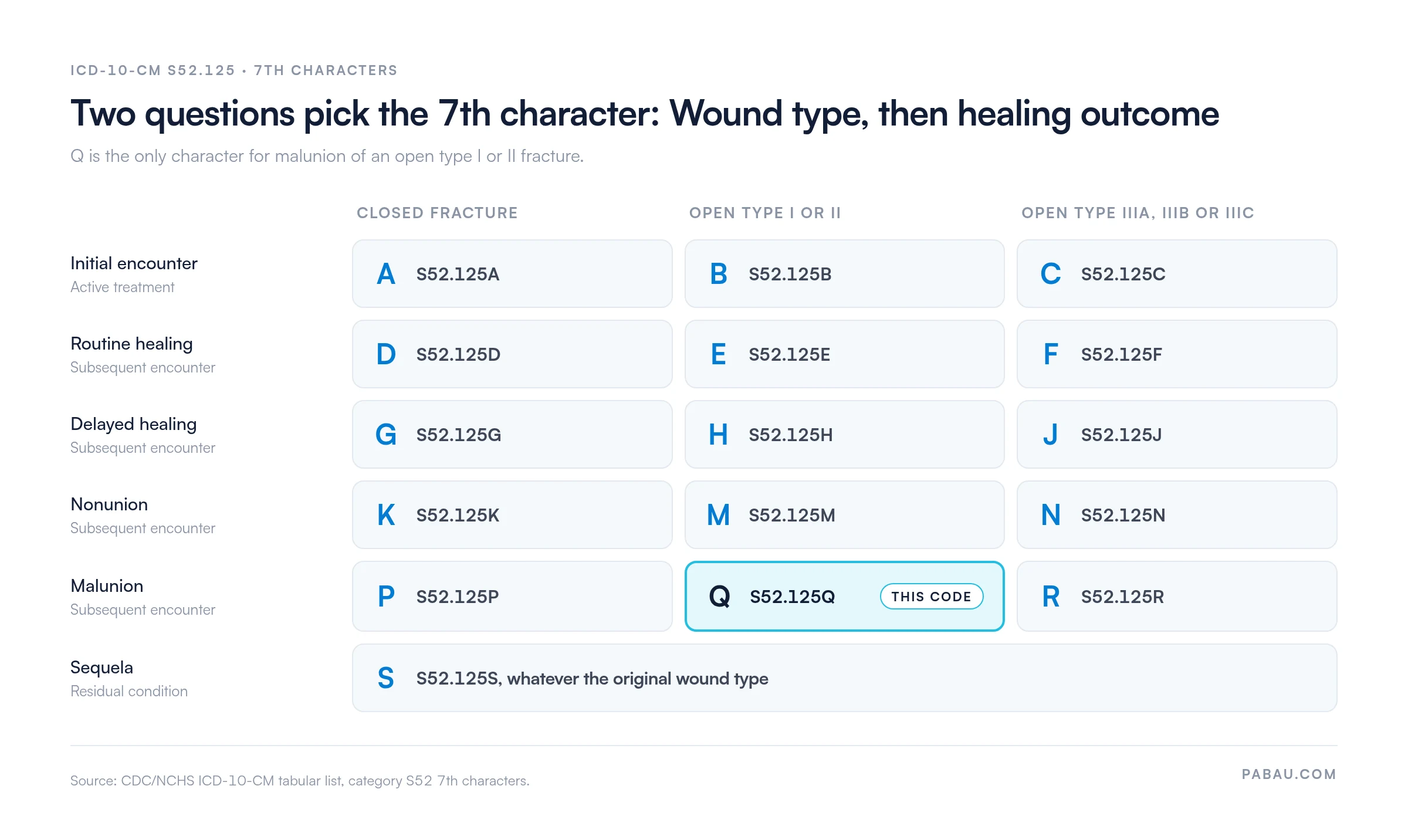
Section I.C.19.c of the ICD-10-CM Official Guidelines for Coding and Reporting governs how fracture 7th characters are applied.
The key distinction: Q requires both an open type I or II fracture history and confirmed malunion at the time of the encounter. Confusing P, Q and R, which differ by open or closed injury and Gustilo grade, is a frequent 7th character error.
Five codes are commonly confused with S52.125Q. A side-by-side comparison shows which clinical or documentation factor decides the correct assignment.
S52.125M and S52.125Q share the same open type I or II wound, so the healing outcome alone separates them. Nonunion (M) means the fracture did not heal, while malunion (Q) means it healed in an incorrect position.
The operative note or radiographic report must state which outcome is present. A note that says only “fracture complication” supports neither code, so query the physician before submission.
Query the physician before choosing between S52.125Q and S52.125M. Ask specifically: ‘Does imaging show bony bridging in an abnormal position (malunion) or no bridging (nonunion)?’ A clarifying query keeps the wrong healing outcome off corrective surgery claims.
Every element of the S52.125Q descriptor must be traceable to the clinical record. This applies at charge capture in the medical billing workflow, not only at claim submission.
A compliant note must include all of the following:
S52.125Q most often supports claims for corrective procedures on a malunited radial head. Verify each CPT code against the AMA CPT manual and the current CMS fee schedule before submission. Post-surgical rehabilitation visits also list S52.125Q as a secondary diagnosis for therapy codes.
Note: CPT 25600 covers distal radius fractures, which are anatomically distinct from radial head fractures. Confirm with the operative note that the procedure site matches the ICD-10 diagnosis site before pairing these codes. The AAPC Codify ICD-10-CM lookup tool includes crosswalk data to check CPT-to-ICD-10 medical necessity alignment.
Prior authorization requirements for procedures billed with ICD-10 code S52.125Q vary by payer and policy year. The guidance below reflects common published payer practices, so always check the payer’s current LCD and benefits manual before submitting.
Submitting S52.125Q claims through a clearinghouse that scrubs each claim before transmission reduces the risk of technical denials.
Denials on ICD-10 code S52.125Q cluster around three root causes: Wrong 7th character, missing malunion documentation, and missing prior authorization. Each one is preventable and has a clear resubmission path.
Tracking denials by ICD-10-CM code shows where documentation breaks down across the practice. Denial management workflows that flag S52.125Q claims for pre-submission review cut the number of corrective resubmissions. Clean claim submission protocols should also check the 7th character against the encounter type in the schedule.
Run a monthly denial report filtered to S52.125 base codes. If M or E characters keep getting corrected after submission, the error starts at charge capture. Move the 7th character check to the moment the charge is first entered.
Several Excludes notes at the S52 level affect S52.125Q claim validity. Review them before assigning the code alongside other diagnoses.
The Check ICD-10 database, which mirrors official CMS and NCHS data, lists the full Excludes note hierarchy for S52 and adjacent codes. Verify the excludes notes for your fiscal year, because they can change in annual revisions.
Orthopedic and hand surgery practices billing ICD-10 code S52.125Q need to catch 7th character errors and missing malunion notes before a claim reaches the payer. Pabau, the practice management platform we build, includes claims management software that scrubs every claim for missing or invalid details before it leaves the system.
Pabau sends CMS-1500 claims through Claim.MD to thousands of US payers. Eligibility checks run before the visit, and electronic remittance advice (ERA) comes back into Pabau matched to each claim.
When a payer rejects an S52.125Q claim, Pabau flags it as Needs action and shows the reason. Your billing team can correct the 7th character or attach the missing malunion note, then resubmit. Each correction stays on the claim record, which supports your medical billing compliance audits.

Pabau scrubs every claim for missing or invalid details before it leaves the system. Rejected claims come back flagged with the reason, so your team can fix the 7th character and resubmit.

Before you assign S52.125Q, confirm two facts in the record. The original wound was Gustilo type I or II, and imaging shows the fracture healed in malposition.
If either fact is missing, query the physician rather than guessing among the M, P, Q and R codes. A one-line query costs far less than a denied corrective surgery claim and its resubmission.
Pabau scrubs each claim before it goes to thousands of US payers through Claim.MD, and it flags rejected claims with the reason. Book a demo to see how Pabau keeps S52.125Q claims clean from charge entry to payment.

Need a structured approach to managing claim denials? Denial management in healthcare covers the end-to-end workflow for tracking, appealing, and preventing common denial patterns in orthopedic billing.
Want to understand how clearinghouses work? Medical claims clearinghouse guide explains how ICD-10-CM code validation happens between the practice and the payer before claim adjudication.
Looking to tighten your billing compliance process? Superbill documentation guide outlines how to structure encounter documentation to support accurate ICD-10-CM code assignment from the point of care.
ICD-10 code S52.125Q is the billable code for malunion of a nondisplaced open type I or II left radial head fracture at a follow-up visit. It is valid for FY2025 and FY2026 under ICD-10-CM Chapter 19. Assign it when a follow-up visit documents that the fracture healed in an abnormal position. The original fracture must have been an open wound classified as Gustilo type I or II.
The Q 7th character designates a subsequent encounter for an open fracture (type I or II) that has healed with malunion. That means the fracture united, but in an abnormal position. Q applies only when the original fracture was open type I or II and malunion is confirmed. For closed fracture malunion, use P instead.
S52.125Q indicates malunion, meaning the fracture healed in an abnormal position. S52.125M indicates nonunion, meaning the fracture failed to heal. Both are subsequent encounter codes for an open type I or II fracture of the nondisplaced head of the left radius. Radiographic bony bridging in malposition supports Q, and absent bridging supports M. S52.125K is the nonunion code for a closed fracture.
Use a subsequent encounter code such as S52.125Q once active treatment has ended and the patient is seen for a healing complication. The visit must reflect follow-up care, not ongoing acute fracture management. While active treatment continues, an initial encounter character applies, however many visits have occurred. For an open type I or II fracture that is B, and for type IIIA, IIIB or IIIC it is C.
Common denial reasons for S52.125Q are an incorrect 7th character, missing malunion confirmation and a laterality mismatch between the ICD-10 code and the procedure record. Typical character errors are B instead of Q, or M when malunion is documented. Missing prior authorization for corrective surgery also triggers denials. A pre-submission check that compares the 7th character with the encounter type on file catches these errors before the claim reaches the payer.
CPT 24665 is a common surgical pairing for a malunited radial head. It covers open treatment of a radial head or neck fracture, with or without internal fixation or radial head excision. CPT 24666 applies when the radial head is replaced with a prosthesis. CPT 97110 (therapeutic exercises) lists S52.125Q as a secondary diagnosis during rehabilitation. Distal radius codes such as 25600 cover a different anatomical site, so check the operative note before pairing them.
The clinical or operative note must state six elements. These are the fracture site (head of radius), the side (left), the displacement status (nondisplaced) and the original wound classification (open type I or II). The note also needs the encounter type (subsequent) and the healing outcome (malunion, confirmed by imaging or clinical assessment). Each element must trace to a dated entry. A code with no radiographic or clinical description behind it does not meet the documentation requirement.
Traditional Medicare fee-for-service does not generally require prior authorization for most orthopedic corrective procedures, but Medicare Advantage plans and commercial payers vary. Practices should check the specific payer’s LCD and benefits manual before scheduling corrective surgery for radial head malunion. Medical necessity documentation, including imaging confirmation and functional limitation assessment, is required regardless of whether formal prior authorization is mandated.