ICD-10 Code S66.308A: Extensor muscle injury, other finger
ICD-10 Code S66.308A: Definition and code hierarchy ICD-10 Code S66.308A is the ...

Last Updated: Oct 14, 2026
Billable Code Specific Code
S49.091P is the billable ICD-10-CM code for other physeal fracture of upper end of humerus, right arm, subsequent encounter for fracture with malunion.
Coders reach for it when a child or adolescent returns for follow-up care and imaging confirms the fracture healed in a mal-aligned position. The 7th character P carries that finding. Using K (nonunion) or D (routine healing) instead describes a different healing status, and the payer will query or deny the claim.
Let Pabau's smart automation suggest the right codes, reduce claim denials, and keep your practice compliant—effortlessly.
Automate repetitive tasks and focus on what matters most—your patients.
Reduce coding errors and ensure compliance with the latest regulations.
Clean claims, fewer denials, and faster reimbursements.
Powerful insights and reporting to help your practice thrive.
HIPAA compliant SOC 2 certified GDPR-compliant Trusted by 4,000+ clinics worldwide

S49.091P is a billable ICD-10-CM code specific to the right arm and a subsequent encounter with confirmed malunion, not routine healing or nonunion.
The 7th character P means the fracture healed in a malunited position, distinct from K (nonunion) and D (routine healing). Payer systems enforce that distinction.
Physeal fractures of the proximal humerus mostly occur in children and adolescents whose growth plates are still open. Laterality and age context both belong in the note.
Practice management software like Pabau links the diagnosis code to the procedure at billing, so 7th-character errors surface before the claim goes out.
ICD-10 Code S49.091P is the billable, specific ICD-10-CM code for other physeal fracture of the upper end of the humerus, right arm.
The 7th character P marks a subsequent encounter for a fracture that has healed with malunion.
The code is valid under the FY2026 edition of ICD-10-CM, maintained by CMS and the National Center for Health Statistics (NCHS). That edition took effect on October 1, 2025, which is the start of the current annual cycle. S49.091P itself has been in ICD-10-CM for years, so the date reflects the edition rather than the creation of the code.
The code sits in the S40-S49 block, which covers injuries to the shoulder and upper arm. It is specific enough to be used directly on claims, with no further child code required.
The descriptor breaks down into four components, and each one has to be supported by documentation:
Missing laterality and an unconfirmed malunion finding are the two fastest routes to a coding query or a denial on this code.
A physeal fracture is a fracture involving the growth plate (physis) of a bone. The physis is a cartilaginous zone near the end of long bones where longitudinal growth occurs. Because the physis closes in late adolescence, these fractures mostly occur in children and adolescents whose growth plates are still open.
The proximal humerus is one of the most common sites for physeal injury in young patients. It is usually caused by a fall on an outstretched arm, a contact sports injury, or direct trauma to the shoulder.
Orthopedic clinicians often use the Salter-Harris classification to characterize the fracture pattern. ICD-10-CM does not follow that convention here. The S49.091x codes describe the injury as an “other physeal fracture” rather than mapping to a numbered Salter-Harris type.
The “upper end of humerus” descriptor refers to the proximal end of the bone, covering the proximal physis and the epiphyseal region. Laterality is encoded in the 5th digit (1 = right, 2 = left, 9 = unspecified), which is why S49.091P applies exclusively to right-arm injuries. The encounter that produces the code is the follow-up visit where malunion is diagnosed, not the original injury visit.
The 7th character in ICD-10-CM fracture codes specifies the encounter type and the healing status of the fracture. For the S49.091 base code, six 7th characters are valid. The character P means the patient is presenting for a subsequent encounter rather than the initial acute treatment visit. It also means the fracture has united in an abnormal alignment.
Malunion is clinically distinct from nonunion. Malunion means the bone has healed, but not in the correct anatomical alignment. Nonunion means the fracture has failed to heal at all. Confusing P (malunion) with K (nonunion) is the most common 7th-character error on this code group. Payer edits flag any mismatch between the stated healing status and the imaging documentation.
The ICD-10-CM Official Guidelines for Coding and Reporting define a subsequent encounter as any visit after the patient has received active treatment. At that point the provider is managing the healing process or its complications. Two questions then settle the character on an S49.091 claim: whether active treatment has ended, and what the imaging shows at that visit.
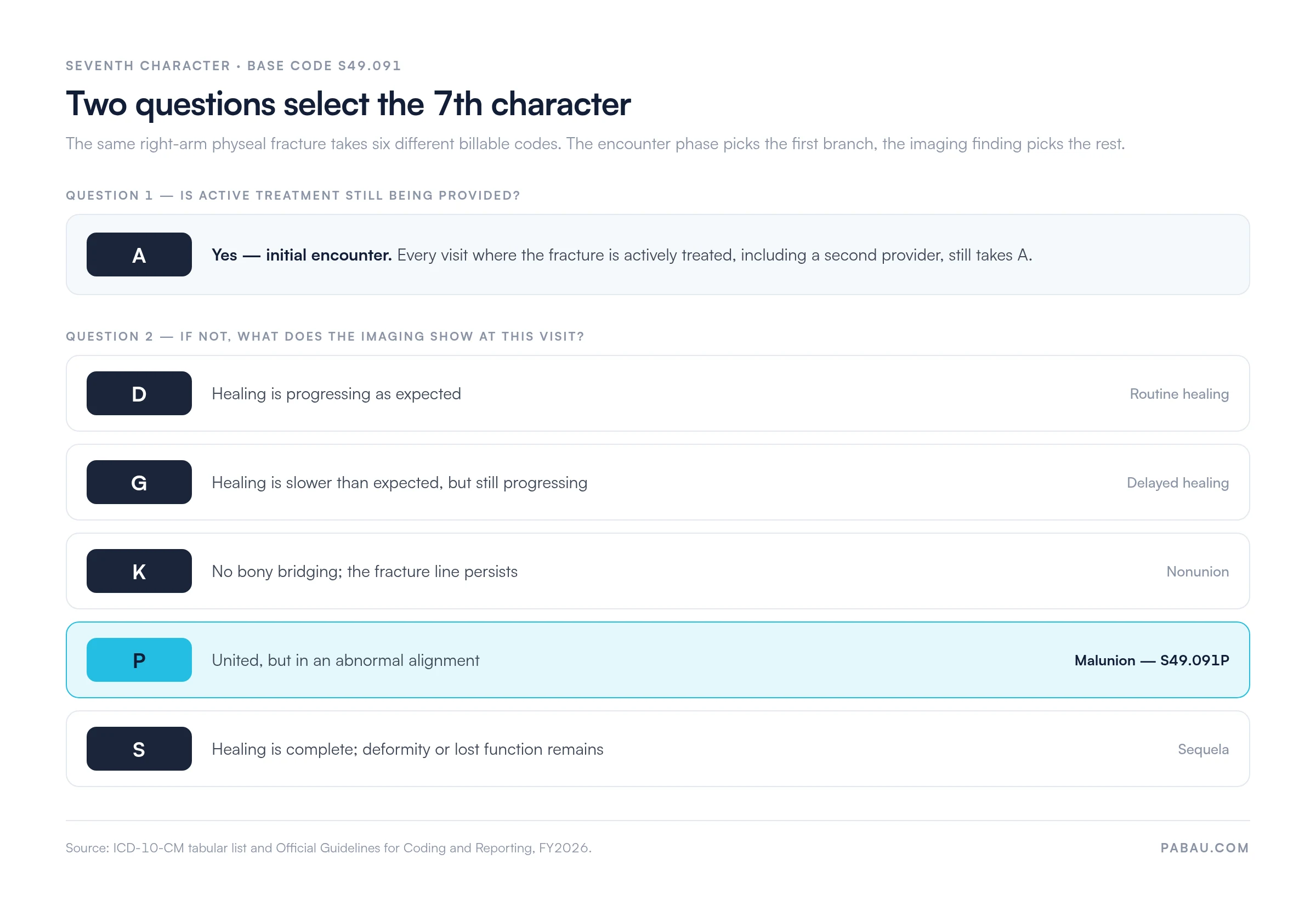
The S49.091 base code (right arm) has six valid 7th-character extensions. Select the character that reflects the encounter type and healing status documented in the clinical record. Each variant is a separate billable code.
S49.091P sits at the most specific level of the ICD-10-CM hierarchy for shoulder and upper arm injuries. Knowing the parent codes helps coders confirm code placement and navigate the tabular list accurately.
The injury chapters follow this pattern consistently. The block defines the body region, the category and subcategory narrow the injury type, and the 7th character captures encounter and healing status. Reading the hierarchy in that order keeps a claim from landing on a non-billable parent code instead of the specific billable one.
The following alternate descriptions and clinical synonyms map to ICD-10 Code S49.091P. Coders meet these terms in operative reports, discharge summaries, and referring provider notes, and each one supports this code.
These synonyms are clinically equivalent for coding purposes. Where documentation uses Salter-Harris terminology alongside a confirmed malunion finding, check whether a numbered Salter-Harris code applies instead. S49.091P stays correct only while the record describes an “other physeal fracture”. The AAPC’s ICD-10-CM code lookup is a useful cross-reference for that comparison.
The numbered Salter-Harris codes carry the same 7th characters. A Type IV fracture of the right upper humerus healing normally takes ICD-10 code S49.041D.
The ICD-10-CM Official Guidelines for Coding and Reporting set out specific rules for fracture encounter types. These are the rules to apply consistently to S49.091P and its sibling codes. CMS and NCHS publish the full guidelines annually, and they are available through the CDC ICD-10-CM web tool.
The same encounter-type logic runs across every trauma chapter. A coder fluent in it on one fracture family can apply it to the next. At the subsequent-encounter stage, accurate billing depends on the diagnosis code reflecting exactly what the provider documented at that visit.
Laterality on the supply side of the claim follows a different convention. Device codes such as HCPCS code L3809 carry no side in the descriptor, so a bilateral fitting bills as two lines with RT and LT.
These codes are the most relevant lateral variants, hierarchical siblings, and related fracture codes a coder handling S49.091P should know.
Coders who handle several of these variants can work through the full ICD-10 diagnostic codes library and confirm each sibling descriptor before assigning one. Cross-reference the WHO ICD-10 browser when you need the international equivalent of a code.
ICD-10 Code S49.091P needs four documentation elements to be defensible on audit. Each element maps to a component of the code descriptor. Missing one of them moves the encounter to a less specific code, which may reduce reimbursement or prompt a medical necessity query.
Structuring the encounter note around all four elements is the most reliable way to avoid post-payment audits. Pabau’s denial-reducing claims management links the assigned ICD-10-CM code to the encounter documentation. That cross-check prompts the provider to confirm each required element before the claim is submitted.

Four errors account for the majority of claim issues on S49.091P and its sibling codes. Each one is preventable with the right documentation discipline and coding workflow.
Practices with high denial rates on these codes benefit from a review of their denial management workflows. That review shows which 7th-character errors recur in their own claim population. Pre-submission validation catches the structural problems first, including a missing or invalid 7th character, before the claim reaches the payer.
Run a monthly query on all S49.091x claims submitted in the prior period, sorted by the 7th character used. If almost all of them carry D (routine healing), check whether malunion cases are being under-coded as routine follow-ups. The usual cause is the imaging report arriving after the claim went out, so attach the radiology report to the encounter before billing.
In most orthopedic practices the coding decision and the evidence for it live in separate places. The radiology report sits in one system, the encounter note in another, and the claim is built from whichever one the biller happens to open. A malunion coded as routine healing is then discovered weeks later, in a remittance advice.
Practice management software like Pabau keeps the three in one record. The imaging report is attached to the encounter it belongs to, and the diagnosis code is assigned against that same encounter. Billing then pulls the code from the note rather than from a separate worksheet. A coder reviewing an S49.091P claim can see the report that justifies the P in the same screen.
The outcome is fewer claims going out with a 7th character the documentation does not support. Denials on this code family tend to come from that single mismatch. Catching it before submission removes most of the rework a billing team would otherwise carry.

Pabau’s claims management software links ICD-10 diagnosis codes to procedures at the point of billing. That catches 7th-character errors before a claim reaches the payer. See how it works for orthopedic and sports medicine practices.

ICD-10 Code S49.091P demands precision on all four of its descriptor components: physeal injury at the proximal humerus, right arm, subsequent encounter, and confirmed malunion. Denials on this code almost always trace back to one of two issues. Either the 7th character is wrong, or the malunion is not confirmed in the documentation.
The practical move is to treat the imaging report as the source of the 7th character, not the coder’s memory of the last visit. A practice that builds that habit into its billing review will see this code family settle down. Book a demo to see how Pabau ties the code to the documentation before an orthopedic claim leaves the practice.

Need a workflow for managing orthopedic billing across multiple encounter types? Denial management in healthcare covers the systematic approaches practices use to identify, appeal, and prevent recurring claim denials.
Want to know what a payer-ready submission looks like? Clean claim guidelines sets out the fields and checks a claim has to pass to be paid on first submission.
Handling high volumes of ICD-10 code submissions for injury cases? Revenue cycle management fundamentals explains how diagnosis code accuracy feeds directly into clean-claim rates and overall practice revenue performance.
New to the claims side of a practice? What is medical billing walks through how a coded encounter becomes a submitted claim, and where it usually stalls.
ICD-10 Code S49.091P is a billable ICD-10-CM diagnosis code. It covers other physeal fracture of the upper end of the humerus, right arm, subsequent encounter for fracture with malunion. It is a long-standing code, and it remains valid under the FY2026 edition of ICD-10-CM, the annual cycle that began on October 1, 2025.
Yes, S49.091P is a billable, specific ICD-10-CM code. It can be submitted directly on claims for reimbursement purposes and does not require a more specific child code.
The 7th character P means the patient is presenting for a subsequent encounter, after active treatment, and the fracture has healed in a malunited position. The bone has united in an abnormal alignment rather than anatomically. P is distinct from K (nonunion, where healing has not occurred) and D (routine healing, where the fracture is progressing normally).
S49.091A applies to the initial encounter, when the patient is receiving active treatment for the physeal fracture. S49.091P applies to a subsequent encounter, when the fracture has healed but in a malunited position. Using A on a follow-up visit where the patient is in the monitoring phase, not receiving active treatment, is a coding error.
Proximal humerus fractures are coded across several ICD-10-CM subcategories, depending on the fracture type and the specificity of the record. S49.001x covers physeal fractures of the upper end that are not further specified, and S49.011x through S49.049x cover Salter-Harris Types I to IV. S49.091x covers other physeal fractures of the upper end. Non-physeal proximal humerus fractures sit in other S42 subcategories.
Use the malunion character (P) when imaging confirms the fracture has healed but in an abnormal alignment or position. Use the nonunion character (K) when imaging shows the fracture has not healed, with no callus bridging and a persistent fracture line. Nonunion and malunion are clinically opposite outcomes, and payer systems detect mismatches between the coded healing status and the treatment billed.