Pabau Engage inbox

Pabau Engage is here: every patient conversation in one inbox.

Learn more
ICD-10-CM Code

ICD code S49.199G – Physeal fracture of the lower humerus, delayed healing

Billable Code Specific Code


Code Definition

S49.199G is the billable ICD-10-CM code for other physeal fracture of lower end of humerus, unspecified arm, subsequent encounter for fracture with delayed healing. S49.1 covers the lower end of the humerus, at the growth plate of the elbow. Upper-end physeal fractures are coded from S49.0-.

The "other" designation covers a documented pattern outside Salter-Harris Types I to IV. The 7th character G separates delayed healing from routine healing (D) and sequela (S). A frequent coding error is choosing the wrong 7th character on follow-up visits. Unspecified laterality without supporting documentation can also prompt payer review.

Chapter
S00-T88 Injury, poisoning and certain other consequences of external causes
Category
S49 Other and unspecified injuries of shoulder and upper arm
Group
S49.199 Other physeal fracture of lower end of humerus, unspecified arm
Billable
Yes
Code also known as
distal humerus growth plate fracture, distal humeral physeal fracture, elbow growth plate fracture
Save time. Improve accuracy. Get paid faster.
Automate coding with Pabau

Let Pabau's smart automation suggest the right codes, reduce claim denials, and keep your practice compliant—effortlessly.

  • AI-powered code suggestions
  • Real-time compliance checks
  • Faster claims, fewer denials
Why practices choose Pabau
Save hours every week

Automate repetitive tasks and focus on what matters most—your patients.

Improve accuracy

Reduce coding errors and ensure compliance with the latest regulations.

Get paid faster

Clean claims, fewer denials, and faster reimbursements.

Grow with confidence

Powerful insights and reporting to help your practice thrive.

HIPAA compliant SOC 2 certified GDPR-compliant Trusted by 4,000+ clinics worldwide

Key takeaways

Key takeaways

S49.199G is a billable ICD-10-CM code for an other physeal fracture of the lower humerus, at a follow-up with delayed healing.

The fracture sits at the distal humeral growth plate, at the elbow end of the bone. Upper-end physeal fractures at the shoulder are coded from S49.0-.

The 7th character G means delayed healing. D covers follow-up visits where healing is routine.

Unspecified laterality may trigger medical necessity review with some payers, so document right or left whenever possible.

Pabau’s claims management software validates claims for missing or invalid details, and submits them through the Claim.MD clearinghouse integration.

ICD-10 code S49.199G: Full description and billability

ICD-10 code S49.199G is a valid, billable ICD-10-CM code in the current fiscal year. Its full official descriptor is: Other physeal fracture of lower end of humerus, unspecified arm, subsequent encounter for fracture with delayed healing.

FieldValue
CodeS49.199G
Full descriptorOther physeal fracture of lower end of humerus, unspecified arm, subsequent encounter for fracture with delayed healing
BillableYes. It is a complete 7-character code.
Code systemICD-10-CM (International Classification of Diseases, 10th Revision, Clinical Modification)
ChapterS00-T88: Injury, poisoning and certain other consequences of external causes
CategoryS49: Other and unspecified injuries of shoulder and upper arm
BlockS49.1: Physeal fracture of lower end of humerus
7th characterG: Subsequent encounter for fracture with delayed healing

The code hierarchy, from broadest to most specific, runs as follows:

  • S40-S49: Injuries of shoulder and upper arm
  • S49: Other and unspecified injuries of shoulder and upper arm
  • S49.1: Physeal fracture of lower end of humerus
  • S49.19: Other physeal fracture of lower end of humerus
  • S49.199: Other physeal fracture of lower end of humerus, unspecified arm
  • S49.199G: Subsequent encounter for fracture with delayed healing

Verify the current descriptor against the CDC/NCHS ICD-10-CM web tool before billing.

Knowing the medical billing workflow behind code selection helps practices avoid common 7th-character errors.

Clinical scope: What S49.199G covers

S49.199G covers a physeal (growth plate) fracture of the distal humerus, at the elbow end of the bone. The S49.1 subcategory is the lower-end family. Physeal fractures of the upper end, at the shoulder, are coded from S49.0-.

“Other” in ICD-10-CM language means the provider documented the fracture pattern, but it is not Salter-Harris Type I, II, III, or IV. That separates S49.19- from the type-specific codes (S49.11- through S49.14-). It also separates it from the unspecified codes (S49.10-), which apply when no pattern is documented.

The growth plate (physis) is the cartilage zone near each end of a long bone where growth happens. In skeletally immature patients it is weaker than the surrounding bone, so it tends to fail first under force.

The distal humerus has several growth centers: The capitellum, the trochlea, and the medial and lateral epicondyles. Injuries here usually follow a fall on an outstretched hand. They occur in children and adolescents, because the distal humeral physes close in the teenage years.

Clinical presentations captured by this code include:

  • Distal humerus physeal fractures documented as a pattern other than Salter-Harris Type I through IV
  • Growth plate injuries around the capitellum, trochlea, or the condylar and epicondylar regions of the elbow in pediatric patients
  • Follow-up visits for a fracture showing delayed healing on repeat imaging
  • Rehabilitation or specialist review encounters after the initial active treatment episode

Not every pediatric elbow fracture is physeal. A supracondylar fracture that runs above the growth plate is coded from S42.41- instead. Code to S49.1- only when the provider documents physeal involvement.

The “unspecified arm” element of S49.199G means neither right (S49.191G) nor left (S49.192G) was documented. Reserve it for records that do not name the side.

Understanding the 7th character G: Subsequent encounter explained

The 7th character G means the patient is receiving care at a subsequent encounter for a fracture that is healing more slowly than expected. It follows ICD-10-CM Official Guidelines Section I.C.19, and it is not the same as routine fracture aftercare.

Characters D and G both apply to follow-up visits, but they describe different healing trajectories. Physeal fracture codes in S49 take six 7th characters. Use the table below to pick the right one:

7th characterMeaningUse when…
AInitial encounter for closed fracturePatient receiving active treatment for the fracture (ER, OR, first cast application)
DSubsequent encounter, routine healingPatient in healing phase, fracture progressing normally, routine cast checks or therapy
GSubsequent encounter, delayed healingImaging shows inadequate callus formation or fracture not healing at expected rate
KSubsequent encounter, nonunionFracture has failed to heal, with no bridging callus at the expected healing endpoint
PSubsequent encounter, malunionFracture has healed in a faulty position, such as an elbow angular deformity
SSequelaLate effect of the fracture (e.g., stiffness or chronic pain after healing is complete)

The 7th character reflects healing status at the encounter, not the encounter number. A fifth visit with delayed callus on imaging warrants G, not D. A third visit with normal healing still gets D.

Pro Tip

Check the radiology report and the physician’s assessment note at every follow-up encounter before assigning the 7th character. D fits a note recording healing well and a four-week return. G fits a note recording limited callus formation or concern for delayed union. Never assign G based solely on the number of weeks since injury.

Codes commonly confused with S49.199G

The S49.1 family contains several neighbors that look similar but carry different clinical meanings. Selecting the wrong code risks denial or audit exposure.

CodeDescriptor (abbreviated)Key distinction from S49.199G
S49.101GUnspecified physeal fracture of lower end of humerus, right arm, subsequent, delayed healingNo fracture pattern documented, and the side is known (right)
S49.191GOther physeal fracture of lower end of humerus, right arm, subsequent, delayed healingSame “other” pattern, with the right arm documented
S49.119GSalter-Harris Type I physeal fracture of lower end of humerus, unspecified arm, subsequent, delayed healingFracture type is documented as SH Type I. Use it when imaging or the surgeon records Type I
S49.149GSalter-Harris Type IV physeal fracture of lower end of humerus, unspecified arm, subsequent, delayed healingFracture type is documented as SH Type IV, a pattern that crosses the physis into the joint
S49.199AOther physeal fracture of lower end of humerus, unspecified arm, initial encounter for closed fractureSame base code; A means the initial encounter, during active treatment
S49.199DOther physeal fracture of lower end of humerus, unspecified arm, subsequent, routine healingSame base; healing is progressing normally, so use D for most routine follow-up visits
S49.199KOther physeal fracture of lower end of humerus, unspecified arm, subsequent, nonunionFracture has failed entirely to unite; more severe than delayed healing
S49.199POther physeal fracture of lower end of humerus, unspecified arm, subsequent, malunionFracture has healed, but in a faulty position
S49.199SOther physeal fracture of lower end of humerus, unspecified arm, sequelaLate effect after the fracture has healed; treatment is now for the residual condition
S49.099GOther physeal fracture of upper end of humerus, unspecified arm, subsequent, delayed healingUpper-end counterpart at the shoulder; wrong site for an elbow growth plate injury

Two checks settle most of these choices. First, confirm the site: Lower end of the humerus at the elbow means S49.1-, while the shoulder end means S49.0-. Second, read how the provider described the pattern, because that decides between the type-specific, “other”, and unspecified codes. Add the side and the healing status, and the full code falls out of four answers.
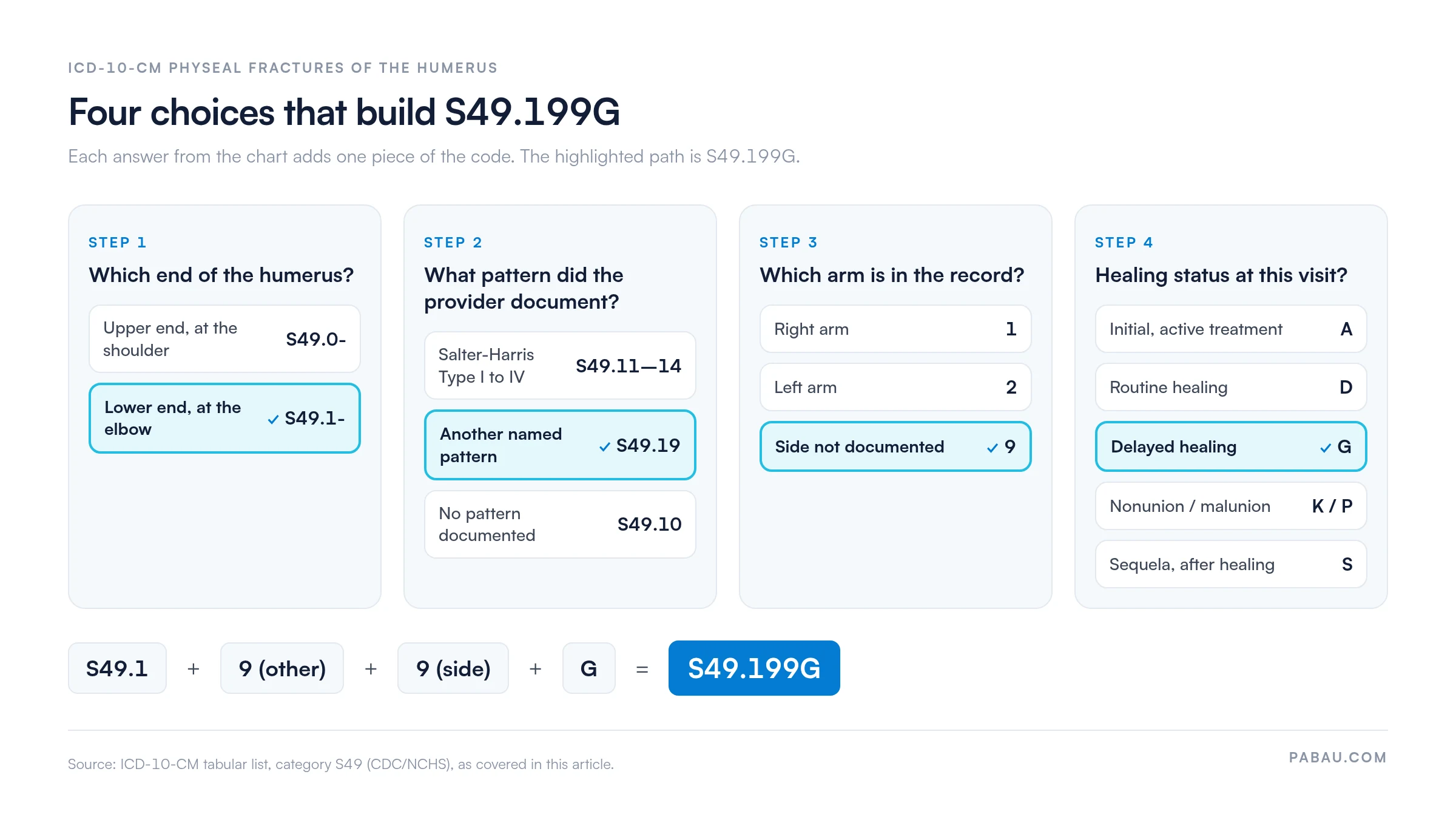
Four-step flow building ICD-10-CM code S49.199G: lower end of humerus at the elbow S49.1 (upper end is S49.0), other documented pattern S49.19 (Salter-Harris I to IV is S49.11 to S49.14, no pattern S49.10), side not documented 9 (right 1, left 2), delayed healing G (A initial, D routine, K nonunion, P malunion, S sequela)
Site, pattern, side and healing status each add one piece, so a wrong answer at any step changes the code. Structure from the ICD-10-CM tabular list.

Documentation requirements for S49.199G

The medical record must substantiate every component of ICD-10 code S49.199G before a claim is submitted. Auditors and payers look for evidence of the fracture site, the encounter type, and the healing status independently.

Required documentation elements include:

  • Imaging confirmation: An X-ray or MRI report confirming a physeal fracture of the distal humerus at the elbow. The report should name the pattern, since an “other” pattern supports S49.19- and an indeterminate one supports S49.10-.
  • Delayed healing documentation: A physician assessment noting slower-than-expected healing, inadequate callus formation, or concern for delayed union. A generic “fracture follow-up” note does not support G over D.
  • Encounter type: The record must confirm this is not the initial active treatment visit. The note should reference the prior treatment episode and describe current status.
  • Laterality: Document right or left wherever clinically determinable. “Unspecified” belongs only where the record genuinely cannot identify the side, such as a transferred patient with incomplete records.
  • Provider specialty: Documentation from an orthopedic surgeon or pediatric orthopedist carries the most weight for fracture healing assessments. Record the treating provider’s credentials.
  • Fracture classification: Record the Salter-Harris type when the provider can assign one. When the pattern falls outside Types I to IV, describe it, because that description supports the “other” code.

Practices that centralize documentation reduce the back-and-forth between coders and providers on healing status. A clean claim for S49.199G depends on that documentation being complete before the claim is generated, not after a denial arrives.

Payer requirements and prior authorization considerations

Medicare, Medicaid, and commercial payers each set their own rules for subsequent encounter fracture billing, and none are uniform across regions. The guidance below reflects general industry patterns, so confirm current requirements in each payer’s policy documents before billing.

  • Medical necessity: Payers expect subsequent encounter visits to show clinical necessity beyond routine monitoring. Physician documentation of delayed healing must be in the record to support G over a routine check.
  • Global surgical period: Surgical treatment usually starts a global period, typically 90 days for major procedures. Follow-up visits inside it may be bundled into the surgical fee. Confirm the global period for the procedure code before billing separately.
  • Prior authorization: Some commercial plans require prior authorization for specialist follow-up beyond a set number of visits. Verify authorization status before each orthopedic or pediatric orthopedic follow-up appointment.
  • Radiology documentation: Many payers want a radiology report in the claim record to support fracture coding at subsequent visits. Some also request the original imaging report alongside the follow-up note.
  • LCD/NCD considerations: No national coverage determination (NCD) applies universally to physeal fracture follow-up. Check your Medicare Administrative Contractor (MAC) for any local coverage determinations (LCDs) in your region.

Reviewing electronic remittance advice after each claim run surfaces payer-specific adjustment patterns for fracture codes.

Common claim denial reasons for S49.199G

Denials on ICD-10 code S49.199G cluster around a small set of predictable errors. Strong denial management in healthcare starts with knowing the code-specific patterns.

  • Wrong 7th character on follow-up: A frequent coding error is choosing the wrong 7th character on follow-up visits. Using A after active treatment has ended is one example. Payers compare the claim date with the original fracture date and may deny on medical necessity grounds.
  • G used instead of D for routine healing: A note showing normal progress does not support G, and that mismatch may be flagged on audit. Always match the 7th character to the documented healing status.
  • Wrong end of the humerus: A distal humerus growth plate injury coded from S49.0- (upper end) contradicts an elbow-focused record. Payers and auditors read that mismatch as a coding error.
  • Unspecified laterality without justification: Submitting without a right or left designation prompts some payers to request records or deny outright. Document laterality in the medical record and on the claim.
  • Missing imaging documentation: Fracture follow-up claims without a traceable radiology report may fail medical necessity review.
  • Unbundled fracture management codes: Billing a separate fracture care CPT code inside the global surgical period triggers a bundling edit. Check global period status before billing.
  • Coding specificity not achieved: If the provider documented a Salter-Harris type, use the type-specific code. That means S49.119G through S49.149G (unspecified arm) or the right/left equivalents, not S49.199G.

Understanding the full set of medical billing denial codes that accompany these rejections helps coders respond accurately and resubmit clean claims.

Using S49.199G for physical therapy and rehabilitation billing

Physical and occupational therapists can use S49.199G for rehabilitation visits after initial fracture treatment, provided the physician has documented delayed healing. Therapy here is elbow-focused, aimed at restoring elbow flexion and extension, forearm rotation, and grip strength.

Key considerations for PT and OT billing:

  • Transition to sequela coding: Once the fracture is radiographically healed, PT visits for residual deficits move to S49.199S (sequela). Pair it with a code for the residual condition, such as elbow stiffness. Continuing to use G at that point is incorrect.
  • Functional limitation documentation: Record measurable goals and specific functional limitations at each visit. Note elbow and forearm range-of-motion deficits, pain scores, and restrictions in daily activities.
  • CPT pairing: Common CPT codes paired with S49.199G in PT settings include 97110 (therapeutic exercise), 97140 (manual therapy), and 97530 (therapeutic activities). Each needs documented time, technique, and patient response.
  • Medicare therapy thresholds: Medicare Part B outpatient therapy carries annual threshold amounts. Confirm current KX modifier requirements for the benefit year before submitting high-visit claims.
  • Referring provider documentation: Many payers require a signed physician order or referral for outpatient PT. The referring physician’s record should confirm the delayed healing that justifies G over D.

Keep the physician’s healing-status note in the same record as the therapy claim. When a payer asks why G still applies, the answer is already on file.

Pro Tip

When moving a patient from fracture follow-up to post-fracture rehabilitation, document the transition explicitly in the clinical note: ‘Fracture now radiographically healed per [date] imaging. Patient presents with residual elbow stiffness and limited range of motion. Treatment plan addresses sequelae of prior distal humerus physeal fracture.’ This entry justifies the shift from G to S coding and protects against audit findings on both sides of the transition.

Excludes notes and what S49.199G does not cover

The S40-S49 block carries exclusion notes that limit where this code applies. Review them before assigning S49.199G, particularly when a patient has a more complex injury.

  • Excludes2 for injuries of elbow (S50-S59): A distal humerus physeal fracture sits at the elbow, but ICD-10-CM still classifies it to S49.1-. Excludes2 means a separate elbow injury, such as a dislocation or a forearm bone fracture, is coded additionally when present.
  • Salter-Harris type specificity: S49.199G does not apply when the Salter-Harris type is documented. Types I to IV each have their own codes (S49.11x through S49.14x), and choosing “other” when a type is documented is under-coding.
  • Laterality variants: S49.191G is the right-arm and S49.192G the left-arm equivalent of S49.199G. Do not default to the unspecified-arm code when laterality is documented.
  • Upper end of the humerus: A growth plate fracture at the shoulder end belongs in S49.0- (physeal fracture of upper end of humerus), not S49.1-.
  • Periprosthetic fracture: A fracture around an internal prosthetic elbow joint is coded from M97.4-, not from the S49.1- physeal codes.
  • Adult patients: Once the distal humeral physes have fused, a fracture there is coded from S42.4- (fracture of lower end of humerus). The physeal designation no longer fits after closure.

Cross-reference the AAPC’s ICD-10-CM code lookup and the CMS ICD-10 codes page to review the full Excludes1 and Excludes2 notes for the S40-S49 block.

How Pabau checks S49.199G claims before submission

Many S49.199G denials start before the claim is built. A 7th character gets keyed from memory, the side is left blank, or a follow-up lands inside a global period. Catching those by hand means a coder rereads every follow-up chart before the claim goes out.

Pabau’s claims management software checks each claim for missing or invalid details before it leaves Pabau. Claims then go out through Pabau’s Claim.MD clearinghouse integration, with real-time eligibility checks across thousands of US payers.

Claims are checked for missing or invalid details before transmission, which cuts avoidable rejections. The choice between G and D still comes from the provider’s healing-status note, which is why the documentation steps above matter.

Check every claim before it reaches the payer

Pabau integrates with Claim.MD to submit claims, check US payer eligibility and track remittances. See how the workflow looks for orthopedic and physical therapy practices.

Pabau claims management dashboard

Conclusion

Coding S49.199G correctly starts with the anatomy. A growth plate injury at the elbow belongs in the lower-end S49.1- family, not the shoulder-level S49.0- codes. Settle the site and the documented pattern first, and the remaining digits follow from the chart.

The second judgment is healing status. Keep G for visits where the provider documents slow healing, and return to D once the note shows normal progress. Coding the visit in front of you keeps these claims out of the denial queue.

Book a demo to see how Pabau validates claims and tracks remittances before and after submission.

Continue your research

Continue your research

Need a complete reference for managing claim denials? Medical billing compliance covers the documentation standards and audit-readiness practices that keep fracture and orthopedic claims clean.

Want to understand how clean claims are built? Superbill guide walks through how diagnosis codes, CPT codes, and modifiers combine into a billable encounter record.

Billing through a US clearinghouse for the first time? Medical claims clearinghouse guide explains how clearinghouses validate and route claims to payers across the 837 EDI format.

Frequently asked questions

What is ICD-10 code S49.199G?

ICD-10 code S49.199G is the billable code for other physeal fracture of lower end of humerus, unspecified arm, subsequent encounter for fracture with delayed healing. It sits in S49.1 (physeal fracture of lower end of humerus), the growth plate at the elbow. Use it when the documented pattern is not Salter-Harris Type I to IV and the follow-up shows delayed healing.

Is S49.199G a billable ICD-10 code?

Yes, S49.199G is a valid, billable ICD-10-CM code. It is a complete 7-character code. Confirm it against the current fiscal year code set before billing.

What is the difference between S49.199G and S49.199D?

S49.199D applies when the fracture is healing at a normal rate during a subsequent encounter. S49.199G applies when that encounter shows delayed healing on imaging or physician assessment. The physician’s documentation of healing progress decides which 7th character is correct, not the number of weeks since injury.

Is S49.199G a shoulder or an elbow code?

S49.199G is an elbow-end code. S49.1 covers physeal fractures of the lower end of the humerus, at the elbow. Growth plate fractures of the upper end, at the shoulder, are coded from S49.0-, such as S49.099G.

Can S49.199G be used for physical therapy billing?

Yes, PT and OT practices can use S49.199G for rehabilitation visits when the referring physician has documented delayed fracture healing. Once imaging confirms the fracture has healed and treatment targets residual elbow deficits, coding moves to S49.199S (sequela).

What are the common claim denial reasons for S49.199G?

Common denials involve using 7th character A on a follow-up visit, applying G when the physician documented routine healing, and submitting without laterality. Missing radiology reports and separate billing inside a global surgical period also generate denials.
Avatar photo
Maja Popovska
Content Writer

Maja is a Senior Content Writer at Pabau, where she covers everything from practice management and compliance to medical aesthetics and patient experience. Off the clock: binging true crime docuseries, baking and dreaming about travel.
×