

ICD-10 code S61.201A: Open wound of left index finger without nail damage
ICD-10 code S61.201A covers a left index finger wound of unstated type ICD-10 co...

Last Updated: Oct 16, 2026
Billable Code Specific Code
S43.92XD is the billable ICD-10-CM code for sprain of unspecified parts of left shoulder girdle, subsequent encounter.
Let Pabau's smart automation suggest the right codes, reduce claim denials, and keep your practice compliant—effortlessly.
Automate repetitive tasks and focus on what matters most—your patients.
Reduce coding errors and ensure compliance with the latest regulations.
Clean claims, fewer denials, and faster reimbursements.
Powerful insights and reporting to help your practice thrive.
HIPAA compliant SOC 2 certified GDPR-compliant Trusted by 4,000+ clinics worldwide

ICD-10 code S43.92XD covers a sprain of unspecified parts of the left shoulder girdle at a follow-up encounter. It took effect on October 1, 2025, for the 2026 code year.
The 7th character D signals that the patient is receiving active care after the initial treatment phase, rather than a first visit for the injury.
Common coding errors include using S43.92XA for follow-up visits and omitting laterality documentation, and both cause claim denials.
Pabau’s claims management software helps physical therapy, sports medicine, and chiropractic practices submit claims and track their status through the Claim.MD clearinghouse integration.
S43.92XD is a billable, submission-ready ICD-10-CM diagnosis code. Its full official description is Sprain of unspecified parts of left shoulder girdle, subsequent encounter.
Coders use it when a patient returns for active care after the initial treatment of a left shoulder sprain. It applies where the clinical documentation does not identify the specific ligament or joint structure involved.
According to the CMS ICD-10-CM code set, the 2026 edition of S43.92XD became effective October 1, 2025. It is valid on medical claims submitted to Medicare, Medicaid, and most commercial payers. This is the American ICD-10-CM version of the code, and it differs from the international WHO classification used in other countries.
This reference covers the code’s full details, the 7th character encounter logic, and the complete code hierarchy. It also covers related sibling codes, documentation requirements, common coding errors, and billing considerations for physical therapy, sports medicine, and orthopedic teams.
The table below provides a quick-reference summary of the code’s key attributes as defined in the 2026 ICD-10-CM tabular list.
One detail coders sometimes overlook: the “X” in S43.92XD is a placeholder character, not a clinical qualifier. ICD-10-CM uses placeholder X to hold the code’s seven-character structure when a code needs fewer than seven characters to reach its 7th position. It carries no clinical meaning beyond holding that slot so the 7th character D lands in the correct position.
The 7th character is the most consequential part of this code for billing accuracy. Getting it wrong is the fastest path to a claim denial on shoulder sprain encounters. Physical therapy practices treat shoulder injuries across multiple visits. The distinction between A, D, and S governs code selection for every appointment after the first.
The WHO ICD-10 framework and the ICD-10-CM Official Guidelines for Coding and Reporting agree on one point. “Subsequent encounter” does not mean a second provider or a second facility. It means the patient’s injury is in the active treatment phase past the initial encounter. Physical therapy visits two, three, and ten all take 7th character D, provided the injury is still being actively treated.
Understanding where S43.92XD sits in the larger code tree helps coders navigate to the right level of specificity. It also shows which parent categories govern the code’s use.
Read left to right, each character of the finished code answers a separate question, and only the last one changes across a course of treatment. The breakdown below shows what each segment carries.
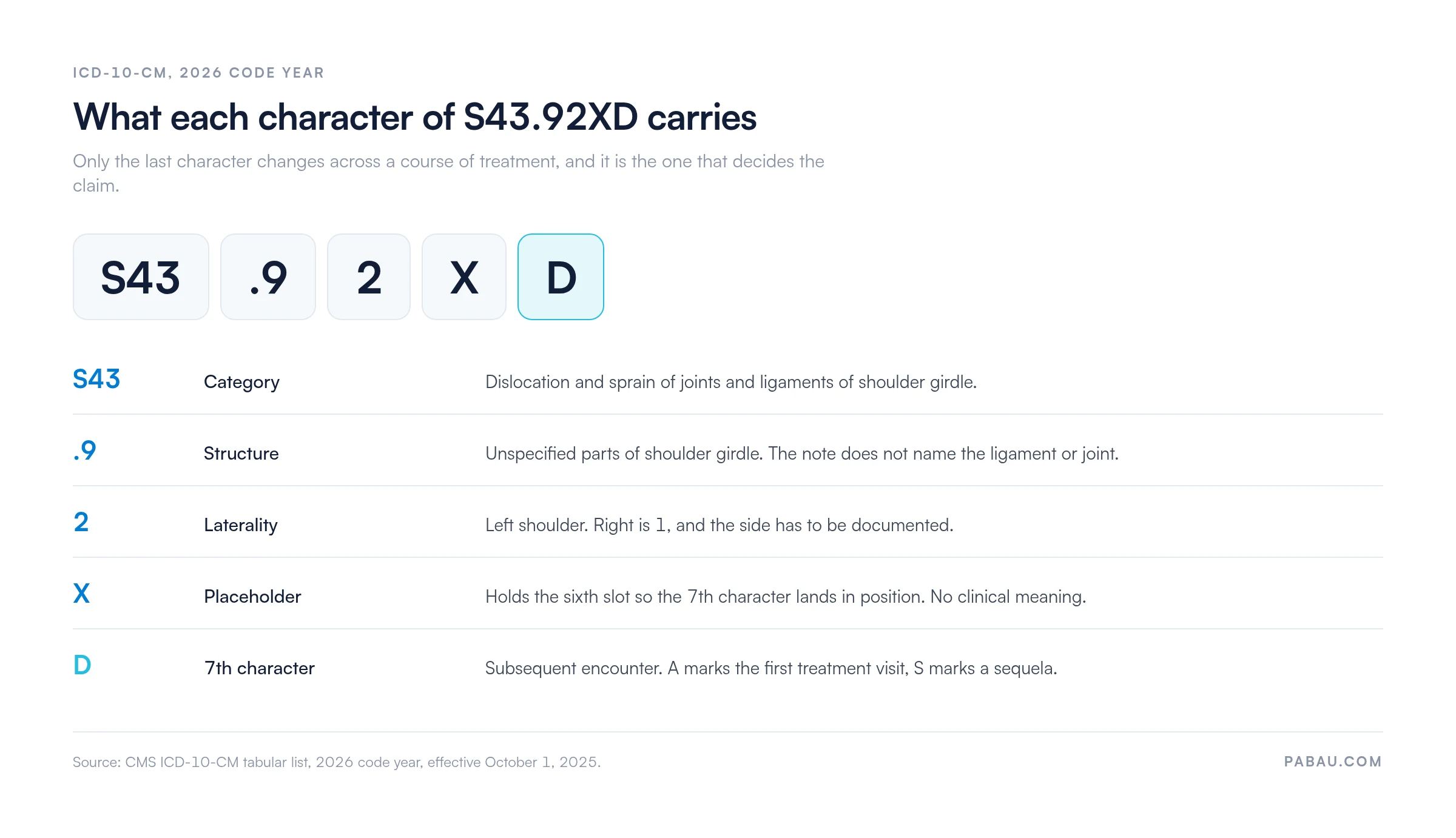
Coders working on musculoskeletal injury claims meet the S43 category often. The “unspecified” qualifier at the S43.9 level reflects what the note leaves out. When the clinical note names the specific ligament or joint, such as the acromioclavicular or glenohumeral, a more precise code within S43 applies. Our ICD-10-CM code library follows the same hierarchy logic across every injury category in the S00-T88 block.
The table below maps the complete encounter-type series for this code alongside the right-shoulder equivalent. These are the codes most often confused with S43.92XD or reported alongside it.
Approximate synonyms that may appear in clinical notes and index references for this code include:
Claim denials on S43.92XD often trace back to what the note leaves out rather than to the wrong code. Clinicians and coders handling shoulder injury caseloads should confirm the following elements appear in every note supporting this code.
The ICD-10-CM Official Guidelines for Coding and Reporting govern subsequent encounter coding. They are maintained by the National Center for Health Statistics and the Centers for Medicare and Medicaid Services.
Key guideline principles for S43.92XD:
Consistent encounter-type selection matters most in practices that bill across multiple payers, since payer-level edit rules for 7th characters vary.
Four errors account for the majority of denials and audits on this code.
Run a monthly audit of your shoulder sprain claims. Filter by S43.9X codes, then check that 7th character A never repeats beyond the first visit date. Catching that pattern before submission prevents denial backlogs and payer audits.
S43.92XD is accepted by Medicare, Medicaid, and most commercial payers as a valid diagnosis code. Several practical billing considerations affect reimbursement outcomes for it.
Workers’ compensation: Left shoulder sprains are common workers’ compensation claims in jobs involving repetitive overhead activity, manual handling, or falls. Workers’ compensation payers generally accept S43.92XD for ongoing treatment visits, but state-specific requirements vary. Some state systems require additional external cause codes to accompany the diagnosis. Confirm requirements with the specific payer before submitting.
Orthotic supplies: A brace dispensed during treatment goes on a DMEPOS supplier claim to the DME MAC, not the physician claim carrying S43.92XD. Orthosis codes carry their own LCD diagnosis requirement, which the coverage rules for HCPCS code L1843 set out for knee bracing.
Additional codes that may apply: S43.92XD describes the diagnosis but does not capture the external cause or the treatment setting. Depending on payer requirements, consider also assigning:
Denials on subsequent encounter shoulder sprain claims cluster around a predictable set of edit failures. The denial management strategies that apply to S43.92XD save billing teams a lot of rework time.
In most practices, the 7th character is decided by whoever opens the chart that day. The first visit is coded S43.92XA, the record moves on, and nobody re-reads it before visit four goes out with the same code. The mistake only surfaces weeks later, in a remittance file.
Practice management software like Pabau keeps the diagnosis code attached to the treatment episode rather than to a single appointment. Your team can see which visit was the initial encounter and which visits followed it. The switch from A to D then happens where it should.
From there, Pabau’s claims management software submits the CMS-1500 through the Claim.MD clearinghouse, checks patient eligibility in real time, and tracks each claim’s status. Remittance advice comes back into the same record. A denied shoulder sprain claim lands next to the visit that produced it, not in a separate inbox.

Pabau connects to Claim.MD for real-time eligibility checks, CMS-1500 submission, claim status tracking, and electronic remittance. See how it works for physical therapy, sports medicine, and orthopedic teams.

S43.92XD is not a difficult code to assign. It is an easy code to leave stale. The first four segments are fixed the moment the injury is documented. On every later visit, the only decision left is whether the patient is still in active treatment.
Treat that decision as a step in the visit, not as a copy-forward from last time. Practices that stay clean on this code have somebody check the encounter type before the claim leaves. They check laterality against the procedure code side as well.
The trade-off is a few seconds per visit against a denial that costs a rework cycle weeks later. Book a demo to see how Pabau tracks encounter types and claim status across a course of shoulder injury treatment.

Need to understand how claim edits work? What makes a clean claim explains the validation rules that clearinghouses apply before a claim reaches the payer.
Billing for musculoskeletal injury visits? Superbill documentation guidance covers how to structure superbills for injury encounters to support ICD-10 code selection.
Managing eligibility before the visit? Insurance eligibility verification outlines how to confirm coverage before treatment starts, which cuts denial risk on follow-up claims.
New to the billing cycle? What is medical billing walks through the path a claim takes from the encounter note to the remittance file.
Worried about an audit? Medical billing compliance sets out the record-keeping standards that support encounter-type decisions like this one.
ICD-10 Code S43.92XD is a billable diagnosis code meaning “Sprain of unspecified parts of left shoulder girdle, subsequent encounter.” It applies when a patient returns for active treatment of a left shoulder sprain after the initial visit. The specific ligament or joint structure has not been documented.
Yes. S43.92XD is a specific, billable ICD-10-CM code valid for claim submission in the 2026 code year, effective October 1, 2025. It is accepted by Medicare, Medicaid, and most commercial payers for reimbursement on musculoskeletal injury claims.
S43.92XA covers the initial encounter, which is the first time the patient receives active treatment for this left shoulder sprain. S43.92XD covers all later visits while active treatment continues. Using XA for a follow-up physical therapy session is the most common coding error on this code family.
Use 7th character D for any encounter after the initial one while the patient is still in the active healing or treatment phase. This applies to all follow-up visits, regardless of how many providers are involved. The test is whether the patient is still receiving active therapeutic intervention for the same injury.
Yes, S43.92XD is generally accepted on workers’ compensation claims for ongoing treatment of a left shoulder sprain sustained at work. Requirements vary by state jurisdiction, and some payers also require external cause codes from the W-X-Y categories. Verify requirements with the specific payer before submitting.
Documentation must confirm four points. The injury is a sprain rather than a muscle strain. It affects the left shoulder. The specific structure is unspecified. The patient is still in active treatment. Notes recording functional limitations, therapeutic goals, and treatment response strengthen medical necessity for later claims.
In ICD-10-CM, a sprain involves injury to ligaments or joint capsule structures, coded in the S43 category for shoulder injuries. A strain involves injury to muscles or tendons, coded in the S46 category. Clinical documentation must distinguish between the two, because the wrong category produces an inaccurate diagnosis code.



