ICD code S43.215D – Anterior dislocation of left sternoclavicular joint
Billable Code•Specific Code
Code Definition
S43.215D is the billable ICD-10-CM code for anterior dislocation of left sternoclavicular joint, subsequent encounter. It applies to follow-up, rehab and healing-phase visits after the dislocation has had its initial active treatment.
The 6th character 5 sets the left side, and the 7th character D marks the subsequent encounter. The first visit for active treatment takes S43.215A, and a late effect after healing takes S43.215S.
Related Information
Chapter
S00-T88 Injury, poisoning and certain other consequences of external causes
Category
S43 Dislocation and sprain of joints and ligaments of shoulder girdle
Group
S43.215 Anterior dislocation of left sternoclavicular joint
Billable
Yes
Code also known as
anterior SC dislocation, left sternoclavicular dislocation, SC joint dislocation left side
Save time. Improve accuracy. Get paid faster.
Automate coding with Pabau
Let Pabau's smart automation suggest the right codes, reduce claim denials, and keep your practice compliant—effortlessly.
Anterior dislocation of left sternoclavicular joint
Codes
Suggested by Pabau AI
S43.215DAnterior dislocation of left sternoclavicular joint
ICD Code Suggestion
AI
Suggested code
S43.215DAnterior dislocation of left sternoclavicular jointHigh match
Confidence score
98%
Why this code?
Matches patient diagnosis
Supported by clinical notes
Commonly used for this condition
Why practices choose Pabau
Save hours every week
Automate repetitive tasks and focus on what matters most—your patients.
Improve accuracy
Reduce coding errors and ensure compliance with the latest regulations.
Get paid faster
Clean claims, fewer denials, and faster reimbursements.
Grow with confidence
Powerful insights and reporting to help your practice thrive.
HIPAA compliant•SOC 2 certified•GDPR-compliant•Trusted by 4,000+ clinics worldwide
Key takeaways
S43.215D covers anterior dislocation of the left sternoclavicular joint at a subsequent (healing-phase) encounter. Laterality is encoded in the 6th character (5 = left) and encounter type in the 7th character (D).
The 7th character D applies when the patient is receiving routine or healing-phase care. Active initial treatment takes A instead (S43.215A).
A missing or wrong 7th character is the top denial trigger for this code, so confirm the encounter type against the note before submitting.
Pabau, the practice management platform we build, helps orthopedic and sports medicine practices track encounter type across multi-visit shoulder injury claims.
ICD-10 code S43.215D: Quick reference
ICD-10 code S43.215D is the billable code for anterior dislocation of the left sternoclavicular joint, subsequent encounter. Use it for follow-up, rehab and other healing-phase visits after the dislocation has had its initial treatment. The table below lists its status, chapter, category and edition.
Field
Value
Code
S43.215D
Full descriptor
Anterior dislocation of left sternoclavicular joint, subsequent encounter
Billable
Yes, valid for submission when documentation supports it
Code system
ICD-10-CM (International Classification of Diseases, 10th Revision, Clinical Modification)
Chapter
Chapter 19: Injury, poisoning and certain other consequences of external causes (S00-T88)
Category
S43 (Dislocation and sprain of joints and ligaments of shoulder girdle)
7th character
D (subsequent encounter)
Applicable edition
FY 2027 ICD-10-CM (effective October 1, 2026), unchanged from FY 2026
What S43.215D means: Breaking down the code
Each segment of S43.215D encodes a specific clinical fact. Reading the code character by character is the fastest way to confirm you have the right one before a claim goes out.
Character(s)
Value
Meaning
S43
Category
Dislocation and sprain of joints and ligaments of shoulder girdle
.2
Subcategory (4th character)
Subluxation and dislocation of sternoclavicular joint
1
Direction (5th character, S43.21)
Anterior subluxation and dislocation of sternoclavicular joint
5
Type and side (6th character)
Dislocation, left side
D
Encounter (7th character)
Subsequent encounter (routine or healing-phase care)
The code is already 7 characters long, so no placeholder X is needed. S43.215D is a valid, fully specified code in the FY 2027 tabular list, and you can confirm it in the CDC/NCHS ICD-10-CM web tool.
Clinical description: Anterior dislocation of the left sternoclavicular joint
The sternoclavicular (SC) joint is where the medial end of the clavicle meets the manubrium of the sternum. It is the only synovial joint that attaches the upper limb to the axial skeleton. There is one on each side of the sternum, so every code in this family has to state which side is affected.
Mechanism: Anterior SC dislocations typically result from a lateral compressive force applied to the shoulder, driving the medial clavicle anteriorly. Common causes include contact sports injuries, motor vehicle incidents, and falls onto an outstretched arm.
Presentation: Visible or palpable anterior prominence at the medial clavicle, localized pain, swelling, and restricted shoulder range of motion. Anterior dislocations are far more common than posterior dislocations.
Distinction from posterior dislocation: A left posterior SC dislocation (S43.225x) is often treated as a surgical emergency. The mediastinal structures sit close behind the joint. Anterior dislocation is generally managed conservatively with closed reduction. The direction of dislocation is what separates S43.215x (anterior) from S43.225x (posterior) in the tabular list.
Why laterality matters: The 6th character 5 (dislocation, left) separates S43.215D from right-sided S43.214D. It also separates it from S43.216D, which covers an anterior dislocation where the side is unspecified. Payers can and do deny claims where the coded laterality does not match imaging or operative reports.
When to use S43.215D: Subsequent encounter explained
The 7th character D denotes a subsequent encounter. The patient has already received active treatment for the anterior left SC dislocation and is now returning for routine care during healing or recovery.
Per Section I.C.19.a of the ICD-10-CM Official Guidelines, this includes follow-up visits such as sling or cast checks and physical therapy after reduction. Medication adjustment during recovery and wound care after surgery count too.
Clinical scenario
Correct 7th character
Code
First ED visit with active reduction performed
A (initial encounter)
S43.215A
Office follow-up 2 weeks post-reduction for a sling check
D (subsequent encounter)
S43.215D
Physical therapy visit for shoulder rehabilitation
D (subsequent encounter)
S43.215D
Post-surgical wound check after open stabilization
D (subsequent encounter)
S43.215D
Chronic instability or late deformity after a healed dislocation
S (sequela)
S43.215S
A common mistake: Coders keep using S43.215A at later visits because it was used at the initial ED encounter. The 7th character switches to D once active treatment is complete and the patient moves into routine healing care.
S43.215A vs S43.215D vs S43.215S: Choosing the right 7th character
All three variants share the same base anatomy, an anterior dislocation of the left SC joint. The 7th character alone decides which one a claim carries, and it is the easiest part of this code family to get wrong.
Code
7th character
When to use
Documentation trigger
S43.215A
A (initial encounter)
First contact for active treatment of the dislocation
ED note, urgent care note, or first surgical encounter documenting active reduction or a treatment decision
S43.215D
D (subsequent encounter)
Follow-up, rehab, or healing-phase visits after initial treatment
Progress note referencing the prior reduction or surgery, with healing-phase care as the visit purpose
S43.215S
S (sequela)
Treatment of a late effect or complication after the injury itself has healed
Note documenting chronic instability, deformity, or post-traumatic arthritis as a direct consequence of the original dislocation
Codes commonly confused with S43.215D
Several neighboring codes in the S43 category share similar descriptors. Picking the wrong one usually means laterality or dislocation direction was not checked, and it produces immediate payer edits or medical necessity denials.
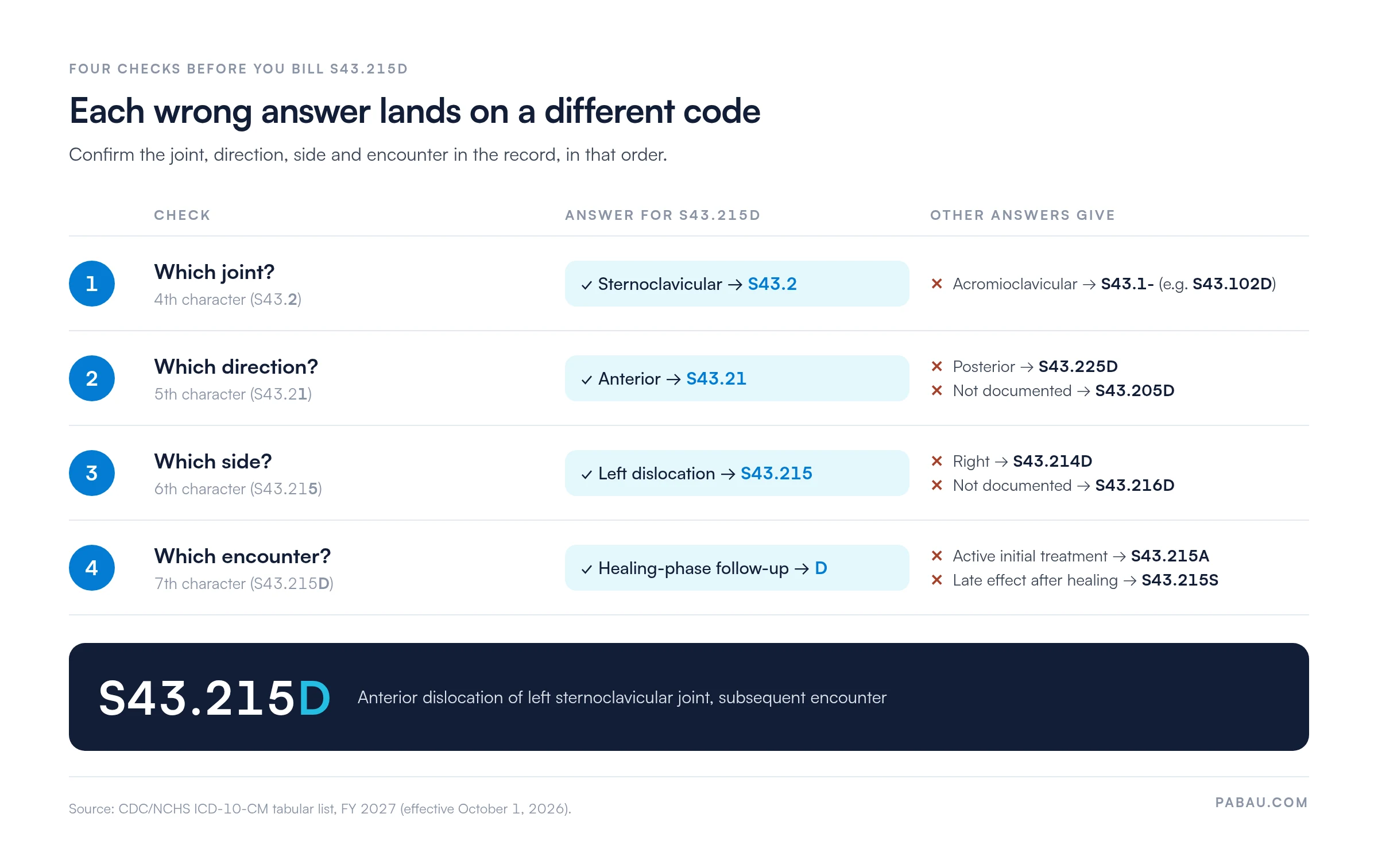
Four checks in the record settle which code applies, and each wrong answer leads to a different neighbor:
Each of the four checks has its own wrong-answer code, so a denial usually points to the check that was skipped. Codes from the CDC/NCHS FY 2027 tabular list.
Code
Descriptor
How to distinguish
S43.205D
Unspecified dislocation of left sternoclavicular joint, subsequent encounter
Use only when the direction (anterior or posterior) is unknown. Avoid it if the note or imaging names the direction.
S43.225D
Posterior dislocation of left sternoclavicular joint, subsequent encounter
Reserved for posterior dislocations. These often involve mediastinal compromise and are clinically distinct.
S43.214D
Anterior dislocation of right sternoclavicular joint, subsequent encounter
Right side. Verify laterality against the operative or clinical note before selecting.
S43.216D
Anterior dislocation of unspecified sternoclavicular joint, subsequent encounter
Use only when the record does not say which side. Query the provider before falling back on it.
S43.112D
Subluxation of left acromioclavicular joint, subsequent encounter
Different joint and a partial displacement. The acromioclavicular (AC) joint sits at the outer end of the clavicle, and the SC joint at the inner end.
S43.102D
Unspecified dislocation of left acromioclavicular joint, subsequent encounter
AC joint with the dislocation type unspecified. Query the provider if AC vs SC is unclear in the note.
CPT codes commonly billed with S43.215D
On subsequent encounter claims, the paired CPT codes reflect post-reduction care rather than the initial reduction procedure. Understanding the medical billing workflow for traumatic shoulder injuries helps coders anticipate the common pairings and avoid unbundling errors.
CPT code
Descriptor
Pairing rationale
99213 / 99214
Office or other outpatient E/M visit, established patient
Standard follow-up office visit for healing-phase assessment. The level is set by MDM complexity or total time.
97110
Therapeutic exercises
Used during PT encounters for shoulder strength and range-of-motion rehabilitation post-reduction
97012
Mechanical traction
May be applied during rehab for residual joint restriction after reduction
23520
Closed treatment of sternoclavicular dislocation, without manipulation
Note: CPT 23520 and 23525 are primarily initial-encounter procedure codes. Verify against the current AMA CPT edition and CCI edits before pairing with a subsequent encounter diagnosis code.
97530
Therapeutic activities
Functional training in PT post-reduction, commonly paired at physical therapy visits
Each paired code carries its own billing rules. CPT 99213 turns on medical decision-making or total time, and CPT 97110 is billed in 15-minute units.
CCI edit caution: Bill an E/M service and a procedure on the same date only when both are separately documented. The E/M line then needs a modifier such as modifier 25. CMS publishes the current NCCI edit tables each quarter.
Documentation requirements for S43.215D
A clean claim submission using ICD-10 code S43.215D depends on documentation that establishes three facts: The specific diagnosis, the laterality, and the encounter type. All three must be traceable in the medical record before billing.
Confirmed anterior left SC dislocation diagnosis: The clinical note, imaging report, or operative report must explicitly document anterior dislocation of the left sternoclavicular joint. “Shoulder injury” or “clavicle pain” alone does not support this specific code.
Laterality specificity: The note must state left-sided involvement. If imaging says left and the note says right, query the provider before coding rather than assuming.
Subsequent encounter justification: The record must establish continuity from an earlier initial encounter. Progress notes should reference prior treatment (e.g. “patient returns 3 weeks after closed reduction”). New injuries presenting for the first time require S43.215A, not S43.215D.
Provider signature and date: All notes must be signed by the treating provider and dated to the encounter date on the claim.
Imaging references where applicable: Radiology reports confirming dislocation direction and laterality strengthen medical necessity documentation, particularly for payers with shoulder-specific LCDs.
Common reasons S43.215D claims are denied
Payer denials on ICD-10 code S43.215D claims cluster around a few predictable patterns. Effective denial management workflows begin with understanding which pattern triggered a specific rejection.
Denial reason
Root cause
Prevention
Wrong 7th character
S43.215A submitted on a follow-up visit, or S43.215D submitted at the first encounter
Build a chart workflow that flags encounter type at charge entry, and confirm it against the visit note before submission
Laterality mismatch
Coded left while the imaging or note says right, or the note is ambiguous
Always cross-reference imaging report laterality against the coded diagnosis before billing
Insufficient medical necessity
Documentation does not establish why the subsequent visit was clinically necessary
Progress notes should document measurable healing status (range of motion, pain scores) and a clear clinical reason for the visit
Duplicate from initial encounter
The same diagnosis code was submitted twice. Or S43.215A was resubmitted as S43.215D without distinct encounter dates.
Ensure each claim includes a distinct DOS and that the 7th character has been updated from the initial encounter code
E/M unbundling
E/M billed with a procedure on the same day without modifier 25
Append modifier 25 only when the E/M and the procedure are separately identifiable and documented
Sorting denials by their medical billing denial codes shows whether a problem is coder-specific, provider-specific, or payer-specific. That answer decides the right intervention.
Pro Tip
Set a charge-entry prompt that asks coders to confirm the 7th character whenever an S43.215x code is selected. Two questions cover the usual denial triggers. Is this the first encounter for active treatment? Is the diagnosis documented as left-sided?
Payer requirements and prior authorization
Prior authorization requirements for subsequent encounter visits billed with S43.215D vary by payer, plan, and geography. No universal rule applies. The following reflects general industry patterns, so verify against the payer’s LCD, plan documents, or provider manual before submitting.
Medicare: Follow-up office visits (E/M) for healing-phase shoulder care typically do not require prior authorization. Associated procedures may still fall under Local Coverage Determination (LCD) requirements, such as shoulder manipulation or physical therapy beyond a threshold visit count. Check your Medicare Administrative Contractor for applicable LCDs covering musculoskeletal rehabilitation.
Medicaid: Prior authorization thresholds vary significantly by state. Some state Medicaid programs require authorization for physical therapy after the first 6-12 visits. Query the state Medicaid portal or MCO plan for specifics.
Commercial payers: Many commercial plans require prior authorization when physical therapy extends beyond a defined visit limit (commonly 20-30 visits per plan year). The diagnosis code S43.215D supporting the continued therapy visits must appear in the authorization request.
Frequency limitations: Payers may limit follow-up orthopedic visit frequency during the healing phase. Documentation of clinical progress at each subsequent encounter visit substantiates medical necessity for continued billing.
ICD-10-CM official coding guidelines for S43.215D
S43.215D falls under Chapter 19 of ICD-10-CM (Injury, poisoning and certain other consequences of external causes). Section I.C.19 of the ICD-10-CM Official Guidelines for Coding and Reporting governs it. The provisions below are confirmed via the CMS ICD-10-CM Official Guidelines.
7th character requirement: All codes in category S43 that require a 7th character extension must use the appropriate character to be valid and billable. S43.215D already contains 7 characters, so no placeholder X is required.
Highest specificity rule: Code to the highest level of specificity supported by the documentation. S43.215D (anterior, left, subsequent encounter) is more specific than S43.205D (unspecified direction) and must be used when the documentation supports it.
Laterality: When laterality is not documented, assign the unspecified-joint code, e.g. S43.216D. Do not assume left or right.
Sequencing: On subsequent encounter claims, S43.215D is generally the principal or first-listed diagnosis for visits focused on the shoulder injury. Codes for complicating conditions, external cause, or place of occurrence may follow per standard sequencing guidelines.
External cause codes: ICD-10-CM guidelines recommend reporting an external cause code (Chapter 20, V01-Y99) alongside the injury code when the mechanism is known. This is not strictly required for payment but supports complete documentation and epidemiological accuracy.
A clearinghouse that validates ICD-10-CM code format and payer-specific edits before transmission catches format errors before they become rejections.
Use the Check ICD-10 lookup tool to confirm S43.215D against the current fiscal year’s tabular list before billing.
How Pabau keeps S43.215D claims on the right 7th character
Coders usually confirm the encounter type by reading back through earlier notes to see whether the reduction already happened. On a shoulder injury billed across many follow-up visits, that check repeats at every charge entry.
Pabau keeps the notes, imaging reports and claim history for each patient in one record. Its error-catching claims management lets coders see the earlier encounter before choosing A, D or S.
Claims go out through the Claim.MD integration, which runs eligibility verification and payer-specific edit checks before submission. Payments come back as electronic remittance advice, so a 7th-character denial shows up against the claim that caused it.
Reduce ICD-10 coding errors across your practice
Pabau helps orthopedic and sports medicine practices track encounter type, laterality and 7th character selection. Mismatches surface before the claim reaches the payer.
Treat the switch from A to D as a documented event, not a coder’s judgment call. Once the note records that active treatment is done, each healing-phase visit takes the D code. The code moves to S only when the record describes a late effect.
The cost of checking is a few seconds per claim. The cost of skipping it is a denial, a resubmission and a delayed payment on a multi-visit injury. Book a demo to see how Pabau tracks encounter type across every follow-up visit.
Continue your research
Need guidance on denial management workflows?Denial management in healthcare covers how to build systematic processes for tracking and resolving common payer rejections.
Preparing a clean claim for shoulder injury billing?Clean claim submission outlines the documentation and format requirements payers check before adjudicating a claim.
Want to understand clearinghouse workflows?Medical claims clearinghouse explains how clearinghouses validate, format, and route claims to payers on your behalf.
Frequently asked questions
What does ICD-10 code S43.215D mean?
ICD-10 code S43.215D is the billable diagnosis code for anterior dislocation of the left sternoclavicular joint, subsequent encounter. Use it when a patient returns for routine healing-phase care after initial treatment of this shoulder girdle injury.
Is S43.215D a billable ICD-10 code?
Yes, S43.215D is a billable, valid ICD-10-CM code in the FY 2027 tabular list. Documentation has to support an anterior left sternoclavicular dislocation and a subsequent (healing-phase) encounter. It is a fully specified 7-character code requiring no placeholder X.
What is the difference between S43.215A, S43.215D, and S43.215S?
All three codes describe anterior dislocation of the left sternoclavicular joint, and only the 7th character differs. S43.215A is for the initial encounter (active treatment). S43.215D is for subsequent encounters, such as healing-phase follow-up, physical therapy and routine checks. S43.215S is for sequela, a late effect or complication after the original injury has healed.
When should I use the 7th character D in ICD-10?
Use the 7th character D when the patient has already received active treatment for the injury and now receives routine care during healing or recovery. Typical examples are follow-up office visits, physical therapy sessions and post-surgical wound checks. Per ICD-10-CM Official Guidelines Section I.C.19.a, “subsequent encounter” applies to the healing or recovery phase, not to active treatment.
Why would a claim using S43.215D be denied?
The most common reason is a wrong 7th character, such as billing S43.215A at a follow-up visit. A laterality mismatch with the clinical or imaging notes is next. Thin medical necessity documentation and E/M unbundling without modifier 25 also trigger denials. The CARC denial code on the remittance advice shows which issue caused the rejection.
What documentation is required to support S43.215D?
The record must state anterior dislocation of the left sternoclavicular joint and confirm the visit is a follow-up, not a first encounter for active treatment. It needs a signed provider note with a clinical reason for the visit, ideally referencing the initial treatment. Imaging reports confirming direction and laterality further support medical necessity.