ICD-10 Code V09.01XS: Pedestrian injured in nontraffic accident involving military vehicle, sequela
ICD-10 Code V09.01XS: Code description and clinical meaning ICD-10 code V09.01XS...

Last Updated: Oct 26, 2026
Billable Code Specific Code
S42.262P is the billable ICD-10-CM code for displaced fracture of lesser tuberosity of left humerus, subsequent encounter for fracture with malunion.
The 7th character P applies when imaging shows the fracture united in an abnormal position. Coders often confuse this code with S42.261P, the right-side code. Another frequent error is the wrong 7th character: D (routine healing) or K (nonunion) when imaging confirms malunion.
Let Pabau's smart automation suggest the right codes, reduce claim denials, and keep your practice compliant—effortlessly.
Automate repetitive tasks and focus on what matters most—your patients.
Reduce coding errors and ensure compliance with the latest regulations.
Clean claims, fewer denials, and faster reimbursements.
Powerful insights and reporting to help your practice thrive.
HIPAA compliant SOC 2 certified GDPR-compliant Trusted by 4,000+ clinics worldwide

S42.262P is a billable ICD-10-CM code for a displaced lesser tuberosity fracture of the left humerus with malunion, at a subsequent encounter.
The 7th character P means the fracture healed in an abnormal position. A fracture that failed to unite takes K (nonunion) instead.
Laterality is a hard requirement. S42.261P is the right-side code and S42.263P is unspecified, so match the code to the documented side.
Imaging must confirm the malunion, and the record must show the patient is still receiving care for it.
Pabau, the practice management platform we build, helps billing teams validate diagnosis-to-procedure pairings before a claim is submitted.
ICD-10 code S42.262P is a billable ICD-10-CM code for a displaced lesser tuberosity fracture of the left humerus, at a subsequent encounter for malunion. It is valid for the current fiscal year (FY 2027, from October 1, 2026). The code sits in Chapter 19 of the tabular list, which covers injury, poisoning and certain other consequences of external causes. Its block is S40-S49, injuries to the shoulder and upper arm.
The lesser tuberosity is a bony prominence on the anterior surface of the proximal humerus. It is the attachment point for the subscapularis muscle, part of the rotator cuff complex. Fractures here are less common than greater tuberosity injuries, but they matter. The subscapularis drives internal rotation and keeps the front of the shoulder stable.
A displaced fracture means the fracture fragments have separated beyond acceptable alignment and are no longer in anatomical position. Displacement matters for coding because it determines both treatment approach and the specific code within the S42.26x family (displaced vs nondisplaced).
Malunion means the fracture did heal, but in an abnormal position. The bone has united, just not in correct alignment. This is the key clinical distinction from nonunion: The fracture is no longer broken. The healed position still causes functional deficit, pain, or mechanical restriction.
Patients with lesser tuberosity malunion typically present with limited internal rotation, anterior shoulder pain with resisted motion, and subscapularis weakness on testing.
Each character position in S42.262P carries a distinct anatomical or encounter meaning. Understanding the structure helps coders select the correct code and confidently choose the 7th character extender.
The 6th character encodes displacement and laterality: 1 = displaced right, 2 = displaced left, 3 = displaced unspecified, 4-6 = the same three for nondisplaced. Using S42.263P when the chart clearly states “left shoulder” is a laterality specificity error that commercial payers and Medicare auditors flag routinely.
The 7th character extender for S42.262 encodes both the encounter type and the fracture’s healing status. Selecting the wrong character is a frequent denial trigger for this code family. The seven valid options are shown below.
Character P applies when imaging confirms the fracture united in malalignment and the patient is still receiving treatment or follow-up for that malunion. Once active treatment ends and only the residual effect remains, the encounter shifts to sequela (S). The ladder below puts these rules in the order a coder should check them.
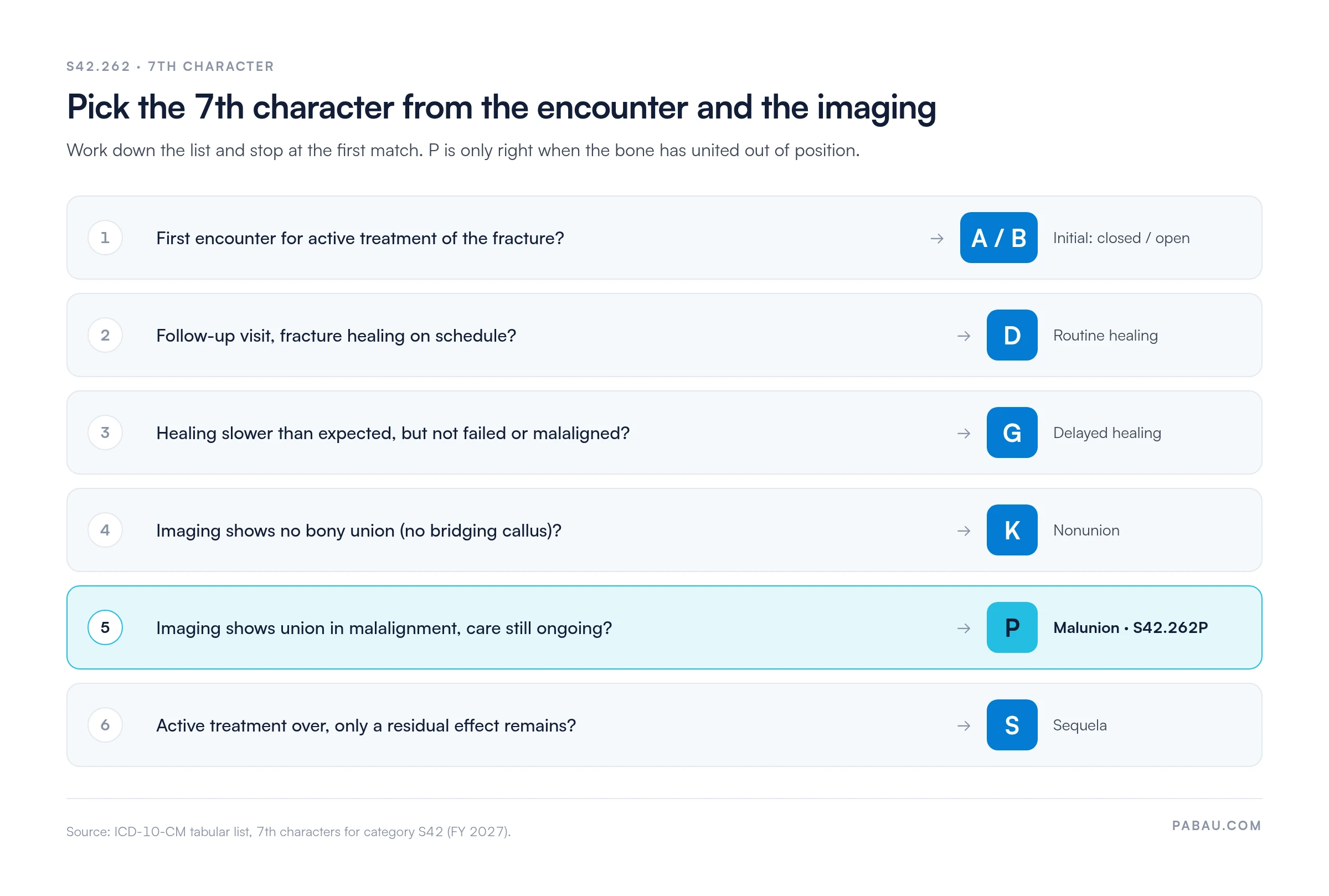
Check the radiology report before finalizing the 7th character. A report that says ‘healed fracture with angulation’ supports P (malunion). A report that says ‘no evidence of bridging callus’ or ‘pseudarthrosis’ supports K (nonunion). Never assign P or K on clinical impression alone when imaging is available. Payers routinely request the supporting radiology report during an audit.
The S42.26x family covers all lesser tuberosity fractures across three axes: Laterality (right/left/unspecified), displacement (displaced vs nondisplaced), and 7th character. Coders must confirm all three before selecting a code. The table below maps the most commonly confused neighbors.
Two errors come up often in this code family. One is reversing laterality, using S42.261P for the left side. The other is using unspecified S42.263P when the operative or imaging report clearly identifies the left shoulder. Payers treat unnecessary unspecified-laterality codes as incomplete documentation.
Malunion and nonunion are distinct clinical diagnoses that map to different 7th characters, different treatment approaches, and different payer expectations for supporting documentation. Swapping them is an audit flag.
The American Hospital Association’s Coding Clinic for ICD-10-CM/PCS treats malunion versus nonunion as a recurring source of coder queries. Radiology language like “healed in varus/valgus” or “consolidated in malalignment” supports P (malunion). When the report reads “no evidence of fracture healing” or “fibrous union,” that supports K.
Because S42.262P is a subsequent-encounter malunion code, the CPT codes associated with it reflect either ongoing rehabilitation or surgical correction. The pairing depends on where the patient is in their treatment course. Office follow-ups for the malunion usually bill as 99213 through 99215, depending on medical decision making.
Verify each CPT-to-ICD pairing against the payer’s medical necessity policy before submission. Malunion repair (24430 or 24435) and corrective osteotomy (24400) need imaging that documents the malunion, plus the operative report. The record should also explain why non-operative management was not enough. CPT codes are maintained by the American Medical Association, and payer coverage criteria change every year.
Claims submitted with S42.262P require a specific documentation set. Missing any element below is a common denial trigger, particularly for Medicare and commercial orthopedic policies. Validating diagnosis-to-procedure pairings before submission catches many of these denials before a payer sees the claim.
Knowing what a clean claim requires helps billing staff build documentation checklists for malunion codes like this one. Those checklists stop denials before the claim is submitted.
Physical therapy visits often carry S42.262P as the supporting diagnosis, billed under 97110 or 97530. Notes that record functional status, treatment goals and progress next to the diagnosis code make the medical necessity case much stronger.
Claims using S42.262P are denied for a predictable set of reasons. Most are documentation failures rather than coding errors. The right code was used, but the supporting record did not back it up. Effective denial management workflows start with knowing which documentation faults payers look for on this code family. The denial codes on the remittance advice tell you which fault the payer found.
The S42 category carries coding conventions that govern what codes may or may not be reported alongside S42.262P. These come from the ICD-10-CM tabular list and the Official Guidelines for Coding and Reporting. The Centers for Medicare and Medicaid Services (CMS) and the National Center for Health Statistics (NCHS) publish both each year.
Excludes1 (cannot be coded together): S42 codes carry an Excludes1 note for traumatic amputation of the shoulder and upper arm (S48.-). If a traumatic amputation occurred, S48 takes precedence and S42 fracture codes are not reported in the same encounter.
Excludes2 (both may be coded when both are present): Periprosthetic fracture around an internal prosthetic shoulder joint (M97.3-). The same applies to physeal fractures of the upper end of the humerus (S49.0-). Report these alongside S42 when both conditions exist.
Always verify Excludes1 and Excludes2 notes against the current fiscal year CMS tabular list, not a cached reference. CMS and NCHS update the tabular list annually on October 1, and Excludes note changes occasionally appear in midyear addenda. The CDC/NCHS ICD-10-CM web tool at icd10cmtool.cdc.gov is the authoritative source for current-year notes.
The denials above come down to three checks: Laterality, the 7th character and the radiology report. In many practices, a biller runs those checks by hand after the visit, one claim at a time.
Pabau, the practice management platform we build, keeps the encounter note and the billing record in one system. Its claims management software helps billing teams validate diagnosis-to-procedure pairings before submission.
That matters most for orthopedic practices with high volumes of fracture follow-ups, where 7th character errors repeat across several visits. A pairing caught before submission never becomes a denial to appeal.

Pabau’s claims management tools help orthopedic and musculoskeletal practices validate diagnosis-to-procedure pairings before each claim goes out.

The 7th character P is the part of this code that is easiest to get wrong and hardest to defend in an audit. Read the radiology report before you assign it. If imaging shows no union, the code takes K. If healing is only slow, it takes G.
Then check that the note names the left side and shows care is still active. Those two lines in the chart decide whether a malunion follow-up pays the first time.
Orthopedic and musculoskeletal practices with high volumes of fracture follow-ups gain the most from checking pairings before submission. Book a demo to see how Pabau helps your billing team review fracture claims before they reach payers.

Need help understanding how clearinghouses validate ICD-10 diagnosis codes? How medical claims clearinghouses work explains the role of electronic claim routing and validation in the billing workflow.
Want the full claim lifecycle in one place? What medical billing involves covers the end-to-end claim lifecycle from diagnosis code to payment posting.
Want to understand denial patterns across fracture codes? Denial codes in medical billing maps the most common CARC denial reason codes that accompany musculoskeletal claim rejections.
Coding the nondisplaced fracture at a routine follow-up? ICD-10 code S42.265D covers a nondisplaced lesser tuberosity fracture of the left humerus with routine healing.
Coding a malunion higher up the humerus? ICD-10 code S42.226P covers a nondisplaced surgical neck fracture that healed with malunion.
ICD-10 code S42.262P is the diagnosis code for a displaced fracture of the lesser tuberosity of the left humerus, at a subsequent encounter for malunion. Malunion means the bone united in an abnormal position. The code sits in Chapter 19 of the ICD-10-CM tabular list, in the S40-S49 block. Use it when imaging confirms the malunion and the patient is still receiving care for it.
Yes, S42.262P is a billable ICD-10-CM code valid for claims submission. It is specific enough to report directly on a claim, with no more specific code beneath it. Payers still expect supporting documentation: Confirmed laterality, imaging evidence of malunion and subsequent-encounter status.
S42.261P is the right-side code, and S42.262P is the left-side code. Both describe a displaced fracture of the lesser tuberosity with malunion at a subsequent encounter. The only difference is the 6th character: 1 means displaced right and 2 means displaced left. Always verify laterality against the clinical note and imaging report before choosing between them.
Use 7th character P when imaging confirms the fracture healed in an abnormal position and the patient is still receiving care for the malunion. If the fracture has not united, use K (nonunion). If it is healing normally at a follow-up visit, use D (routine healing). At the first encounter for active treatment, use A (closed fracture) or B (open fracture).
Payers expect five elements in the record. The first is documentation that establishes the original fracture. The second is explicit laterality (left humerus or left shoulder) in the encounter note. A radiology report must confirm bony union in malalignment, and the note must show a subsequent encounter. Finally, the record needs clinical justification for ongoing care. Missing any of them often gets a claim denied or returned for more information.
Common pairings are CPT 24430 or 24435 for surgical repair of the malunion, and CPT 24400 for corrective osteotomy of the humerus. Follow-up office visits use 99213-99215, and physical therapy uses 97110 (therapeutic exercise) and 97530 (therapeutic activities). CPT 23470 (hemiarthroplasty) applies when the malunion is severe enough for shoulder replacement. Verify each pairing against the payer’s medical necessity policy before submission.
Two reasons top the list: A wrong 7th character (A or D instead of P at a malunion follow-up) and laterality missing from the note. Claims also fail when no radiology report supports the malunion, or when unspecified S42.263P is used despite documented laterality. Missing medical necessity documentation for continued care is another frequent trigger, especially on repeated physical therapy visits.