ICD-10 Code S52.541M: Smith’s fracture of right radius with nonunion (open type I or II)
ICD-10 Code S52.541M: Definition and billable status ICD-10 Code S52.541M is the...

Last Updated: Oct 15, 2026
Billable Code Specific Code
S42.199A is the billable ICD-10-CM code for fracture of other part of scapula, unspecified shoulder, initial encounter for closed fracture. It applies when imaging places a closed fracture on a named part of the shoulder blade that has no subcategory of its own. The record also doesn't say which side.
The code sits in category S42 under the scapula subcategory, S42.1. Unlike the body, acromion, coracoid, glenoid and neck codes, S42.19- has no displaced or nondisplaced split. If the side is documented, S42.191A (right) or S42.192A (left) replaces it. Character A holds for as long as the fracture is under active treatment.
Let Pabau's smart automation suggest the right codes, reduce claim denials, and keep your practice compliant—effortlessly.
Automate repetitive tasks and focus on what matters most—your patients.
Reduce coding errors and ensure compliance with the latest regulations.
Clean claims, fewer denials, and faster reimbursements.
Powerful insights and reporting to help your practice thrive.
HIPAA compliant SOC 2 certified GDPR-compliant Trusted by 4,000+ clinics worldwide

S42.199A codes a closed fracture of a named scapula part outside the body, acromion, coracoid, glenoid and neck, with the side undocumented.
When the record names the side, S42.191A (right) or S42.192A (left) is the more specific code.
When the record never says which part of the scapula broke, S42.109A fits instead of S42.199A.
Character A covers every visit during active treatment of a closed fracture, and an open fracture takes B.
Pabau’s claims management pre-fills the claim from the patient record and checks required fields before sending, so there’s no double entry.
ICD-10 code S42.199A reports a closed fracture of other part of the scapula, unspecified shoulder, at the initial encounter.
In plain terms, imaging has placed the break on a named part of the shoulder blade that has no subcategory of its own. The record also doesn’t say which side. It’s a billable code in the current CMS ICD-10-CM code set and is valid on professional and institutional claims.
S42.199A is a seven-character code, and each level narrows the injury. The chain runs from S42 (shoulder and upper arm) to S42.1 (scapula). From there it moves to S42.19 (other part of scapula) and S42.199 (unspecified shoulder). Check the current hierarchy in the CDC ICD-10-CM web tool before you finalize a code.
The words “other” and “unspecified” send you to different subcategories. “Other part” means the record names a scapular site that has no code of its own. “Unspecified part” means the record says the scapula is broken but never says where.
So when the imaging report reads “scapular fracture” and nothing more, S42.109A is the right code. Once the radiologist names the glenoid or the acromion, move to that subcategory and its displacement choice. An open, displaced glenoid fracture with no side documented, for example, codes to S42.143B.
S42.19- itself has no displaced or nondisplaced option, so the S42 default to displaced has nothing to act on here. The path below runs the three questions that decide whether S42.199A fits.
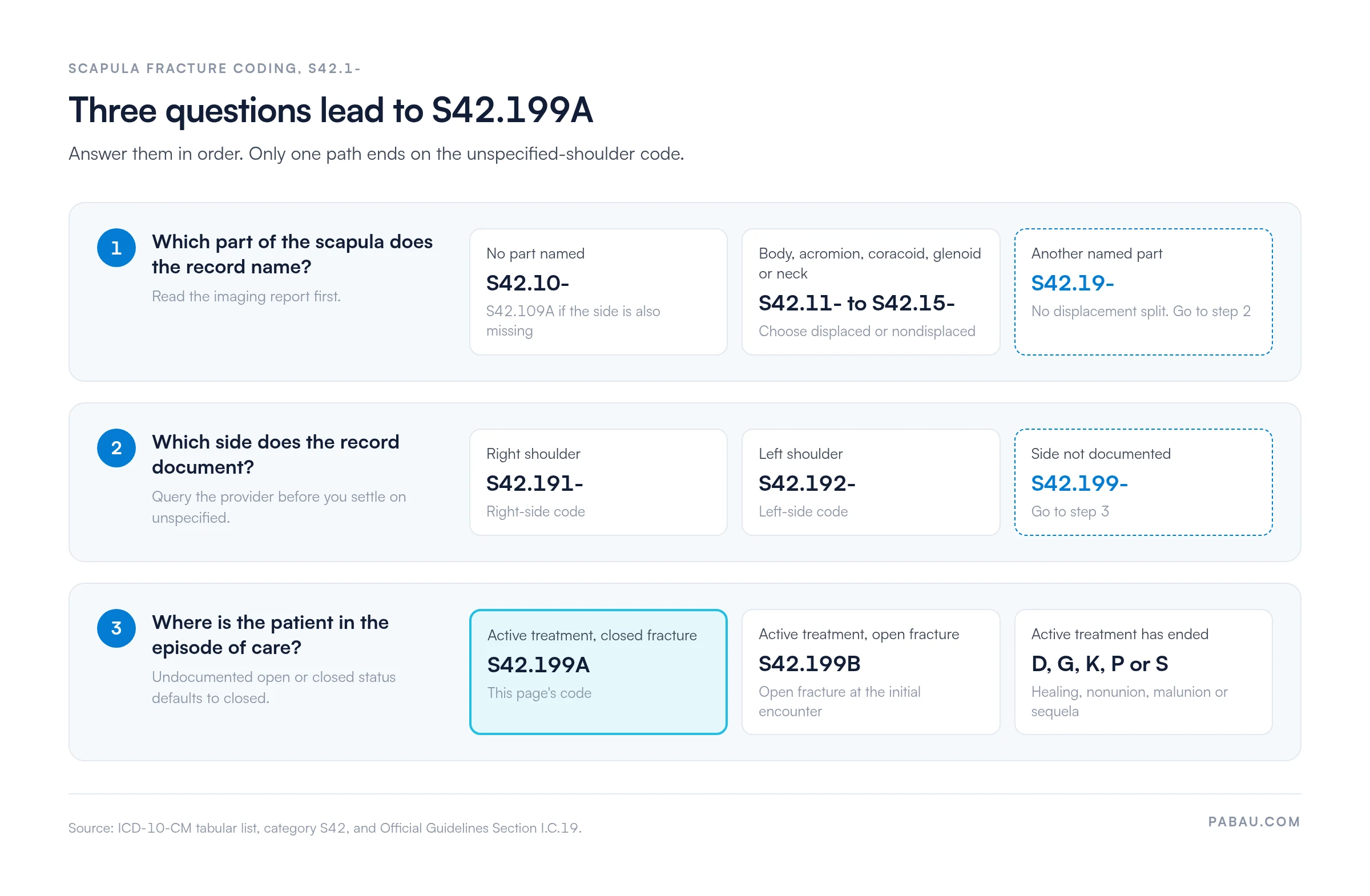
The 7th character follows the episode of care. Under Section I.C.19.a of the ICD-10-CM Official Guidelines, “initial encounter” covers every visit while the patient receives active treatment. The S42 category allows seven characters, and S42.199 accepts all of them.
A and B split on open versus closed. Under the S42 category note, a fracture not documented as open or closed defaults to closed, so A is the fallback at the first encounter.
Look at the treatment plan, not the visit number. If the note describes active fracture management, such as immobilization, manipulation or surgical planning, character A stays on the claim. Switch to D once active treatment has ended and the patient is in routine healing follow-up.
Section I.C.19.c of the ICD-10-CM Official Guidelines governs traumatic fracture coding, including S42.199A. Meeting billing compliance requirements on these claims comes down to four rules.
A claim built on S42.199A has to survive an audit, so the chart must back each part of the code. Submitting a clean claim for a scapula fracture depends on five details in the record.
Scapula fractures are treated and billed with scapula-specific CPT codes. Humerus codes such as 23600 and 23615 describe a different bone and don’t belong on an S42.199A claim.
In Pabau, the practice software we build, the Claim.MD integration can handle real-time eligibility checks and electronic CMS-1500 claim submission. With its claims management software, Pabau pre-fills the claim from the invoice and patient record and sends it through your clearinghouse.
Check each pair against current NCCI edits before submission. The first sling or strapping is part of 23570 or 23575, so it isn’t billed as a separate application code.
“Open treatment” in 23585 describes the surgery, not the wound, so it can pair with S42.199A when a closed fracture is fixed surgically. Review your superbill documentation to confirm the CPT code matches the treatment delivered.
Traditional Medicare fee-for-service generally doesn’t require prior authorization for closed fracture care. Medicare Advantage plans set their own rules, so check the specific plan. Physical therapy for shoulder rehabilitation may need separate authorization with any payer.
External cause codes report how, where and during what activity the injury happened. They are never principal diagnoses, so list them after S42.199A.
Section I.C.20 of the guidelines encourages external cause reporting, but there is no national mandate. They become required only where a state reporting mandate or a payer says so. Mapping your medical billing workflows by payer shows which claims need them.
Claims for S42.199A fail for predictable reasons. A strong denial management workflow catches most of them before submission.
Run three checks on every S42.199A claim before it goes out. Confirm the 7th character matches the treatment phase. Confirm the side is undocumented, and confirm the named part has no subcategory of its own. Those checks catch the errors above before a payer does.
S42.199A inherits its Excludes notes from category S42, so it does carry an Excludes1 note. Traumatic amputation of the shoulder and upper arm (S48.-) is Excludes1. A periprosthetic fracture around an internal prosthetic shoulder joint (M97.3-) is Excludes2. Confirm the current notes in the AAPC ICD-10-CM lookup before you finalize the code.
Scapula fracture claims often start in a busy emergency department or orthopedic practice. The coder pieces the claim together from imaging, notes and a superbill. A missed side, a wrong 7th character or a blank authorization field can send it back weeks later.
Pabau pre-fills the CMS-1500 from the patient record instead. Invoice, patient and insurer details from the record pre-fill the claim, so there’s no double entry.
Before a claim can be sent, Pabau checks that required fields such as membership numbers and authorization codes are complete. In the US, the Claim.MD integration adds real-time eligibility checks, claim-status tracking and ERA remittance posting. Your team spends less time reworking returned claims and more time on the next encounter.

Pabau pre-fills claims from the patient record and checks required fields before sending, so the claim reaches payers with the required details in place. Real-time eligibility checks run through Claim.MD.

S42.199A is a narrow code, and it earns its place only when three facts line up. The fracture is closed, it sits on a scapular part with no subcategory of its own, and the record never names the side. When any of those changes, a more specific code exists and payers expect you to use it.
Treat an S42.199A claim as a prompt to query rather than a default. One question to the radiologist or treating physician about the side or the exact site often turns an unspecified code into a specific one.
Book a demo to see how Pabau pre-fills each fracture claim from the patient record so it reaches payers with the required details in place.

Need a clean-claim checklist for injury codes? Clean claim requirements covers the fields and documentation every payer expects before processing an injury diagnosis claim.
Want to understand denial patterns across your practice? Denial management in healthcare outlines how to categorize, track, and appeal denied claims by root cause.
Looking for the broader revenue cycle picture? Revenue cycle management explained walks through each stage from eligibility verification to payment posting.
Coding a named scapula part instead? ICD-10 code S42.143B covers an open, displaced glenoid fracture when the side isn’t documented.
Looking up a neighboring injury code? ICD-10-CM codes collects the diagnosis code guides by chapter.
S42.199A means a closed fracture of a named scapula part outside the body, acromion, coracoid, glenoid and neck, at the initial encounter. The side isn’t documented. It’s a billable ICD-10-CM code.
No. S42.199A sits under S42.1, fracture of scapula. Proximal humerus fractures are coded in S42.2-, and the clavicle has its own subcategory, S42.0-.
Use S42.191A when the record documents the right shoulder and S42.192A for the left. Section I.B.13 allows the unspecified side only when the record doesn’t identify it, so check the imaging report first.
Seven are valid. A and B cover initial closed and open fractures, while D, G, K and P cover subsequent encounters. S is for sequela. Character A applies throughout active treatment, not only at the first visit.
Not nationally. ICD-10-CM guidelines encourage external cause reporting but don’t mandate it. It becomes required only when a state mandate or a payer contract says so, so check your payer rules.