ICD code S63.102D – Unspecified left thumb subluxation, follow-up care
Billable Code•Specific Code
Code Definition
S63.102D is the billable ICD-10-CM code for unspecified subluxation of left thumb, subsequent encounter.
Coders most often use this code at physical therapy sessions and orthopedic follow-up appointments. It generates denials when the wrong 7th character is used, laterality is missing, or medical necessity is unclear.
Related Information
Chapter
S00-T88 Injury, poisoning and certain other consequences of external causes
Category
S63 Dislocation and sprain of joints and ligaments at wrist and hand level
Group
S63.102 Unspecified subluxation of left thumb
Billable
Yes
Code also known as
partial dislocation of left thumb
Save time. Improve accuracy. Get paid faster.
Automate coding with Pabau
Let Pabau's smart automation suggest the right codes, reduce claim denials, and keep your practice compliant—effortlessly.
Unspecified left thumb subluxation, follow-up care
Codes
Suggested by Pabau AI
S63.102DUnspecified left thumb subluxation, follow-up care
ICD Code Suggestion
AI
Suggested code
S63.102DUnspecified left thumb subluxation, follow-up careHigh match
Confidence score
98%
Why this code?
Matches patient diagnosis
Supported by clinical notes
Commonly used for this condition
Why practices choose Pabau
Save hours every week
Automate repetitive tasks and focus on what matters most—your patients.
Improve accuracy
Reduce coding errors and ensure compliance with the latest regulations.
Get paid faster
Clean claims, fewer denials, and faster reimbursements.
Grow with confidence
Powerful insights and reporting to help your practice thrive.
HIPAA compliant•SOC 2 certified•GDPR-compliant•Trusted by 4,000+ clinics worldwide
Key takeaways
S63.102D is the billable ICD-10-CM code for unspecified subluxation of the left thumb at a subsequent encounter.
“Unspecified” refers to the joint. When the note names the MCP, IP, or CMC joint, a more specific code applies.
The 7th character D applies once active treatment is complete and the patient receives routine care while the thumb heals.
Subluxation and dislocation have separate codes. S63.105D is the left thumb dislocation code, so the note must say which one occurred.
ICD-10 Code S63.102D: Quick reference
ICD-10 Code S63.102D is the billable code for unspecified subluxation of the left thumb at a subsequent encounter. It applies once active treatment is over and the note does not name the joint that slipped. The table lists the code details from the FY2026 ICD-10-CM tabular list published by the CDC.
Field
Detail
Code
S63.102D
Full descriptor
Unspecified subluxation of left thumb, subsequent encounter
Billable
Yes. It is fully specified and valid for claim submission
Valid period
FY2026 (October 1, 2025 through September 30, 2026)
Code system
ICD-10-CM (International Classification of Diseases, 10th Revision, Clinical Modification)
Parent code
S63.102 Unspecified subluxation of left thumb (non-billable without a 7th character)
Subcategory
S63.1 Subluxation and dislocation of thumb
Category
S63 Dislocation and sprain of joints and ligaments at wrist and hand level
Chapter
S00-T88: Injury, poisoning and certain other consequences of external causes
7th character
D, subsequent encounter
What does S63.102D mean? Breaking down the code
S63.102D is a seven-character ICD-10-CM code, and each segment narrows the diagnosis. Read from left to right, it names the injury type, the digit, the side, and the stage of care.
Segment
Level
Meaning
S63
Category
Dislocation and sprain of joints and ligaments at wrist and hand level
S63.1
Subcategory
Subluxation and dislocation of thumb
S63.10
Subclassification
Unspecified subluxation and dislocation of thumb (the joint is not named)
S63.102
6th character 2
Subluxation of the left thumb. The 1 to 3 codes are subluxations and the 4 to 6 codes are dislocations
S63.102D
7th character
Subsequent encounter, during the healing or recovery phase
The word “unspecified” describes the joint, not the side. The record confirms a left thumb subluxation but does not say whether the MCP, IP, or CMC joint slipped. Laterality is still fully specified, which is why the code is billable.
Anatomy covered: Which thumb joints S63.102D applies to
The thumb has three joints that can sublux, and the ICD-10-CM code set gives each of them its own code. S63.102D is the fallback for when the documentation does not identify the joint.
Carpometacarpal (CMC) joint: the basal joint where the first metacarpal meets the trapezium. A CMC subluxation codes to S63.04-, which sits in S63.0 rather than S63.1.
Metacarpophalangeal (MCP) joint: the knuckle joint at the base of the thumb. A left MCP subluxation at follow-up is S63.112D.
Interphalangeal (IP) joint: the single joint between the two thumb phalanges. A left IP subluxation at follow-up is S63.122D.
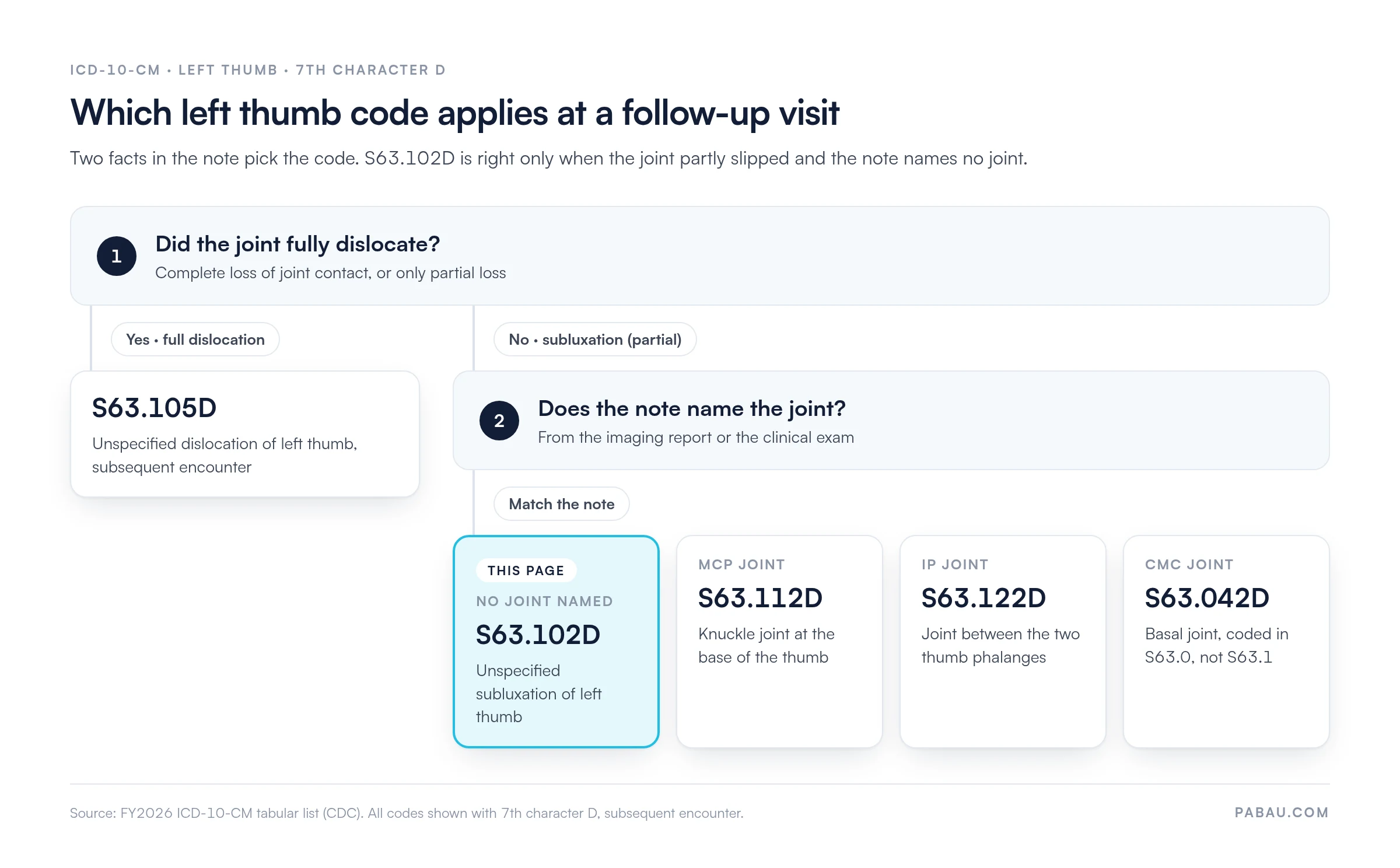
A subluxation is a partial dislocation, where the joint surfaces lose contact only in part. A full dislocation of the left thumb with no joint named is S63.105D instead. When the imaging report or the clinical note names the joint, code to that joint and leave S63.102D aside. The chart below runs the two questions in the order a coder answers them.
The injury type separates S63.105D from the subluxation codes, and the named joint decides the rest. Codes from the FY2026 ICD-10-CM tabular list.
The 7th character D: Subsequent encounter vs A and S
The ICD-10-CM Official Guidelines define the 7th character D in their chapter 19 injury rules. D applies after the patient has completed active treatment and is receiving routine care during healing or recovery.
7th character
Meaning
Thumb subluxation example
A
Initial encounter
Any visit with active treatment: the emergency visit, closed reduction, or evaluation by a new physician
D
Subsequent encounter
Splint check or removal, follow-up X-ray of the reduced joint, medication adjustment, or a routine recheck
S
Sequela
A late effect after healing, such as chronic thumb instability. Code the late effect first and S63.102S after it
The character follows the type of care, not the visit count. A second physician who evaluates and treats the injury still reports A. A routine recheck after the reduction reports D, however few days have passed.
Two errors account for most 7th character mistakes on this code. One is carrying the A code from the emergency visit into every follow-up claim. The other is switching to D while the patient is still receiving active treatment.
Pro Tip
Check how your EHR carries diagnosis codes forward. Many systems copy the initial encounter code into every follow-up note until someone changes it. Add a step that prompts the coder to confirm the 7th character on every established thumb injury claim.
Excludes notes and coding instructions for S63.102D
S63.1 and S63.10 carry no Excludes notes of their own in the FY2026 tabular list. The instructions that govern S63.102D sit at the category and block level above it.
Includes (category S63): the category covers these injuries at wrist and hand level.
Avulsion of a joint or ligament
Laceration of cartilage, joint, or ligament
Sprain of cartilage, joint, or ligament
Traumatic hemarthrosis, traumatic rupture, or traumatic tear of a joint or ligament
Traumatic subluxation of a joint or ligament
Code also (category S63): any associated open wound, such as a laceration of the left thumb from the same injury.
Excludes2 (category S63): strain of muscle, fascia, and tendon of wrist and hand (S66.-). A tendon strain can be coded alongside S63.102D when both are documented.
Excludes2 (block S60-S69): burns and corrosions (T20-T32), frostbite (T33-T34), and venomous insect bites or stings (T63.4).
One more note points back at this code. Subcategory S63.04 carries an Excludes2 for interphalangeal subluxation and dislocation of the thumb (S63.1-). It confirms that CMC injuries and IP or MCP injuries live in different subcategories.
Neighboring codes most often confused with S63.102D
Several codes sit close to S63.102D in the tabular list and differ by a single character. The table shows when each one replaces it.
Code
Descriptor
Use instead when…
S63.102A
Unspecified subluxation of left thumb, initial encounter
The patient is receiving active treatment at this visit
S63.102S
Unspecified subluxation of left thumb, sequela
Treatment is complete and the visit is for a late effect
S63.101D
Unspecified subluxation of right thumb, subsequent encounter
The injured thumb is the right one
S63.103D
Unspecified subluxation of unspecified thumb, subsequent encounter
The record does not state the side. Query the provider first
S63.104D
Unspecified dislocation of right thumb, subsequent encounter
The right thumb was fully dislocated, not subluxed
S63.105D
Unspecified dislocation of left thumb, subsequent encounter
The left thumb was fully dislocated, not subluxed
S63.106D
Unspecified dislocation of unspecified thumb, subsequent encounter
A full dislocation with no side documented
S63.112D
Subluxation of metacarpophalangeal joint of left thumb, subsequent encounter
The note names the MCP joint
S63.122D
Subluxation of interphalangeal joint of left thumb, subsequent encounter
The note names the IP joint
S63.042D
Subluxation of carpometacarpal joint of left thumb, subsequent encounter
The note names the CMC (basal) joint
S63.602D
Unspecified sprain of left thumb, subsequent encounter
The injury was a ligament sprain with no joint displacement
Clinical documentation requirements for S63.102D
A follow-up note has to support three choices the coder makes: the injury type, the side, and the encounter stage. Supporting a clean claim submission means the note includes the following.
Laterality: state “left thumb” explicitly. A note that says only “thumb” forces S63.103D, which invites a payer query.
Subluxation or dislocation: name the injury type. A partial loss of joint contact is a subluxation, and a complete loss is a dislocation.
Joint, where known: if imaging or examination identifies the MCP, IP, or CMC joint, record it. The coder can then use the more specific code.
Encounter stage: show that active treatment is complete. Reference the date of reduction, the splint plan, or the earlier visit.
Medical necessity: record pain, range of motion, pinch and grip strength, joint stability, and the plan going forward.
Mechanism of injury: keep the original mechanism traceable in the chart, so the follow-up claim connects to the initial encounter.
Meeting billing compliance requirements at the documentation stage prevents the slowest denial category to fix: insufficient medical necessity.
Common CPT codes billed with S63.102D at follow-up visits
S63.102D is a diagnosis code, so every claim also needs a CPT code for the service performed. These are the codes most often paired with it during thumb subluxation follow-up care.
CPT code
Service
Use context
99213 / 99214
Established patient office visit (E/M)
Orthopedic, hand surgery, or primary care recheck of the healing thumb
99024
Postoperative follow-up visit included in the global service
A follow-up by the physician who performed a closed reduction, inside its global period
29130 / 29131
Application of finger splint, static / dynamic
A new or changed splint applied at the follow-up visit
29280
Strapping, hand or finger
Buddy taping or strapping to protect the thumb joint
73140
Radiologic examination, finger(s), minimum of 2 views
Follow-up imaging to confirm the joint stays in alignment
97110
Therapeutic exercise
Range of motion and strengthening work for the left thumb
97140
Manual therapy techniques
Joint mobilization once the treating physician clears it
97530
Therapeutic activities
Functional training for pinch, grasp, and fine motor tasks
97763
Orthotic management and training, subsequent encounter
Adjusting or checking a thumb orthosis fitted at an earlier visit
Watch the global period. If the same physician reduced the thumb, routine follow-up inside the global days is usually reported with 99024 and not paid separately. Check the global days for the reduction code in the CMS Physician Fee Schedule.
In physical therapy, each therapy code needs a matching intervention in the note. A 97110 line, for example, needs the exercises performed and the time spent. Payers with local coverage determinations may ask for functional measures beyond a set visit count.
Payer requirements and prior authorization
Payer rules for S63.102D claims vary by plan type. The table summarizes typical requirements, but always check the individual payer contract, since terms change every year.
Payer type
Typical authorization or threshold
Key documentation note
Commercial (PPO/HMO)
Often a set number of therapy visits before authorization is needed; varies by plan
Functional outcome measures at each authorization renewal
Medicare (Original)
KX modifier above $2,480 for PT and SLP combined, and $2,480 for OT, in CY2026 (CY2025 was $2,410)
Medical necessity documented at every visit; targeted medical review can start at $3,000
Medicare Advantage
Prior authorization rules set by each plan, often stricter than Original Medicare
Check the plan coverage determination before extended therapy
Workers’ compensation
State-specific; many states require authorization for therapy past the acute phase
Work-relatedness and return-to-work status in every note
Medicaid
State-specific; some programs require authorization from the first therapy visit
Check the state fee schedule and coverage rules before treating
The Medicare KX threshold is not a hard cap. Therapy above it is still covered when the KX modifier confirms medical necessity and the record supports it.
Top claim denial reasons for S63.102D and how to fix them
S63.102D denials cluster around a few predictable errors. Fixing them at the documentation and coding stage costs far less than working remittances later. Effective denial management workflows start with knowing which edits fire most often.
Denial reason
Root cause
Corrective action
Wrong 7th character
The EHR carried the A code forward, or D was used during active treatment
Match the 7th character to the care given at each visit
Unspecified joint when one is documented
The note names the MCP, IP, or CMC joint, but S63.102D was assigned
Use S63.112D, S63.122D, or S63.042D as the note supports
Subluxation coded as dislocation, or the reverse
The note does not say whether the joint fully dislocated
Query the provider, then choose S63.102D or S63.105D
Missing laterality
The note says “thumb” with no side, so S63.103D was used
Query the provider and record the side before assigning a lateral code
Insufficient medical necessity
No functional measures or plan in the follow-up note
Record range of motion, pinch strength, stability, and the plan
E/M inside the global period
A routine recheck was billed as 99213 after the same physician did a closed reduction
Report 99024 for routine follow-up within the global days
Therapy above the KX threshold
Medicare therapy claims passed $2,480 without the KX modifier
Track the running total and add KX when the record supports it
Coding S63.102D for workers’ compensation claims
Workers’ compensation payers apply state rules that go beyond commercial and Medicare requirements. The medical billing fundamentals still apply, and an occupational injury claim adds record requirements of its own.
Every S63.102D claim on a workers’ compensation case needs these elements in the record.
Work-relatedness statement: the initial note must tie the left thumb injury to the job. Each follow-up note should reference it.
Return-to-work status: record full duty, modified duty, or off work at each visit. Thumb injuries limit gripping and fine motor tasks, so name the restrictions.
Functional capacity data: measure pinch strength, grip strength, and range of motion at follow-up visits. These figures support medical necessity and any disability rating.
Mechanism of injury narrative: the initial note, coded S63.102A, must describe the work activity that caused the subluxation.
State fee schedule compliance: reimbursement follows the state fee schedule. Confirm each CPT code is listed and payable there.
Workers’ compensation rules differ by state. Check the state board’s guidelines or the payer contract before you submit S63.102D on an occupational injury claim.
How Pabau supports accurate S63.102D coding
Most S63.102D denials start when the claim drifts away from the note. The note names the joint but the claim says unspecified, or the visit was routine but the claim still carries A.
Pabau, our practice software for clinical teams, keeps the clinical record and the claim in one system. The biller codes from the follow-up note itself, not from a re-keyed summary. That makes the joint, the side, and the encounter stage easy to check before the claim goes out.
Pabau’s claims management screen tracks each thumb injury claim from submission to remittance, so a rejected follow-up claim surfaces the day it happens.
Pabau’s claims management software handles submission, eligibility checks, claim status, and remittance posting. Claims route through Claim.MD, Pabau’s US clearinghouse partner. Responses come back against the same patient record, so the team sees a rejection when it lands.
Get thumb injury follow-up claims right the first time
Pabau keeps the clinical note and the claim in one system, then submits through the Claim.MD clearinghouse with eligibility checks and remittance posting built in.
S63.102D is the right code only when three facts line up. The injury is a subluxation, it is in the left thumb, and the patient is past active treatment. When the note also names the joint, a more specific code replaces it.
Most errors on this code come from a note that leaves one of those facts unstated. Write the joint, the side, and the stage of care into every follow-up note, and the claim codes itself. Book a demo to see how Pabau keeps the note and the claim in one workflow.
Continue your research
Submitting claims electronically for the first time?Medical claims clearinghouse guide explains how clearinghouse validation works and what payers expect on a clean submission.
Want to understand what makes a claim pay first time?Clean claim submission breaks down every element payers check before adjudicating a musculoskeletal claim.
Frequently asked questions
What does ICD-10 Code S63.102D mean?
ICD-10 Code S63.102D is the billable code for unspecified subluxation of the left thumb at a subsequent encounter. The patient has completed active treatment and is receiving routine care while the thumb heals. “Unspecified” means the record does not name the joint that partially dislocated.
Is S63.102D a billable ICD-10 code?
Yes. S63.102D is a billable ICD-10-CM code, valid for fiscal year 2026 (October 1, 2025 through September 30, 2026). Its parent, S63.102, needs a 7th character before it can go on a claim.
What is the difference between S63.102A, S63.102D, and S63.102S?
The three codes describe the same injury and differ only in the 7th character. S63.102A applies to any visit with active treatment, such as a closed reduction. S63.102D applies to routine care during healing. S63.102S applies to a late effect after the injury has healed.
Should I use S63.102D or S63.105D?
Use S63.102D when the left thumb joint was partially dislocated, or subluxed. Use S63.105D when the joint was fully dislocated. If the note does not say which, query the provider before you code.
When should I use a more specific code instead of S63.102D?
Use a more specific code whenever the note names the joint. A left MCP joint subluxation is S63.112D and a left IP joint subluxation is S63.122D. A left CMC joint subluxation is S63.042D, which sits in subcategory S63.0.
Can S63.102D be used for physical therapy billing?
Yes. S63.102D fits therapy visits for a left thumb subluxation in the recovery phase. It pairs with codes such as 97110, 97140, 97530, and 97763. Medicare claims above the CY2026 KX threshold of $2,480 need the KX modifier.