ICD-10 Code T31.77: Burns involving 70-79% of body surface
ICD-10 code T31.77: Quick reference and code details ICD-10 code T31.77 is the b...

Last Updated: Nov 5, 2026
Billable Code Specific Code
S36.93XA is the billable ICD-10-CM code for laceration of unspecified intra-abdominal organ, initial encounter.
It sits in subcategory S36.9 and applies when the record documents a laceration of an organ inside the abdomen, but not which organ. A contusion takes S36.92XA, another injury type S36.99XA, and an injury of unstated type S36.90XA. A placeholder X fills the sixth position, and the 7th character A marks active treatment.
Let Pabau's smart automation suggest the right codes, reduce claim denials, and keep your practice compliant—effortlessly.
Automate repetitive tasks and focus on what matters most—your patients.
Reduce coding errors and ensure compliance with the latest regulations.
Clean claims, fewer denials, and faster reimbursements.
Powerful insights and reporting to help your practice thrive.
HIPAA compliant SOC 2 certified GDPR-compliant Trusted by 4,000+ clinics worldwide

S36.93XA is the billable ICD-10-CM code for a laceration of an intra-abdominal organ that the record does not name, at the initial encounter.
It covers lacerations only. A contusion takes S36.92XA, an unspecified injury takes S36.90XA, and any other injury type takes S36.99XA.
The 7th character A marks active treatment. Switch to D for subsequent encounters or S for sequelae.
A placeholder X fills the sixth position, so S36.93A is not a valid code and rejects on submission.
External cause codes are voluntary under the guidelines unless a state mandate or a payer requires them, but they record how the injury happened.
ICD-10 Code S36.93XA is the billable diagnosis code for laceration of unspecified intra-abdominal organ, initial encounter. It is valid for fiscal year 2026 per the CMS ICD-10-CM code files. Use it when the record documents a laceration inside the abdominal cavity but does not identify which organ was torn.
The code describes one injury type only. A contusion, an unspecified injury, or another injury type of the same unnamed organ each has its own sibling code in subcategory S36.9.
Knowing the parent chain helps coders keep S36.93XA apart from its siblings. The CDC/NCHS ICD-10-CM tabular tool shows the full path from chapter to final code.
Subcategory S36.9 holds every injury of an intra-abdominal organ that the record does not name. S36.93 narrows that to lacerations. The 7th character A then marks the encounter as active treatment.
The 7th character in S36.93XA encodes the encounter type, not the injury severity. Per ICD-10-CM Official Guidelines Section I.C.19.a, character A is used while the patient receives active treatment. That holds whether or not it is literally the first visit.
The placeholder X requirement: S36.93 has only five characters before the 7th character is added. ICD-10-CM Official Guidelines Section I.A.4 require a placeholder X to fill the empty sixth position. Without it, the code reads S36.93A, which is not a valid code and fails the payer edit on submission.
“Unspecified intra-abdominal organ” means the record does not name the organ at the time of the encounter. “Laceration” means the record describes a tear or cut of that organ. S36.93XA needs both.
It applies to blunt and penetrating trauma alike, such as a stab wound, when imaging or operative findings have not yet named the organ.
How subcategory S36.9 splits by injury type (all initial encounter):
What it does not cover: once the physician note, operative report, or imaging names the injured organ, an organ-specific laceration code takes over. Using S36.93XA when the record supports a more specific code breaks the level-of-detail rule in Guideline I.B.2 and invites a denial. The chart below puts the two deciding questions in order, organ first.
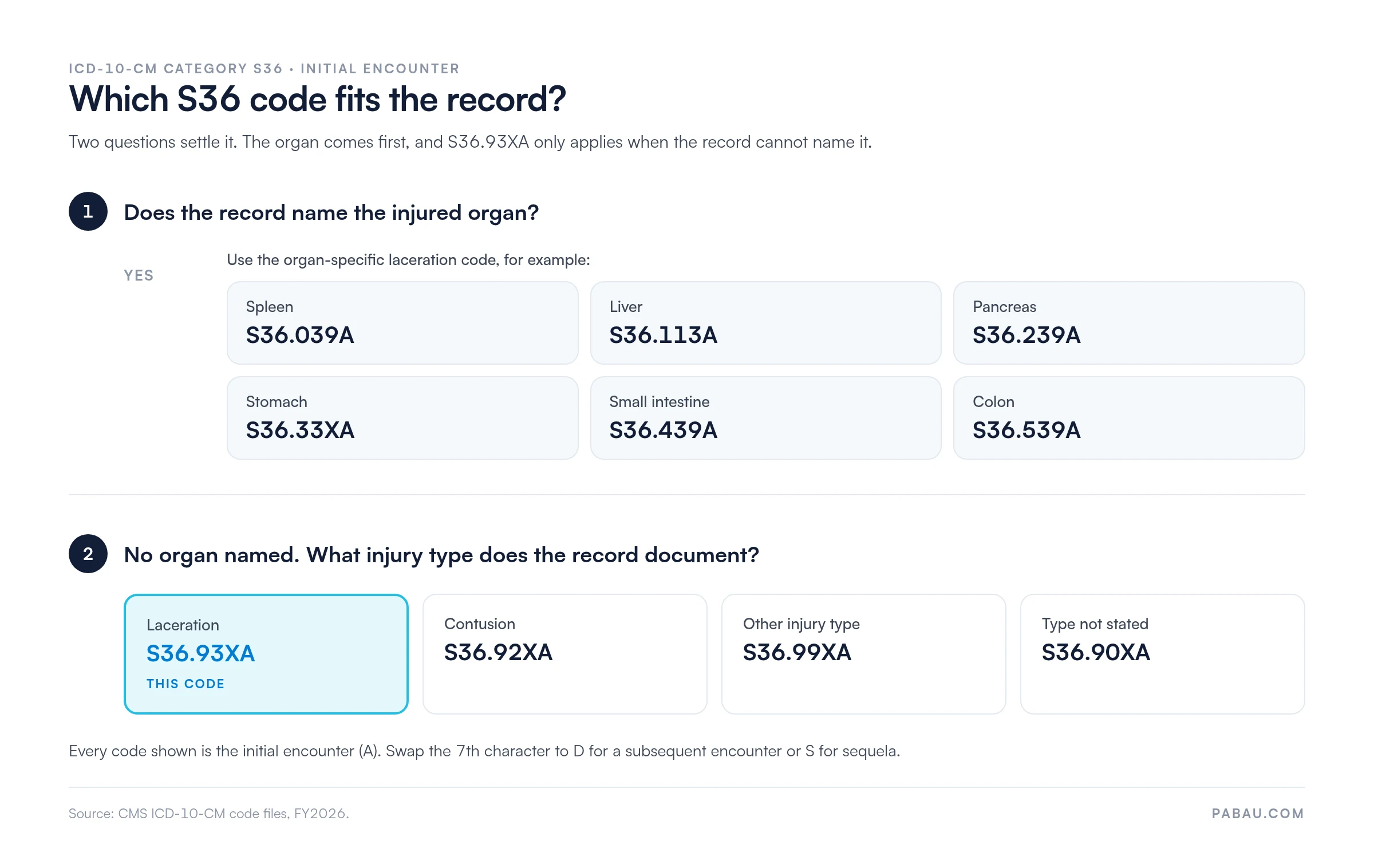
Run a documentation query before assigning S36.93XA. Does the ED note, operative report, or radiology read name the organ, and does it call the injury a laceration? If a CT report describes a splenic laceration, the chart supports S36.039A or a more specific spleen code. Reserve S36.93XA for encounters where the laceration is documented but the organ is not yet identified.
Several codes in and next to category S36 are selected in error. The table below maps the most common confusion points, checked against the CMS ICD-10-CM code files.
Stomach, small intestine and colon lacerations have their own codes too. S36.33XA covers the stomach, and S36.439A and S36.539A cover the unspecified part of the small intestine and colon.
Code also an open wound: category S36 carries a “code also” note for any associated open wound (S31.-). A stab wound that enters the abdomen adds a code such as S31.609A. That code is an unspecified open wound of the abdominal wall with penetration into the peritoneal cavity.
An unspecified code has to be earned by the record. For S36.93XA to survive a documentation review, the chart must show the laceration and show that the organ could not yet be identified. Understanding medical billing fundamentals helps coding teams see why documentation quality drives reimbursement.
The physician note, operative report, or emergency department record must contain:
External cause codes explain how and where the injury happened. Under ICD-10-CM Official Guidelines Section I.C.20, there is no national requirement to report them.
They are voluntary unless a state-based mandate or a particular payer requires them. Many trauma programs report them anyway, because they record the mechanism the claim depends on.
The cause code carries the same 7th character as the injury code, so it takes A while S36.93XA does. Place, activity and status codes have no 7th character. They are reported once, at the initial encounter only.
Medicare, Medicaid, and commercial payers treat S36.93XA as a trauma diagnosis that needs full clinical support. CMS publishes no Local Coverage Determination for intra-abdominal injury codes as a group. Medicare Advantage plans and commercial payers still apply internal edits that check for the following.
S36.93XA behaves differently by care setting. Following medical billing compliance requirements for each setting prevents sequencing errors that trigger DRG downgrades or outpatient claim edits.
S36.93XA denials cluster around four correctable errors. Each maps to a coding rule that, once understood, prevents the same error across category S36. Strong denial management workflows catch these before they reach the payer. Our list of denial codes in medical billing gives the CARC lookup when a claim does come back.
Where a state mandate or payer contract requires external cause codes, a missing one is a fifth trigger. Check each payer’s rules once and build them into the claim template.
S36.93XA claims usually go wrong when the chart moves on and the claim does not. The operative note names the organ, but the claim still carries the unspecified code. Or the follow-up visit goes out with the A it had at admission.
Pabau, the practice management platform we build, keeps the clinical record and the claim in one system. The billing team codes from the note itself, not from a re-keyed summary. Pabau’s claims management software sends those claims through the Claim.MD clearinghouse.
That connection runs real-time eligibility checks before the visit and tracks claim status and denials after submission. It also processes electronic remittance advice, so a rejected S36.93XA claim shows up the day it happens.

Pabau connects to the Claim.MD clearinghouse for real-time eligibility checks, claim status and denial tracking, and ERA processing, all against the patient record.

S36.93XA answers one narrow question: there is a laceration inside the abdomen, and nobody has named the organ yet. If the record cannot say “laceration”, the code is wrong, and a sibling in S36.9 is right. If the record names the organ, the code has expired.
That makes S36.93XA a holding code for the first hours of trauma care. The practices that bill it cleanly re-check it at every handoff, from ED to theater to discharge. Book a demo to see how Pabau keeps the trauma record and the claim in step from first encounter to remittance.

Want to see how a clearinghouse handles trauma claims? Pabau’s Claim.MD clearinghouse guide explains how electronic claim routing, eligibility checks and status tracking work for coded claims.
Want to understand how claim denials are tracked and resolved? Electronic remittance advice explained covers how 835 ERA files carry CARC denial codes so coders can find and correct S36.93XA rejections.
Need the end-to-end picture of trauma billing? Revenue cycle management fundamentals outlines the billing workflow that carries an injury claim from documentation to payment posting.
Once imaging names the small intestine? ICD-10 code S36.418D shows how an organ-specific S36 code handles a follow-up encounter.
Coding the open wound that goes with a stab injury? ICD-10 code S31.644D covers a puncture wound of the abdominal wall that penetrates the peritoneal cavity.
ICD-10 Code S36.93XA is the billable diagnosis code for laceration of unspecified intra-abdominal organ, initial encounter. It is used when the record documents a laceration inside the abdominal cavity but does not identify which organ was torn.
All four sit in subcategory S36.9 for an unnamed intra-abdominal organ, and they split by injury type. S36.93XA is a laceration and S36.92XA is a contusion. S36.99XA covers any other documented injury type, and S36.90XA applies when the injury type is not stated.
Use S36.93XA while the patient receives active treatment for the laceration. Switch to S36.93XD for routine follow-up or healing-phase encounters. Use S36.93XS only for a late complication or residual effect after the original injury has healed.
Yes, as long as the injury is a documented laceration and the organ cannot yet be identified. A penetrating wound also needs a code for the associated open wound from S31.-, per the “code also” note on category S36. The mechanism of injury can be captured with external cause codes.
Not nationally. ICD-10-CM Guidelines Section I.C.20 make external cause reporting voluntary unless a state mandate or a particular payer requires it. When you do report them, the cause code takes the same 7th character as S36.93XA. Place, activity and status codes are reported once, at the initial encounter.
The common triggers are a missing placeholder X and a 7th character that does not match the encounter. Another is S36.93XA billed for an injury that is not a laceration. A fourth is using the unspecified code when imaging or surgery names the organ. Each is a correctable coding error, not a coverage exclusion.