ICD-10 Code S66.308A: Extensor muscle injury, other finger
ICD-10 Code S66.308A: Definition and code hierarchy ICD-10 Code S66.308A is the ...

Last Updated: Oct 14, 2026
Billable Code Specific Code
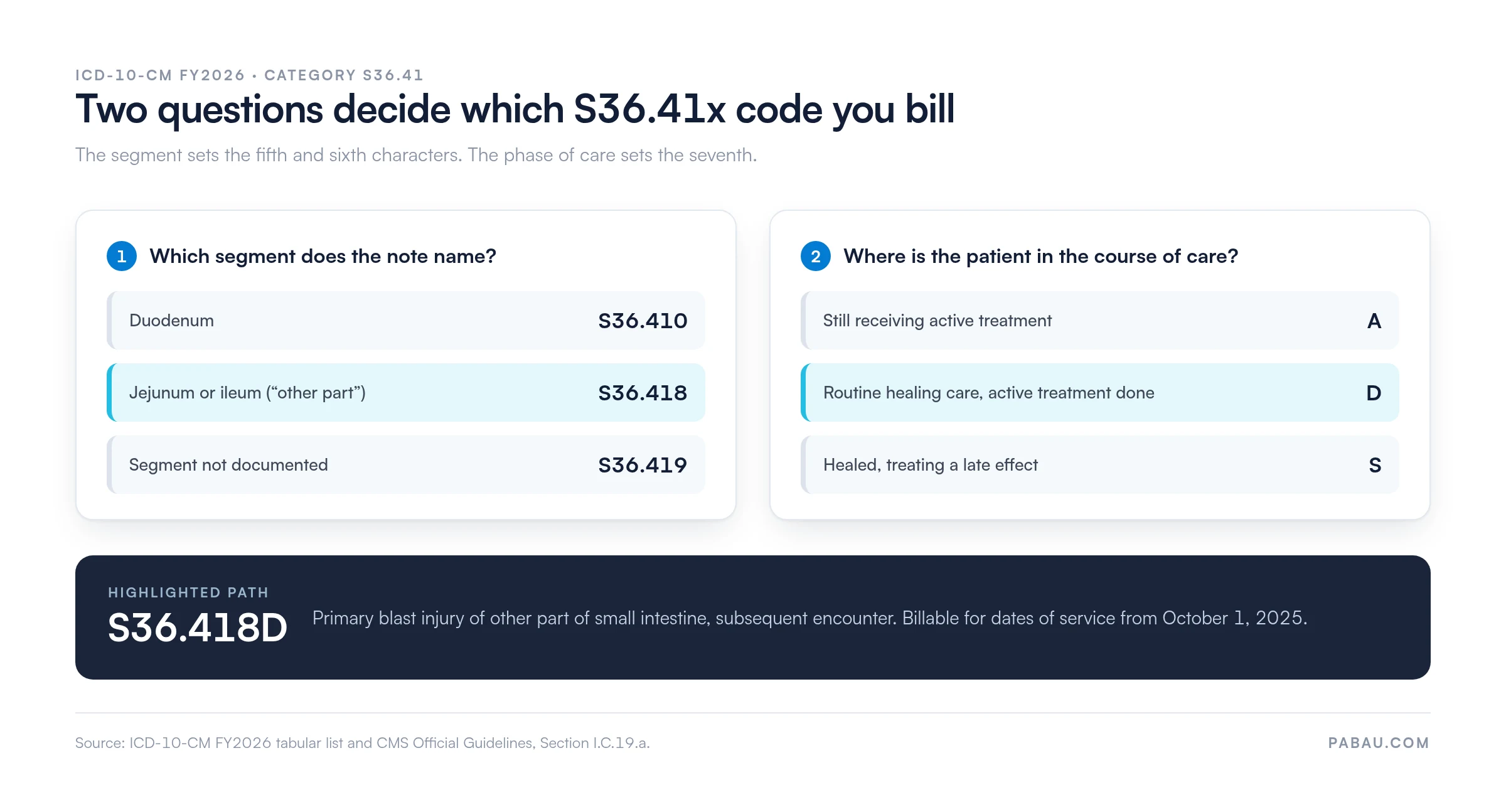
S36.418D is the billable ICD-10-CM code for primary blast injury of other part of small intestine, subsequent encounter. It covers blast damage to the jejunum or ileum at a follow-up visit, once active treatment is complete.
The code took effect on October 1, 2025 under the CMS ICD-10-CM FY2026 update, and it is valid for HIPAA-covered transactions. The 7th character is where blast-injury claims usually fail. A coder who leaves the initial-encounter character A on a routine follow-up has billed the wrong phase of care.
Let Pabau's smart automation suggest the right codes, reduce claim denials, and keep your practice compliant—effortlessly.
Automate repetitive tasks and focus on what matters most—your patients.
Reduce coding errors and ensure compliance with the latest regulations.
Clean claims, fewer denials, and faster reimbursements.
Powerful insights and reporting to help your practice thrive.
HIPAA compliant SOC 2 certified GDPR-compliant Trusted by 4,000+ clinics worldwide

S36.418D is a billable ICD-10-CM code for primary blast injury of the small intestine outside the duodenum, at a subsequent encounter.
The 7th character D covers routine healing care after active treatment ends, not the active-treatment visit (A) or a late effect (S).
Documentation must name the blast mechanism, the segment of small intestine, and the phase of care, or the claim is at risk.
S36 carries no Excludes notes. A Code Also note directs you to add an S31.- code for any associated open wound.
Practice management software like Pabau connects to Claim.MD to submit ICD-10-coded claims, check eligibility, and process ERAs.
S36.418D is a billable, specific ICD-10-CM code valid for reimbursement submission. The table below captures the fields a coder confirms before the claim leaves the practice, sourced from the CDC/NCHS ICD-10-CM official tool.
S36.418D means primary blast injury of other part of small intestine during a subsequent encounter. Each alphanumeric segment carries a specific clinical meaning, and reading the structure from left to right prevents miscoding at every level.
The “other part” qualifier at S36.418 separates injuries of the jejunum and ileum from injuries of the duodenum. Blast damage to the duodenum falls under a different subcode, so anatomical specificity in the clinical note decides which code can legitimately be assigned.
The 7th character tells the payer which phase of care the encounter represents. Each of the three variants maps to a different point in the patient’s recovery.
CMS ICD-10-CM Official Guidelines Section I.C.19.a draws the line at active treatment, not at a fixed number of days. Character A applies while the patient is still receiving active treatment for the injury, including surgery and emergency department care.
Character D applies only once active treatment is complete and the patient has moved into routine healing or recovery care. A patient seen weekly for wound management after bowel repair surgery is in that recovery phase, so D is correct. Sequela (S) applies only when the injury itself has healed and the visit addresses a residual condition it caused.
Two questions settle the whole code, and the panel below puts them side by side.
Primary blast injury describes tissue damage caused by the overpressure wave an explosion generates. It is separate from secondary blast injury (fragmentation wounds), tertiary injury (displacement trauma), and quaternary injury (burns and crush).
The small intestine is especially vulnerable to overpressure because of its gas-filled lumen. The pressure differential across the bowel wall can produce contusion, perforation, or hemorrhage with no visible external wound.
That mechanism is why documentation accuracy matters so much here. A note reading only “bowel injury from explosion” leaves the coder unable to assign S36.418D with confidence. The same encounter could map to a secondary or tertiary blast injury code.
The distinction carries clinical weight as well as coding weight. Primary blast injury patients often present with delayed symptoms, and they need different post-discharge monitoring than fragmentation-wound patients.
S36.418D sits inside a defined hierarchy that runs from chapter down to billable code. The same layered logic governs the whole ICD-10-CM code set. Confirming specificity at each level before you finalize a selection is what keeps the choice defensible.
The ICD-10-CM alphabetical index maps several clinical phrases to S36.418D. Coders working from a physician’s narrative note should recognize these terms as pointing to this code family.
The “other part” wording at S36.418 covers every named small-intestine segment except the duodenum. If the physician specifies the duodenum, use S36.410D. If no segment is named anywhere in the record, use S36.419D.
Check the physician note for the specific bowel segment before assigning S36.418D. Duodenal blast injuries are coded to S36.410x. A note that says only ‘small bowel blast injury’ with no segment named belongs at S36.419x, the unspecified-part code. S36.418x means the site was named and was not the duodenum. Query the provider and document the query in the chart whenever the segment is ambiguous.
S36 carries no Excludes1 or Excludes2 notes in the FY2026 tabular list. The one instructional note attached to the category is a Code Also note, and it changes what a complete blast-injury claim looks like.
A Code Also note means two codes may be needed to describe the encounter fully. It sets no sequencing rule of its own, so the order follows the circumstances of the visit and the payer’s reporting requirements.
Blast trauma frequently drives fragments and debris through the abdominal wall, so an open wound often accompanies the bowel injury. When the record documents one, report the matching S31.- code alongside S36.418D at the same encounter.
Because S36 carries no exclusion notes, nothing in the tabular list stops you from reporting S36.418D with a code from a neighboring injury category. Injuries of urinary and pelvic organs are classified to S37, and both categories may be reported together when the record documents both.
Accurate abdominal trauma ICD-10 coding for S36.418D depends on three elements in the physician’s documentation. Missing any one of them forces the coder to query the provider or drop to a less specific code, which delays billing. Pabau’s claims management software supports structured documentation workflows that reduce missing-information denials at submission.
Practices using Pabau can route ICD-10-coded claims electronically through the Claim.MD clearinghouse, which validates code format and payer eligibility before submission. That check catches documentation-driven errors before they become denials. The integration reaches thousands of US payers and processes CMS-1500 and 837P claim formats.
Three errors account for most denials on S36.418D claims, and each one is preventable with a pre-submission check. Good denial management starts at the documentation and code-selection stage, not after a remittance comes back.
Coders working with blast injury patients meet the full S36.41x family regularly. The table below shows the sibling and parent codes closest to small-intestine blast injuries in the FY2026 tabular list.
Use S36.419D only when the physician note says “small intestine” without naming the duodenum, jejunum, or ileum. Specificity is preferable wherever the record supports it. Query the provider before assigning an unspecified code when the documentation might support a more precise one.
A wrong 7th character usually surfaces after the remittance arrives. The claim goes out carrying A on a follow-up visit, the payer rejects it, and a coder reworks the encounter weeks later. By then the clinical detail that would settle the question sits in a note nobody has reopened.
Pabau, a practice management platform built for healthcare practices, keeps the diagnosis code attached to the note that justifies it. Charting templates prompt for the injury mechanism, the anatomical segment, and the phase of care. The three elements an S36.418D claim needs are captured during the visit.
Claims then route through the Claim.MD integration, which validates format and checks payer eligibility before submission. Electronic remittance advice returns into the same system, so a denial on S36.418D appears next to the encounter that produced it. Your coders correct the pattern once instead of chasing it claim by claim.

Pabau connects to the Claim.MD clearinghouse to validate, submit, and track ICD-10-coded claims electronically. You get real-time eligibility checks before the visit, ERA processing after it, and documentation prompts that catch missing code detail before submission.

ICD-10 Code S36.418D holds up once the record answers three questions. Was the mechanism a primary blast overpressure wave? Was the injured segment outside the duodenum? Is this visit routine care after active treatment ended? A yes to all three makes the code defensible.
The 7th character is the one most often rewritten at appeal, so settle the phase of care before the claim leaves the practice. That single check removes the most common reason these claims come back.
Pairing accurate coding with electronic validation handles the rest. Pabau’s Claim.MD integration supports real-time eligibility verification, 837P submission to thousands of US payers, and ERA processing, so correctly coded claims move faster. Book a demo to see how Pabau handles trauma billing workflows end to end.

Need to understand how clearinghouse claim validation works? Our Claim.MD clearinghouse guide covers how electronic claim submission, eligibility verification, and ERA processing reduce denials on ICD-10-coded claims.
Coding another intra-abdominal trauma case? Our revenue cycle management guide explains how accurate diagnosis coding connects to the full billing and collection workflow.
Want to build cleaner claims from the documentation stage? Understanding electronic remittance advice shows how ERA data reveals the denial patterns that trace back to thin documentation at coding time.
ICD-10 code S36.418D is the billable diagnosis code for primary blast injury of other part of small intestine. That means the jejunum or ileum, not the duodenum. The D marks a subsequent encounter: routine follow-up care once active treatment for the injury is complete.
Yes, S36.418D is a billable and specific ICD-10-CM code valid for HIPAA-covered transactions. It became effective October 1, 2025, under the FY2026 ICD-10-CM edition and can be submitted for reimbursement in claims that include adequate supporting documentation.
S36.418A applies while the patient is still receiving active treatment for the blast injury. S36.418D applies at routine follow-up visits once active treatment is complete and the patient is healing. S36.418S applies when the injury has healed and the visit addresses a residual complication such as adhesions or chronic bowel dysfunction.
Three elements are required. The note must identify the blast overpressure wave as the injury mechanism. It must name a small-intestine segment outside the duodenum. Finally, it must establish that the visit is routine care after active treatment ended, not the first treatment contact.
No. The S36 category carries no Excludes1 or Excludes2 notes in the FY2026 tabular list. It carries a Code Also note instead. That note directs you to report any associated open wound with a code from S31.- alongside S36.418D.
S36.418D became effective October 1, 2025, as part of the ICD-10-CM FY2026 edition. It remains valid for the current fiscal year. Claims with dates of service before October 1, 2025 require the applicable prior-year code version.