ICD-10 Code S82.242H: Displaced spiral tibial shaft fracture, delayed healing
ICD-10 Code S82.242H: Definition and code details ICD-10 Code S82.242H designate...

Last Updated: Oct 15, 2026
Billable Code Specific Code
S31.644D is the billable ICD-10-CM code for puncture wound with foreign body of abdominal wall, left lower quadrant with penetration into peritoneal cavity, subsequent encounter.
The site is the left lower quadrant, the wound has penetrated the peritoneal cavity, and the visit is a subsequent encounter. Coders assign it at follow-up visits once active treatment is finished. The code has been valid since ICD-10-CM took effect on October 1, 2015, and it stays in force in FY2026.
Three parts of the code do the work. The S31.6 subcategory fixes the depth at peritoneal penetration. The 6th character 4 fixes the site at the left lower quadrant. The 7th character D then marks the visit as routine follow-up.
Let Pabau's smart automation suggest the right codes, reduce claim denials, and keep your practice compliant—effortlessly.
Automate repetitive tasks and focus on what matters most—your patients.
Reduce coding errors and ensure compliance with the latest regulations.
Clean claims, fewer denials, and faster reimbursements.
Powerful insights and reporting to help your practice thrive.
HIPAA compliant SOC 2 certified GDPR-compliant Trusted by 4,000+ clinics worldwide

ICD-10 code S31.644D covers a puncture wound of the abdominal wall with a foreign body, left lower quadrant, with peritoneal penetration, subsequent encounter.
S31.644 is the non-billable parent code. Only the three 7th-character codes bill: S31.644A, S31.644D and S31.644S.
The 6th character 4 means left lower quadrant. The S31.6 subcategory is what signals penetration into the peritoneal cavity.
S31.644D is not a new code. It has been valid since ICD-10-CM took effect on October 1, 2015, and it stays active in FY2026.
Documentation must confirm the puncture mechanism, the foreign body, the left lower quadrant site, peritoneal penetration, and that active treatment has ended.
S31.644D is a valid, billable ICD-10-CM diagnosis code. It carries all seven characters the code set requires, so payers accept it for reimbursement without a further qualifier. It is the American ICD-10-CM version of the code. The Centers for Medicare and Medicaid Services and the National Center for Health Statistics maintain the code set jointly.
The full official description is: Puncture wound with foreign body of abdominal wall, left lower quadrant with penetration into peritoneal cavity, subsequent encounter. Every word carries a clinical and a billing implication, and the next section breaks each one down.
On the effective date, one point is worth stating plainly. S31.644D is not a recent addition to ICD-10-CM. It was part of the original code set that took effect on October 1, 2015, and it has carried the same description ever since. The FY2026 edition, which governs encounters from October 1, 2025 through September 30, 2026, leaves it unchanged. You can confirm the current status in the CDC/NCHS ICD-10-CM web tool.
Each component of the S31.644D description has a distinct clinical meaning. Each one also has to be verifiable in the patient record before the code is assigned. The table below breaks down every descriptor and the documentation it requires.
In practice the code shows up most often in outpatient surgical follow-up. The acute episode is over by then, and the wound is being monitored rather than treated.
The 7th character D means subsequent encounter. On injury codes, that character reports the phase of care, not the severity of the wound. Getting it wrong is a common reason trauma and wound-care claims are denied.
A key distinction: subsequent encounter does not mean a second hospital admission for the same injury. It means the active treatment phase is over and the patient is receiving routine healing care. A patient can move from A to D inside the same week. All it takes is for the surgery or closure to be complete and the next visit to be monitoring.
When sequela applies instead: use S31.644S only once the patient develops a new condition caused directly by the original injury. A post-operative adhesion or a scar contracture would qualify. The sequela character attaches to that resulting condition. It does not describe ongoing care of the wound itself.
S31.644 is the non-billable parent code. It groups the encounter-type variants for a puncture wound of the abdominal wall with a foreign body, left lower quadrant, with peritoneal penetration. It cannot be submitted on its own, because ICD-10-CM requires a 7th character here. Coders pick one of the three billable children below.
The 6th character carries the site. S31.64 gives you ten to choose from:
Left lower quadrant is always 4. It is never A, which is the placeholder for a flank wound with no documented side.
Knowing where S31.644D sits in the tabular list makes navigation faster. It also shows which adjacent code to reach for when the record does not support the most specific level.
The AAPC ICD-10-CM lookup tool lets you walk this hierarchy interactively and check the codes either side of the one you have chosen.
Two lookalike codes are the usual source of error on this wound. Each one changes part of the description while staying a valid ICD-10-CM code. That is why a claim scrubber will not flag either of them.
S31.144D swaps the depth. Its description is identical apart from four words: without penetration into peritoneal cavity. The S31.1 subcategory covers abdominal wall wounds that stopped short of the peritoneum. S31.6 covers the wounds that went through it.
So the depth is decided by the digit after the decimal point, before you ever reach the site character. If your operative note or CT report confirms a peritoneal breach, the code has to start S31.6.
S31.14AD swaps both the depth and the site. It reads: puncture wound of abdominal wall with foreign body, unspecified flank without penetration into peritoneal cavity, subsequent encounter.
The A in that code is a 6th character, and it means unspecified flank, not left lower quadrant. Submitting S31.14AD for an LLQ wound with peritoneal penetration understates the injury on two axes at once.
Both errors come down to two characters sitting in different places. The diagram below shows which part of S31.644D fixes the depth and which one fixes the site.
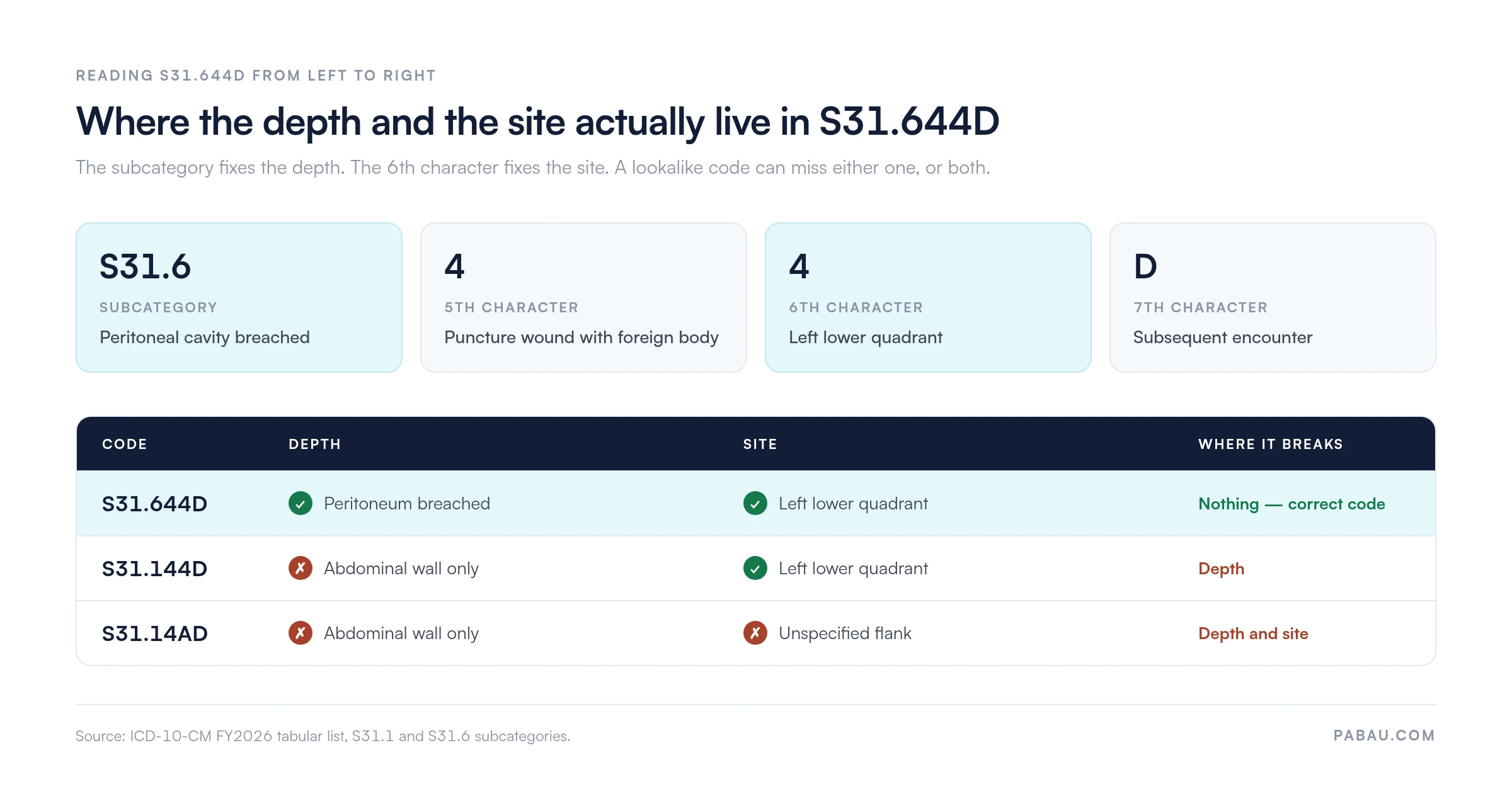
Read S31.644D from left to right in three steps, and the lookalikes stop being a problem. First, S31.6 means the peritoneum was breached. Second, 64 means a puncture wound with a foreign body. Third, the 4 fixes the site at the left lower quadrant. Only then add the 7th character for the phase of care.
Denials on S31.644D usually trace back to notes that are clinically accurate but incomplete for coding. A clinician can observe the peritoneal breach without recording the words a coder needs to cite. That distance between the note and the code is where revenue leaks. Work through this checklist before the encounter is closed.
Practice management software like Pabau submits claims through the Claim.MD clearinghouse, which reaches thousands of US payers. Complete documentation at the code level is still the most reliable route to a clean claim on the first pass.
Finish the note before the encounter closes. A late addendum that introduces a new clinical finding after the claim went out carries audit risk.
Excludes notes in ICD-10-CM are binding instructions that block incorrect code combinations. Ignoring one is the fastest route to a medical necessity denial or an audit finding. These are the notes and restrictions that apply to S31.644D.
The recurring coder mistakes on this family are worth naming too:
Our guide to claim denial codes shows which reason codes tend to accompany specificity errors on open wound diagnoses. An excludes violation that surfaces after submission is worth appealing differently from a standard underpayment dispute.
EHR search fields and note templates often use wording that differs from the official description. The phrases below map to S31.644D for documentation matching. Searching any of them in the ICD List free lookup tool usually returns S31.644D or one of its siblings.
When you write free-text notes, stay as close to the official ICD-10-CM wording as the clinical picture allows. That reduces the chance of an auto-coding tool settling on a less specific code. It also keeps the diagnosis clean for the claims management software that submits it.
Audit your S31.64 claims periodically for 7th character consistency across an episode. Three follow-up visits after abdominal wound surgery should all carry D. A mix of A and D inside one episode is an audit flag. It often prompts a request for every encounter record.
A penetrating abdominal wound generates a long tail of encounters. The operative note lives with the initial visit, and the imaging that confirmed the breach sits somewhere else. The wound checks then arrive weeks after both. Coders assigning S31.644D at visit four often have to request the original chart just to confirm the depth and the quadrant.
Pabau keeps the S31.644A encounter, every S31.644D follow-up, and any later sequela visit inside one patient record. A coder can open the wound check and read the operative note behind it without leaving the chart. Pabau’s claims management also catches a six-character parent code submitted without its 7th character, before the claim leaves the practice.
The result is fewer denials tied to encounter-type mismatches, and faster coding when the provider who treated the original wound has moved on.

Pabau links clinical documentation to claims submission through Claim.MD. A subsequent-encounter visit like an S31.644D wound check is then coded from the original operative note, not from memory.

A puncture wound that reaches the peritoneal cavity produces several follow-up encounters, and each one needs the right 7th character to be paid. S31.644D is the code for those visits, but only where the record confirms the foreign body, the left lower quadrant site, and the peritoneal breach.
Miss the breach and you are in the S31.1 series. Miss the quadrant and you are on an unspecified code that invites a specificity denial.
Pabau’s Claim.MD partnership gives practices a direct path from the clinical note to an electronic claim. That reaches thousands of US payers. Coding accurately at the source means fewer denials and fewer retrospective addenda. To see how Pabau handles trauma and surgical follow-up documentation, book a demo.

Need a framework for managing claim denials on injury codes? Denial codes in medical billing explains the most common reason codes and how to respond to each.
Want to understand how clearinghouses process ICD-10 claims? Medical claims clearinghouse guide covers how claims flow from practice to payer and where ICD-10 specificity errors are caught.
Looking for guidance on ERA and remittance reconciliation for wound care claims? Electronic remittance advice (ERA) explains how to read 835 files and identify denial patterns by diagnosis code.
ICD-10 code S31.644D is a billable ICD-10-CM diagnosis code. It covers a puncture wound with foreign body of the abdominal wall, left lower quadrant, with penetration into the peritoneal cavity, subsequent encounter. Coders assign it at follow-up visits once active treatment of the wound is complete.
Yes. S31.644D carries all seven characters ICD-10-CM requires, so payers accept it for reimbursement. The six-character parent code S31.644 is not billable on its own. It has to carry a 7th character of A, D or S before it can be submitted.
The 7th character D means subsequent encounter. The patient is receiving routine care while the wound heals, after the active treatment phase has ended. Wound checks, suture or staple removal, drain management and dressing reviews all fall under D.
All three describe the same injury and differ only by encounter type. S31.644A covers the initial encounter, when the wound is first treated. S31.644D covers routine follow-up after that treatment is finished. S31.644S covers a sequela, meaning a later condition caused by the original wound, such as an adhesion or a scar contracture.
No, and the two are wrong for each other on two axes. S31.644D sits in the S31.6 subcategory, which means the wound penetrated the peritoneal cavity. S31.14AD sits in S31.1, which means it did not. S31.14AD also describes an unspecified flank rather than the left lower quadrant.
S31.644D has been valid since ICD-10-CM took effect on October 1, 2015. It remains active in the FY2026 edition, which governs encounters from October 1, 2025 through September 30, 2026. It is not a new code, and its description has not changed.
The record has to state the puncture mechanism, the foreign body and whether it was removed, and the left lower quadrant site. It also has to evidence peritoneal penetration from an operative note, an imaging report or an attending attestation. Finally, it must show that initial treatment happened at an earlier visit.