

ICD-10 Code S53.013D: Anterior subluxation of unspecified radial head
ICD-10 Code S53.013D: Quick reference summary Use the table below as your first ...

Last Updated: Nov 6, 2026
Billable Code Specific Code
S32.89XB is the billable ICD-10-CM code for fracture of other parts of pelvis, initial encounter for open fracture. It covers an open break in a pelvic bone that no other S32 subcategory names, while the patient is still in active treatment.
The B in the seventh position separates it from the closed-fracture code, S32.89XA, and choosing the wrong character is a common cause of first-submission denials. The note should state the open wound, the pelvic site, and the encounter type before the code goes to a payer.
Let Pabau's smart automation suggest the right codes, reduce claim denials, and keep your practice compliant—effortlessly.
Automate repetitive tasks and focus on what matters most—your patients.
Reduce coding errors and ensure compliance with the latest regulations.
Clean claims, fewer denials, and faster reimbursements.
Powerful insights and reporting to help your practice thrive.
HIPAA compliant SOC 2 certified GDPR-compliant Trusted by 4,000+ clinics worldwide

S32.89XB is a billable ICD-10-CM code for an open fracture of a pelvic part that no other S32 subcategory names.
The seventh character B means an open fracture at the initial encounter. Subsequent visits use D, G, or K depending on healing status, and S is for sequela.
The placeholder X in position six is mandatory, so leaving it out makes the code invalid and the claim is rejected at the edit stage.
To hold up in a payer audit, the note must state the fracture is open, name the pelvic structure, and record the mechanism of injury.
ICD-10 code S32.89XB reports a fracture of other parts of the pelvis, initial encounter for open fracture. It is billable in the current ICD-10-CM release and has been valid since October 1, 2015. Use it while the patient is in active treatment for an open pelvic fracture that no more specific S32 code describes.
The S32 category already names most pelvic sites. Those are the lumbar vertebra (S32.0-), sacrum (S32.1-), coccyx (S32.2), ilium (S32.3), acetabulum (S32.4), pubis (S32.5), and ischium (S32.6). S32.89 is the residual subcategory, so reach for it only when the operative or radiology report places the fracture outside all of them.
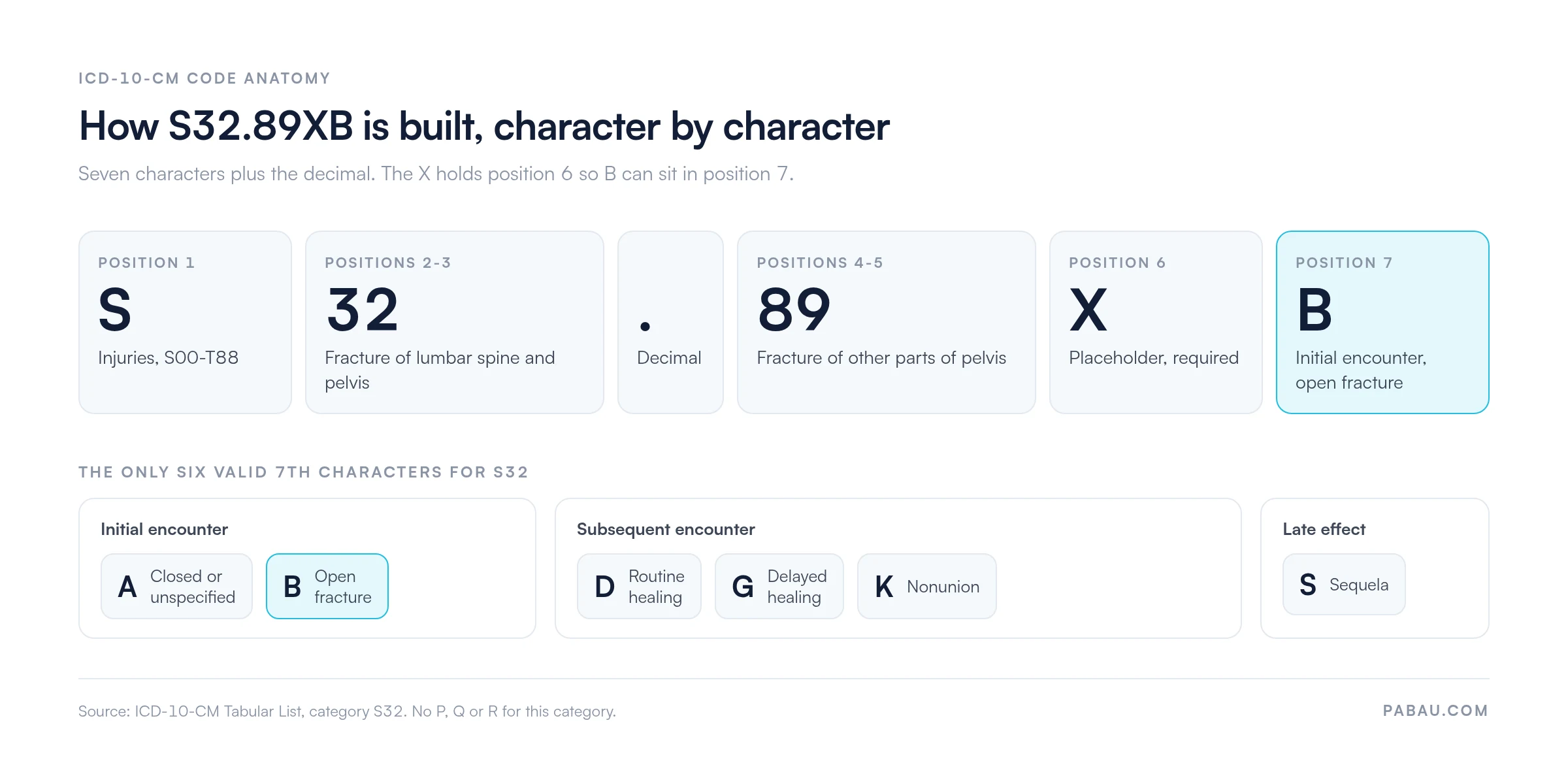
Read the code left to right and it spells out the injury, the site, and the encounter. Misreading one character, particularly position 6 or 7, produces an unrecognized or incorrect code.
The placeholder X at position 6 is mandatory. ICD-10-CM conventions use it to extend the code to the seventh character. Without it, S32.89B is an invalid code and will not pass clearinghouse edits.
The diagram below puts the structure and the six valid seventh characters on one screen.
S32.89 holds pelvic fractures that cannot be classified to S32.0 through S32.6. It also sits apart from the multiple-fracture codes for the pelvic ring, S32.81- (with disruption of the ring) and S32.82- (without it). A pubic ramus fracture, for example, belongs in the pubis subcategory, as S32.509A shows for the closed form.
Clinically, an open fracture is one where the bone is exposed through a wound in the skin or mucosa. Guidelines Section I.C.19.c settles the coding side. A fracture not documented as open or closed is coded as closed. Surgery does not make a fracture open either, so an operatively treated fracture with no wound stays closed.
Clinicians grade open fracture severity with the Gustilo-Anderson classification (Type I through Type IIIC). ICD-10-CM does not need the Gustilo type to select S32.89XB, so the code applies at any wound grade. Still, capture the type whenever the physician records it, because it strengthens the medical necessity record for surgery.
S32.89XA and S32.89XB describe the same anatomical site and differ only in fracture type. S32.89XA is for a closed or unspecified fracture at the initial encounter. S32.89XB is for an open fracture at the initial encounter.
When the note is silent on fracture type, the guidelines default to closed. So never infer open status from the procedure performed. Only explicit physician documentation of an open wound justifies S32.89XB over S32.89XA.
Every code in the S32.89 series needs one of six seventh characters, listed below. A and B belong to the initial encounter only. Once the patient has had active treatment and returns during healing, the encounter becomes subsequent and D, G, or K applies.
Before assigning ICD-10 code S32.89XB, read the tabular notes at the S32 level. Excludes1 notes are hard stops. If the excluded condition is present, you cannot report S32.89XB for it at the same encounter.
Guidelines Section I.C.19 governs traumatic fracture coding. Work through these five steps in order, because a clean claim depends on each one being settled before the next.
Payer audits of open pelvic fracture claims start with one question: does the physician note support the open designation? Vague documentation is behind most S32.89XB downcodes. A trauma documentation checklist, built into your medical billing compliance routine, fixes that at the source.
To justify S32.89XB, the clinical note should contain these five elements:
Open pelvic fractures usually need surgery, so the CPT codes billed alongside S32.89XB cover both the acute evaluation and the operative treatment. Temporary stabilization often comes first, which is where CPT 20690 enters the claim.
Which pairing applies depends on the operative report and the payer contract. Treat the table as common patterns, and check each combination against the documentation before submission. CPT 27217 and 27218 in particular need a close read of the fracture pattern and fixation method.
Medicare covers medically necessary treatment of open pelvic fractures, including surgery, when the documentation meets coverage criteria. Any applicable Local Coverage Determination (LCD) comes from the patient’s Medicare Administrative Contractor (MAC).
The emergency admission rarely needs approval, but staged surgery is a different matter. Elective or semi-elective fixation after initial stabilization may trigger prior authorization under commercial plans. Verify requirements with each payer before scheduling definitive fixation, and don’t assume the emergency presentation waived later authorization.
Most S32.89XB denials trace back to three causes. They are a missing placeholder X, a wrong seventh character, or a note that doesn’t support the open designation.
Good denial management catches these before they reach the payer. For the reason codes you will see on the remittance, keep the denial codes reference open.
Run this list on every open pelvic fracture claim before it goes into the batch. It takes two minutes and covers each denial cause in the table above.
In many orthopedic and trauma practices, a biller still retypes diagnosis and procedure codes from the chart into the claim form. Each manual step is a chance to drop the X or swap the seventh character.
Pabau, our practice management and billing platform, pre-fills the claim from the patient record instead. Its claims management software includes ICD-10-CM and CPT lookup libraries. It also checks that required claim fields are complete before you can send.
US claims go out electronically through Claim.MD, with eligibility checks and claim-status tracking in the same workflow. The coding judgment stays with your team, but fewer claims bounce back for missing data.
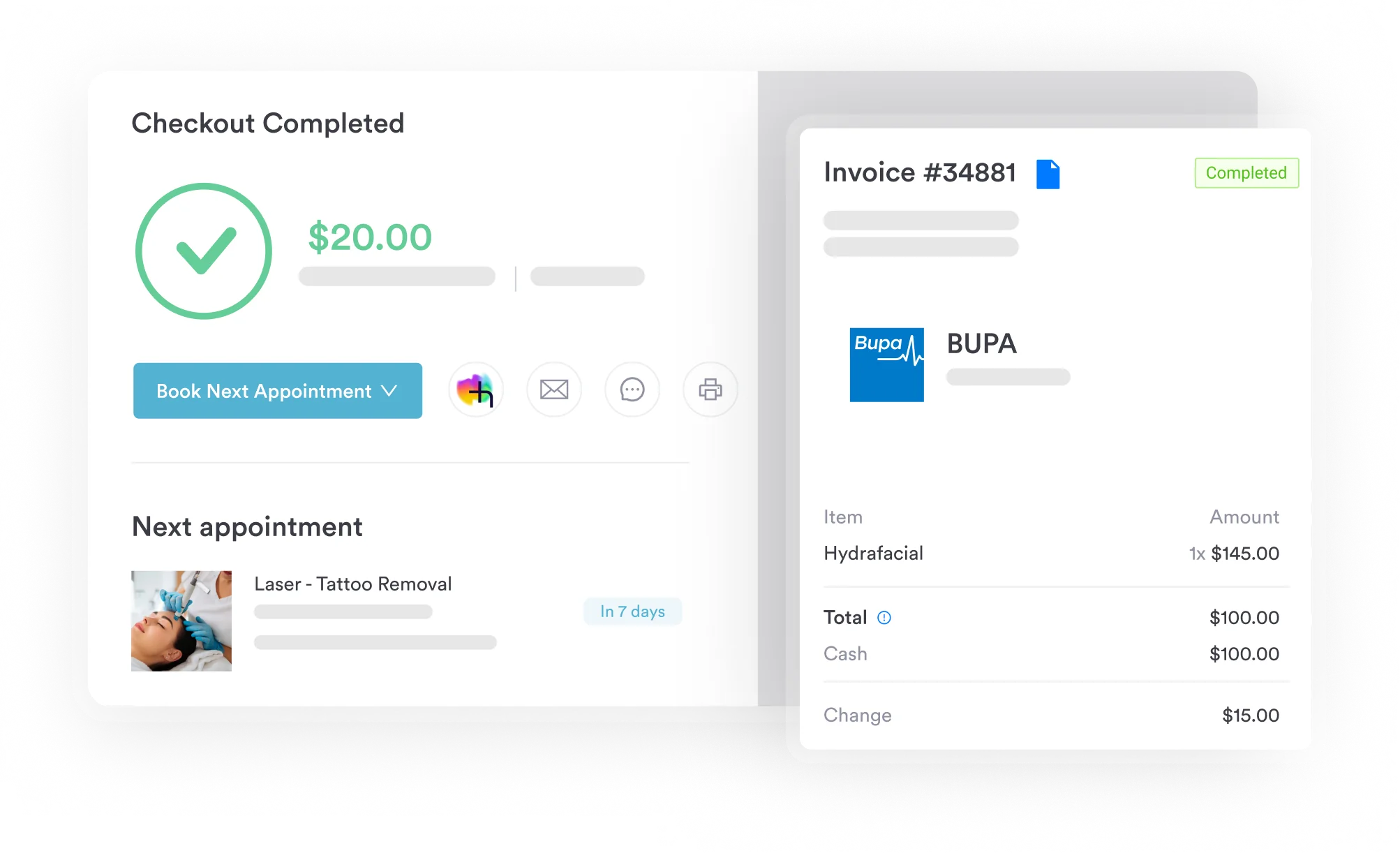

Pabau pre-fills claims from the patient record, gives your team ICD-10 and CPT lookup libraries, and checks required fields before submission through Claim.MD. See how it works for trauma and orthopedic practices.

S32.89XB rewards coders who stop and read the note. If the open wound, the site, and the encounter phase are in writing, the code is straightforward. If any one is missing, query before you bill rather than appeal afterward.
The trade-off is speed. A physician query delays the claim by a day or two, while a downcode or denial on a surgical trauma claim costs weeks. Build the open-fracture question into your trauma intake, and the residual code stops being a guess.
If your team still moves codes from chart to claim by hand, that step is worth fixing next. Book a demo to see how Pabau pre-fills fracture claims from the record and checks them before they go out.

Need to understand how claim denials are categorized and resolved? Denial codes in medical billing covers the most common CARC and RARC denial reason codes with resolution steps.
Looking for guidance on submitting claims electronically? Claim.MD clearinghouse overview explains how electronic claim submission works through a clearinghouse.
Want a primer on how the billing cycle connects to coding? Revenue cycle management fundamentals walks through each stage from code assignment to payment posting.
Coding an acetabular fracture instead? ICD-10 code S32.411A covers a displaced anterior wall fracture of the right acetabulum at the initial encounter.
Yes. S32.89XB is billable in the current ICD-10-CM release and has been valid since October 1, 2015. It can be reported as a principal or secondary diagnosis.
Use B for as long as the patient is in active treatment for the open fracture. That includes the emergency visit, surgery, and evaluation by a new physician. Once care moves to the healing phase, switch to D, G, or K.
Use S32.89XS for a sequela, such as chronic pain or deformity from the healed fracture. Code the late effect itself first, then S32.89XS to show its cause.
No. Multiple pelvic fractures with disruption of the pelvic ring code to S32.81-, and those without disruption code to S32.82-. S32.89 is for other pelvic parts only.
Query the physician before billing. Without an answer, the guidelines default to closed, so the code becomes S32.89XA rather than S32.89XB.



