ICD-10 Code Y76.0: Diagnostic obstetric and gynecological devices
ICD-10 Code Y76.0: Definition and billable status ICD-10 Code Y76.0 is a valid, ...

Last Updated: Oct 23, 2026
Billable Code Specific Code
S32.411A is the billable ICD-10-CM code for displaced fracture of anterior wall of right acetabulum, initial encounter for closed fracture.
Documentation has to specify four elements: laterality, displacement status, fracture wall, and encounter type. Missing any one of them can trigger a claim denial, and mixing this code up with S32.412A (the left acetabulum) produces a laterality mismatch.
This page covers the code's 7th character rules, the S32.4 code hierarchy, the documentation elements a coder needs, and the related codes that get confused with it most often.
Let Pabau's smart automation suggest the right codes, reduce claim denials, and keep your practice compliant—effortlessly.
Automate repetitive tasks and focus on what matters most—your patients.
Reduce coding errors and ensure compliance with the latest regulations.
Clean claims, fewer denials, and faster reimbursements.
Powerful insights and reporting to help your practice thrive.
HIPAA compliant SOC 2 certified GDPR-compliant Trusted by 4,000+ clinics worldwide

S32.411A is a billable ICD-10-CM code for displaced fracture of anterior wall of right acetabulum, initial encounter for closed fracture, valid for FY2026.
The 7th character ‘A’ designates initial encounter for closed fracture; subsequent encounters use D (routine healing), G (delayed healing), or S (sequela).
Documentation must specify four elements: laterality, displacement status, fracture wall, and encounter type. Missing any one of them can trigger a claim denial.
S32.412A is the displaced left acetabulum, not the non-displaced right one, and mixing the two produces a laterality mismatch denial.
Practice management software like Pabau supports ICD-10-CM claim submission and remittance tracking through its Claim.MD integration.
ICD-10 code S32.411A is a billable, specific ICD-10-CM diagnosis code.
The CDC/NCHS ICD-10-CM web tool publishes its full official description as Displaced fracture of anterior wall of right acetabulum, initial encounter for closed fracture. The 2026 edition took effect on October 1, 2025 under FY2026 ICD-10-CM.
This page covers the code hierarchy, the valid 7th characters, and the four documentation elements a coder needs. It then works through the related S32.4 codes and the mistakes that generate denials.
S32.411A sits four levels down the ICD-10-CM tabular list. Seeing the full hierarchy laid out makes it clear why none of the parent codes can be billed on their own.
S32.411 without a 7th character is not valid for claim submission. The CMS ICD-10-CM code files confirm that codes in this series need a 7th character extension before they become billable.
The S32.411 base code has four valid 7th character extensions. Each one reflects a specific clinical phase of care, and picking the wrong one is a common denial trigger on orthopedic fracture claims.
Per ICD-10-CM Official Guidelines Section I.C.19, the default assumption when physician documentation does not specify open or closed is closed fracture. So 7th character A is the appropriate selection when a physician’s notes describe a fracture without qualifying it as open. Coders should not assume open status without explicit documentation.
Claim denials for acetabular fracture codes almost always trace back to incomplete physician documentation. Four elements must be present before a coder can confidently assign S32.411A.
Each of those elements controls a specific character position in the code. That is why one missing detail changes which code you submit, rather than just weakening the note.
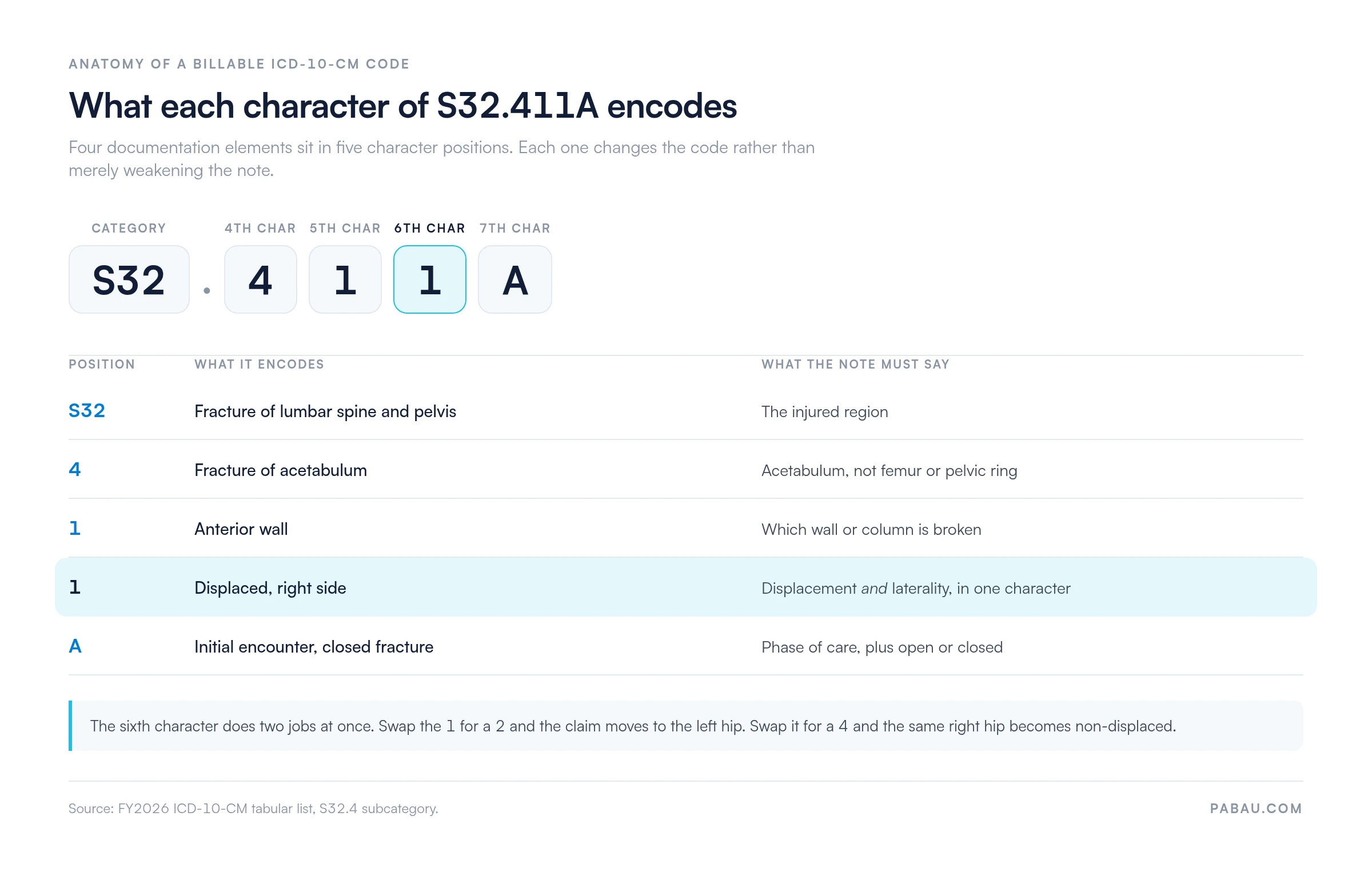
Payer remittance reports are the fastest way to see which of the four elements your physicians skip most often. Log the denial reason code against the note that produced it, and the pattern shows up within a quarter.
Build a fracture documentation checklist into your surgical and ED note template. Prompt the physician to answer four questions before signing: which side, displaced or not, which wall, and open or closed. Required fields like these can meaningfully cut coder queries and get claims out on the first attempt.
The most costly error on right acetabular anterior wall fractures is confusing the displaced and non-displaced codes. A common misconception holds that S32.412A is the non-displaced counterpart to S32.411A. It is not.
S32.412A is the displaced fracture of the anterior wall of the LEFT acetabulum. The non-displaced fracture of the anterior wall of the RIGHT acetabulum is S32.414A. Submitting S32.412A when you mean S32.414A creates a laterality mismatch that payers will flag.
Confirm both the side and the displacement status from the operative or ED note before selecting the code. Imaging reports often note displacement, but the physician’s diagnosis statement is the authoritative source for coding.
The S32.4 subcategory covers every acetabular fracture. Coders working orthopedic or trauma cases meet these codes alongside S32.411A regularly. The wider ICD-10-CM code set applies the same specificity logic in every chapter, so the habits transfer.
Coders in orthopedics and rehabilitation should know the full S32.4 range. Subsequent encounter coding with the D and G extensions draws on exactly the same wall and laterality detail as the initial claim. At a delayed-healing follow-up, a displaced transverse-posterior fracture of the right acetabulum becomes ICD-10 code S32.461G.
The split between initial encounter (A), subsequent encounter (D or G), and sequela (S) is one of the most misapplied concepts in trauma coding. The terminology is counterintuitive. “Initial encounter” does not mean the patient’s first visit to a provider, it means the patient is still in the active treatment phase.
The 7th character is read off the encounter in front of you, not off the patient’s history with the practice. A patient on their fourth visit can still be an initial encounter if surgery is still on the table.
Coders who search by clinical description rather than code number need to know which terms the ICD-10-CM alphabetic index maps to S32.411A. The following terms all lead to this code in the tabular list.
These synonyms also appear in coding software keyword searches, so they help coders confirm they have landed on the correct code. Searching “anterior wall right acetabulum displaced” in a compliant lookup tool should return S32.411A first for initial encounters.
Several sections of the ICD-10-CM Official Guidelines apply directly to S32.411A. The AAPC Codify ICD-10-CM lookup surfaces them under coding guidelines for the code.
Embed these rules in the coding workflow rather than leaving them to memory. A pre-submission scrub that checks for a missing 7th character and an absent external cause code catches most of the guideline failures above.
These are the mistakes that generate the most denials on right acetabular anterior wall fracture claims.
Solid denial management is the practical backstop for all five. Log the denial reason code and trace it back to the missing documentation. Then fix it at the source rather than reworking claims one at a time.
Run a quarterly audit on every S32.4xx claim submitted in the previous 90 days. Filter for cases where 7th character A was used more than twice in the same encounter sequence. Legitimate cases exist. But repeated A usage on one patient often signals a coder defaulting to the initial encounter code.
In most orthopedic practices, a bad fracture code gets caught by the payer rather than by the practice. The coder reworks the claim, resubmits, and waits another cycle for payment. A laterality mismatch on a single acetabular claim can hold up reimbursement for weeks.
Practice management software like Pabau moves that check earlier. Our claims management software keeps the ICD-10-CM catalog inside the claim screen. A coder who picks S32.411 sees the valid 7th characters before the claim goes out, so an incomplete code never reaches the clearinghouse.
Eligibility checks and electronic remittance tracking run in the same place, through our Claim.MD integration. So the claims that do come back carry a remittance record you can trace to the encounter that caused it. That is what turns a denial into a documentation fix instead of a rework.

Pabau integrates with Claim.MD to support ICD-10-CM claim submission, real-time eligibility checks, and electronic remittance tracking for orthopedic and trauma practices.

S32.411A rewards precision in the note more than fluency with the code book. If the physician records side, displacement, wall, and encounter type, the code follows in seconds.
So the fix worth making sits upstream, in the note template rather than the coder’s checklist. A practice that changes the template stops paying twice a quarter for the same laterality mismatch. The trade-off is a slightly longer note, and it buys back the rework cycle every time.
Book a demo to see how Pabau validates diagnosis codes before an orthopedic claim ever reaches the payer.

Need a clearinghouse submission walkthrough? Medical claims clearinghouse guide covers how claims move from EHR through clearinghouse to payer, including ICD-10-CM validation steps.
Want to understand denial reason codes? Denial codes in medical billing explains the CARC codes that appear when fracture claims are rejected for an invalid diagnosis code.
Looking to verify codes before submission? Superbill best practices outlines how to structure encounter documentation so code selection holds up on the first pass.
S32.411A is a billable ICD-10-CM diagnosis code meaning displaced fracture of anterior wall of right acetabulum, initial encounter for closed fracture. It is valid for FY2026 and became effective October 1, 2025. The code describes an active-treatment encounter for a fracture of the anterior portion of the right hip socket. The bone has moved out of position, and the skin is intact.
Yes, S32.411A is a billable and specific ICD-10-CM code. Both the CDC/NCHS ICD-10-CM tool and the CMS FY2026 code files confirm it. The parent code S32.411 is not billable on its own. One of the 7th character extensions (A, D, G, or S) must be present before the claim goes out.
S32.411A is used during active treatment, as the initial encounter for a closed fracture. S32.411D is used for subsequent encounters, once the fracture is healing routinely. The shift from A to D happens when no new active treatment decisions are being made. That is usually when the patient moves to monitoring, rehabilitation, or cast management.
The 7th character “A” indicates an initial encounter for a closed fracture. The patient is in the active treatment phase, and the fracture has not broken through the skin. Per ICD-10-CM Official Guidelines Section I.C.19, closed is the default when a fracture is not documented as open or closed. So 7th character A is the correct selection in those cases.
No. S32.411A designates a closed fracture at the initial encounter. For an open fracture of the displaced anterior wall of the right acetabulum, use S32.411B or S32.411C at the initial encounter. S32.411B covers open fracture type I or II, and S32.411C covers type IIIA, IIIB, or IIIC. The choice follows the Gustilo-Anderson classification the physician documented.
Five related codes come up most often, all at the initial closed encounter. They are S32.401A (unspecified right acetabulum), S32.411A (displaced anterior wall), S32.414A (non-displaced anterior wall), S32.421A (displaced posterior wall), and S32.431A (displaced anterior column). The CDC/NCHS ICD-10-CM tool lists the full S32.4 subcategory with every encounter extension.