ICD-10 Code Z74.8: Other problems related to care provider dependency
ICD-10 Code Z74.8: Definition and code details ICD-10 Code Z74.8 is the billable...

Last Updated: Oct 19, 2026
Billable Code Specific Code
S32.509A is the billable ICD-10-CM code for unspecified fracture of unspecified pubis, initial encounter for closed fracture.
Let Pabau's smart automation suggest the right codes, reduce claim denials, and keep your practice compliant—effortlessly.
Automate repetitive tasks and focus on what matters most—your patients.
Reduce coding errors and ensure compliance with the latest regulations.
Clean claims, fewer denials, and faster reimbursements.
Powerful insights and reporting to help your practice thrive.
HIPAA compliant SOC 2 certified GDPR-compliant Trusted by 4,000+ clinics worldwide

ICD-10 Code S32.509A describes an unspecified fracture of unspecified pubis at the initial encounter for a closed fracture, valid for FY2026 claims.
The seventh character A applies while the patient is receiving active treatment. Use D for routine subsequent healing, G for delayed healing, and K for nonunion.
Document the fracture type, the encounter type, and the pubis as the site. Use S32.501A for a right pubic fracture and S32.502A for a left one when the record states the side.
Practice management software like Pabau attaches ICD-10 codes to the encounter record and routes the claim through a clearinghouse, so nobody retypes the code.
ICD-10 Code S32.509A is a billable ICD-10-CM diagnosis code describing an unspecified fracture of unspecified pubis at the initial encounter for a closed fracture.
It is valid for FY2026, covering discharges and encounters on or after October 1, 2025. Both the UB-04 and the CMS-1500 claim form accept it.
The code sits in the S32 category (fracture of lumbar spine and pelvis) of the ICD-10-CM tabular list, under subcategory S32.5, fracture of pubis. Two characters stay unspecified here: the fracture subtype and the side. So the code fits only when the documentation supplies neither.
According to the CMS ICD-10-CM resources page, S32.509A carries no exclusion notes. It stands on its own as the primary code for a traumatic pelvic fracture.
Use the table below as a quick reference before coding an initial encounter for a pubic fracture where laterality is not documented.
The pubis is the anterior portion of the pelvic ring, formed by the superior and inferior pubic rami joining at the pubic symphysis. Fractures here follow two mechanisms. Older adults with reduced bone density fall from standing height. Younger patients arrive from high-energy trauma, such as motor vehicle collisions and pedestrian impacts.
For coders, the clinical context decides which secondary diagnoses to consider. It also tells you whether the record can support a laterality-specific code. Five features of pubic fracture coding matter here:
The ICD-10-CM seventh character is required on all traumatic fracture codes in the S00-T88 block. The suffix tells payers which phase of care the encounter represents. Choosing the wrong suffix is one of the most common sources of fracture coding denials, according to AAPC’s ICD-10-CM coding guidance.
Common mistake: Using suffix A for all follow-up fracture visits. The ICD-10-CM Official Guidelines (Section I.C.19.a) are explicit. Suffix A applies only while the patient is receiving active treatment. That holds whether or not it is the patient’s first visit to that provider. Once active treatment ends and the patient enters the healing phase, the encounter type shifts to D, G, or K depending on healing progress.
Three elements must be supported by clinical documentation before S32.509A can be assigned. Missing any one of them forces the coder to either query the provider or select a different code.
The cleanest habit is to get laterality into the note at the index encounter whenever imaging is available. That keeps unspecified codes off every subsequent claim for the same injury.
Query the provider when imaging is available but the clinical note never mentions laterality. A short attestation addendum stating ‘right pubic ramus fracture’ switches S32.509A to the more specific S32.501A. The specific code is easier to defend in an audit and supports more precise DRG assignment for inpatients.
Pubic fracture coding follows a consistent laterality and encounter-type structure. The table below maps S32.509A to its sibling codes and to the adjacent pelvic fracture categories coders reach for most often. Pabau’s diagnostic code library covers the rest of the S32 block.
Unspecified codes are valid when documentation genuinely does not contain the information needed to assign a more specific code. They are not a shortcut around querying the provider. This distinction matters because payers and auditors increasingly flag patterns of overuse of unspecified codes as a documentation quality signal.
Here is the decision workflow that experienced coders use for pubic fractures:
Both decisions sit side by side below, in the order a coder makes them.
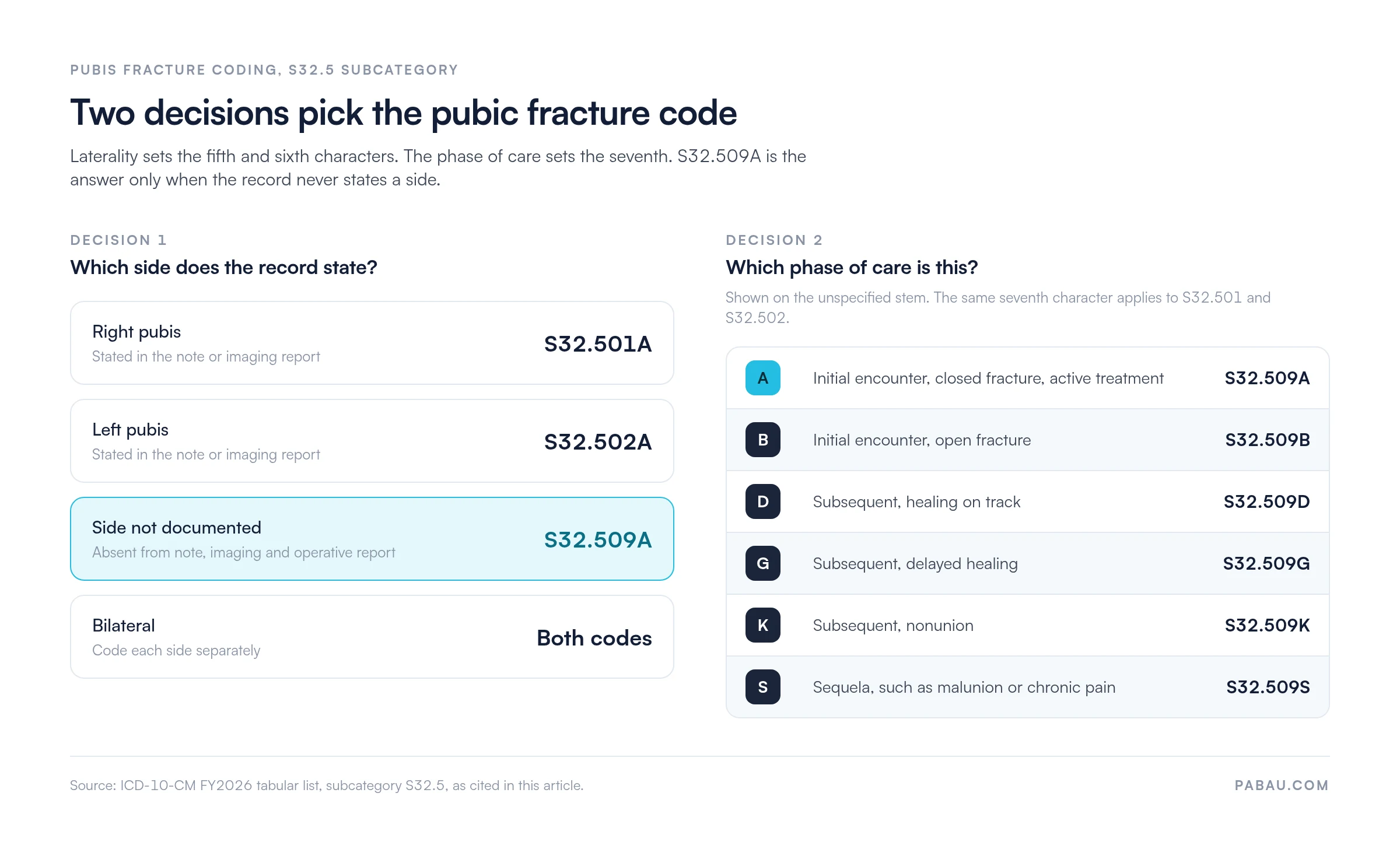
Following this workflow keeps unspecified code rates down. It also holds specificity steady across every diagnosis category, not just pelvic fractures.
CPT pairings depend entirely on the treatment rendered and vary by care setting. The table below reflects codes that frequently appear alongside S32.509A based on common clinical management pathways. These pairings are illustrative, not prescriptive. Always code from the documentation.
S32.509A is accepted on both the CMS-1500 (professional) and the UB-04 (facility) claim form. That covers outpatient orthopedic offices, emergency departments, and inpatient hospital settings.
For inpatient admissions, S32.509A groups to MS-DRG 535 (fractures of hip and pelvis with MCC) or MS-DRG 536 (without MCC), depending on the documented comorbidities. A more specific laterality code does not change the DRG for this fracture category. It does feed the risk-adjustment models used in value-based payment programs.
Practices submitting pelvic fracture claims electronically can route S32.509A through Pabau’s Claim.MD clearinghouse integration. It validates the code against payer edits before submission. The integration reaches thousands of US payers and supports both the CMS-1500 and the 837P electronic claim format.
Teams handling high volumes of musculoskeletal claims should know what makes a clean claim before they submit one. Diagnosis codes also meet medical necessity edits at the payer, and a vague code is what usually trips them. Pabau’s claims management software attaches the ICD-10 code at the encounter level, so the diagnosis reaches the claim without a manual transfer step.
Pubic ramus fractures in older adults are often fragility fractures. Low-energy trauma, such as a fall from standing height, breaks bone that normal density would have held. The coding turns on the secondary diagnosis.
When the physician documents osteoporosis as a contributing condition, a secondary M80.x code may belong alongside S32.509A. That family covers osteoporosis with a current pathological fracture. The ICD-10-CM Official Guidelines require documentation linking the osteoporosis to this fracture, not just a history of osteoporosis in the problem list.
Documentation trigger: Look for “fragility fracture,” “insufficiency fracture,” or “fracture due to osteoporosis” in the attending note or the discharge summary. Those phrases support dual coding.
A bare “history of osteoporosis” in the medical history does not. Without a stated clinical link to this fracture, there is nothing to hang an M80.x secondary on. Query the provider instead of adding the diagnosis on inference.
Secondary diagnosis coding here also feeds hierarchical condition category (HCC) risk scores in Medicare Advantage plans. So the same two lines in a note move both the claim and next year’s risk score.
Flag fall-related encounters in patients aged 65 or older for a documentation quality review. If the note describes a low-energy mechanism and the patient has a known osteoporosis history, query the provider. Ask whether this meets the criteria for a fragility fracture. One answer can unlock dual coding and sharpen risk adjustment.
Coders working follow-up encounters need the typical treatment arc for isolated pubic fractures. It decides which seventh-character suffix applies on a return visit.
Knowing this arc helps coders pick the correct subsequent encounter code, so each claim reflects the phase of care delivered. Submitting an initial-encounter suffix on a routine follow-up visit is an audit flag, and it is one of the easiest to spot from the outside.
In most practices the diagnosis is written in one place and typed into the claim in another. A coder reads the ED note, settles on S32.509A, and someone re-enters it in the billing tool. Each hand-off is a chance to drop a digit or the seventh character.
Pabau holds the encounter record and the claim in one system. The code assigned at the encounter is the code that leaves the practice, and the Claim.MD integration checks it against payer edits before submission. No one retypes the code, so no transcription step can corrupt it.
For a coding team, that turns rejections tied to a mistyped diagnosis code into a rarity rather than a monthly clean-up. It also leaves an audit trail showing which code was assigned at which encounter, and by whom.

Pabau attaches ICD-10 codes at the point of care and routes them through the Claim.MD clearinghouse, cutting transcription errors and reducing pelvic fracture claim rejections.

S32.509A is a legitimate code, not a shortcut. Assigned where the record genuinely omits the side, it is defensible on any audit. Assigned out of habit, it becomes a pattern a payer can read straight off your claim history.
The trade-off worth remembering is timing. Specificity is cheap to capture at the index encounter and expensive to reconstruct a year later. One line in the note, or one short provider query, decides which code you end up defending.
Keeping the code attached to the encounter from documentation through to submission is what removes the retyping step. Book a demo to see how your coders and billers can work from one encounter record instead of two systems.

Need to understand how claims move from diagnosis to payment? What is medical billing covers the end-to-end revenue cycle workflow from encounter coding to remittance.
Want to reduce pelvic fracture claim denials? Denial management in healthcare explains the most common denial categories and how to fix the documentation behind them.
Submitting 837P claims electronically? Electronic remittance advice walks through how ERAs map back to submitted diagnosis codes and how to reconcile payer responses.
ICD-10 Code S32.509A is a billable ICD-10-CM diagnosis code describing an unspecified fracture of unspecified pubis at the initial encounter for a closed fracture. It belongs to the S32 category (fracture of lumbar spine and pelvis) and is valid for FY2026 claims on CMS-1500 and UB-04 forms.
Yes, S32.509A is a fully billable ICD-10-CM code accepted for claim submission. It has been valid since ICD-10-CM adoption and remains active for FY2026 with no excludes notes preventing its use as a standalone primary diagnosis.
S32.509A applies to a closed fracture at the initial encounter; S32.509B applies to an open fracture (skin integrity compromised) at the initial encounter. The fracture type (open vs. closed) must be documented by the treating physician; coders cannot make this determination independently.
Use suffix ‘A’ when the patient is receiving active treatment for the fracture at the current encounter. Switch to ‘D’ for routine subsequent healing visits, ‘G’ when the physician documents delayed healing, and ‘K’ when nonunion is documented. The ICD-10-CM Official Guidelines (Section I.C.19.a) govern these definitions.
S32.509A can be the primary code for a pubic fracture in a patient with osteoporosis. When the physician explicitly links the fracture to osteoporosis as a fragility or insufficiency fracture, consider a secondary M80.x code. Always confirm with the provider before adding the secondary diagnosis.
Use S32.501A for a right pubic fracture and S32.502A for a left pubic fracture when the clinical record or imaging report specifies the side. S32.509A is reserved for cases where laterality is genuinely absent from all available documentation. When imaging is on file, review it or query the provider before defaulting to the unspecified code.