Pabau Engage inbox

Pabau Engage is here: every patient conversation in one inbox.

Learn more
ICD-10-CM Code

ICD code S32.038G – Other L3 fracture with delayed healing

Billable Code Specific Code


Code Definition

S32.038G is the billable ICD-10-CM code for other fracture of third lumbar vertebra, subsequent encounter for fracture with delayed healing. It applies at a follow-up visit for an L3 fracture that isn't a wedge compression or burst fracture, once active treatment has ended.

The 7th character G is where this claim succeeds or fails. The provider's note has to say healing is delayed. If it describes routine healing, the code is S32.038D, and a documented nonunion moves it to S32.038K.

Chapter
S00-T88 Injury, poisoning and certain other consequences of external causes
Category
S32 Fracture of lumbar spine and pelvis
Group
S32.038 Other fracture of third lumbar vertebra
Billable
Yes
Code also known as
Delayed union of L3 fracture, follow-up; third lumbar vertebra fracture with delayed healing
Save time. Improve accuracy. Get paid faster.
Automate coding with Pabau

Let Pabau's smart automation suggest the right codes, reduce claim denials, and keep your practice compliant—effortlessly.

  • AI-powered code suggestions
  • Real-time compliance checks
  • Faster claims, fewer denials
Why practices choose Pabau
Save hours every week

Automate repetitive tasks and focus on what matters most—your patients.

Improve accuracy

Reduce coding errors and ensure compliance with the latest regulations.

Get paid faster

Clean claims, fewer denials, and faster reimbursements.

Grow with confidence

Powerful insights and reporting to help your practice thrive.

HIPAA compliant SOC 2 certified GDPR-compliant Trusted by 4,000+ clinics worldwide

Key takeaways

Key takeaways

ICD-10 code S32.038G reports a follow-up visit for an L3 fracture, other than a wedge compression or burst fracture, that is healing slower than expected.

In category S32 the 7th character G means delayed healing and D means routine healing. A note that says healing is on track needs S32.038D.

S32.038 takes only six 7th characters, A, B, D, G, K and S, and has no malunion character.

An L3 fracture after minor trauma in a patient with age-related osteoporosis belongs to M80.08XG, not S32.038G. Other osteoporosis types take their own M80 code, such as M80.88XG.

Sequence any associated lumbar spinal cord or nerve injury from S34 first, because the S32 category carries a code first note.

ICD-10 code S32.038G at a glance

ICD-10 code S32.038G is the billable ICD-10-CM code for other fracture of third lumbar vertebra, subsequent encounter for fracture with delayed healing. You use it when a patient returns for L3 fracture care after active treatment. The provider must document that the bone is healing slower than expected.

Three facts have to line up before it fits. The fracture is at L3, its type is named but isn’t a wedge compression or burst fracture, and the note says healing is delayed.

FieldDetail
CodeS32.038G
Official descriptorOther fracture of third lumbar vertebra, subsequent encounter for fracture with delayed healing
Chapter19, Injury, poisoning and certain other consequences of external causes (S00-T88)
BlockS30-S39, Injuries to the abdomen, lower back, lumbar spine, pelvis and external genitals
CategoryS32, Fracture of lumbar spine and pelvis
Anatomical siteThird lumbar vertebra (L3)
Fracture typeOther, meaning a documented type that isn’t wedge compression, stable burst or unstable burst
7th characterG, subsequent encounter for fracture with delayed healing
BillableYes, valid for HIPAA-covered transactions

What S32.038G covers, one character at a time

Each step in the code narrows the diagnosis. Reading it left to right is the fastest way to check you have the right one.

  • S32 is the category for fractures of the lumbar spine and pelvis.
  • S32.0 narrows that to a fracture of a lumbar vertebra. A note that only says “fracture of lumbar spine” lands here, at the unspecified-level codes.
  • S32.03 fixes the level at the third lumbar vertebra, L3.
  • S32.038 is “other fracture” of L3. It sits beside wedge compression (S32.030), stable burst (S32.031), unstable burst (S32.032) and unspecified (S32.039).
  • G is the 7th character for a subsequent encounter with delayed healing.

“Other” has a narrow meaning here. The record names a fracture type, but that type has no code of its own at L3. If the note gives no type at all, the right code is S32.039G, and the Alphabetic Index entry for the documented type settles any doubt.

The 7th character decides the claim

Category S32 uses six 7th characters. Each one tells the payer where the patient is in their care, from the first visit to a late effect. Here’s how each reads for an “other” L3 fracture.

7th characterMeaningL3 example
AInitial encounter for closed fractureS32.038A: emergency visit after a fall, CT confirms the L3 fracture and treatment starts
BInitial encounter for open fractureS32.038B: the same fracture is open, and the patient is still in active treatment
DSubsequent encounter, routine healingS32.038D: six-week check where the provider notes healing is progressing as expected
GSubsequent encounter, delayed healingS32.038G: follow-up where the provider documents that union is slower than expected
KSubsequent encounter, nonunionS32.038K: the provider documents that the fracture has failed to unite
SSequelaS32.038S: a late effect of the healed fracture, coded after the condition it caused

D and G are the pair that get swapped. D is routine healing and G is delayed healing, and that order trips up coders who expect G to come first. Two questions settle it, as the decision path below shows.
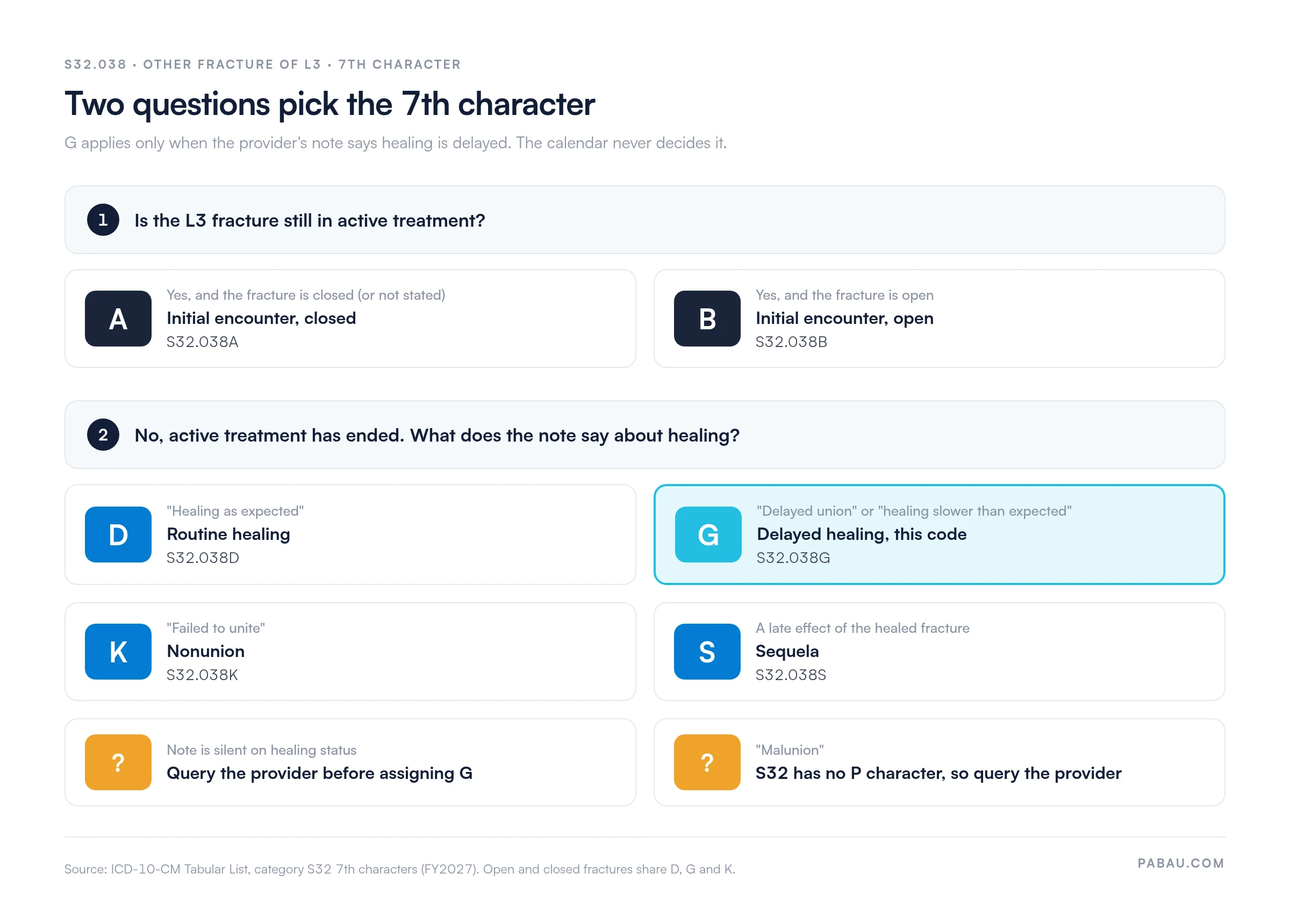
Decision diagram for the 7th character of S32.038, other fracture of L3
Once active treatment ends, the provider’s healing wording picks D, G or K for the follow-up. Character meanings follow the ICD-10-CM Tabular List for category S32.

Two quirks of this category matter at follow-up. Open and closed fractures share D, G and K, so an open L3 fracture with slow healing still takes S32.038G. There’s also no malunion character P in S32, so don’t stretch G to cover a malunion. Check the Index and query the provider instead.

Pro Tip

Delayed healing is the provider’s clinical call. ICD-10-CM sets no week count that turns D into G. If the note doesn’t say healing is delayed, query the provider before you assign G.

The notes that bind S32.038G

The notes for S32.038G sit higher up the tree, at the category and chapter levels. They still bind the code, so read them before you finalize the claim.

NoteWhat it saysWhat it means for S32.038G
Includes (S32)Fracture of lumbosacral neural arch, spinous process, transverse process, vertebra and vertebral archFractures of these parts of L3 stay in the S32.03- subcategory
Code first (S32)Any associated spinal cord and spinal nerve injury (S34.-)List the S34 code ahead of S32.038G when the note documents a cord or nerve injury
Excludes1 (S32)Transection of abdomen (S38.3)Don’t report the two together unless the conditions are unrelated
Excludes2 (S32)Fracture of hip NOS (S72.0-)A separate hip fracture can be coded alongside it
Default note (S32)A fracture not indicated as open or closed is coded to closedUse A, not B, at the first visit when the note is silent
Chapter 19 noteUse secondary codes from Chapter 20 to show the cause of injuryExternal cause codes can follow S32.038G where they’re reported

Two guideline rules decide which code family a follow-up belongs to. If a patient with known osteoporosis fractures L3 from trauma that wouldn’t break healthy bone, guideline I.C.13.d sends it to category M80. With age-related osteoporosis, a delayed-healing visit takes M80.08XG. Other osteoporosis types take their own M80 code, such as M80.88XG.

Aftercare Z codes don’t apply to injuries either. Guideline I.C.21.c.7 says to report the injury code with its subsequent-encounter character, so S32.038G replaces a code such as Z47.89.

Codes that get mistaken for S32.038G

Most S32.038G errors are a single character away from the right answer. These are the neighbors to rule out.

CodeDescriptorHow it differs
S32.038DOther fracture of L3, subsequent encounter, routine healingSame fracture, but the note says healing is on track
S32.038KOther fracture of L3, subsequent encounter, nonunionThe provider documents that the fracture has failed to unite
S32.030GWedge compression fracture of L3, delayed healingThe note names a wedge compression fracture
S32.031GStable burst fracture of L3, delayed healingThe note names a stable burst fracture
S32.032GUnstable burst fracture of L3, delayed healingThe note names an unstable burst fracture
S32.039GUnspecified fracture of L3, delayed healingThe note gives no fracture type
S32.048GOther fracture of L4, delayed healingSame type and phase, one level lower
S32.1-Fracture of sacrumA different bone, so the sacral zone codes never describe an L3 fracture

Level errors are the easiest to miss. Check the vertebral level in the imaging report against the code before the claim goes out, especially when the referral letter says “lumbar fracture”.

If no record names the level, the delayed-healing code for an other fracture of an unspecified lumbar vertebra is S32.008G. Query the provider first, because the imaging report usually names it.

How an S32.038G claim moves from note to payment

A delayed-healing claim passes through five hands. Each one can stop it.

  1. The visit. The provider examines the patient and records healing status in their own words, such as “delayed union” or “healing slower than expected”.
  2. Coding. The coder confirms a prior active-treatment encounter, then reads level, type and healing status from the note.
  3. Charge entry. S32.038G is linked to each CPT line it supports, with any S34 code listed first.
  4. Clearinghouse. The claim is checked for format and code validity, then sent to the payer.
  5. Payer review. The payer tests medical necessity, authorization and the diagnosis-procedure pairing, then pays or denies.

Most S32.038G problems start at step one. If the note never says “delayed”, the coder has nothing to support G, and no later step can fix it.

CPT codes that often travel with S32.038G

Pick the CPT code from the service performed. These are common pairings at a lumbar fracture follow-up. Check each against current payer policy, because they aren’t guaranteed reimbursable combinations. When slow healing changes the plan, the visit may reach the moderate decision making that 99214 requires.

CPT codeServiceWhen it fits a delayed-healing L3 visit
99213Office visit, established patient, low medical decision making (or 20 minutes)A straightforward review where the plan barely changes
99214Office visit, established patient, moderate medical decision making (or 30 minutes)Slow healing changes the plan, such as new imaging or a longer brace period
72100Radiologic exam, lumbosacral spine, 2 or 3 viewsPlain films to check healing at L3
72110Radiologic exam, lumbosacral spine, minimum of 4 viewsA fuller plain-film series when the provider needs more angles
72131CT, lumbar spine, without contrastCross-sectional imaging when films can’t show whether union is progressing
72148MRI, lumbar spinal canal and contents, without contrastSoft tissue or neural assessment when symptoms suggest more than slow bone healing
97110Therapeutic exercises, each 15 minutesPhysical therapy for strength and mobility during the slower recovery

A CT under 72131 or a lumbar MRI often needs prior authorization, and an approval from the initial encounter rarely carries over. Get a fresh one before the follow-up scan is booked. Plain films such as 72100 usually go through without one.

Why S32.038G claims get denied

Payers deny this code for a handful of predictable reasons. The claim adjustment reason codes (CARCs) shown are the ones you’ll usually see on the remittance. Our guide to medical billing denial codes explains how to answer each one.

Denial triggerWhat usually happenedFix
Diagnosis inconsistent with procedure (CARC 11)The CPT line doesn’t make sense for a delayed-healing L3 fractureLink S32.038G only to the services it supports
Authorization absent (CARC 197)A CT or MRI ran on the initial-encounter approvalRequest a new authorization for follow-up imaging
Not medically necessary (CARC 50)The note shows a routine check, so the payer reads G as unsupportedMake sure the note documents delayed healing and the plan it changed
Wrong phase of careS32.038A was carried forward to a follow-up visitSwitch to D, G or K once active treatment has ended
Wrong code familyA fragility fracture in a patient with osteoporosis was coded as traumaUse M80.08XG for age-related osteoporosis when guideline I.C.13.d applies, or another M80 code, such as M80.88XG, for other types

Before you submit: A seven-point check

Run this list on every S32.038G claim. It takes a minute and catches most of the denials above.

  • The record shows an earlier encounter where the L3 fracture was actively treated.
  • The provider’s note says healing is delayed, in words you can quote.
  • The note or imaging names L3, not just “lumbar spine”.
  • The fracture type is named, and it isn’t wedge compression or burst.
  • Any spinal cord or nerve injury is coded from S34 and listed first.
  • Each CPT line on the claim is one that S32.038G supports.
  • Authorization is on file for any CT or MRI billed at this visit.

Common mistakes with delayed-healing L3 fractures

These five habits start at the coding desk. Each one produces a clean-looking claim that won’t survive an audit.

  • Inferring G from the calendar. Twelve weeks since injury doesn’t mean delayed healing unless the provider says so.
  • Putting G on the external cause code. External cause codes use A, D and S only. At a follow-up, the external cause code takes D while the fracture code takes G.
  • Treating external cause codes as optional everywhere. There’s no national mandate, but some states and payers require them. Check the contract.
  • Coding aftercare with a Z code. Z47.89 doesn’t belong on an injury follow-up, so report S32.038G instead.
  • Using G for a malunion. S32 has no malunion character, so query the provider rather than forcing the closest fit.

How Pabau keeps delayed-healing fracture claims moving

A delayed-healing claim usually breaks between the note and the claim form. The provider writes healing status in one place, and billing rekeys the diagnosis somewhere else.

In Pabau, the practice management and EHR platform we build, the follow-up note can be a form that asks for healing status at every visit. The coder reads delayed or routine healing straight from the record before choosing D or G.

For US practices, Pabau’s record-linked claims management sends the claim through its Claim.MD clearinghouse integration, from the same system that holds the note. That means fewer rekeying errors, because the diagnosis comes from the same record the provider wrote.
Pabau checkout screen with a completed invoice billed to an insurer
Pabau’s checkout raises the invoice from the patient record, so an L3 follow-up is billed against the visit the provider documented.

Fewer denials on fracture follow-up claims

Pabau keeps the clinical note and the claim in one system, so delayed-healing visits are coded from what the provider wrote. US practices submit through our Claim.MD clearinghouse integration.

Pabau claims management dashboard

Conclusion

S32.038G is a narrow code, and it should stay that way. Use it only when the note puts the fracture at L3, names a type with no code of its own, and says healing is delayed.

If any of those three is missing, the claim is guessing. A quick query to the provider costs less than a denial. It costs far less than an audit that finds G on visits the note calls routine.

The habit worth building is upstream. Ask providers to record healing status at every fracture follow-up, and most of this code’s denials disappear. Book a demo to see how Pabau links fracture follow-up notes to cleaner claims.

Continue your research

Continue your research

Need help managing claim denials by denial code? Denial codes in medical billing explains the most common CARC and RARC codes and how to respond to each one.

Want to understand how clearinghouses handle your claims? Medical claims clearinghouse guide covers how claims move from practice to payer and where they get stuck.

Looking for a primer on the 837 claim file format? 837 file format explained covers the EDI transaction structure that carries ICD-10-CM codes to payers.

Frequently asked questions

Is S32.038G valid in the FY2027 code set?

Yes. S32.038G carried over unchanged into the FY2027 ICD-10-CM code set, effective October 1, 2026. It has been valid since ICD-10-CM took effect on October 1, 2015.

Does S32.038G need a present-on-admission indicator?

No. S32.038G is exempt from present-on-admission reporting, so an inpatient claim doesn’t need a POA indicator for it.

Which MS-DRG does S32.038G group to?

As a principal diagnosis, S32.038G groups to MS-DRGs 559, 560 and 561, aftercare of the musculoskeletal system and connective tissue. Secondary diagnoses decide which one, depending on whether they add an MCC, a CC or neither.

How do you code fractures of L3 and L4 at the same visit?

Code each vertebra separately. For example, report S32.038G for L3 and S32.048G for L4 when both are other fractures with delayed healing. Each level takes its own 7th character, which can differ.

What is the short description of S32.038G?

The CMS short description is “Oth fracture of third lum vertebra, subs for fx w delay heal”. Billing systems and claim scrubbers often display this abbreviated form, so it helps to recognize it on a rejection.
Avatar photo
Monika Lazarevska
Content Writer

Monika Lazarevska writes content for owners and healthcare professionals who want clear, no-fluff content that actually helps them run their practice better. With a background in storytelling and SEO, she knows how to make even the driest topics worth reading. Off the clock, you'll find her in a café somewhere in Europe, probably with a good book and an even better coffee.
×