ICD-10 Code S49.011P: Salter-Harris physeal fracture, right humerus, malunion
ICD-10 Code S49.011P: Quick reference ICD-10 Code S49.011P is the billable code ...

Last Updated: Oct 15, 2026
Billable Code Specific Code
S25.99XA is the billable ICD-10-CM code for other specified injury of unspecified blood vessel of thorax, initial encounter. It applies when the record documents a thoracic vascular injury other than a laceration but does not identify the vessel.
Common errors on this code are misplacing the X placeholder and choosing the wrong 7th character. Check imaging and operative notes first, because a named vessel moves the claim to a more specific S25 code.
Let Pabau's smart automation suggest the right codes, reduce claim denials, and keep your practice compliant—effortlessly.
Automate repetitive tasks and focus on what matters most—your patients.
Reduce coding errors and ensure compliance with the latest regulations.
Clean claims, fewer denials, and faster reimbursements.
Powerful insights and reporting to help your practice thrive.
HIPAA compliant SOC 2 certified GDPR-compliant Trusted by 4,000+ clinics worldwide

S25.99XA is the billable ICD-10-CM code for other specified injury of an unspecified thoracic blood vessel at the initial encounter.
It is distinct from the identified-vessel codes in S25.0-S25.8 and from S25.90XA and S25.91XA, which share its unspecified vessel.
The X in position 6 is a placeholder with no clinical meaning, and a code submitted without it fails format checks.
Three 7th characters apply to S25.99: A for the initial encounter, D for subsequent encounters and S for sequela.
Pabau’s claims management software submits claims through the Claim.MD clearinghouse and shows rejection reasons, so your team can correct and resubmit them.
ICD-10 Code S25.99XA is the billable code for other specified injury of unspecified blood vessel of thorax, initial encounter.
Use it when the record documents a thoracic vascular injury other than a laceration, but no imaging, operative or clinical note identifies the vessel. It sits in Chapter 19 of the ICD-10-CM Tabular List, under block S20-S29 and category S25 (Injury of blood vessels of thorax).
The table below captures the attributes coders check before submitting a claim.
S25.99XA applies when three facts line up in the medical record. A thoracic blood vessel was injured, and the injury is documented as something other than a laceration. Yet no imaging, operative or clinical note names the vessel involved. That pairing of a specified injury type with an unidentified vessel is what separates S25.99XA from its neighbors in category S25.
Category S25 covers the thoracic aorta, the innominate and subclavian arteries and veins, the superior vena cava and the pulmonary vessels. It also covers the intercostal vessels and other thoracic vessels, such as the azygos vein and the internal mammary artery or vein.
S25.99XA is appropriate when one of these is injured but imaging or surgery has not shown which one.
Two mechanisms commonly lead here. One is penetrating thoracic trauma, such as a stab or gunshot wound whose track crosses several vascular zones. The other is severe blunt trauma, typically a high-speed collision where hemodynamic instability suggests vascular injury before any bleeding source is confirmed.
The code is not a shortcut for incomplete documentation. It needs positive documentation that an injury exists and that the vessel cannot be identified.
The 7th character in S25.99XA tells the payer which phase of care is being billed. Three values are valid for S25.99, and a letter that contradicts the treating provider’s note is an avoidable rejection on trauma claims.
Initial encounter does not mean the first time any provider sees the patient. It means the patient is still receiving active treatment for the injury.
A patient transferred to another hospital on day three of an admission still takes the A character. Switch to the D character only once active treatment is complete and the patient is in the healing or recovery phase.
The X in position 6 of S25.99XA is a placeholder, not a clinical qualifier. Section I.A.4 of the ICD-10-CM Official Guidelines covers the placeholder character. Where a placeholder exists, the X must be used for the code to be valid.
Category S25 needs a 7th character, so S25.99 takes an X in position 6 to push the A into position 7. Without it, payers and clearinghouses reject the string on format alone.
Read left to right, S25 is the category and .9 marks an unspecified vessel. The next 9 means other specified injury, X is the placeholder and A is the initial encounter. The decimal point is display formatting only. Electronic claims carry the code as S2599XA.
Category S25 carries no Excludes notes of its own. The notes that affect S25.99XA sit at the S20-S29 block level, and the ones below are all Excludes2. Category S25 adds one instruction of its own, which is to code also any associated open wound (S21.-).
An Excludes2 note means the excluded condition is not part of this block. Both codes may still be reported when both are documented in the same encounter. Injuries of the heart (S26) and of other intrathoracic organs (S27) are sibling categories rather than Excludes notes. Code them alongside S25.99XA when the record documents them.
ICD-10-CM coding works specificity first, so use the most detailed code the documentation supports. S25.99XA sits near the bottom of the S25 ladder, and two questions decide whether it applies. The diagram below shows them in order, with the vessel question always asked first.
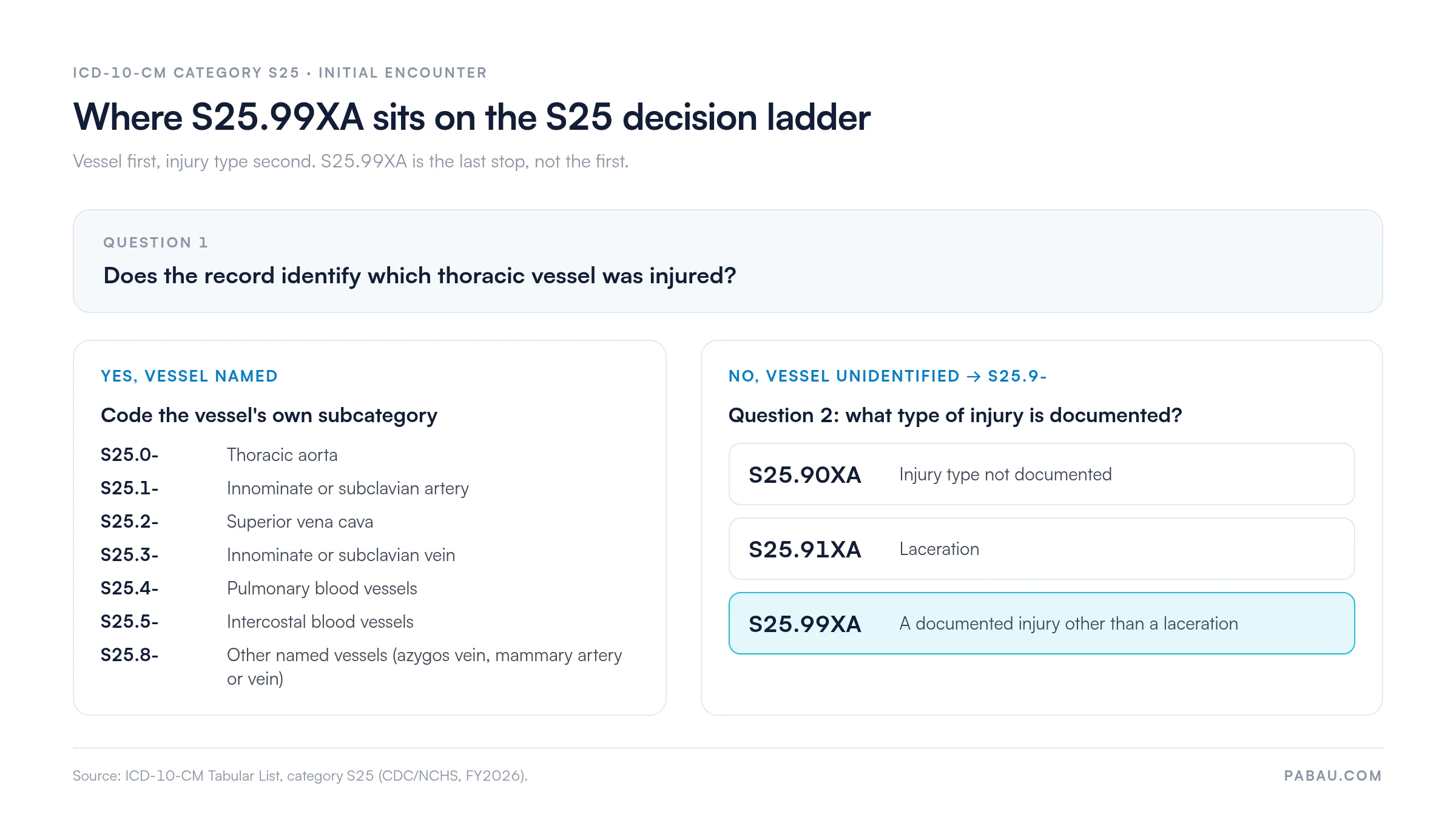
Laterality matters in the subcategories that carry it. An intercostal vessel injury with no side and no injury type documented is S25.509A, not a code from S25.9-, because the vessel itself is known. You can check every subcategory and its 7th characters in the ICD-10-CM code set.
Follow this sequence before assigning S25.99XA. Jumping to an unspecified-vessel code when the documentation supports a more specific one breaks the ICD-10-CM specificity principle. You can browse the full category in AAPC’s ICD-10-CM code ranges.
S25.99XA is billable, but it places a documentation burden on the clinical record that coders must verify before submission. Meeting medical billing compliance standards for this code requires the record to address four areas.
Building clean claim requirements into documentation at the point of care reduces the audit risk that comes with unspecified-vessel codes.
Verify the imaging report before submitting S25.99XA. If the radiology report names a vessel, such as a mediastinal hematoma originating from the descending thoracic aorta, the attending documentation should reflect that finding. A more specific code is then appropriate. Mismatches between imaging findings and the coded diagnosis are a common audit flag on thoracic trauma claims.
The ICD-10-CM Official Guidelines state there is no national requirement to report external cause codes. They are secondary codes, and some payers and state mandates ask for them. Codes from V00-Y99 describe the mechanism, place of occurrence, activity and patient status at the time of injury.
Thoracic vascular trauma codes draw close payer scrutiny because they sit on high-cost admissions. Knowing the denial management workflows that apply to S25.99XA helps reduce write-offs. Check these five patterns first.
MS-DRG assignment depends on the principal diagnosis, procedures and CC/MCC status. Check the grouper version for the admission date before you predict the DRG for an S25.99XA admission.
Medicare and Medicaid publish no Local Coverage Determinations (LCDs) specific to S25.99XA. It is a trauma diagnosis rather than a procedure-linked medical necessity code. Coverage follows the facility claim and the procedure codes for surgical repair, monitoring or intensive care.
The CDC/NCHS ICD-10-CM tool confirms the code’s billable status for the fiscal year and shows the official tabular entry with its notes.
Revenue cycle teams handling high-acuity admissions need the medical billing fundamentals that link the diagnosis code, the DRG grouper and the payer’s adjudication logic. When the electronic remittance advice returns a denial on S25.99XA, read the CARC on the 835 transaction. It shows whether the denial is format-based, documentation-based or a coordination-of-benefits issue.
When clinical notes and billing live in separate systems, the coder re-keys the diagnosis, the external cause codes and the 7th character by hand. Each re-key is another chance to drop the placeholder X or pick the wrong encounter letter.
Pabau, the practice management platform we build, keeps clinical notes, invoices and claims in the same patient record. Its claims management software submits claims through the Claim.MD clearinghouse and shows rejection reasons in the platform.
The result is a shorter correction loop. A claim rejected for a malformed S25.99XA string or a mismatched 7th character shows the reason next to the patient record. Your team can fix it and resubmit without chasing paperwork between systems.

Pabau’s claims management software submits claims through the Claim.MD clearinghouse and shows rejection reasons, so S25.99XA errors get fixed and resubmitted fast. See it in a live demo.

S25.99XA earns its place only when the record proves two things. The injury type is documented and is not a laceration, and nobody could identify the vessel. If either fact is missing, a more specific S25 code or S25.90XA is the safer claim.
Before you submit, read the imaging report against the code. A vessel named anywhere in the file is the likeliest reason this claim gets downcoded, so resolve it with the physician first. The placeholder X and the 7th character are mechanical, and they should never be the reason a trauma claim comes back.
Book a demo to see how Pabau submits trauma claims through Claim.MD and shows every rejection reason in one place.

Need to know what happens to a claim after you submit it? Claim.MD clearinghouse overview explains how claims travel to payers and how rejections come back.
Working through a denial on a thoracic trauma claim? Denial codes in medical billing maps CARC codes to their root causes so your team knows which field to correct.
Is the injured vessel an intercostal artery or vein? ICD-10 code S25.509A covers the intercostal subcategory when the side and injury type are not documented.
Did the trauma also injure the lung? ICD-10 code S27.309A covers the sibling S27 category that is often coded alongside S25.
Want to see how diagnosis codes reach the claim form? Superbill guide for medical practices shows how ICD-10 codes are tied to claim documents and what payers check on each.
ICD-10 code S25.99XA is the billable diagnosis code for other specified injury of unspecified blood vessel of thorax, initial encounter. It applies when the record documents a thoracic vascular injury other than a laceration, but the clinical evidence does not identify the vessel. The X is a placeholder in position 6, and the A marks the initial encounter in position 7.
Yes. S25.99XA is valid in ICD-10-CM, the US code set maintained by NCHS and CMS. It can be submitted on inpatient and outpatient claims when the encounter and documentation criteria are met.
The 7th character A designates an initial encounter, meaning the patient is receiving active treatment for the thoracic vascular injury. Switch to D once active treatment is complete and the patient is healing. Use S when treating a condition that results directly from the original injury.
Not nationally. The ICD-10-CM Official Guidelines set no national requirement to report external cause codes, but some payers and state mandates ask for them. When reported, they describe the mechanism of injury, the place of occurrence (Y92), the activity (Y93) and the patient’s status (Y99).
S25.99XD applies to subsequent encounters, such as follow-up visits, wound care or rehabilitation after active treatment of the injury. S25.99XS applies to sequela encounters, where the condition being treated is a late effect of the original injury, such as chronic vascular insufficiency or scarring.