

ICD-10 Code S53.013D: Anterior subluxation of unspecified radial head
ICD-10 Code S53.013D: Quick reference summary Use the table below as your first ...

Last Updated: Nov 6, 2026
Billable Code Specific Code
S24.9XXS is the billable ICD-10-CM code for injury of unspecified nerve of thorax, sequela. It applies when care targets a lasting condition from an earlier thoracic nerve injury, and the record does not name the nerve.
The seventh character S distinguishes this code from its siblings S24.9XXA (initial encounter) and S24.9XXD (subsequent encounter). Choosing the wrong character is a common denial trigger for this code. Thoracic spinal cord injuries use S24.0- or S24.1- instead, so S24.9XXS never describes a cord injury.
Let Pabau's smart automation suggest the right codes, reduce claim denials, and keep your practice compliant—effortlessly.
Automate repetitive tasks and focus on what matters most—your patients.
Reduce coding errors and ensure compliance with the latest regulations.
Clean claims, fewer denials, and faster reimbursements.
Powerful insights and reporting to help your practice thrive.
HIPAA compliant SOC 2 certified GDPR-compliant Trusted by 4,000+ clinics worldwide

S24.9XXS codes injury of unspecified nerve of thorax, sequela, and is valid and billable for FY2027.
Use it only when a thoracic nerve injury is documented but the nerve is not named; spinal cord injuries use S24.0- or S24.1- instead.
Two placeholder X characters fill positions five and six, so S24.9S is an invalid code that payers reject.
Sequence the residual condition first, such as intercostal neuropathy (G58.0), then S24.9XXS as the injury that caused it.
ICD-10 code S24.9XXS is the billable ICD-10-CM code for injury of unspecified nerve of thorax, sequela. Use it when a visit treats a lasting effect of an earlier thoracic nerve injury, and the record does not name the nerve.
The code sits in Chapter 19 (Injury, Poisoning and Certain Other Consequences of External Causes, S00-T88). Within it, S24.9XXS falls under block S20-S29 (Injuries to the thorax) and category S24 (Injury of nerves and spinal cord at thorax level). The table below gives the lookup data to confirm before you document or submit a claim.
The CDC/NCHS ICD-10-CM web tool hosts the official Tabular List, and CMS and NCHS update the code set every year. Always verify code validity against the current fiscal year release before submitting claims.
S24.9XXS applies when a patient injured a nerve at thorax level, and the current visit treats a condition the injury left behind. Thoracic nerves include the nerve roots, the intercostal and other peripheral nerves of the chest wall, and the thoracic sympathetic chain. The word “unspecified” means the documentation does not say which of these nerves was injured.
Typical residual conditions include intercostal neuralgia, chronic chest wall pain, and numbness or tingling along the injured nerve. The code does not apply to the visit that treats the fresh injury, or to follow-up while it is still healing. A sequela encounter means the injury is in the past, and the patient now has a lasting effect of it.
S24.9XXS is a seven-character ICD-10-CM code. Each position carries a specific meaning, and an error in any one of them produces an invalid code that payers reject outright.
The ICD-10-CM Official Guidelines for Coding and Reporting require the placeholder X wherever a code needs to reach the required length before the seventh character.
Submitting S24.9S (dropping both X characters) produces an invalid code that no clearinghouse will accept. The CMS ICD-10-CM code files list S24.9XXS with both placeholder characters explicitly.
The seventh character is the most consequential coding decision on a thoracic nerve injury claim. All three variants share the S24.9 base code. The character in position seven tells the payer whether the visit treats the injury itself, its recovery, or a residual condition.
A frequent error is S24.9XXA on a pain management or neurology visit months after the original injury. That visit treats a late effect, so S24.9XXS is the right code. The residual condition is sequenced first and S24.9XXS follows it, per ICD-10-CM Official Guidelines Section I.C.19.a.
Category S24 carries instructional notes that affect how S24.9XXS is reported alongside other codes. Apply them before you finalize the claim.
S24.9XXS shares category S24 with nerve codes that name the injured structure, and with the thoracic spinal cord codes. Rule out the more specific options before you default to S24.9. A complete cord lesion at T11-T12 treated in its healing phase, for example, takes S24.114D instead.
The ICD-10-CM guideline to code to the highest degree of specificity means S24.9 is correct only when the record genuinely lacks the nerve.
Query the physician before you submit, rather than defaulting to an unspecified code that invites a specificity denial. The AAPC Codify ICD-10-CM lookup lets coders browse the full S24 series and confirm which specific codes are available.
Those checks run in a fixed order, and each one can move the claim to a different code.
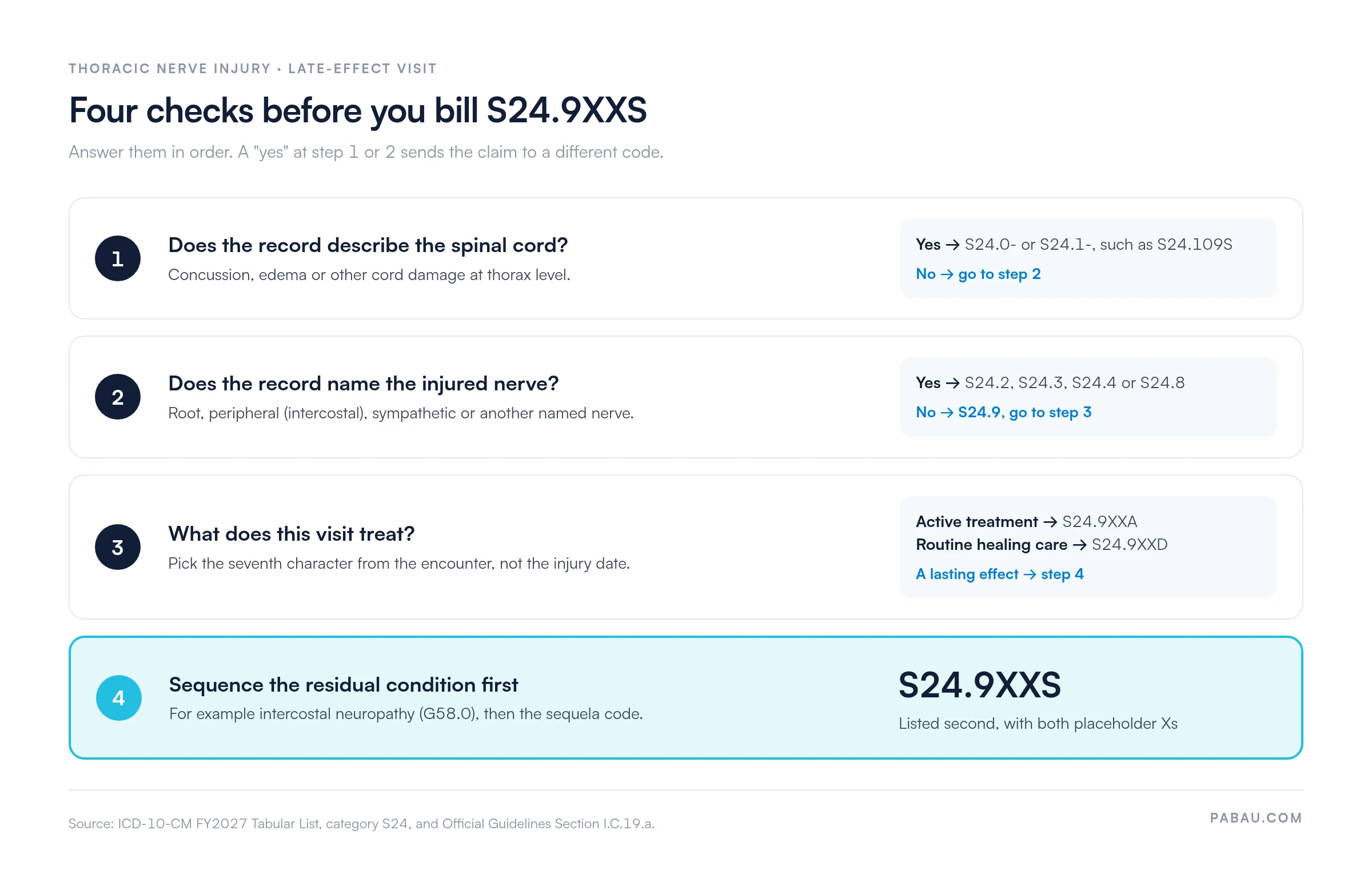
Missing or vague documentation is a leading cause of S24.9XXS denials. The physician note must establish three things: a prior thoracic nerve injury, a current condition caused by it, and why the nerve is not named.
Run a physician query before the claim leaves the practice if the note describes a chest wall nerve injury but not the nerve. When the response confirms the nerve is unknown, the unspecified code becomes a documented and defensible choice. If the response describes spinal cord involvement, recode to S24.0- or S24.1-.
ICD-10-CM Chapter 20 guidelines allow external cause codes on injury encounters, including sequela visits. There is no national requirement to report them, but many payers and state programs expect them. For S24.9XXS, the external cause code describes how the original injury happened and also takes seventh character S.
Common pairings include fall codes from the W categories and transport accident codes from the V categories. Place of occurrence, activity and external cause status codes are reported only at the initial encounter, so leave them off sequela claims. The residual condition codes below are sequenced before S24.9XXS.
Pabau, the practice management and billing software we build, sends these multi-code claims through its Claim.MD clearinghouse integration. It runs real-time eligibility checks and submits claims electronically to thousands of US payers.
Medicare and commercial payers handle thoracic nerve sequela visits by service type. Nerve blocks, nerve conduction studies and outpatient therapy each carry their own coverage rules. No single LCD or NCD governs every S24.9XXS encounter, and requirements vary by MAC jurisdiction.
Pabau’s guide to denial management in healthcare covers how to work these denials across payer types. For electronic submissions, clean claim best practices shorten the time between submission and payment on sequela encounters.
S24.9XXS denials cluster around a predictable set of errors. Catching them before submission is faster than appealing after the fact. When a denial does come back, the claim adjustment reason code (CARC) on the remittance names the error. This guide to medical billing denial codes explains the 20 most common ones.
Thoracic nerve sequela visits generate procedure codes across pain management, nerve testing, therapy and evaluation and management. The table below covers the most common pairings.
Check current NCCI edits before you bill an E&M code on the same date as a therapy evaluation. Claims management software with built-in NCCI logic can flag these conflicts before submission.

Each procedure carries its own billing rules on top of the diagnosis. Before you pair S24.9XXS with an intercostal block or a nerve study, check the guides for CPT 64420 and 95907.
Audit a sample of S24.9XXS claims each quarter. Pull any claim dated more than six months after the documented injury, and check that seventh character A was not used. Check the sequencing too: the residual condition should come before S24.9XXS.
Most S24.9XXS denials start before the claim is built. A seventh character is copied from the first visit, the residual condition is listed second, or the note never names the nerve. Catching those by hand means a coder re-reading every chart.
Pabau keeps the clinical note, the diagnosis codes and the claim in one patient record. Its built-in ICD-10 and CPT catalogues let the treating clinician select codes while the note is still open. The claim then goes to Claim.MD with eligibility already checked, and ERA reconciliation closes it out after payment.
The result is fewer claims bounced for character or sequencing errors, and less of your team’s week spent on appeals.

Pabau connects directly to the Claim.MD clearinghouse, supporting electronic claims, real-time eligibility verification, and ERA reconciliation for practices billing complex ICD-10 sequela encounters.

S24.9XXS is a narrow code, and most problems with it come from using it too widely. It belongs only on a visit that treats a lasting effect of a thoracic nerve injury where the nerve is not named. If the record describes the spinal cord, it is the wrong code.
Settle three questions before the claim leaves the practice. Is it a nerve or the cord, is the nerve named anywhere in the chart, and is the residual condition sequenced first? A physician query takes minutes, while a denied sequela claim can take weeks to appeal.
Book a demo to see how Pabau keeps the note, the codes and the claim aligned on complex sequela encounters.

Want to understand how the clearinghouse processes ICD-10 claims? Medical claims clearinghouse guide explains how electronic claims move from practice to payer and where they get stuck.
Submitting rehabilitation claims electronically? 837 file format guide covers the EDI transaction structure that carries ICD-10 diagnosis codes to payers.
ICD-10 code S24.9XXS is the billable diagnosis code for injury of unspecified nerve of thorax, sequela. It is used when a visit treats a lasting condition, such as intercostal neuralgia, caused by an earlier thoracic nerve injury. The record documents a nerve injury but does not name the nerve involved.
Use S24.9XXA while the injury is receiving active treatment, and S24.9XXD for routine care while it heals. Use S24.9XXS when the visit treats a residual condition after the injury has healed. Pain or neurology visits months after the injury usually call for S24.9XXS.
S24.9XXS covers an injury to a thoracic nerve that the record does not name. S24.2XXS covers an injury to a nerve root of the thoracic spine. If the physician documents nerve root involvement, S24.2XXS is the more accurate code.
Medicare has no blanket policy for or against S24.9XXS. Coverage depends on the service, such as nerve blocks, nerve conduction studies or outpatient therapy, and on the local MAC’s coverage determination. Document the residual condition and its functional impact, and check the relevant LCD before you submit.
The most common reasons are the wrong seventh character (A instead of S) and missing placeholder X characters. Others are listing S24.9XXS ahead of the residual condition, or no documented link to the prior injury. A record that names the nerve or describes the spinal cord also needs a different code.
No. S24.9XXS covers an unspecified nerve of the thorax, not the spinal cord. Thoracic spinal cord injuries use S24.0- or S24.1-, and the sequela code for a cord injury at an unspecified level is S24.109S.
Established-patient office visits (99213-99215), intercostal nerve blocks (64420, 64421) and nerve conduction studies (95907-95913) are frequent pairings. Physical therapy evaluations (97161-97163), therapeutic exercise (97110) and manual therapy (97140) are common too. Check current NCCI edits when you bill an office visit and a therapy code on the same date.
The physician note must establish a prior thoracic nerve injury and a current condition caused by it. It should also say why the specific nerve is not named. Functional impact, symptoms and the reason for ongoing treatment support medical necessity and hold up in an audit.



