

HCPCS Code L0472: Hyperextension TLSO billing guide
HCPCS code L0472: Official descriptor and device definition HCPCS code L0472 des...

Last Updated: Nov 5, 2026
64420 is the CPT code for injection of an anesthetic agent and/or steroid at a single intercostal nerve level. Each additional level injected in the same session is reported with add-on code 64421.
Common denial causes include billing extra units of 64420 instead of adding 64421, and a diagnosis the payer's coverage policy does not list. Billing ultrasound guidance (76942) without a documented image interpretation is another.
Let Pabau's smart automation suggest the right codes, reduce claim denials, and keep your practice compliant—effortlessly.
Automate repetitive tasks and focus on what matters most—your patients.
Reduce coding errors and ensure compliance with the latest regulations.
Clean claims, fewer denials, and faster reimbursements.
Powerful insights and reporting to help your practice thrive.
HIPAA compliant SOC 2 certified GDPR-compliant Trusted by 4,000+ clinics worldwide

CPT Code 64420 reports an anesthetic and/or steroid injection at a single intercostal nerve level.
Each additional level in the same session goes on add-on code 64421, so 64420 is never billed for more than one unit.
Medicare gives 64420 a 0-day global period, and the 2026 office rate is about double the facility rate.
Pabau, the practice management platform we build, checks each claim for missing or invalid details before it goes out through Claim.MD.
CPT Code 64420 is defined by the American Medical Association as “Injection(s), anesthetic agent(s) and/or steroid; intercostal nerve, single level.” Specifically, it covers one intercostal level per session, and each further level is reported with add-on code 64421. The physician injects a local anesthetic such as bupivacaine or lidocaine, with or without a steroid, beneath the lower border of a rib. Indeed, that is where the intercostal nerve runs alongside the intercostal artery and vein.
The code sits in the Nervous System subsection of the CPT Surgery section, among the nerve block injection codes (64400-64530). In fact, it is not an anesthesia code. Therefore, the physician who performs the injection reports 64420.
CPT 64420 covers the first intercostal level injected in a session. Meanwhile, CPT 64421 is the add-on code, reported once for each additional level. However, the classic mistake with this pair is billing two or more units of 64420 when several levels are treated. In fact, Medicare limits 64420 to one unit per day through its Medically Unlikely Edit (MUE), so the extra units deny.
Say a pain management physician injects the T5, T6, and T7 intercostal nerves in one visit. As a result, the claim carries one unit of 64420 (T5) plus two units of 64421 (T6, T7). In addition, the procedure note must name each rib level to support the unit count.
CPT 64450 is the “other peripheral nerve or branch” code, for nerves that have no dedicated code of their own. Therefore, use 64420 only when the target is an intercostal nerve. Instead, use 64450 for branches or peripheral nerves that no named code covers.
Document the rib level by number (T4, T6, T8) in the procedure note heading, not only in the body text. Auditors check the note for level specificity first. A missing level is a common reason 64420 claims come back with a request for more documentation.
The National Correct Coding Initiative (NCCI) publishes quarterly procedure-to-procedure (PTP) edits. Specifically, they define which code pairs cannot be billed together without a modifier, and knowing the pairs that touch 64420 prevents many automated rejections.
The 2020 CPT revision changed how this code family works. Specifically, it rewrote the 64420 descriptor to include steroids and made 64421 an add-on code reported with 64420. Overall, these are the pairs that matter most for 64420.
Modifier -59 can bypass a PTP edit when the procedures are separate and distinct. Additionally, the procedure note must document why each service stands on its own. Otherwise, -59 turns a denial into an audit finding.
CPT 76942 (ultrasonic guidance for needle placement, imaging supervision and interpretation) can be reported separately with CPT Code 64420. Specifically, it applies when image guidance is both used and independently documented. However, payer policies on this pairing vary.
The procedure note must include these elements for 76942 to survive audit:
Overall, payers that cover 76942 with 64420 generally expect all four elements, so confirm the payer’s policy before billing. In fact, billing 76942 without an interpretation paragraph in the note is a common reason guidance charges deny on remittance.
Medicare Administrative Contractors (MACs) publish Local Coverage Determinations (LCDs) and billing and coding articles. Specifically, these list the ICD-10-CM codes that establish medical necessity for nerve blocks. In addition, the table below shows diagnoses commonly paired with 64420. Post-thoracotomy pain, for example, is usually reported with G89.18.
Always verify the applicable LCD for your MAC jurisdiction. Indeed, LCDs are contractor-specific, and the covered diagnosis list differs between regions. In fact, a diagnosis missing from the MAC’s covered list is a top denial cause for 64420 claims. Search your contractor’s current policy in the Medicare Coverage Database.
Medicare pays CPT Code 64420 under the Medicare Physician Fee Schedule (MPFS), with rates set by place of service and geographic locality. Specifically, the 2026 national values below come from the CMS relative value file, which updates every January 1. Look up your locality’s rate with the CMS Physician Fee Schedule lookup.
Practice expense is what separates the two rates. In fact, work and malpractice RVUs are identical in both settings, but the office practice expense value is nearly five times the facility one.
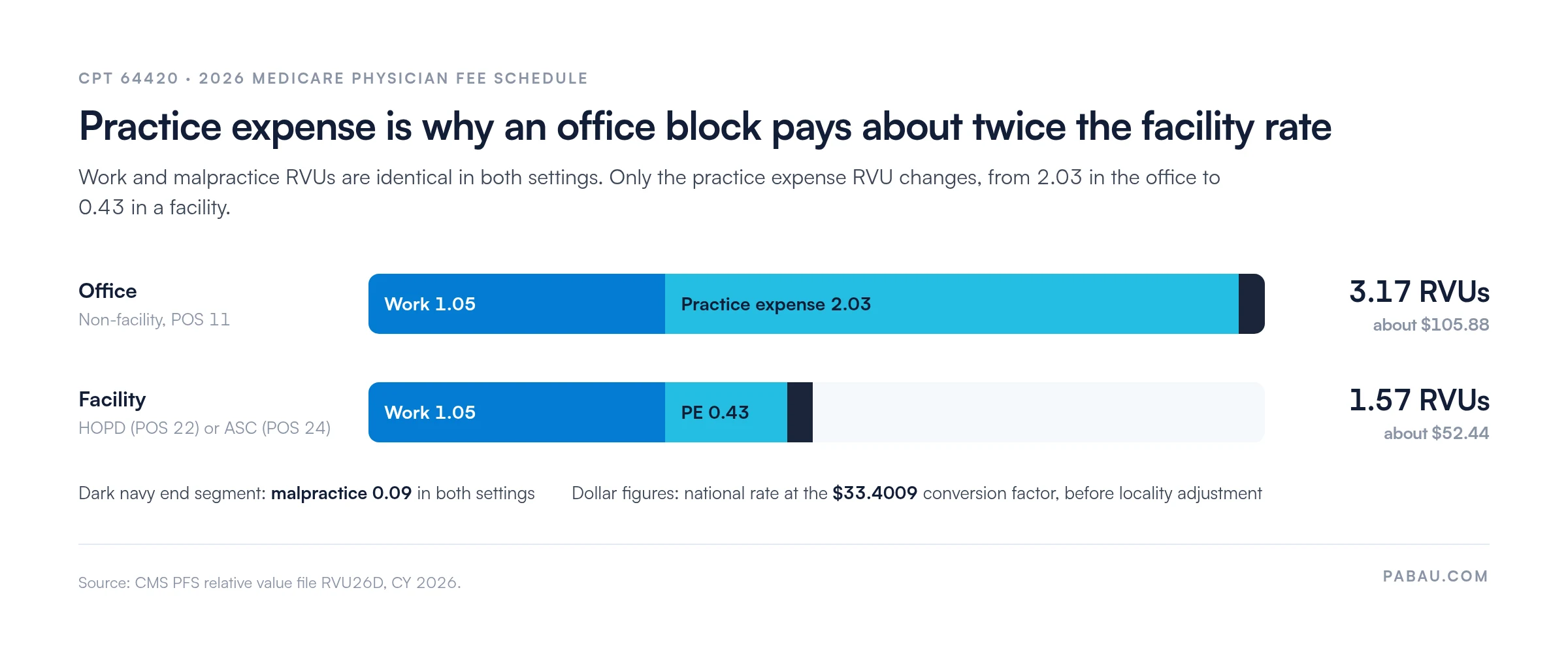
At the 2026 conversion factor of $33.4009, the national payment is about $105.88 in an office and $52.44 in a facility, before locality adjustment. In addition, qualifying APM participants are paid on a $33.5675 conversion factor, so their rates run slightly higher.
For example, when the block is done in a hospital outpatient department, the facility bills separately for the overhead and the physician receives the lower facility rate. Site of service therefore has direct revenue implications for pain management groups.
Prior authorization requirements for CPT Code 64420 depend on payer type and plan. No universal rule applies across Medicare, Medicaid, and commercial insurers, so verify with each payer before performing the procedure.
General patterns (verify with each payer and plan):
First, a prior auth request should include the specific diagnosis code and the planned number of levels, which justifies the 64421 units. Additionally, add evidence of conservative treatment failure. Finally, include a copy of the relevant imaging if available. Indeed, incomplete auth documentation leads to claims paid at zero even when auth is later approved verbally.
Every intercostal nerve block claim must be supported by a procedure note that contains specific elements. Auditors from CMS and commercial payers pull procedure notes when reviewing 64420 claims, and a generic “nerve block performed” note does not survive post-payment review. Therefore, structure your notes for clean claim submission by capturing every required field at the time of documentation.
Build a CPT 64420 billing checklist into your EHR procedure note template. Include the nerve level, agent and volume, image guidance (yes/no with interpretation), prior auth number, and POS code. Make each field required before the note can be signed. That closes off the most common documentation denials without adding time to the visit.
Intercostal nerve block claims deny for predictable reasons, and a pre-submission checklist catches most of them. In addition, each denial comes back with a reason code on the remittance, and our guide to medical billing denial codes explains how to work each one.
Many 64420 denials can be prevented at documentation and claim review, before the claim reaches a payer. As a result, practices that catch errors before submission spend less on rework and get paid faster.
Pabau, the practice management platform we build, raises the claim from the patient’s invoice. Specifically, it checks the claim for missing or invalid details before it leaves the practice. Its claims management software then submits claims electronically through Claim.MD and tracks ERAs and denial status.
For example, a claim missing a POS code or a diagnosis gets flagged before submission rather than weeks later on remittance. In addition, prior authorizations are stored as a case that follows the appointment to the claim. Finally, if a payer rejects the claim, Pabau marks it Needs action and shows the reason, so your biller can correct and resubmit. Our Claim.MD clearinghouse overview explains how that connection works.

Pabau checks each intercostal block claim for missing or invalid details, submits it through Claim.MD, and tracks denial status. Your team fixes problems before the payer sees them.

If you change one habit after reading this, make it level-by-level documentation. In fact, the 64420 unit, every 64421 add-on, and any 76942 charge all rest on a note that names each rib level. Overall, a strong note protects every line on the claim.
In short, the trade-off is a few extra seconds of charting per level against a denial that can take weeks to reverse. Additionally, recheck the MUE table each quarter and your MAC’s coverage policy whenever it is revised.
Therefore, Pabau checks each claim for missing details before it goes to Claim.MD, so documentation problems surface while you can still fix them. Book a demo to see how it handles your intercostal block claims.

Need to understand how clearinghouse validation works? Claim.MD clearinghouse overview explains real-time eligibility checks and ERA reconciliation for US payers.
Dealing with repeated claim rejections? Denial codes in medical billing covers CARC reason codes and how to respond to each one systematically.
Building a denial follow-up process? Denial management in healthcare walks through the causes of denials and how to prevent repeats.
Patients filing out-of-network claims themselves? What is a superbill? explains what the document must include for insurer reimbursement.
Want the bigger billing picture? Revenue cycle management explained walks through the end-to-end billing lifecycle from eligibility to payment posting.
CPT Code 64420 covers the injection of an anesthetic agent and/or steroid at a single intercostal nerve level. It is used for diagnostic or therapeutic blocks at one thoracic level and is reported by the physician who performs the injection. The code covers the injection itself, not any imaging guidance used during the procedure.
CPT 64420 is the base code for the first intercostal level injected. CPT 64421 is the add-on code listed separately for each additional level treated in the same session. Never report 64420 with more than one unit, and use 64421 for every level beyond the first. Modifier -51 is exempt for 64421.
It depends on the payer. Traditional Medicare generally does not require prior authorization for 64420 when medical necessity criteria are met on the claim. Many Medicare Advantage and commercial plans do require prior auth for nerve block procedures. Medicaid requirements vary by state. Verify with each specific plan before scheduling.
For 2026, the national Medicare rate for CPT 64420 is about $105.88 in an office and $52.44 in a facility, before locality adjustment. Office rates are higher because the physician carries the overhead. Use the CMS Physician Fee Schedule lookup tool to find the current rate for your MAC locality.



