ICD-10 code S42.134B: Nondisplaced coracoid process fracture, right shoulder, open
ICD-10 code S42.134B: Quick reference ICD-10 code S42.134B describes a nondispla...

Last Updated: Nov 3, 2026
Billable Code Specific Code
S24.114D is the billable ICD-10-CM code for complete lesion at T11-T12 level of thoracic spinal cord, subsequent encounter. It records a complete (AIS grade A) spinal cord injury at the T11-T12 cord level once active treatment has ended.
The code sits under S24.11, complete lesion of thoracic spinal cord. Assignment turns on three documented facts: a complete injury, a T11-T12 neurological level, and routine care during healing or recovery.
Let Pabau's smart automation suggest the right codes, reduce claim denials, and keep your practice compliant—effortlessly.
Automate repetitive tasks and focus on what matters most—your patients.
Reduce coding errors and ensure compliance with the latest regulations.
Clean claims, fewer denials, and faster reimbursements.
Powerful insights and reporting to help your practice thrive.
HIPAA compliant SOC 2 certified GDPR-compliant Trusted by 4,000+ clinics worldwide

S24.114D codes a complete lesion at the T11-T12 level of the thoracic spinal cord, subsequent encounter. Complete means AIS grade A, with no motor or sensory function below the lesion.
The T11-T12 level is the neurological (cord) level, not the fractured vertebra, so a T12 fracture alone never decides the code.
Seventh character D applies once active treatment has ended and the patient receives routine care during healing or recovery, including rehabilitation.
The record must name a complete injury, state the T11-T12 neurological level, and show that active treatment is over.
Pabau, the practice software we build, scrubs each claim before it reaches Claim.MD and flags rejections with the reason, so coding errors get fixed fast.
ICD-10 code S24.114D is the billable diagnosis code for a complete lesion at the T11-T12 level of the thoracic spinal cord, subsequent encounter. It sits in Chapter 19 of ICD-10-CM, under category S24, injury of nerves and spinal cord at thorax level.
The code describes a complete traumatic spinal cord injury in the lowest thoracic cord segments. The seventh character D shows that active treatment is over. The patient is now receiving routine care while the injury heals or recovers.
Inpatient rehabilitation facilities, outpatient rehabilitation teams, physiatrists, and the physicians who manage follow-up care typically report it. It is valid in the FY2027 code set, effective October 1, 2026, and must be reported with all seven characters.
Each character in S24.114D narrows the diagnosis. The table below translates the code into plain English, using the official ICD-10-CM tabular titles.
The sixth character works the same way across S24.1. The values are 1 for T1, 2 for T2-T6, 3 for T7-T10, 4 for T11-T12, and 9 for an unspecified level. Other injury codes follow the same build, and the diagnostic codes library breaks each one down by character.
A complete lesion means no motor or sensory function is preserved below the neurological level of injury. That includes the lowest sacral segments, S4-S5. Under the International Standards for Neurological Classification of Spinal Cord Injury (ISNCSCI), this is ASIA Impairment Scale (AIS) grade A.
Some patients keep partial function in a few segments just below the level. The examiner records this as the zone of partial preservation, and the injury is still complete. Any sacral sparing, by contrast, makes the injury incomplete (AIS B to D), which moves it out of S24.11.
A complete lesion at T11-T12 typically causes paraplegia. Leg movement and sensation are lost, while arm function and most trunk control remain. Neurogenic bladder and bowel are expected and shape much of the follow-up care.
A tabular note under category S24 states that S24.0 and S24.1 codes refer to the cord level, not the bone level. The level in S24.114D therefore comes from the neurological examination, not from the fracture on imaging.
The distinction matters at the thoracolumbar junction. In the lower thoracic spine, cord segments sit higher than the vertebrae with the same number. A T12 burst fracture can injure lumbar or sacral cord segments, which are coded in category S34, not S24.
Two more tabular rules apply. Code to the highest level of thoracic cord injury documented. Then code any associated fracture of a thoracic vertebra separately, such as S22.08-, fracture of T11-T12 vertebra.
The seventh character D is used after the patient has completed active treatment and is receiving routine care during the healing or recovery phase. That is the wording of the ICD-10-CM Official Guidelines for Coding and Reporting for Chapter 19.
The choice turns on the type of care, not on the provider. A new physician or facility does not reset the seventh character to initial encounter. The same guidelines also say aftercare Z codes are not used for injuries. Aftercare for this injury is reported with S24.114D itself.
The three seventh-character options for S24.114 are often confused. The table below matches each one to its clinical scenario.
S24.114D inherits the instructional notes of category S24. They tell the coder what else to report and what sits outside the category.
The CDC/NCHS ICD-10-CM browser tool and the official guidelines define which supporting codes travel with an injury code on a subsequent encounter.
Before you submit, check that the seventh character on the external cause code matches S24.114D. A D on the injury code and an A on the external cause code is a mismatch that edits can catch.
S24.114D sits beside codes that share its level or its lesion type, and those neighbors are easy to confuse. The table below compares it with its nearest neighbors, all subsequent encounter, using official CMS descriptors.
Three checks, run in order, settle which of these codes fits the record.
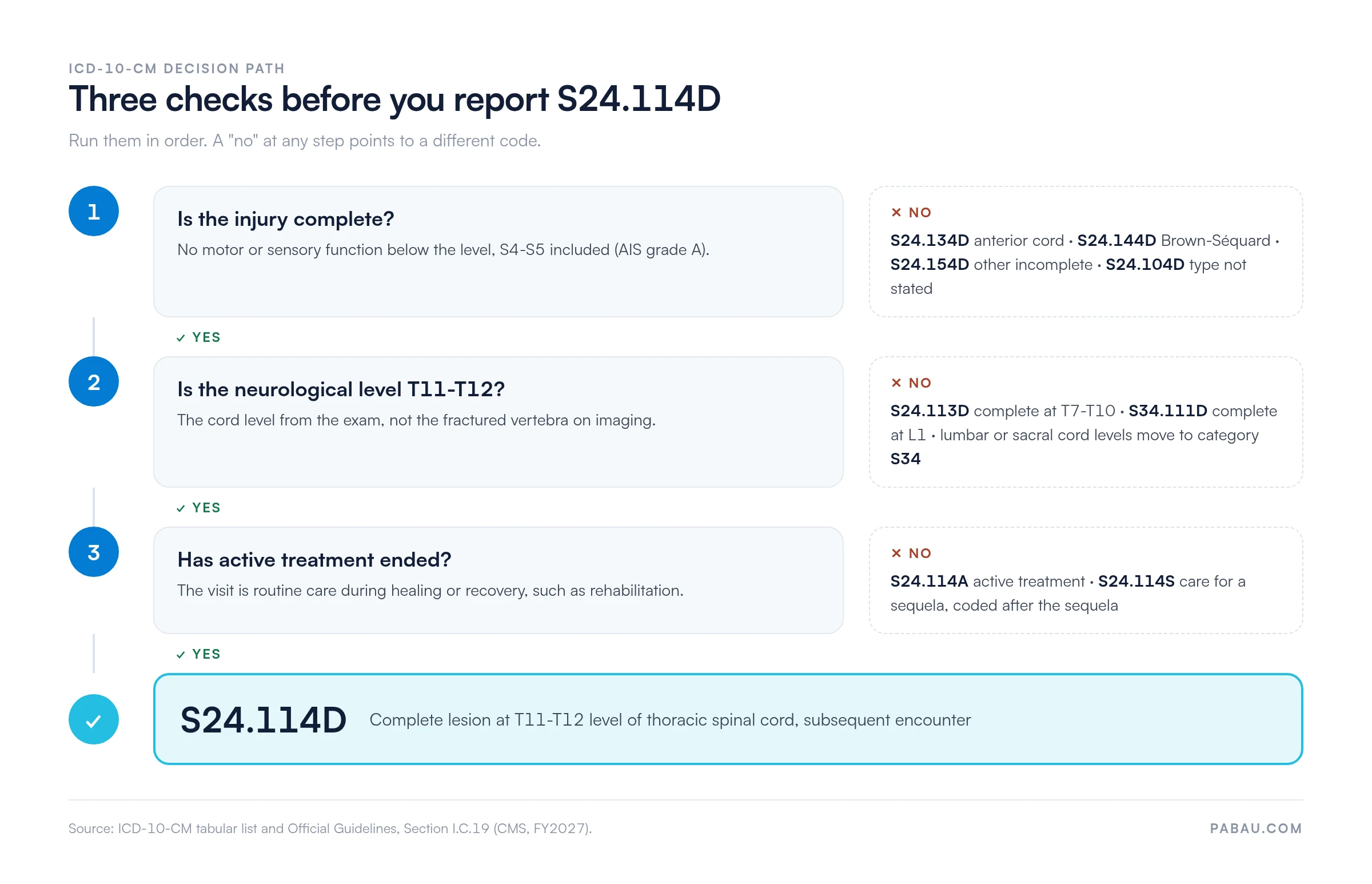
ICD-10-CM asks for the most specific code the record supports. S24.104D fits when the physician documents a cord injury at T11-T12 but never says whether it is complete.
If the record states a complete injury or AIS grade A at T11-T12, S24.114D is correct and S24.104D undercodes it. If the record is unclear, query the provider. Code assignment rests on the provider’s diagnostic statement, not on the coder’s reading of the exam.
A claim for ICD-10 code S24.114D needs a record that supports each part of the code. Auditors look for each of these elements. A grounding in medical billing fundamentals helps practices build records that hold up.
Medicare and commercial payers apply the standard Chapter 19 rules to S24.114D. Denial risk sits in three places. They are the seventh character, the level, and a lesion type the record does not support.
Inpatient rehabilitation facilities (IRFs) commonly bill S24.114D. Once acute care ends and the patient moves to rehabilitation, the injury code takes D, not A.
For IRF payment, the IRF-PAI impairment group drives the case-mix group. The etiologic diagnosis code should agree with it, so a complete paraplegia impairment group fits S24.114D. A mismatch between the two invites review.
Rehabilitation teams should confirm the neurological level and AIS grade before the first rehabilitation claim goes out.
These sources settle most S24.114D questions. Each one covers a different layer of the coding decision.
Spinal cord injury follow-up produces a long run of claims for the same diagnosis. When each one is checked by hand, one wrong seventh character can repeat across weeks of visits.
Pabau’s claims management software submits CMS-1500 claims through its Claim.MD clearinghouse integration. It scrubs each claim for missing or invalid details before it leaves Pabau. A rejected claim is flagged as needing action, with the reason shown, so your team can correct and resubmit it.
Payments then settle from electronic remittance advice files. Your billers spend less time chasing S24.114D claims and more time on the documentation that supports them.

Pabau scrubs each claim before it reaches Claim.MD and flags rejections with the reason, so S24.114D errors get fixed before they repeat.

S24.114D is narrow by design. It fits only a complete injury, at the T11-T12 cord level, after active treatment has ended. When the record proves all three, the code is easy to defend.
The risk sits in the inputs. A fracture level, a vague exam, or an A carried over from the hospital will each undo the claim. Settle the level and AIS grade at the first rehabilitation visit, and every claim after it inherits a clean diagnosis.
Pabau’s electronic remittance advice workflows show payer responses alongside the original claim, so a pattern across S24.114D claims is visible early. Book a demo to see how Pabau handles billing for spinal cord injury care.

Need a framework for reducing injury code denials? Denial codes in medical billing covers the most common CARC codes your team will see after an S24.114D rejection and how to address each one.
Billing for spinal cord injury patients across care transitions? Claim.MD clearinghouse overview explains how real-time eligibility verification and 837P submission work together to reduce front-end rejections.
Looking to verify payer eligibility before the encounter? Insurance eligibility verification outlines the pre-visit checks that prevent encounter-type mismatches and missing coverage issues on SCI claims.
S24.114D is the ICD-10-CM code for a complete lesion at the T11-T12 level of the thoracic spinal cord, subsequent encounter. It is used for routine care after active treatment ends, such as rehabilitation or follow-up visits.
A complete lesion means no motor or sensory function is preserved below the neurological level, including the S4-S5 sacral segments. That is AIS grade A. Any sacral sparing makes the injury incomplete and points to a different S24.1 code.
S24.114A covers encounters with active treatment of the injury. S24.114D covers routine care during healing or recovery after active treatment ends. S24.114S marks the injury as the cause of a sequela, which is coded first.
No. S24 codes follow the cord level, not the bone level. Use the neurological level from the examination, and code the vertebral fracture separately, for example with a code from S22.08-.
Anterior cord syndrome at the T11-T12 level, subsequent encounter, is S24.134D. At the T2-T6 level it is S24.132D. Anterior cord syndrome is an incomplete injury, so it is never coded as S24.114D.
Yes. Once active treatment ends, rehabilitation counts as routine care during recovery, so seventh character D applies. Aftercare Z codes are not used for injuries, which is why S24.114D itself goes on the claim.