ICD-10 Code S42.444P: Medial epicondyle fracture, right humerus
ICD-10 Code S42.444P: full descriptor and code validity ICD-10 Code S42.444P car...

Last Updated: Oct 13, 2026
Billable Code Specific Code
S21.141S is the billable ICD-10-CM code for puncture wound with foreign body of right front wall of thorax without penetration into thoracic cavity, sequela.
The seventh character "S" marks a sequela encounter. It applies only after the original wound has healed and the patient returns with a condition caused by that injury. Coders can confuse this code with S21.141A and S21.141D, or omit the companion code for the sequela condition. Both can trigger a claim edit, query or denial.
Let Pabau's smart automation suggest the right codes, reduce claim denials, and keep your practice compliant—effortlessly.
Automate repetitive tasks and focus on what matters most—your patients.
Reduce coding errors and ensure compliance with the latest regulations.
Clean claims, fewer denials, and faster reimbursements.
Powerful insights and reporting to help your practice thrive.
HIPAA compliant SOC 2 certified GDPR-compliant Trusted by 4,000+ clinics worldwide

S21.141S is the billable ICD-10-CM code for the sequela of a right front chest wall puncture wound with foreign body, without thoracic cavity penetration.
The seventh character ‘S’ applies only after the original wound has healed. Assigning it during active treatment can draw a payer query.
A companion code for the sequela condition (e.g. chronic chest wall pain, scarring, foreign body granuloma) is listed first, with S21.141S second.
If the wound entered the thoracic cavity, the correct sequela code is S21.341S, not S21.141S.
Pabau’s claims management software supports ICD-10-CM code submission and integrates with Claim.MD for US claim clearinghouse processing.
ICD-10 Code S21.141S has the official descriptor “Puncture wound with foreign body of right front wall of thorax without penetration into thoracic cavity, sequela.” Each element of that descriptor must be supported by documentation before the code can be reported.
If the original wound did enter the thoracic cavity, S21.141S is the wrong code. The penetrating equivalent is S21.341S, which sits in subcategory S21.3 rather than S21.1.
Every element must appear in both the original injury record and the current encounter note. Missing even one pushes the code toward a less specific alternative in the S21 category, which affects coding accuracy and reimbursement.
S21.141S sits in ICD-10-CM Chapter 19 (S00–T88, Injury, poisoning and certain other consequences of external causes). Breaking the code down character by character shows which clinical element each position encodes.
The sixth character carries laterality. S21.141S specifies the right anterior chest wall, and a left-side wound takes S21.142S instead. Confirm the side in the original injury record before reporting.
The seventh character “S” denotes a sequela encounter. The original injury has healed, and the patient now presents for a condition that exists as a direct result of it. This is distinct from active treatment (seventh character “A”) and routine healing follow-up (seventh character “D”).
Section I.B.10 of the ICD-10-CM Official Guidelines for Coding and Reporting covers sequela coding. It defines a sequela as the residual effect left once the acute phase of an injury has ended. It also sets the order: the sequela condition is coded first, and the injury code with “S” is sequenced second. Section I.C.19.a confirms that “S” is for complications or conditions arising as a direct result of an injury.
One sequela coding mistake to check for is assigning “S” while the wound is still under active treatment. If the record still references wound care, debridement or open-wound management, use “A.” Assign “S” only when the documentation states the wound has resolved.
S21.141S applies when a patient with a healed, non-penetrating puncture wound of the right anterior chest wall returns for a condition caused by that injury. The foreign body may have been removed at the time, or it may still sit in the chest wall soft tissue.
Common late-effect presentations that warrant this code:
Here is a worked example. Eight months after a glass shard punctured the right anterior chest wall, a patient reports a firm, painful nodule at the healed site. Imaging shows a small fragment in the subcutaneous tissue and no intrathoracic involvement.
The clinician documents a foreign body granuloma as a sequela of the injury. The coder reports L92.3 (foreign body granuloma of the skin and subcutaneous tissue) first, then S21.141S. Z18.81 (retained glass fragments) identifies the fragment still in place.
In every case, sequence the condition being treated today first and S21.141S second. The current condition drives the first-listed diagnosis, and S21.141S explains its origin.
Review the original encounter record before assigning S21.141S. If the prior record coded the wound as S21.141A, confirm that documentation from a later visit explicitly closes the wound and marks treatment complete. Without that bridge, the sequela link is unsubstantiated and the claim can draw a payer query.
Documentation decides whether a sequela claim holds up. For clean claim submission, the current encounter note must establish five specific elements:
If any of these five elements is absent, the coder should query the clinician before assigning S21.141S. Submitting without that support can draw a payer query or a request for records.
Several codes in the S21 category share most of the S21.141S descriptor but differ on one element. Picking the wrong one is a coding specificity error.
Two assignment errors are worth checking for. One is using S21.141S when the correct encounter type is “A” or “D.” The other is reaching for S21.101S when the record supports the full specificity of S21.141S.
The costliest mix-up is between subcategories S21.1 and S21.3. A wound that entered the pleural space or mediastinum belongs in S21.34-, so confirm penetration status before choosing. The four checks below run in the order a coder should apply them.
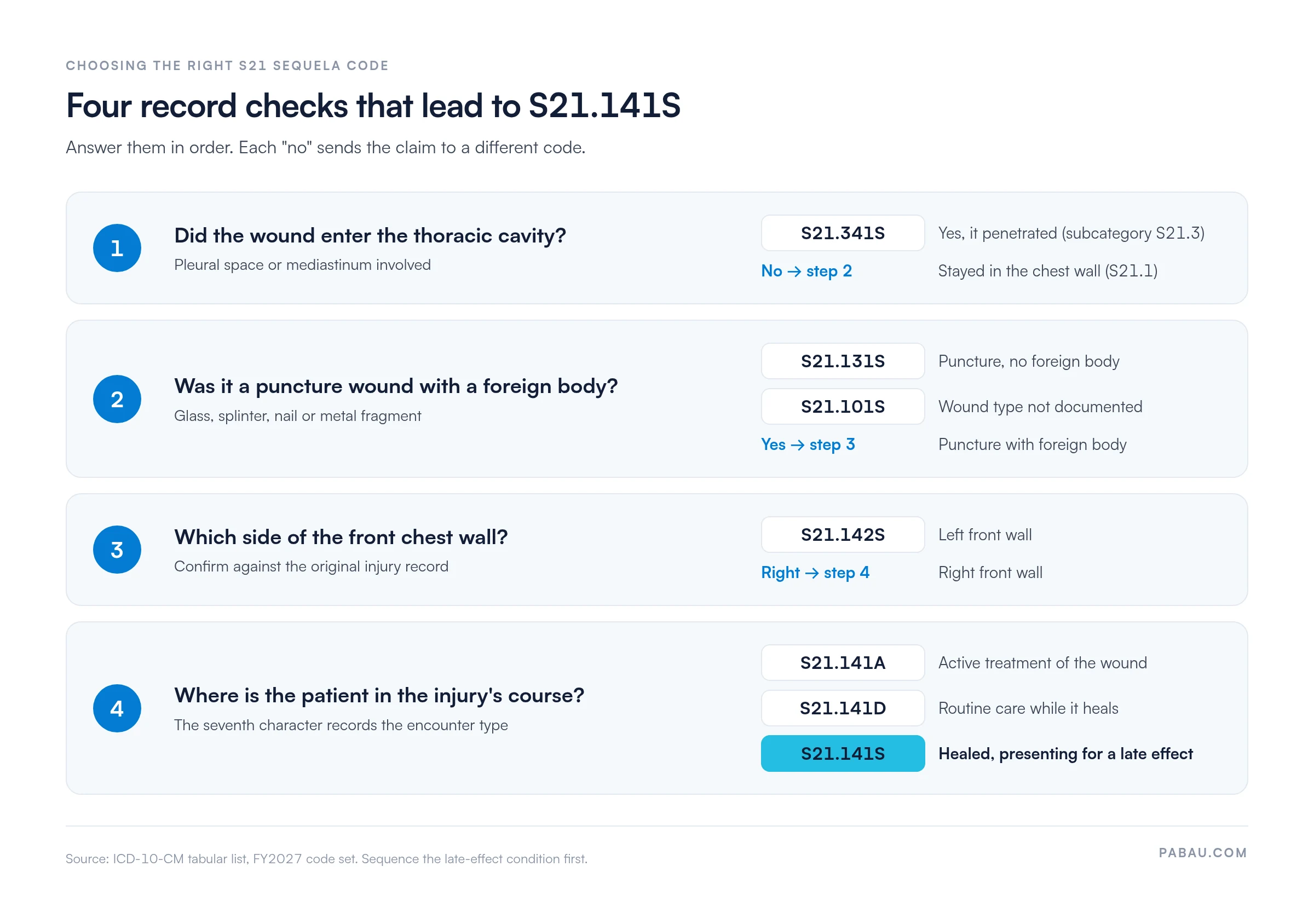
S21.141S inherits instructional notes from category S21 and from the S20–S29 block. Review each level in the current tabular list before assigning the code.
The Z18 retained foreign body codes deserve particular attention. If the foreign body is documented as still present at the current encounter, a Z18.- code adds precision and supports any related removal procedure.
When a practice reports external cause codes, Section I.C.20 asks for the same seventh character as the injury code. For a glass injury at the sequela stage, that means W25.XXXS (contact with sharp glass, sequela) alongside S21.141S.
Place of occurrence (Y92) and activity (Y93) codes work differently. They are reported once, at the initial encounter, so they do not return on a sequela claim. There is no national mandate for external cause reporting, but some states and payers require it.
S21.141S is a valid billable code in the FY2027 ICD-10-CM code set, effective October 1, 2026. Confirm it against the CMS ICD-10-CM coding files each year. Submitting it correctly depends on code sequencing, companion codes and payer-specific documentation expectations.
Key payer requirements:
Practices using claims management software with built-in ICD-10 validation can catch a missing companion code before submission. Pabau, the practice management platform we build, sends electronic claims through Claim.MD, its US clearinghouse partner. Claim.MD processes CMS-1500 claims across thousands of US payers and returns eligibility checks and ERA remittances. Building medical billing compliance into the claim itself costs less than appealing a denial later.

A sequela claim depends on a chain of causation that the record has to show. The patterns below are the likeliest reasons an S21.141S claim stalls, and each maps to a step in denial management in healthcare:
Reviewing the denial codes returned on S21.141S claims shows which of these patterns applies in a specific practice. CARC reason codes on the 835 remittance indicate whether the denial is a specificity issue, a missing code or a documentation deficiency.
Build a pre-bill checklist for S21.141S encounters. (1) Is the wound documented as healed? (2) Is the companion code for the sequela condition included? (3) Does the note state the current condition is caused by the prior injury? (4) Is laterality confirmed as right side? (5) Does the record confirm the wound did not enter the thoracic cavity?
S21.141S took effect with the US implementation of ICD-10-CM on October 1, 2015. It remains a billable code, with the same descriptor, in the FY2027 code set that took effect on October 1, 2026.
To verify current validity, coders can cross-reference the code against the CDC/NCHS ICD-10-CM web tool, which is updated each October. The AAPC Codify ICD-10-CM lookup and Check ICD-10 are commercial tools that mirror the official CMS and NCHS data.
Understanding medical billing fundamentals, including the annual update cycle, helps coders avoid submitting a revised or deleted code. Check the current tabular list at the start of each fiscal year, as the S21 category can gain specificity when the code set is updated.
Coding S21.141S correctly depends on facts recorded months apart. The coder needs the original wound type, the foreign body, the side, the penetration status and the date the wound healed. In many practices those details sit in separate notes, scanned letters and old claims.
Pabau keeps clinical notes, past diagnoses and claims on one patient record. A coder reviewing a sequela visit can open the original injury note next to today’s encounter.
Code validation and Claim.MD submission then flag a missing companion code before the claim goes out. Your team then spends less time rebuilding the injury story after a denial.

Pabau integrates scheduling, clinical notes and billing in one system, so coders and clinicians have the documentation they need before a claim is submitted.

S21.141S rests on one distinction above the others. The puncture stayed in the chest wall and never entered the thoracic cavity. When the record cannot show that, query the clinician before coding, because S21.341S may be the correct code.
Once penetration status is settled, the rest is a short sequence. Confirm the right side and the healed wound, then list the late-effect condition ahead of S21.141S. To see how Pabau handles ICD-10-CM claim submission end to end, book a demo with the team.

Need to understand how claim denials are managed after submission? Denial management in healthcare covers the end-to-end process for identifying, appealing, and preventing recurring denials.
Coding a left-side chest wall wound at the sequela stage? ICD-10 Code S21.102S covers the unspecified open wound of the left front wall of thorax, sequela.
Want fewer claims sent back for missing details? What makes a clean claim walks through the fields and checks payers expect before they pay.
Want to reduce billing errors at the point of claim build? Claims management software from Pabau includes built-in code validation and direct payer submission tools.
ICD-10 Code S21.141S is the billable code for a puncture wound with foreign body of the right front chest wall, sequela. The wound did not penetrate the thoracic cavity. The code is used once the wound has healed and the patient presents for a late effect of that injury.
Yes. S21.141S is a valid billable ICD-10-CM code in the FY2027 code set, effective October 1, 2026. It is sequenced after a companion code that identifies the specific sequela condition.
S21.141A is for initial encounters during active wound treatment. S21.141D is for subsequent encounters during the healing phase, and S21.141S is for sequela encounters after the wound has fully healed. The injury descriptor is identical across all three, and only the seventh character changes.
“S” applies when the wound is fully healed and the patient presents for a condition caused by the injury, such as chronic pain or scarring. “D” applies while the wound is still healing and the patient receives routine follow-up care. If the wound is under active treatment, use “A” instead.
Yes. Section I.B.10 of the ICD-10-CM Official Guidelines requires the sequela condition to be coded first, with S21.141S second. Common companion codes include R07.89 for chest wall pain, L90.5 for scar conditions and L92.3 for a foreign body granuloma. Add a Z18.- code if a fragment remains.
The likeliest problems are using “S” during active treatment, leaving out the companion code and lacking a documented link to the prior injury. Coding S21.141S for a wound that entered the thoracic cavity, which belongs under S21.341S, is another. Laterality errors and using S21.101S when the record supports S21.141S also stall claims.
Use S21.341S, puncture wound with foreign body of right front wall of thorax with penetration into thoracic cavity, sequela. S21.141S covers only wounds that stayed within the chest wall.