ICD-10 code S12.591B: Nondisplaced C6 fracture, open
ICD-10 code S12.591B: Definition and billable status ICD-10 code S12.591B is the...

Last Updated: Nov 2, 2026
Billable Code Specific Code
S20.01XS is the billable ICD-10-CM code for contusion of right breast, sequela. You report it when a patient returns for a condition caused by an earlier right breast bruise, after active treatment has ended. Persistent breast pain, fat necrosis and firm scar tissue are the usual reasons for that visit.
The X holds the sixth position, so the code is invalid without it. S20.01XS records the cause, so the residual condition goes first on the claim.
Let Pabau's smart automation suggest the right codes, reduce claim denials, and keep your practice compliant—effortlessly.
Automate repetitive tasks and focus on what matters most—your patients.
Reduce coding errors and ensure compliance with the latest regulations.
Clean claims, fewer denials, and faster reimbursements.
Powerful insights and reporting to help your practice thrive.
HIPAA compliant SOC 2 certified GDPR-compliant Trusted by 4,000+ clinics worldwide

S20.01XS is the billable ICD-10-CM code for contusion of right breast, sequela, and it needs all seven characters to be valid.
The X in the sixth position is a required placeholder, because the S20.01 subcategory has only five characters.
The S suffix marks a sequela visit for a condition left by the bruise, not routine follow-up while the bruise heals.
The residual condition, such as breast pain or fat necrosis, is listed first, and S20.01XS follows it as the cause.
Laterality sits in the subcategory: S20.01 is the right breast, S20.02 the left, and S20.00 an unspecified breast.
ICD-10 Code S20.01XS is the billable ICD-10-CM code for contusion of right breast, sequela. You assign it when a patient is seen for a condition left by an earlier right breast bruise. By then, the bruise itself is no longer being treated.
The code is valid in the FY2027 ICD-10-CM code set, which runs from October 1, 2026, to September 30, 2027. Each character segment confirms one fact about the encounter.
S20.01 on its own is not a billable code, and neither is S20.01S. The ICD-10-CM Official Guidelines from CMS require the X placeholder wherever a code has fewer than six characters and needs a 7th character. A claim with the truncated code is rejected as invalid before it reaches the payer.
You can confirm the descriptor and its validity in the CDC/NCHS ICD-10-CM browser tool. Check it again after each October 1 update.
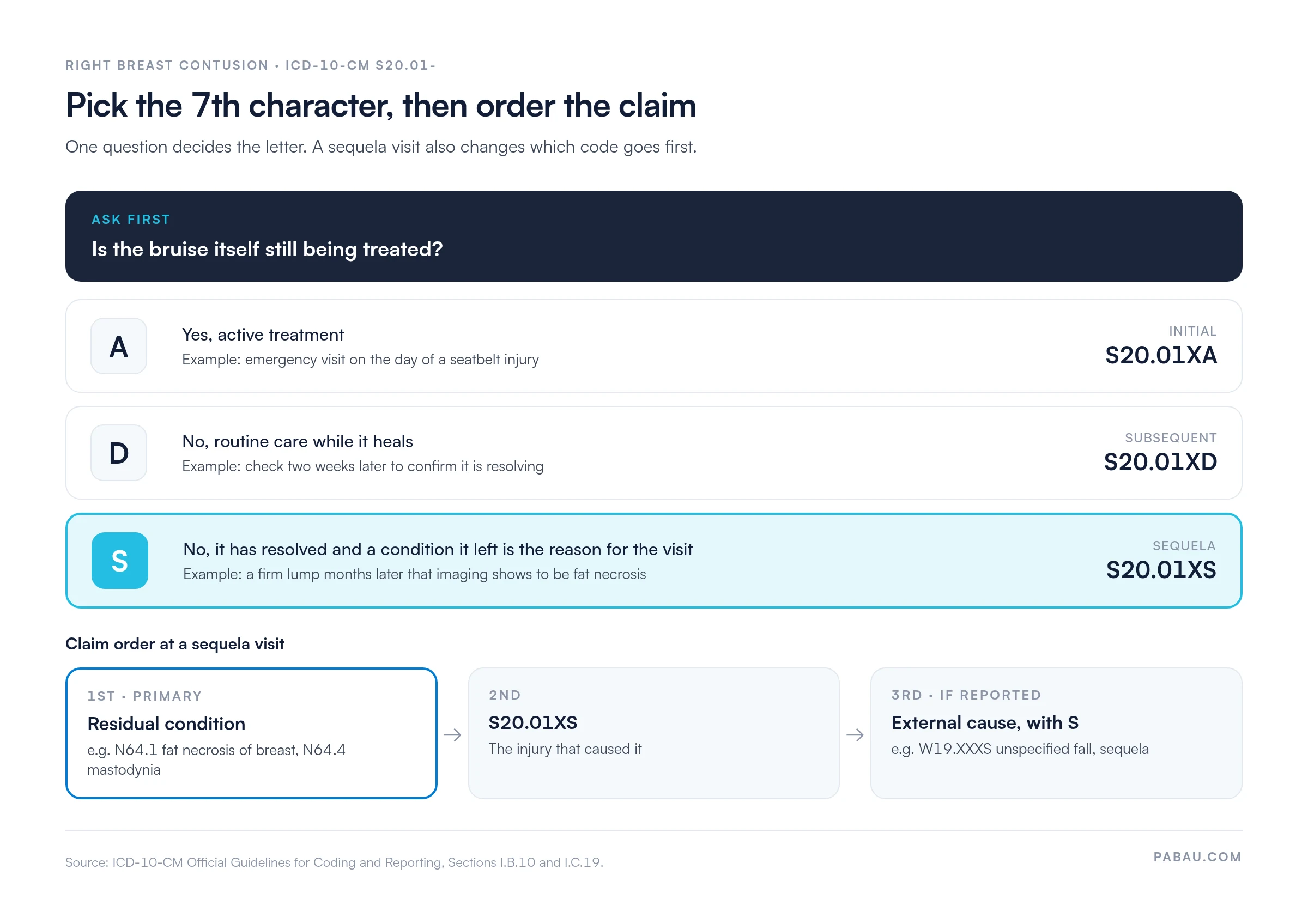
The 7th character tells the payer what kind of encounter this is. The S20 category takes three values, and the choice turns on whether the bruise itself is still being treated.
Section I.C.19.a of the official guidelines adds the S only to the injury code, never to the code for the residual condition. Section I.B.10 sets no time limit on sequela coding. A sequela visit can come one month or several years after the injury, as long as the provider documents the link.
The path below puts the three choices side by side and shows how the claim is ordered once S applies.
S20.01XS sits in subcategory S20.0, Contusion of breast. The siblings below differ by laterality or by encounter type, and both choices come straight from the note.
Do not confuse this code with S20.142S, which describes external constriction of part of the left breast, sequela. That code sits in subcategory S20.14 and covers a different injury on the other side.
The notes at the block and category level decide which other codes can appear with S20.01XS. Most of them point to injuries coded elsewhere in Chapter 19.
An Excludes2 note means the excluded condition is not part of this code. Both codes can appear on one claim when the patient has both conditions.
A sequela claim never carries S20.01XS on its own. It needs the code for the condition being treated and, where your payer or state requires it, an external cause code.
These are common reasons a patient returns after a breast bruise. Code the condition the provider documents, not the one that seems most likely.
External cause codes from Chapter 20 describe how the injury happened. At a sequela visit, they take the same S 7th character as the injury code.
Place of occurrence (Y92), activity (Y93) and external cause status (Y99) codes are reported only once, at the initial encounter. Leave them off the sequela claim. No national rule requires external cause codes, but many payers and state reporting programs ask for them.
The order of the codes tells the payer why the patient was seen. Follow this order on every sequela claim for a clean claim submission:
Putting S20.01XS first is the most common sequencing error on these claims. The payer then sees a bruise as the main diagnosis with no active treatment for it, and the claim can be denied for medical necessity.
The record must support three facts: the injury was a contusion, it was on the right breast, and it caused the condition treated today. Without all three, the code will not hold up in an audit. This checklist follows standard medical billing compliance requirements:
Query the provider whenever the note mentions the earlier injury but does not link it to today’s complaint. A coder should never infer the link from timing or location alone.
Before you code a sequela visit, ask one question: is the bruise itself still being treated? If yes, it is an A or D encounter. If the bruise has resolved and something it left behind is the reason for the visit, code that condition first and add S20.01XS.
Most denials on this code trace back to the 7th character, the sequencing, or a missing causal statement. These patterns come up in denial management workflows for sequela claims.
Track these against your medical billing denial codes to see which error recurs in your practice. A repeat pattern usually points to a template or training fix.
Medicare has no coverage policy specific to breast contusion sequela codes. The official guidelines on sequela coding apply, and the residual condition must meet the usual medical necessity standard.
Commercial payers set their own rules for sequela visits. Check each payer’s policy in its provider portal before you bill the visit.
Sequela claims fail on details that are easy to miss when the note, the codes and the claim live in different places. A coder has to cross-check the 7th character, the sequencing and the causal statement by hand.
Pabau, the practice management and billing platform we build, keeps the visit note, the diagnosis codes and the claim in one patient record. Its claims management software scrubs every claim for missing or invalid details before it leaves Pabau. Claims then go out electronically through the Claim.MD clearinghouse.
The outcome is fewer rejected claims to rework, so your team spends less time on appeals.
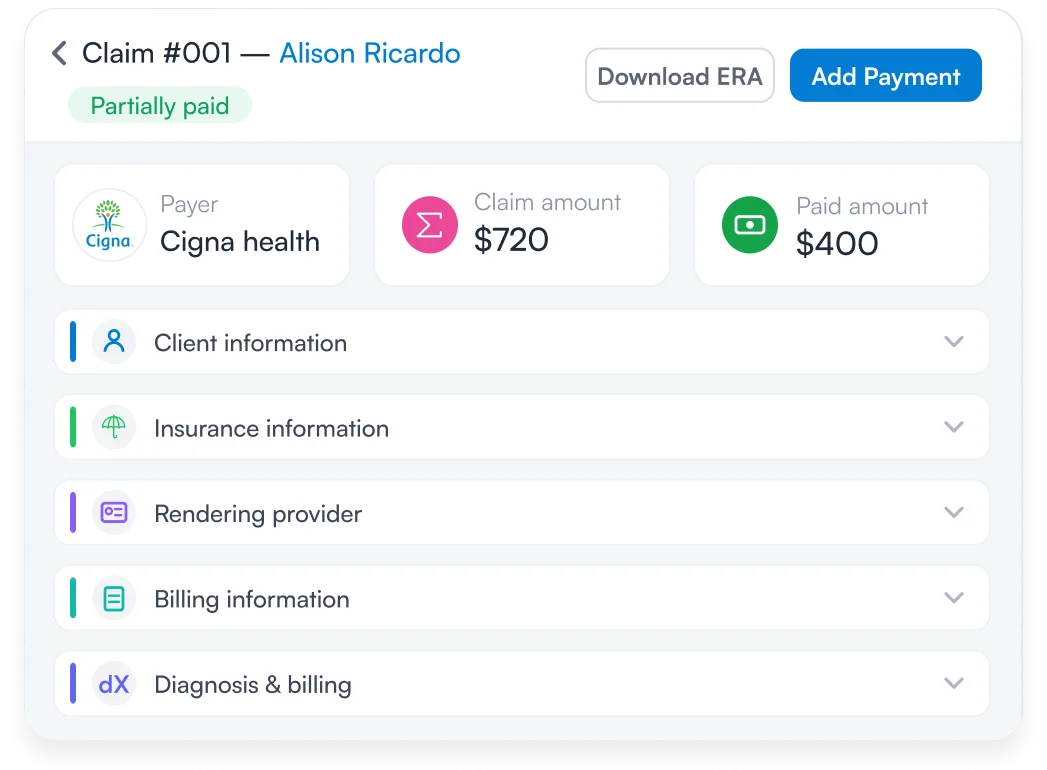

Pabau keeps the visit note, the diagnosis codes and the claim in one record. Every claim is scrubbed for missing or invalid details before it leaves Pabau.

S20.01XS is simple to code once the note does its job. Confirm the bruise has resolved, name the condition it left behind, and list that condition first. Then check that the X placeholder and the S are both in place.
The checks that matter happen before the claim is built, when a coder can still query the provider. Book a demo to see how Pabau keeps your sequela notes, codes and claims in one place.

Want to understand what goes into a clean claim? Medical billing fundamentals outlines the end-to-end process from encounter documentation through payment posting.
ICD-10 Code S20.01XS means contusion of right breast, sequela. It is used when a patient is seen for a condition caused by an earlier right breast bruise, such as persistent pain or fat necrosis. The S marks a sequela encounter, which differs from initial (A) and subsequent (D) encounters.
Yes, S20.01XS is a billable ICD-10-CM code in the FY2027 code set. It is valid only with all seven characters. S20.01 and S20.01S are not valid and will be rejected.
The X is a placeholder that fills the sixth position. Subcategory S20.01 has only five characters, and the 7th character must sit in the seventh position. Without the X, the code is invalid.
A subsequent encounter (D) covers routine care while the bruise heals after active treatment ends. A sequela encounter (S) applies when the bruise has resolved and a condition it caused is the reason for the visit. At a sequela visit, the residual condition is coded first.
S20.02XS is contusion of left breast, sequela, so the only difference is the side. In subcategory S20.0, the fifth character 1 means right and 2 means left. Match the code to the side named in the note.
List the residual condition first, such as N64.4 for breast pain or N64.1 for fat necrosis. S20.01XS follows as the cause. If your payer requires an external cause code, add one with the S 7th character, such as W19.XXXS for a fall.