ICD-10 code S12.591B: Nondisplaced C6 fracture, open
ICD-10 code S12.591B: Definition and billable status ICD-10 code S12.591B is the...

Last Updated: Nov 2, 2026
Billable Code Specific Code
S21.331D is the billable ICD-10-CM code for puncture wound without foreign body of right front wall of thorax with penetration into thoracic cavity, subsequent encounter.
Use it at follow-up visits after initial treatment, such as wound checks, suture removal, or dressing changes. The note must document a puncture, the right front chest wall, penetration into the thoracic cavity, no foreign body, and a follow-up visit.
Let Pabau's smart automation suggest the right codes, reduce claim denials, and keep your practice compliant—effortlessly.
Automate repetitive tasks and focus on what matters most—your patients.
Reduce coding errors and ensure compliance with the latest regulations.
Clean claims, fewer denials, and faster reimbursements.
Powerful insights and reporting to help your practice thrive.
HIPAA compliant SOC 2 certified GDPR-compliant Trusted by 4,000+ clinics worldwide

ICD-10 Code S21.331D covers a puncture wound without foreign body of the right front chest wall that penetrates the thoracic cavity, at follow-up encounters only.
The 7th character D means healing-phase care is continuing. Switch to S21.331S only for a late effect of the healed wound, never for routine wound checks.
The note must state the wound type, the front-wall site and side, and penetration into the thoracic cavity. It must also confirm no foreign body and a follow-up visit.
Pabau, the practice management platform we build, submits ICD-10-CM claims through Claim.MD and checks eligibility, which cuts preventable denials on follow-up codes like S21.331D.
ICD-10 Code S21.331D is the billable code for a follow-up visit after a right front chest wall puncture with no foreign body. The wound must have penetrated the thoracic cavity.
Each of its seven characters carries a specific clinical meaning. Coders who parse them one by one are far less likely to pick an adjacent code or the wrong encounter type.
The laterality digit is where coders most frequently slip. The digit 1 in position 6 specifies the right side of the anterior thorax. When the clinical note documents the left side, S21.332D applies. When laterality is genuinely unspecified in the provider note, S21.339D is the fallback. Even then, query the provider before defaulting to unspecified.
The S21 category covers all open wounds of the thorax within the broader S20-S29 injuries-to-the-thorax block. The hierarchy explains why S21.331D never fits back-wall wounds, lacerations, wounds with a foreign body, or wounds that stop short of the cavity.
Within S21.33, the six-character code S21.331 specifies the right front wall. S21.332 covers the left front wall, and S21.339 is the unspecified-side option. Each then takes a 7th character (A, D, or S) to complete the billable code.
The 7th character for wound coding marks the phase of patient care, not the severity of the injury. The CMS ICD-10-CM Official Guidelines for Coding and Reporting tie the encounter type to the nature of the visit. Seeing a different provider from the one who first treated the wound does not change it.
S21.331A applies as long as the provider is actively treating the wound itself. That covers irrigation, initial closure, debridement, or the first evaluation of the injury.
Once active treatment ends and the patient returns for healing-phase care, S21.331D takes over. S21.331S is reserved for a healed wound that has caused a new problem, such as a scar needing revision or neuropathic pain at the site.
Five conditions must all be true to support ICD-10 Code S21.331D. If any one of them fails, a different code applies.
The path below adds laterality as a sixth check and shows the code each “no” answer leads to.
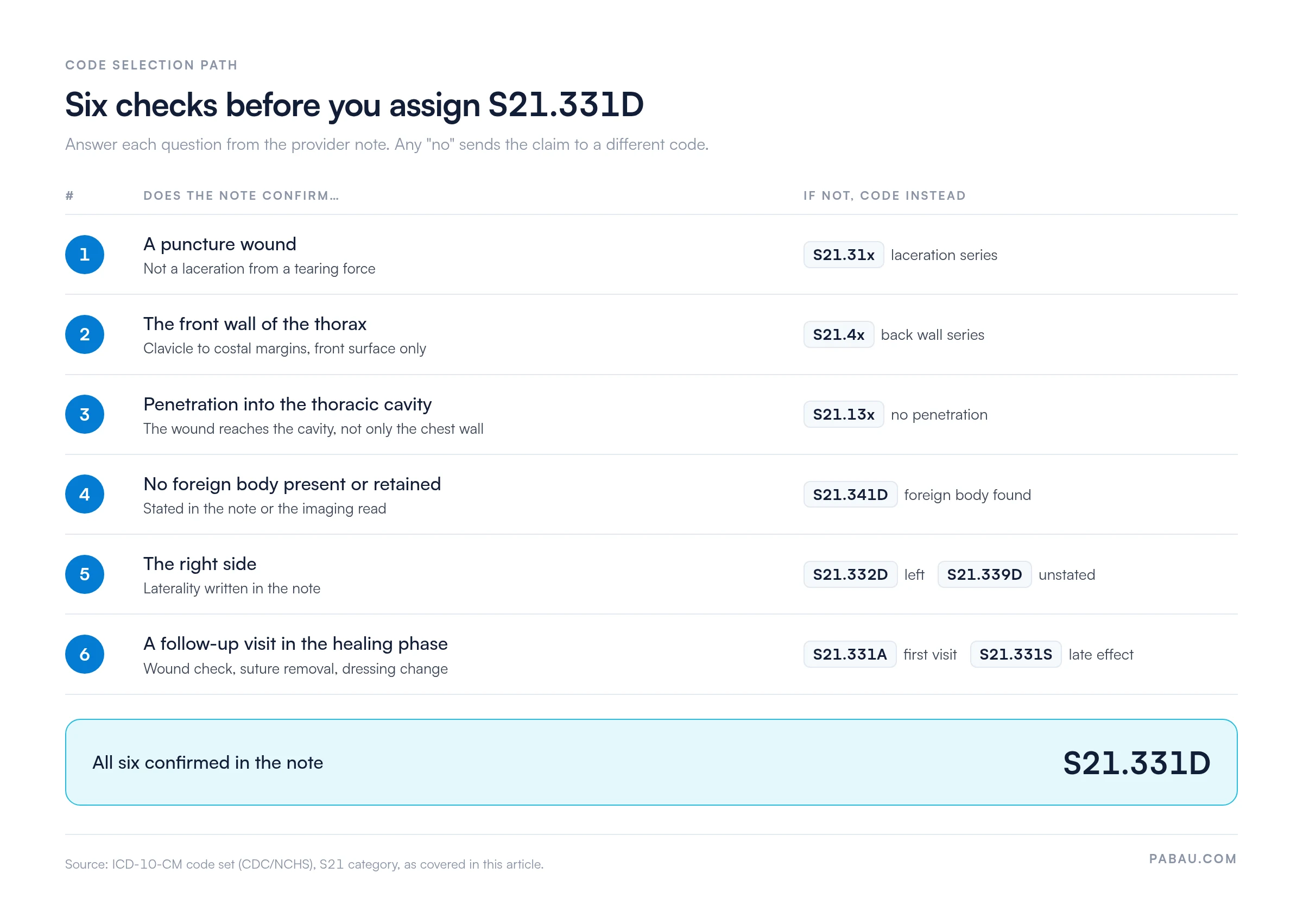
The S21.33x family sits close to codes that differ by wound type, wall location, depth, laterality, or encounter type. The table below covers the codes most often confused with S21.331D in coder audits.
When a note reads ‘chest wound follow-up,’ query the provider before you pick a code. Ask for the wound mechanism (puncture or laceration), the wall (front or back), whether it reached the thoracic cavity, and the foreign body status. Each answer moves the claim to a different branch of the S21 family.
The provider note must back up each of the five clinical conditions above. Coders, not providers, assign the 7th character, and they assign it from the documentation.
The note therefore has to make the encounter type unambiguous. Vague notes lead to wrong-character codes and, later, to denials or audit findings. Strong medical billing compliance programs flag notes missing any of these elements before claims go out.
Medicare and most commercial payers require medical necessity documentation for subsequent wound-care encounters. The number of covered follow-up visits for this wound is payer-specific. It varies by Local Coverage Determination (LCD), and no universal visit count applies. Practices should verify coverage under the applicable LCD before billing multiple subsequent encounters for routine wound management.
For outpatient office visits, S21.331D supports an E&M code or a wound-care procedure code. Billing the diagnosis without either one is a common trigger for medical necessity denials. Place of service also matters. Home health agencies, hospital outpatient departments, and emergency departments each have separate billing rules for wound follow-up care.
Most denials on ICD-10 Code S21.331D are preventable. They fall into a short list of repeating patterns, each with a clear correction path. A structured denial management workflow catches them before they become write-offs.
The medical billing denial codes on the remittance advice tell you which pattern you’re dealing with. Corrections can then target the root cause instead of a blanket resubmission.
Run a monthly audit of every S21.331D claim. Check that the initial encounter used S21.331A and that an E&M or procedure code accompanies each claim. Also flag any S21.331D claim whose date of service matches the documented date of injury. A pre-submission review catches all three before a payer does.
For most subsequent wound-care encounters, ICD-10 Code S21.331D is the principal diagnosis, meaning the condition chiefly responsible for the visit. External cause codes from Chapter 20 can sit alongside it to describe how the injury happened.
Per Chapter 20 of the ICD-10-CM Official Guidelines, external cause codes report the mechanism, place of occurrence, activity, and patient status for injury encounters. These codes are listed as secondary to the injury code.
The guidelines set no national requirement to report them, but some state mandates and payer policies do. Check the applicable payer policy before leaving them off.
If imaging at a subsequent encounter reveals a retained foreign body that was not identified during initial treatment, the diagnosis code must change.
Switch from S21.331D to S21.341D, the puncture-with-foreign-body code for the right front wall, and document the finding clearly in the note. Don’t record it as an addendum to the original encounter. It is a new clinical finding at the current visit.
On a follow-up wound visit, the coder picks the 7th character from the note, and the payer judges it weeks later. When the two disagree, the practice learns about it from a denial and reworks the claim by hand.
Pabau sends ICD-10-CM claims, S21.331D included, through Claim.MD, its US clearinghouse partner. Its claims management software runs real-time eligibility checks before a claim goes out. Electronic remittance advice then shows exactly why a payer rejected one.
Submitting a clean claim the first time saves the appeal work that encounter-type confusion creates. A structured medical billing workflow also captures external cause codes at every injury encounter, not only at the first visit.
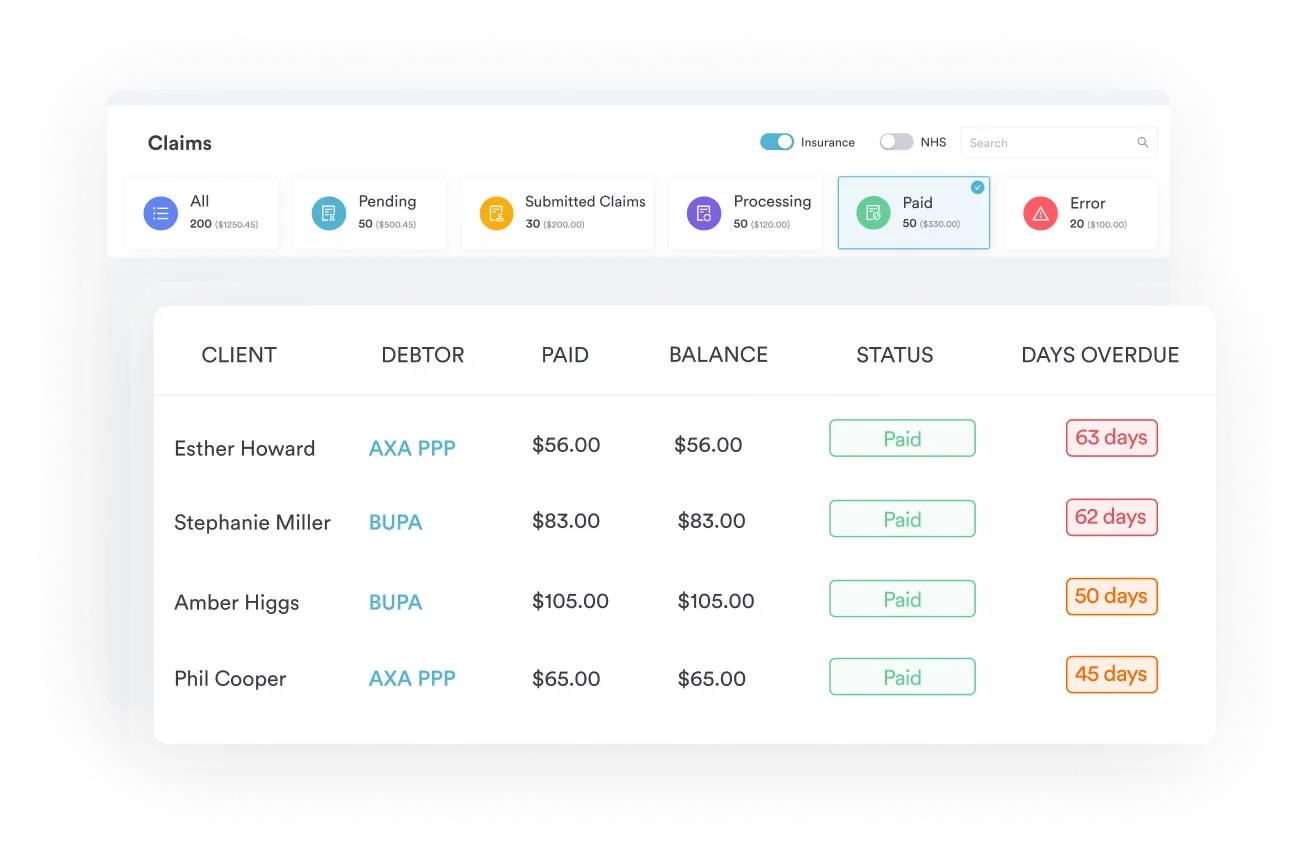

Pabau integrates with Claim.MD to support electronic ICD-10-CM claim submission, real-time eligibility verification, and ERA retrieval. Wound care and trauma practices use it to cut denials on subsequent-encounter codes.

S21.331D is easy to assign and easy to get wrong, because one missing statement in the note changes the code. Treat the five clinical conditions and the side as a checklist the note must pass before the claim goes out.
The trade-off is a few extra provider queries on vague notes. Those cost minutes, while a corrected claim and an appeal cost weeks of delayed payment.
Book a demo to see how Pabau tracks S21.331D follow-up claims from submission to payment, so 7th-character errors get fixed before they turn into write-offs.

Want to understand the clearinghouse behind your ICD-10 submissions? Claim.MD clearinghouse overview explains how electronic claim routing, eligibility checks, and ERA retrieval work together.
Looking for a reference on superbill requirements for wound encounters? Superbill guide covers what diagnosis and procedure codes must appear together for a clean claim submission.
ICD-10 Code S21.331D is the billable code for a follow-up visit after a puncture wound without foreign body of the right front chest wall. The wound must have penetrated the thoracic cavity. Use it once initial treatment has been coded with S21.331A.
S21.331A applies at the first encounter where active treatment is delivered, such as the emergency visit, urgent care, or initial office evaluation. S21.331D applies at each later visit for healing-phase wound management, such as wound checks, suture removal, or dressing changes. The deciding factor is the nature of the current visit, not whether a different provider sees the patient.
S21.331D is used while the wound is still healing and the patient returns for wound care. S21.331S is used once the wound has healed and the patient presents with a condition it caused. Examples include scar contracture, persistent numbness, or chronic pain at the site. Using S21.331S during the healing phase is a coding error.
The provider note must document five elements. It names the wound as a puncture, not a laceration, and places it on the right front wall of the thorax. It confirms penetration into the thoracic cavity and that no foreign body is present or retained. It also shows the visit is a follow-up, not an initial encounter. If any element is missing, query the provider before assigning the code.
The most common triggers are assigning D at the initial encounter, where A belongs, and billing the diagnosis without an E&M or procedure code. Others are using S21.331D for a left-side wound, which takes S21.332D, and leaving foreign body status or penetration unconfirmed. Each has a direct correction path in the denial table above.
Yes. S21.331D is valid across care settings, including outpatient offices, hospital outpatient departments, and inpatient facilities. The accompanying procedure code differs by setting. Outpatient claims use CPT or E&M codes, while inpatient claims use ICD-10-PCS procedure codes. The diagnosis code itself stays the same.
If imaging or an exam at a follow-up visit reveals a retained foreign body missed at first, the code changes to S21.341D. That is the code for a puncture wound with foreign body of the right front wall, subsequent encounter. Document the new finding in the current encounter note, and don’t backdate the change to the original visit.