ICD-10 Code S52.101P: Right radius fracture with malunion
ICD-10 Code S52.101P: definition and code details ICD-10 Code S52.101P is a bill...

Last Updated: Oct 19, 2026
Billable Code Specific Code
S45.001A is the billable ICD-10-CM code for unspecified injury of axillary artery, right side, initial encounter. It applies when the record confirms a right axillary artery injury during active treatment but does not name the injury type.
Assignment turns on three points: the axillary artery rather than the brachial, a documented right side, and active treatment at the encounter. A documented laceration moves the code to S45.011A, and another named injury moves it to S45.091A.
Let Pabau's smart automation suggest the right codes, reduce claim denials, and keep your practice compliant—effortlessly.
Automate repetitive tasks and focus on what matters most—your patients.
Reduce coding errors and ensure compliance with the latest regulations.
Clean claims, fewer denials, and faster reimbursements.
Powerful insights and reporting to help your practice thrive.
HIPAA compliant SOC 2 certified GDPR-compliant Trusted by 4,000+ clinics worldwide

S45.001A is a billable ICD-10-CM code, valid for FY2026 and FY2027, for right axillary artery injuries where the record does not specify the injury type.
The 7th character A marks the initial encounter, meaning active treatment. Switching to D or S without updating the clinical record is a frequent denial trigger.
S45.001A and S45.002A are not interchangeable, because the right vs left distinction needs explicit laterality in the operative or imaging report.
Report external cause codes where a payer requires them. Pabau’s claims management software sends claims to Claim.MD and tracks their status, while code review stays with your coder.
ICD-10 code S45.001A is the billable code for an unspecified injury of the right axillary artery at the initial encounter, during active treatment. It sits in category S45, injury of blood vessels at shoulder and upper arm level. The table below lists each attribute a coder checks before submitting.
S45.001A applies when the documented injury involves the right axillary artery and the clinical record does not specify the injury subtype. No operative note or imaging report uses language like “laceration,” “rupture,” or “spasm.” The word “unspecified” in the descriptor does not signal a documentation failure. It is the correct code when the record cannot characterize the injury further.
Anatomically, the axillary artery runs from the lateral border of the first rib to the inferior border of the teres major muscle. Beyond that point it continues as the brachial artery. Injuries coded under S45.001A typically arise from these mechanisms:
If the operative report does identify a laceration, use S45.011A (laceration of axillary artery, right side, initial encounter) instead. Code to the highest specificity the documentation supports. S45.001A is the fallback only when the record holds no more detail on the injury type.
The 7th character in the ICD-10-CM injury code system signals the episode of care, not the nature of the injury. For S45.001A, getting this character wrong is a frequent denial trigger.
Per the CMS ICD-10-CM guidelines, “initial encounter” means the patient is receiving active treatment, not simply the first time a provider sees them. Take a vascular surgeon who first sees the patient two weeks post-injury and is still managing the repair. That visit still takes A in the 7th position, because treatment is ongoing. The switch to D happens when active treatment ends and the visit is purely for monitoring routine healing.
The parent-to-child hierarchy helps coders navigate the tabular list and shows why S45.001A is billable while its immediate parents are not.
Submitting S45.001 (without the 7th character) is a common error that causes automatic rejection. Payers require a code at the full level of specificity the code system provides. S45.001 is a header code that needs a 7th character (A, D or S) before it can be submitted.
The S45.0 subcategory contains several codes that are easy to confuse. Laterality and specificity errors are the usual reasons a claim lands on the wrong one. The decision path below shows how the injury type, the side and the encounter combine into one code.
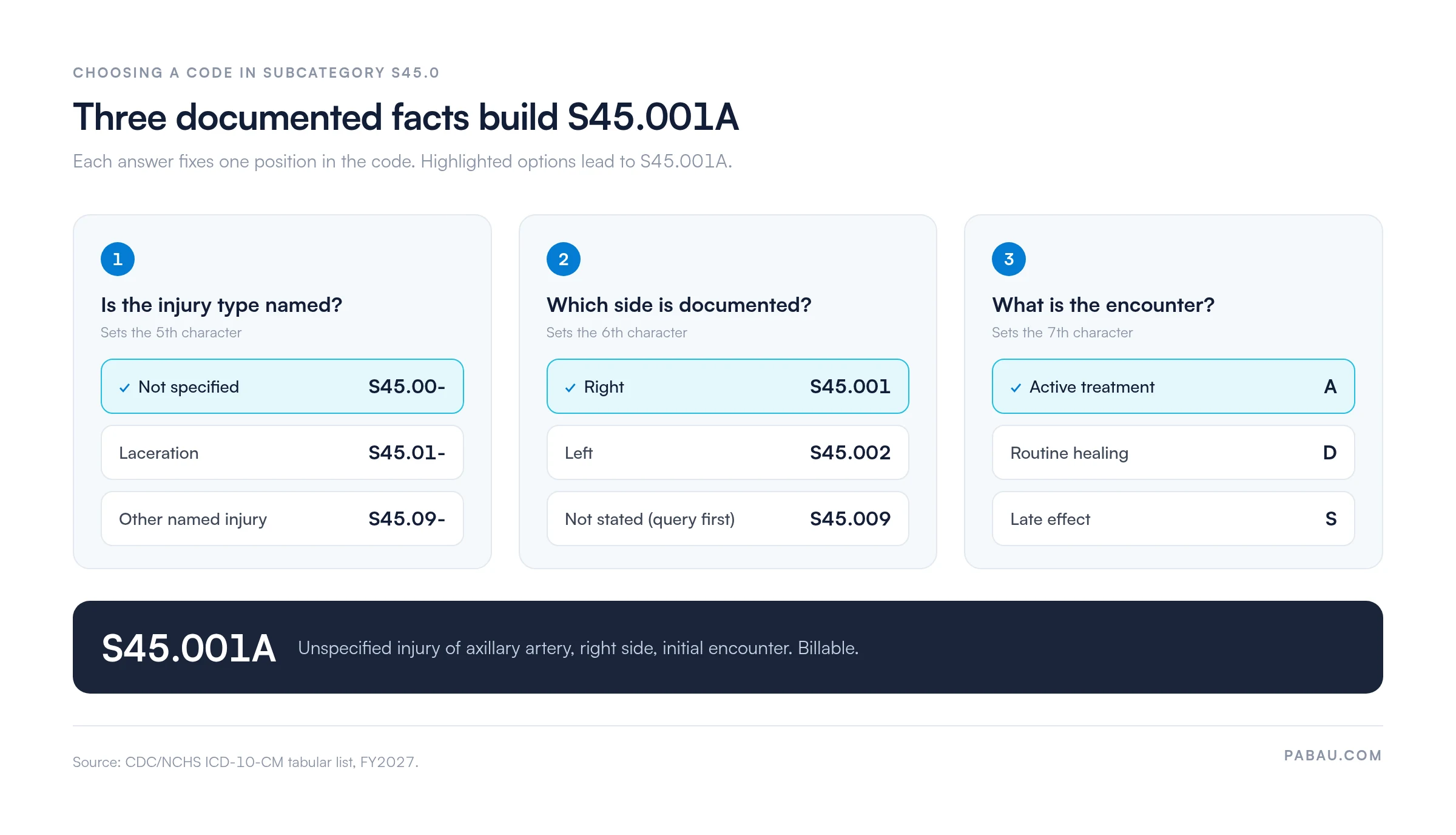
S45.002A is the left-side counterpart. These two codes cannot be used interchangeably, and auditors check them against the operative or imaging report. To assign the correct code, the clinical record must explicitly state which side was injured. “Right” or “right axillary” in the operative note, emergency department note, or radiology report is sufficient.
When laterality is not documented, do not guess. Query the treating provider and document the response before coding. If no response arrives before the claim deadline, S45.009A (unspecified side) may be used. It signals incomplete documentation, though, and draws extra scrutiny from reviewers. A documented laceration with no side recorded follows the same logic and codes to S45.019A. The CDC/NCHS ICD-10-CM tabular list instructs coders to code to the highest degree of specificity the documentation supports.
Clean claim submission for S45.001A depends on the clinical record containing several specific elements. The absence of any one of these is a direct path to denial or audit query.
Solid documentation also supports clean claim submission through the clearinghouse. An error fixed before transmission costs far less to correct than a denied claim that has to be reworked and resubmitted.
ICD-10 code S45.001A is a diagnosis code, and it is often paired with one or more CPT procedure codes describing the surgical intervention. The table below shows typical pairings for axillary artery repair. CPT selection always depends on the procedure the surgeon performed and documented.
Some payers apply National Correct Coding Initiative (NCCI) edits that bundle certain vascular repair codes. Confirm your CPT/ICD pairing against the current NCCI table before submission. Pabau’s claims management sends claims to the Claim.MD clearinghouse and tracks their status. Reviewing codes, 7th characters and CPT pairings stays with your coder.
If the operative note describes an axillary artery repair without saying whether a graft was used, query the surgeon first. The choice is CPT 35206 (direct repair), 35236 (vein graft) or 35266 (non-vein graft). The distinction matters for reimbursement and for audit defensibility. Document the query and response in the coding worksheet.
Section I.C.20 of the ICD-10-CM Official Guidelines directs coders to report external cause codes where documented, and some states and payers mandate them. These codes describe how, where, and under what circumstances the injury occurred.
The three external cause code types relevant to an axillary artery injury are:
An axillary artery injury caused accidentally during a procedure is not coded to S45. It is a complication of care, coded to I97.5- (accidental puncture or laceration of a circulatory system organ during a procedure). Codes from Y83-Y84 apply to later complications of surgical or medical care rather than to the intraoperative injury itself.
Knowing the full medical billing process for trauma cases, including the external cause coding chain, reduces audit exposure later.
Denials on S45.001A claims commonly fall into five categories. Each has a straightforward corrective action.
Systematic denial management workflows built into the billing cycle catch most of these issues before they become denied claims. When a denial does come back, decoding denial codes on the remittance tells you which of the five causes applies. Practices that track denial patterns by code can spot recurring S45.001A issues and fix them at the documentation stage rather than the appeals stage.
Legacy ICD-9-CM coding for axillary artery injury mapped primarily to 903.01 (injury to axillary artery). The General Equivalence Mappings (GEMs) described by CMS and ResDAC identify this as the approximate forward crosswalk from ICD-9 to ICD-10.
GEMs crosswalks are directional approximations, not billing equivalents. A claim corrected from ICD-9 to ICD-10 using only the GEMs mapping may not capture the laterality or specificity that ICD-10-CM now requires. Always review the underlying clinical record when performing retroactive billing corrections or historical data reconciliation. Then check each candidate code against the current tabular list before you resubmit.
When reconciling legacy claims coded under ICD-9 903.01, do not assume the crosswalk maps 1-to-1. Pull the original operative note to confirm laterality before assigning S45.001A vs S45.002A. Submitting a corrected claim with the wrong laterality generates a new denial.
Practices billing vascular trauma cases need to see where each claim stands once it leaves the chart. Pabau, the practice management platform we build, offers simpler claims management for these cases. It pulls the patient, encounter and code data already in the record into a pre-filled claim. It then sends the claim to Claim.MD, which delivers it to thousands of US payers.
Choosing the code, its 7th character and the CPT pairing stays with your coder, using the documentation checks above. Once the claim is out, Pabau tracks its status, so your billing team can see what is paid, pending or denied without phoning the payer.
Pabau also posts electronic remittance advice back into the billing workflow. Knowing how electronic remittance advice reports denial reason codes helps your team link a returned S45.001A claim to its correction quickly.
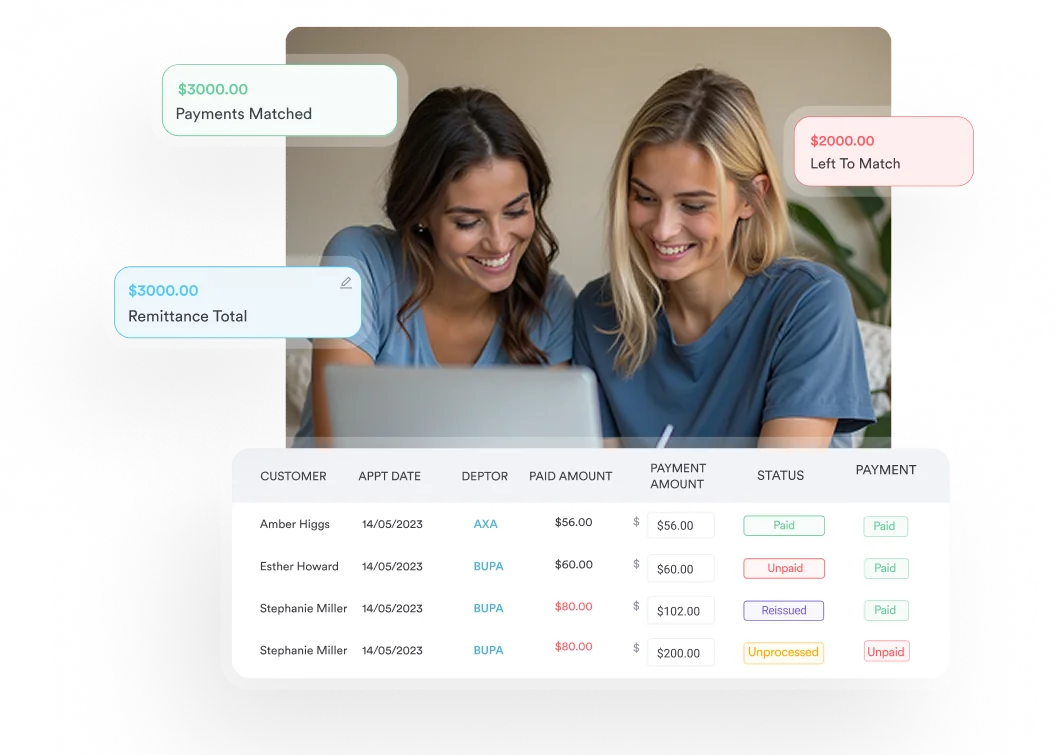

Pabau sends your claims to Claim.MD and tracks each one through to remittance, so your billing team always knows what is paid, pending or denied.

S45.001A fits only when three facts line up in the record. They are a right axillary artery injury, no named injury type, and active treatment at the encounter. If one of them is missing, query the provider before you code rather than appeal after a denial.
The trade-off is time. A provider query holds the claim for a short while. A wrong side or 7th character costs a full resubmission cycle and a second wait for payment.
Pabau sends the finished claim to Claim.MD and tracks it until the remittance posts. Book a demo to see how it fits the billing workflow of your vascular or surgical practice.

Need to understand how a clearinghouse handles your claims? Our Claim.MD clearinghouse guide explains how claims and remittances move between your practice and the payer.
Want to reduce your overall denial rate across all codes? Denial codes in medical billing covers the most common CARC and RARC codes and what each signals about the claim error.
Handling a superbill for a vascular trauma case? Superbill documentation guide walks through the elements a superbill must include for complex diagnosis and procedure code pairings.
Coding a lacerated axillary artery with no side recorded? ICD-10 code S45.019A covers laceration of the axillary artery on an unspecified side.
ICD-10 Code S45.001A is the billable ICD-10-CM diagnosis code for an unspecified injury of the axillary artery, right side, initial encounter. It is valid for FY2026 and FY2027 and sits under subcategory S45.0 (injury of axillary artery) within the S40-S49 shoulder and upper arm injury block.
Yes, S45.001A is a fully billable, specific ICD-10-CM code valid for claim submission. Its parent codes, S45.001 (without 7th character) and S45.00 (subcategory), are header codes that cannot be submitted on a claim.
S45.001A covers the right axillary artery, and S45.002A covers the left. The codes are otherwise identical in structure and clinical meaning. Laterality must be explicitly documented in the operative or imaging report before either code can be assigned.
Use D (S45.001D) when the patient is receiving routine follow-up care and the injury is in a healing phase. Reserve A for visits where active treatment is being provided, such as wound management or surgical intervention. Switch to S (S45.001S) only when treating a late effect or residual condition caused by the original injury.
Five denial triggers come up often. The first three are submitting S45.001 without a 7th character, using the wrong 7th character, and lacking explicit laterality in the chart. The other two are omitting an external cause code a payer or state requires, and a CPT/ICD mismatch or NCCI bundling conflict.
The approximate GEMs forward crosswalk maps to ICD-9-CM 903.01 (injury to axillary artery). This is a directional approximation. ICD-9 did not capture laterality, so retroactive corrections must use the original clinical record to assign S45.001A (right) or S45.002A (left) correctly.