ICD-10 Code S02.412B: LeFort II fracture, open initial encounter
ICD-10 Code S02.412B: Definition and billable status ICD-10 Code S02.412B is the...

Last Updated: Oct 8, 2026
Billable Code Specific Code
S02.602D is the billable ICD-10-CM code for fracture of unspecified part of body of left mandible, subsequent encounter for fracture with routine healing.
Coders use it when a patient returns for follow-up care after active treatment of a left mandible body fracture has ended and healing is routine. A right-sided fracture takes S02.601D instead. Mixing this code up with the initial-encounter code S02.602A is a common cause of denied fracture claims.
Let Pabau's smart automation suggest the right codes, reduce claim denials, and keep your practice compliant—effortlessly.
Automate repetitive tasks and focus on what matters most—your patients.
Reduce coding errors and ensure compliance with the latest regulations.
Clean claims, fewer denials, and faster reimbursements.
Powerful insights and reporting to help your practice thrive.
HIPAA compliant SOC 2 certified GDPR-compliant Trusted by 4,000+ clinics worldwide

S02.602D is a billable ICD-10-CM code for follow-up visits on a fracture of the body of the left mandible during routine healing.
7th character D applies once active treatment is complete. Use A (or B for an open fracture) during active treatment and S for late-effect sequela.
S02.602D already specifies the left side, and only the exact part of the mandible body is unspecified. Use S02.601D for the right side and S02.600D when no side is documented.
Pabau keeps operative notes and earlier claims on the patient record, so coders can confirm the side and 7th character before each follow-up claim.
ICD-10 Code S02.602D is the full billable code for “Fracture of unspecified part of body of left mandible, subsequent encounter for fracture with routine healing.” The side is specified as left, and only the exact part of the mandible body is unspecified.
The code sits in category S02 (Fracture of skull and facial bones) within ICD-10-CM Chapter 19. That chapter covers injury, poisoning and certain other consequences of external causes. The code is valid and billable in the current ICD-10-CM tabular list, as confirmed by the CDC/NCHS ICD-10-CM web tool.
The 7th character D means active treatment of the fracture is complete and the patient is receiving routine care while it heals. Per ICD-10-CM Official Guidelines Section I.C.19, “subsequent encounter” does not mean the patient’s second appointment in a series. It covers any encounter after active treatment ends, during the healing or recovery phase.
A practical test: use A (or B for an open fracture) while the patient is receiving active treatment. That includes the evaluation and the surgical repair. Use D when the patient returns while the fracture heals normally. Typical D visits are a follow-up check, suture removal, an IMF (intermaxillary fixation) wire check, or a post-operative imaging review.
Common coder error: AAPC coding forums flag S02.602A on the second, third, and fourth follow-up visits as a frequent facial-fracture billing mistake. Payers expect the 7th character to advance from A to D once active treatment ends. Keeping A across multiple post-operative visits can trigger medical necessity denials or retrospective audits.
Document the healing phase explicitly in every follow-up note. A phrase like ‘fracture in routine healing, no complications noted’ directly supports the D suffix and gives auditors the clinical justification they need. Without it, a payer reviewer cannot distinguish routine healing (D) from a complication requiring a different code path.
S02.602D covers follow-up care for a fracture of the body of the left mandible during routine healing. The “unspecified” in its descriptor refers only to the part of the mandible body. The side is fixed by the code itself, which always reports the left mandible.
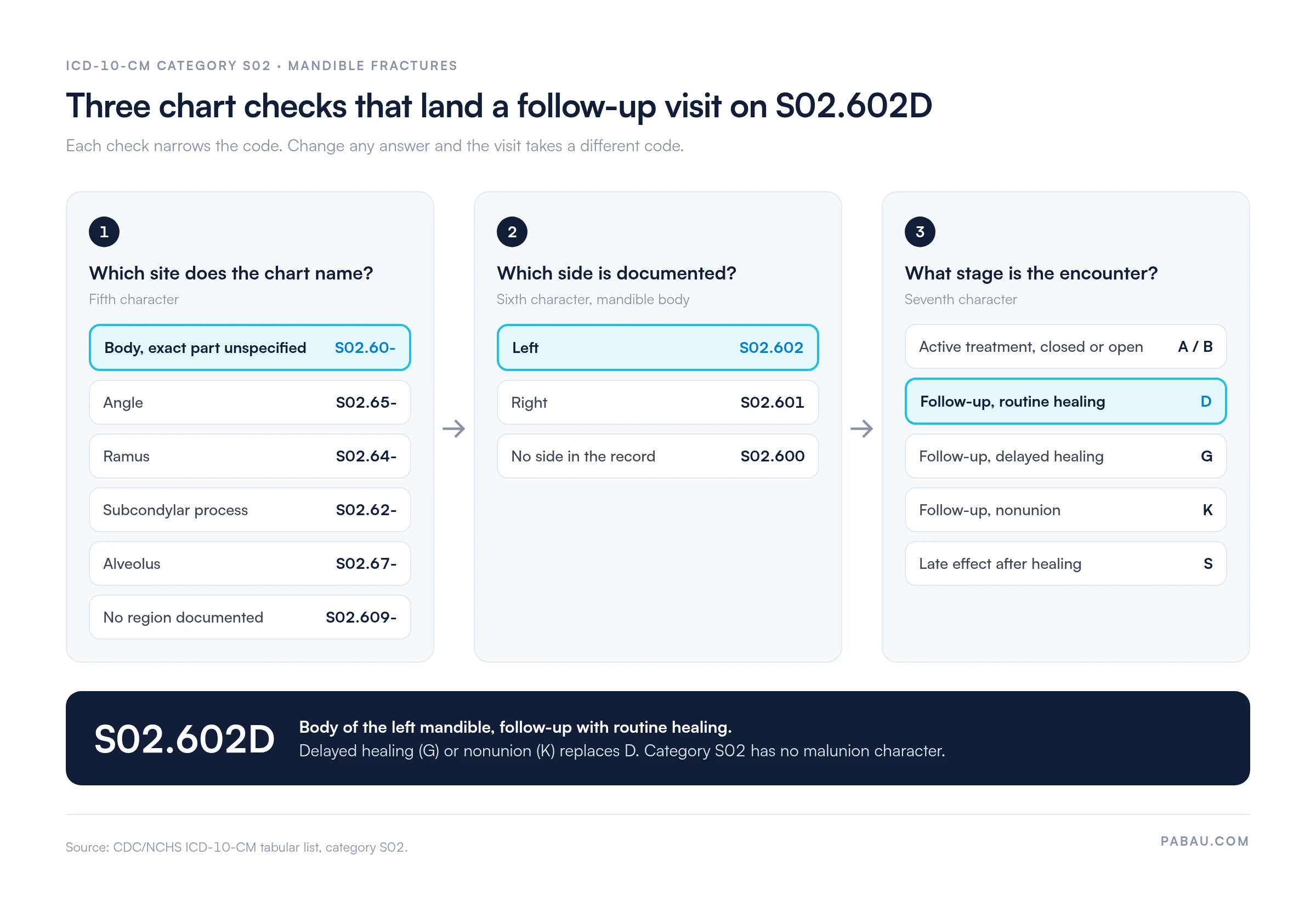
Before assigning it, confirm two facts in the operative report, imaging report, or clinical note. The fracture is in the body of the mandible, and it is on the left. A right-sided body fracture takes S02.601D, and a body fracture with no documented side takes S02.600D. If the chart names a more precise site, such as the angle or ramus, use that site’s code.
The S02.6 family codes mandible fractures by both site and side. Most sites carry an unspecified-side, a right, and a left code. The code you pick must match the site, the side and the encounter stage named in the chart, checked in that order.
S02.602D appears on subsequent-encounter claims after a patient has received initial treatment for a mandible fracture. Common mechanisms include motor vehicle collisions, assaults, sports injuries, and falls. The patient returns to an oral and maxillofacial surgeon, emergency department, or primary care provider while the fracture is still healing.
Visit types typically coded with D include post-operative ORIF checks, fixation hardware reviews, and radiograph reads for callus formation. When plain films are inconclusive, a maxillofacial CT billed as 70486 also carries S02.602D as its diagnosis. Physical therapy referrals for restricted mouth opening take D too.
Whether a follow-up visit is separately payable depends on the global surgery period of the CPT code billed at the operative encounter. That rule is one of the medical billing basics to confirm before a follow-up claim goes out.
S02.602D is a follow-up diagnosis code. It does not appear on the initial operative claim; it appears on subsequent-encounter claims billed after the surgery or initial treatment. The table below shows procedure codes most commonly billed alongside S02.602D on those follow-up claims.
Note on global surgery periods: The initial encounter may have carried an operative CPT code. One example is 21462, open treatment of a mandibular fracture with interdental fixation. Follow-up E&M visits such as 99213 within its global period are then generally bundled into the surgical payment. Whether the visit falls inside or outside the global period depends on the specific CPT code and payer policy.
Confirm the global indicator in the CMS Physician Fee Schedule lookup before billing a separate E&M alongside S02.602D. In oral and maxillofacial surgery practices, tracking the global period end date at the patient level prevents accidental unbundling.
The medical record must substantiate three things to support S02.602D. It confirms a left mandible body fracture, shows the visit is a follow-up rather than the initial encounter, and notes routine healing without complication. Per CMS ICD-10-CM coding guidelines, supporting documentation for injury codes must include the mechanism and clinical status at each encounter.
Submitting a clean claim for a subsequent-encounter fracture visit means the record must address all of the above before the claim leaves the practice. Missing any element leaves the claim exposed to a medical necessity challenge on audit.
Denials on S02.602D claims cluster around a small set of recurring errors. Most are preventable with correct character selection and complete documentation before submission. Denial management workflows for facial-fracture claims should flag each of the patterns below at the coding review stage, before the claim reaches the clearinghouse.
Medicare and most Medicaid plans cover medically necessary mandible fracture treatment and the associated follow-up visits. Subsequent-encounter visits billed with S02.602D generally fall within the global surgery period framework when a covered procedure was performed at the initial encounter. Separately billed follow-up services are covered only outside the global period, and only when the CPT code is not bundled into the initial payment.
Private payer variation is significant. Some commercial plans run laterality edits that compare the side in the diagnosis code with the side in the procedure documentation. A left-coded claim against a right-sided operative note will pend for record review.
Others apply frequency edits that limit the number of follow-up visits reimbursed within a defined healing window. Pre-authorization is typically required for additional imaging (CT, cone-beam CT) ordered during the healing phase, even when the fracture itself was originally authorized.
Reviewing medical billing denial codes for facial fracture claims helps billing teams anticipate which CARC codes a denial will carry. Understanding the denial reason at the code level shortens the appeals cycle considerably.
S02.602D denials usually trace back to manual steps. A coder copies S02.602A forward to every follow-up visit, or keys the side without rereading the operative note.
Pabau, the practice management and billing platform we build, keeps the operative note, imaging reports and earlier claims on the same patient record. Coders working in its claims management software can check the side and 7th character billed at earlier visits before coding today’s follow-up.
In the US, Pabau submits claims electronically through Claim.MD to thousands of payers and runs real-time eligibility checks. Claim status and ERA remittances come back to the same record. A denial on an S02.602D follow-up then sits next to the notes you need to correct and appeal it.

Pabau keeps operative notes, earlier claims and remittances on one patient record. Coders confirm the side and 7th character before each follow-up claim goes out through Claim.MD.

S02.602D fits a claim only when three facts line up. The fracture sits in the body of the left mandible, the visit is a follow-up, and healing is routine. If any one of them changes, the claim needs a different code.
Advance the 7th character from A to D once active treatment ends, and move on to G, K or S when the clinical picture changes. Check the side against the operative and imaging notes on every claim, because the code already commits the claim to the left mandible. To see how Pabau tracks those decisions across a patient’s follow-up visits, book a demo.

Want to understand how clearinghouse claim submission works? Medical claims clearinghouse guide explains how electronic claims are validated, batched, and forwarded to payers.
Looking for a reference on ERA and remittance processing? Electronic remittance advice (ERA) explains how 835 remittance files carry CARC denial codes back to billing teams after adjudication.
Chart names the mandible body but no side? ICD-10 Code S02.600D covers the unspecified-side follow-up code for the same fracture site.
ICD-10 Code S02.602D is the billable diagnosis code for a left mandible fracture at a follow-up visit during routine healing. Its full descriptor is “Fracture of unspecified part of body of left mandible, subsequent encounter for fracture with routine healing.” The side is left, and only the exact part of the mandible body is unspecified. The code tells payers the visit is a follow-up during complication-free healing after initial fracture treatment.
Yes, S02.602D is a billable ICD-10-CM code in the current tabular list. It already specifies the left side, so it needs no further laterality detail. Payers may still check that side against the procedure documentation.
Use D once active treatment is complete and the patient is receiving routine follow-up care while the fracture heals. Use S once healing is complete and the visit addresses a residual late effect of the original fracture. Typical late effects are chronic malocclusion, trismus, or persistent jaw pain. Switching from D to S too early or too late is a common coding error on mandible fracture claims.
Yes, and S02.602D already specifies it. The code reports a fracture of the body of the left mandible, with only the exact part of the body unspecified. Use S02.601D for a right-sided fracture and S02.600D when the record documents no side.
On follow-up claims, S02.602D is most often paired with established-patient E&M codes (99213, 99214). Diagnostic imaging codes are the other common pairing: 70110 for a mandible X-ray and 70486 for a maxillofacial CT. Operative CPT codes such as 21461 and 21462 (open treatment of a mandibular fracture) belong on the initial surgical claim. They don’t go on follow-up visits coded with D.
Four errors cause most denials. Coders keep 7th character A on repeat follow-up visits, or bill an operative CPT code on a follow-up claim. Others submit a follow-up E&M inside the surgical global period without a modifier. The fourth is a left/right mismatch between S02.602D and the procedure documentation. Each denial type has a specific correction path detailed in the denial table above. Per AAPC Codify, accurate 7th-character assignment is among the most scrutinized elements of injury-code audits.
There is no fixed maximum duration specified in the ICD-10-CM guidelines. Use D for as long as the fracture is healing routinely and the patient is receiving follow-up care for it. Once healing is clinically complete and later visits address sequela conditions, switch the 7th character to S for those visits. Some complex fractures need hardware removal or secondary procedures months after the initial repair. In those cases, D may apply well beyond the standard global period.