ICD-10 Code S02.602D: Fracture of mandible, subsequent encounter
ICD-10 Code S02.602D: Definition and billable status ICD-10 Code S02.602D is the...

Last Updated: Oct 8, 2026
Billable Code Specific Code
S02.412B is the billable ICD-10-CM code for LeFort II fracture, initial encounter for open fracture. It covers a pyramidal midface fracture through the maxilla, nasal bones, and orbital rims, at any visit where the fracture is still under active treatment.
Assignment turns on two points. The physician must document the fracture as open, because imaging alone can't support the B character. The encounter must also still be in the active-treatment stage. A closed fracture at the same stage takes S02.412A.
Let Pabau's smart automation suggest the right codes, reduce claim denials, and keep your practice compliant—effortlessly.
Automate repetitive tasks and focus on what matters most—your patients.
Reduce coding errors and ensure compliance with the latest regulations.
Clean claims, fewer denials, and faster reimbursements.
Powerful insights and reporting to help your practice thrive.
HIPAA compliant SOC 2 certified GDPR-compliant Trusted by 4,000+ clinics worldwide

S02.412B is a billable ICD-10-CM code, valid for FY2025–FY2027, for a LeFort II (pyramidal) midface fracture at the initial encounter for an open fracture.
Assign the B character only when the physician explicitly documents an open fracture. Imaging alone cannot support it, and a closed fracture at the initial encounter takes S02.412A.
Most denials on this code come from 7th character mismatches, missing open-wound documentation, or sequencing errors alongside intracranial injury or orbital fracture codes.
Report an orbital floor fracture separately (S02.30XB, S02.31XB, or S02.32XB) only when the physician documents it as an injury distinct from the LeFort II pattern.
Pabau’s claims management software connects to Claim.MD for real-time eligibility checks, claim submission, and claim status tracking.
ICD-10 Code S02.412B is the billable ICD-10-CM code for a LeFort II fracture at the initial encounter for an open fracture. It belongs to category S02, fracture of skull and facial bones. It sits in chapter 19 of ICD-10-CM, which covers injury, poisoning, and certain other consequences of external causes.
It is valid for claim submission for FY2025–FY2027 under the CMS ICD-10 code set, and the FY2027 update effective October 1, 2026 left it unchanged.
The parent code S02.412 is a non-billable header, so a claim carrying S02.412 alone will reject. S02.412B (open, initial) and S02.412A (closed, initial) are the two billable initial-encounter codes for this fracture type, verified in the CDC/NCHS ICD-10-CM official web tool.
A LeFort II fracture is a pyramidal midface fracture. It separates a triangular segment of the central face from the cranial base and lateral facial skeleton. The fracture line runs through the nasal bones, crosses the medial orbital walls and orbital floors, and extends across the pterygoid plates. The zygoma stays attached to the skull.
René LeFort described this pattern in 1901 after cadaveric impact studies. It remains the standard classification in trauma surgery and facial fracture coding today.
Four structures are consistently involved. Clear documentation of all four helps coders confirm S02.412B is the correct assignment and supports co-coding decisions for associated structures.
The mechanism is almost always high-energy blunt trauma, such as motor vehicle collisions, assault, and falls from height. The resulting midface mobility is the classic “floating maxilla” on clinical exam. That finding supports the LeFort classification in the emergency or operative note, and recording it clearly separates S02.412B from generic facial fracture codes.
The “B” suffix in ICD-10 Code S02.412B designates the initial encounter for an open fracture. Every fracture code in category S02 needs a 7th character. Leaving it off, or assigning the wrong letter, is one of the most common technical denial reasons for this code family. The full set of valid 7th characters for S02.412 is shown below.
Under the ICD-10-CM Official Guidelines for Coding and Reporting, the initial encounter character (A or B) covers every visit with active fracture treatment. That holds even when it is not the first visit. A patient transferred to a trauma center from an emergency department for definitive surgical repair is still at the initial encounter stage.
S02.412A applies when the physician documents the LeFort II fracture as closed, with no skin or mucosal breach communicating with the fracture site. S02.412B applies when the physician documents it as open, compound, or with an open wound communicating with the fracture.
That call belongs to the physician. A coder cannot assign S02.412B from CT findings of soft tissue injury or laceration unless the note calls the fracture open.
Misreading open status is the most common coding error in this code family. A high-velocity facial fracture with heavy soft tissue damage may look open on imaging. The code still follows the physician’s characterization, whatever the coder makes of the scan report. The official guidelines also code a fracture to closed when the record doesn’t say open or closed.
The diagram below puts both decisions in one place, from the open/closed call through to the follow-up characters.
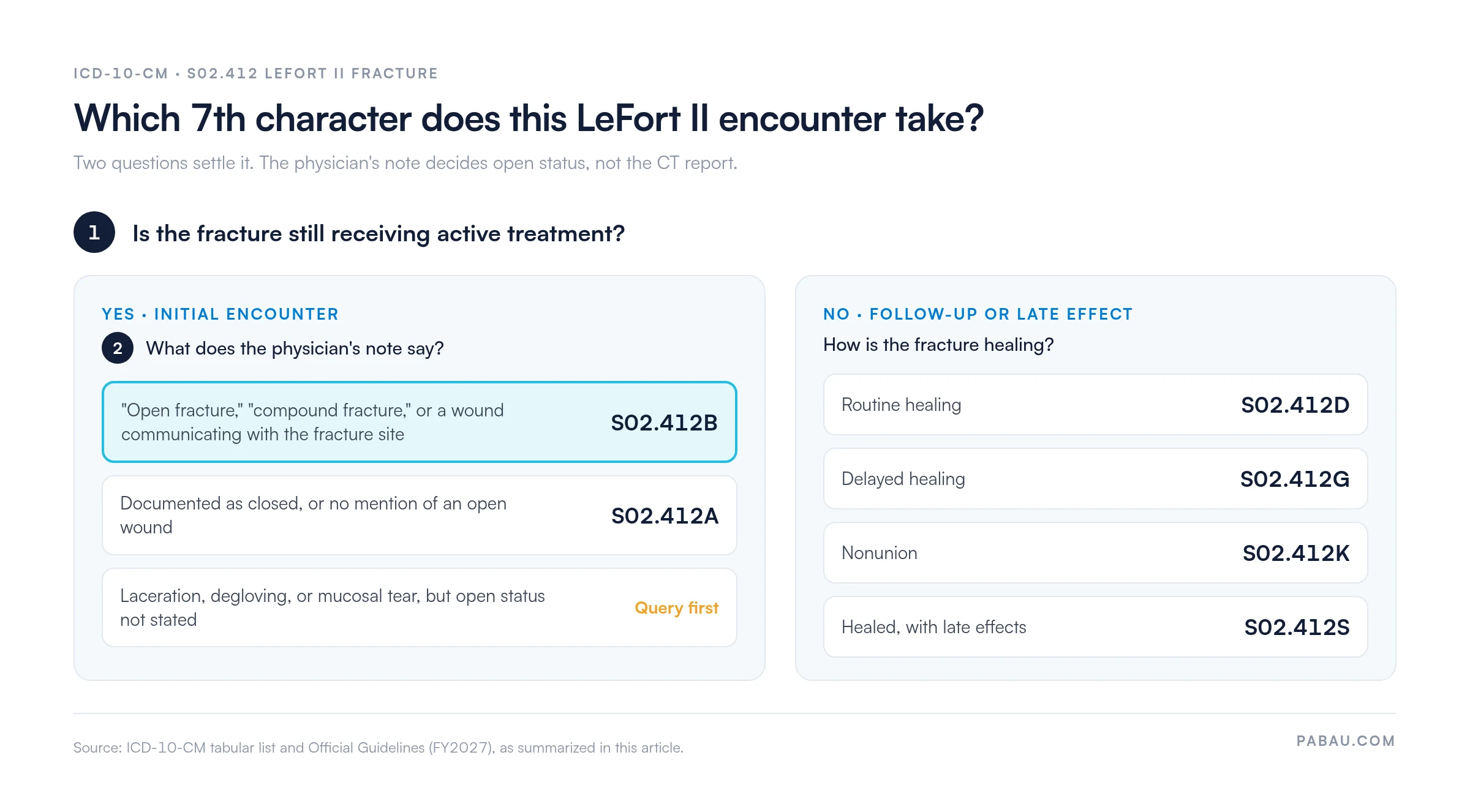
Flag a chart for physician query when the notes document lacerations alongside a LeFort II fracture but never say ‘open fracture.’ A coder-initiated query that ends in physician clarification is the correct workflow. Never default to S02.412B without explicit documentation.
S02.412B sits four levels deep in the ICD-10-CM hierarchy. Understanding the parent structure helps coders navigate the tabular list and confirm they have selected the most specific billable code.
The three LeFort types are anatomically distinct. LeFort I is a horizontal maxillary fracture that does not involve the orbits. LeFort II (S02.412B) is the pyramidal fracture that does involve the orbital rims and nasal bones.
LeFort III (S02.413A/B) is a complete craniofacial separation, with the fracture line running through the frontozygomatic suture and orbital walls. Here the zygoma separates from the skull.
When several LeFort levels coexist in a panfacial fracture, code each level separately. The CMS and AHA ICD-10-CM Official Guidelines sequence multiple fractures by severity.
Category S02 carries instructional notes that affect how S02.412B is reported alongside other codes. Coders must review these before finalizing the code set for any LeFort II claim.
Orbital floor fracture (S02.3-) and fracture of nasal bones (S02.2-) carry Excludes2 designations relative to S02.412B. They may be reported together when both are documented as distinct injuries. One example is an orbital blowout component beyond the orbital fracture that belongs to the LeFort II pattern. Before adding S02.3-, confirm with the physician whether the orbital floor injury is part of the LeFort II or a separate fracture.
The medical record must contain specific elements to support S02.412B. Missing any of the following is the main driver of audit exposure and payer denials. Sound medical billing compliance means confirming them before submission, so nobody chases them after a denial.
LeFort II fractures rarely present in isolation. The following codes are frequently reported alongside S02.412B. Under the ICD-10-CM Official Guidelines, the most serious injury is sequenced first. The provider decides which injury that is, based on the focus of treatment.
On the procedure side, LeFort II repair usually involves open reduction and internal fixation. CPT codes for craniofacial surgery vary by approach and extent of fixation. Payer policies govern reimbursement, and prior authorization rules differ by insurer and Medicare Administrative Contractor (MAC) jurisdiction. Confirm the CPT codes with the operative team and check payer requirements before submission.
S02.412B is covered under Medicare Part A (inpatient hospital) and Part B (outpatient/professional billing) when the fracture is documented as requiring active treatment. No national coverage determination (NCD) is specific to LeFort II fracture repair.
Depending on the setting, coverage follows the inpatient prospective payment system (IPPS) diagnosis-related group (DRG) or the outpatient fee schedule. Local coverage determinations (LCDs) may apply to specific procedures in some MAC jurisdictions, so check with your facility’s compliance team.
Prior authorization rules for LeFort II repair surgery vary between commercial payers. That makes them one of the harder parts of the medical billing process for trauma cases. Most require authorization for elective, delayed repair but not for emergency operative cases.
Record the urgency classification in the operative scheduling note, because it strengthens the authorization record. A clear prior authorization process also tells schedulers which delayed repairs need payer sign-off before the operating room is booked.
LeFort II claims carry extra denial risk because of the 7th character requirement, the open/closed distinction, and the co-reported codes that usually travel with them. A denial management workflow for facial trauma should screen for the four patterns below.
Submitting S02.412 (the non-billable parent) instead of S02.412B is the top technical denial. Some EHR systems autofill the 6-character parent code when the coder searches by description rather than by full 7-character code. Always verify the full code string before finalizing the claim.
Payers auditing S02.412B claims look for explicit open-fracture language in the operative or emergency note. A note may say “laceration with underlying fracture” without calling the fracture itself open. The payer may then downcode to S02.412A or deny for insufficient documentation. Query the physician at the time of coding, before the claim goes out.
When an ED transfers a patient to a trauma center, the receiving facility’s first visit still counts as an initial encounter. That holds whenever active treatment is rendered there. Some coders assign “D” (subsequent encounter) at the receiving facility instead. That mismatches the claim’s DRG and can trigger a clinical validation denial.
When S06.- intracranial injury codes are co-reported, principal diagnosis sequencing must reflect the condition that drove the admission. A significant traumatic brain injury may have been the main reason for the stay. Listing S02.412B as principal then conflicts with the expected DRG and can trigger a medical necessity review.
Payers flag these errors through claim adjustment reason codes (CARCs) and remittance advice remark codes (RARCs). This guide to medical billing denial codes shows which combinations point to a sequencing problem on facial fracture claims.
Billing teams handling LeFort II claims often work across three places: the operative note, a clearinghouse portal, and a spreadsheet of claims waiting on payers. Each handoff is a chance for a skipped eligibility check or a claim that stalls without anyone noticing.
Pabau, the practice management platform we build, connects to the Claim.MD clearinghouse for real-time insurance eligibility checks. It also handles electronic claim submission and claim status tracking. Electronic remittance advice (ERA) comes back through the same connection, so a rejected facial fracture claim surfaces while the chart is still fresh.
Pabau’s claims management for surgeons keeps those statuses and remittances in one view. Recurring denial reasons on trauma claims become visible at the practice level, so you can fix the documentation habit behind them. The coding decision itself still rests with your coders and the physician’s note.

Pabau connects to Claim.MD for real-time eligibility checks, electronic claim submission, and claim status tracking, so facial fracture claims don’t stall unnoticed.

Treat open status as a documentation question first and a coding question second. Without a physician’s note calling the fracture open or compound, S02.412B can’t be supported. That holds however the CT reads.
The habit worth building is a physician query at the point of coding whenever lacerations appear without an open/closed call. It costs a short delay up front and saves a denial, an appeal, and a resubmission later.
Book a demo to see how Pabau handles eligibility checks, claim submission, and status tracking for your facial trauma claims.

Want to understand how clearinghouse submissions work? How the Claim.MD clearinghouse works explains real-time eligibility checks, claim submission, and ERA processing through one connection.
Looking for a reference on clean claim standards? Clean claim requirements outlines the data elements and format standards that reduce rejection rates on trauma and surgical claims.
Need to read the payer’s response on a denied claim? Electronic remittance advice explains how ERA files report payments, adjustments, and denial reason codes.
ICD-10 Code S02.412B is the billable ICD-10-CM diagnosis code for an open LeFort II fracture at the initial encounter. A LeFort II is a pyramidal midface fracture involving the maxilla, nasal bones, and orbital rims. The “B” 7th character means initial encounter for open fracture, as distinct from “A” (initial, closed) or “D” (subsequent encounter).
Yes. S02.412B is a valid billable ICD-10-CM code for FY2025–FY2027, including the FY2027 code set in effect since October 1, 2026. Its parent code, S02.412, is a non-billable header, so a claim carrying S02.412 alone will reject. The full 7-character code S02.412B must appear on the claim.
S02.412A covers a LeFort II fracture at the initial encounter when the fracture is closed. S02.412B covers the same fracture when the physician explicitly documents it as open. That call must come from physician documentation, and imaging interpretation alone can’t make it. When documentation is ambiguous, query the physician before assigning S02.412B.
“B” designates the initial encounter for an open fracture under ICD-10-CM fracture coding convention. Initial encounter applies whenever the patient is receiving active treatment for the fracture. That includes a receiving trauma center after transfer from an ED, so it isn’t limited to the first facility seen.
The physician must characterize the fracture as open or compound. The note must also identify it as LeFort II, or describe a pyramidal midface fracture involving the maxilla, nasal bones, and orbital rims. CT imaging should confirm the pattern, and an external cause code should reflect the injury mechanism. Radiology findings alone cannot substitute for physician open-fracture documentation.
S02.412D is used for subsequent encounters with routine healing progress. S02.412G applies when healing is delayed. S02.412K covers nonunion. These replace S02.412B once active treatment is complete and the patient is in the follow-up phase of care.