ICD-10 Code S02.602D: Fracture of mandible, subsequent encounter
ICD-10 Code S02.602D: Definition and billable status ICD-10 Code S02.602D is the...

Last Updated: Oct 8, 2026
Billable Code Specific Code
S02.11DK is the billable ICD-10-CM code for type II occipital condyle fracture, left side, subsequent encounter for fracture with nonunion.
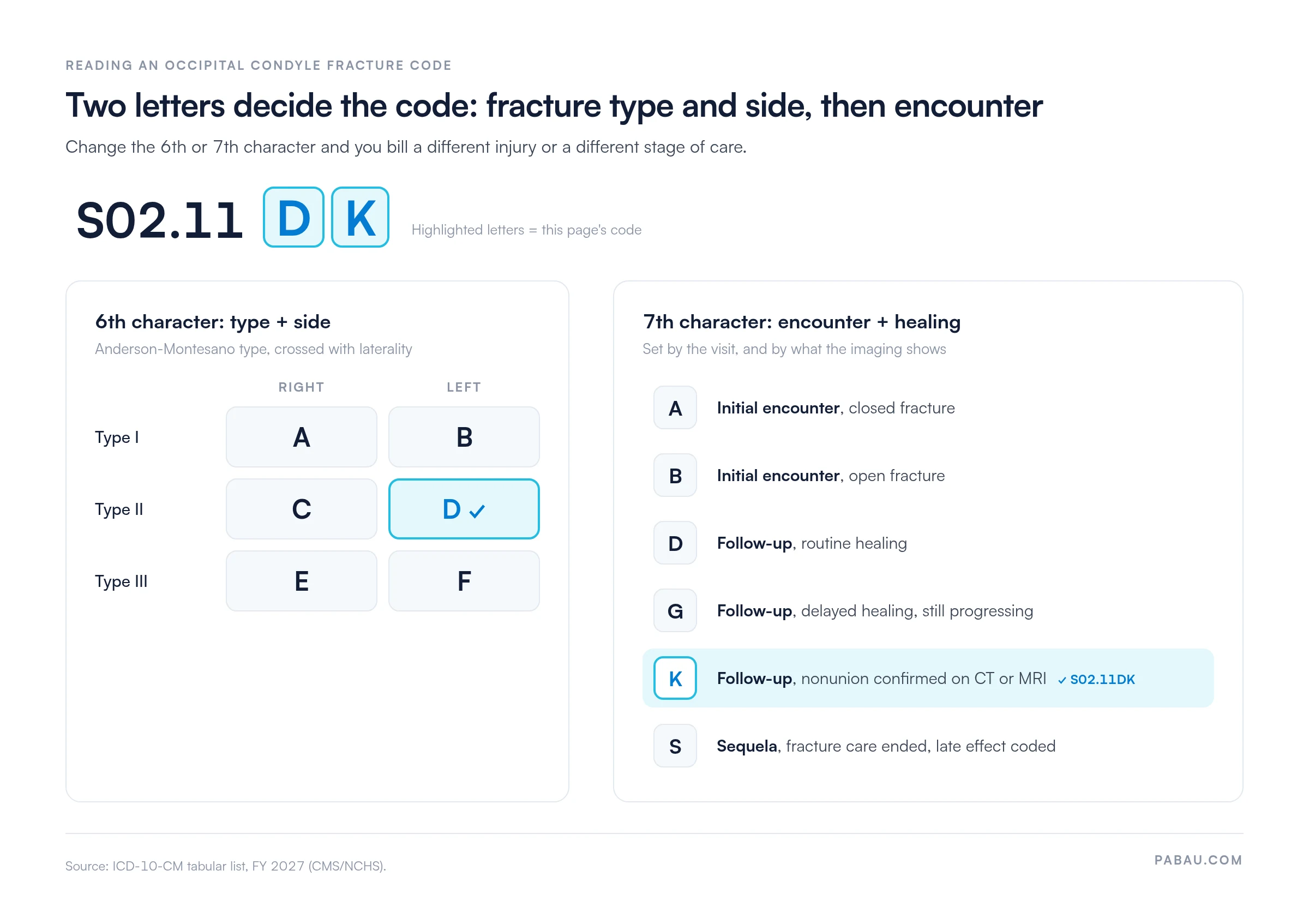
The code packs three facts into one string. The D in position 6 marks an Anderson-Montesano Type II fracture on the left side. The K marks a follow-up visit where imaging confirms the fracture has not united. Use it while fracture care is ongoing, and switch to S once treatment has ended and only a late effect remains.
Let Pabau's smart automation suggest the right codes, reduce claim denials, and keep your practice compliant—effortlessly.
Automate repetitive tasks and focus on what matters most—your patients.
Reduce coding errors and ensure compliance with the latest regulations.
Clean claims, fewer denials, and faster reimbursements.
Powerful insights and reporting to help your practice thrive.
HIPAA compliant SOC 2 certified GDPR-compliant Trusted by 4,000+ clinics worldwide

ICD-10 Code S02.11DK codes a left-side Type II occipital condyle fracture at a follow-up visit where nonunion is confirmed.
The 7th character K means the fracture is still in active treatment but has failed to heal, as shown on imaging in the record.
Coders most often go wrong by using 7th character A at follow-up visits, or S before fracture care has ended.
The 6th character carries both the fracture type and the side, so a Type III left-side nonunion is S02.11FK, not S02.11BK.
Pabau’s claims management software submits claims through the Claim.MD clearinghouse, with eligibility checks, remittance tracking and completeness checks before submission.
ICD-10 Code S02.11DK is the billable code for a left-side Type II occipital condyle fracture that has failed to unite. Report it at follow-up visits once imaging confirms nonunion and fracture care is still ongoing.
The table below summarizes the reference data. Every field reflects the CMS ICD-10-CM Fiscal Year 2027 release, effective October 1, 2026 through September 30, 2027.
Each position in this seven-character code carries a distinct clinical meaning. Misread any one position and the claim codes a different anatomical site, fracture type, or encounter stage. The table below maps every character to its meaning.
Position 6 (D) encodes the fracture type and the side together. A and B are Type I (right and left), C and D are Type II, and E and F are Type III. Switching D to F codes a Type III fracture on the same left side. That is a clinically different injury with different stability implications.
The decoder below shows both letters, and what each one turns into when the documented facts change.
A Type II occipital condyle fracture is a basilar skull fracture that extends into the occipital condyle, caused by a direct blow to the skull. It typically follows high-energy trauma such as motor vehicle collisions or falls from height. The Anderson-Montesano classification divides occipital condyle fractures into three types, and ICD-10-CM’s S02.11 codes follow it.
Left-side laterality matters for coding because ICD-10-CM assigns separate codes for left and right occipital condyle fractures. The clinical note must explicitly state which side is affected. Inferring laterality from imaging reports without physician documentation is a coding violation under CMS guidelines.
The 7th character K means the fracture remains in active treatment but has failed to heal. The bone ends have not bridged, which is typically confirmed by CT or MRI. Per the CDC/NCHS ICD-10-CM Official Guidelines, Section I.C.19.a, K applies while the patient is still receiving care for the fracture. Imaging or clinical assessment must document the nonunion.
The clinical decision point between K and G is imaging. G applies when the fracture is slow to heal but still consolidating. K applies when consolidation has stopped and the fracture gap persists. Document which character applies based on the radiology report, not solely on elapsed time since injury.
Flag the 7th character choice in the progress note rather than leaving it implicit. A note that says ‘fracture nonunion confirmed on CT dated [date]’ lets the coder assign K over G with confidence. It also gives the payer the evidence it needs to pay the claim.
S02.11DK applies only when all four conditions are met simultaneously. Missing any one pushes the correct code to a different 7th-character variant or a different subcategory entirely.
A common scenario: a patient initially coded S02.11DA (initial encounter, Type II left-side fracture) returns at eight weeks with a CT showing no callus formation. That follow-up visit codes S02.11DK, not a repeat of S02.11DA.
The following codes share the same anatomical site or encounter structure but differ in one or more critical dimensions. Billing one of them when S02.11DK is correct, or the reverse, creates a mismatch that payers flag on audit.
Mixing up K and S is a frequent error on late-stage occipital condyle fracture claims. Both apply after the initial encounter, but they code different clinical states.
Here’s a practical test. If the visit note describes ongoing fracture management or nonunion intervention, K applies to the visit. If the note describes a new symptom from a healed fracture, switch to S and code that condition first. The same split applies on the right side, where the Type II sequela code is S02.11CS.
The medical record must support every element embedded in the code. Nonunion extends reimbursable treatment and can trigger surgical authorization, so payers look closely at these follow-up claims. Knowing what makes a clean claim starts with complete documentation. A complete note for S02.11DK should include the following.
Attach the radiology report to the encounter note in the patient record. Payers requesting documentation for S02.11DK will expect to see the imaging that supports nonunion. If the report is filed separately, include its date and impression in the clinical note. The coder can then confirm the link without chasing a second record.
Medicare and most commercial payers process occipital condyle fracture claims under general traumatic injury coverage. There is no national coverage determination (NCD) specific to skull base fractures, so local coverage determinations (LCDs) govern. Practices should verify applicable LCDs through their Medicare Administrative Contractor before submitting claims for surgical interventions associated with S02.11DK.
The seven-character string leaves no room for a vague note, because each element has to be backed by the record. Solid denial management workflows help practices recover faster, but preventing denials at submission costs less. These are five common denial triggers for S02.11DK.
Payers return these denials with adjustment reason codes, and our guide to decoding denial codes explains what each one means.
ICD-10-CM codes are only valid for claim submission at the most specific level, which here is the full seven-character string. Billing a parent code (S02.11, S02.1, or S02) returns a claim as invalid because those codes are header-level only.
The hierarchy below shows every level from chapter to code, with validity notes at each level. Coders navigating from the AAPC Codify ICD-10-CM lookup or the WHO ICD-10 browser should always stop at the seven-character level before billing.
S02.11DK is valid and billable for Fiscal Year 2027, which runs from October 1, 2026 through September 30, 2027. The FY 2027 CMS ICD-10-CM release leaves it unrevised. The code has stayed stable across recent annual updates, with no descriptor changes or deletions.
Check it against the CMS tabular list at each October 1 update, because the annual release is the authoritative source. Claims with dates of service after September 30, 2027 fall under the FY 2028 code set.
A follow-up claim for S02.11DK often carries a prior authorization number and relies on a CT report on file. The payer may also need coordination of benefits. When those details live in a clearinghouse portal and a spreadsheet, claims go out incomplete and denials surface late.
Pabau’s claims management software submits claims electronically through the Claim.MD clearinghouse. It checks patient eligibility before the visit and tracks electronic remittance advice (ERA) once the payer responds. Before a claim goes out, it also checks that administrative fields such as membership numbers and authorization codes are complete.
Fewer claims bounce back for missing details, and a denied S02.11DK claim shows up quickly enough to correct and resubmit. The diagnosis code itself still comes from your coder and the clinical note.

Pabau sends claims through Claim.MD with eligibility checks, completeness checks on authorization and membership fields, and remittance tracking. Fewer claims bounce back, and payments arrive faster.

The imaging report decides S02.11DK. If the latest CT or MRI documents nonunion and the fracture is still being managed, K is the right 7th character. If healing is slow but progressing, G fits better. Once fracture care ends, the code moves to S.
Most denials on this code are fixed before billing starts. Get the fracture type, the left side, and the nonunion finding into the note, and the 6th and 7th characters follow from the record. If your team is newer to the claim cycle, start with medical billing fundamentals.
Book a demo to see how Pabau’s claim submission, eligibility checks and remittance tracking keep fracture follow-up claims moving.

Want to understand clearinghouse claim checks? Medical claims clearinghouse workflows explains what a clearinghouse reviews before a claim reaches the payer.
ICD-10 Code S02.11DK is the billable ICD-10-CM code for a left-side Type II occipital condyle fracture that has failed to heal. It’s reported at a subsequent encounter for nonunion. The characters set the chapter (S), the skull and facial fracture category (02), the skull base (.1), and the occiput (1). D marks a Type II fracture on the left side, and K marks nonunion at a follow-up visit.
Yes, S02.11DK is a valid, billable ICD-10-CM code for Fiscal Year 2027, which runs from October 1, 2026 to September 30, 2027. Seven-character codes with valid 7th-character extensions are billable by definition in ICD-10-CM. Parent-level codes such as S02.11 or S02.11D are not billable and will be rejected on claim submission.
A subsequent encounter (7th characters D, G, K) means the patient is still in active treatment for the fracture. A sequela encounter (7th character S) means fracture treatment has ended. The patient now presents with a late complication, such as chronic pain or a neurological deficit. Use K when managing an ununited fracture. Switch to S only after all active fracture care has concluded.
Under the Anderson-Montesano system, a Type II occipital condyle fracture is a basilar skull fracture extending into the condyle, usually from a direct blow. It is mechanically stable, unlike Type III avulsion fractures, but may require surgical management if nonunion develops. The clinical note must state Type II explicitly for S02.11DK to be coded correctly.
Use S02.11DA at the first encounter when the patient receives initial active treatment for the fracture. Switch to S02.11DK at a subsequent visit when imaging confirms nonunion and active fracture management is ongoing. Use S02.11DS only after all active fracture treatment has ended and you are coding a residual complication of the original injury.
The most common denial reasons are using 7th character A at a follow-up visit instead of K, and missing imaging evidence of nonunion. Another is failing to document left-side laterality or the Type II classification explicitly. Claims are also denied when K is submitted after active treatment has concluded, because S applies instead.