ICD-10 Code S02.602D: Fracture of mandible, subsequent encounter
ICD-10 Code S02.602D: Definition and billable status ICD-10 Code S02.602D is the...

Last Updated: Oct 8, 2026
Billable Code Specific Code
S03.00XS is the billable ICD-10-CM code for dislocation of jaw, unspecified side, sequela. It covers a residual condition, such as chronic jaw instability or post-traumatic arthritis, that a prior jaw dislocation left behind after the injury healed.
On the claim, the residual condition is coded first and S03.00XS follows it. Use S03.00XD instead while the injury is still healing. When the note records the side, use S03.01XS (right), S03.02XS (left), or S03.03XS (bilateral).
Let Pabau's smart automation suggest the right codes, reduce claim denials, and keep your practice compliant—effortlessly.
Automate repetitive tasks and focus on what matters most—your patients.
Reduce coding errors and ensure compliance with the latest regulations.
Clean claims, fewer denials, and faster reimbursements.
Powerful insights and reporting to help your practice thrive.
HIPAA compliant SOC 2 certified GDPR-compliant Trusted by 4,000+ clinics worldwide

S03.00XS codes a residual condition left by a healed jaw dislocation, not the acute injury itself.
The 7th character S (sequela) differs from D (subsequent encounter), and mixing them up is a leading denial trigger for this code.
Sequela coding needs two codes: the residual condition goes first, then S03.00XS as the cause.
A documented bilateral dislocation takes S03.03XS, not S03.00XS, because unspecified side excludes bilateral cases.
Pabau’s claims management software checks details such as membership numbers and authorization codes before each claim is sent.
ICD-10 Code S03.00XS is the ICD-10-CM code for “Dislocation of jaw, unspecified side, sequela,” confirmed billable in the current CMS FY tabular list release. Each segment carries a specific meaning that coders must understand before assigning the code to a claim.
The placeholder X in the 5th position is mandatory. Per ICD-10-CM Official Guidelines Section I.A.5, the placeholder fills the empty character positions. That puts the 7th character in its correct position.
Omitting it produces an invalid code that clearinghouses will reject before the claim reaches adjudication. You can verify code validity against the CDC/NCHS ICD-10-CM web tool, which mirrors the current-year official release.
Clinically, the temporomandibular joint connects the mandible to the temporal bone of the skull on each side of the face. A dislocation, also called luxation, means the condylar head has moved out of the glenoid fossa.
At the sequela stage, the acute dislocation has resolved, but the patient has a residual condition caused by that past injury. Typical examples are chronic jaw instability, post-traumatic arthritis, or persistently restricted opening. Sound medical billing practice requires documenting that causal chain explicitly in the provider note.
A frequent coding error on TMJ dislocation claims is submitting 7th character D (subsequent encounter) when the correct character is S (sequela). The two aren’t interchangeable, and payers treat them as different visit types.
Per ICD-10-CM Official Guidelines Sections I.B.10 and I.C.19.a, sequela describes a condition that is a late effect of a previous injury. The original injury no longer exists as an active condition.
The key clinical question the coder must answer is: is the provider treating the healing injury, or treating a new condition caused by that injury? If the latter, the 7th character is S. The decision tree below runs that test in order, from active treatment to sequela.
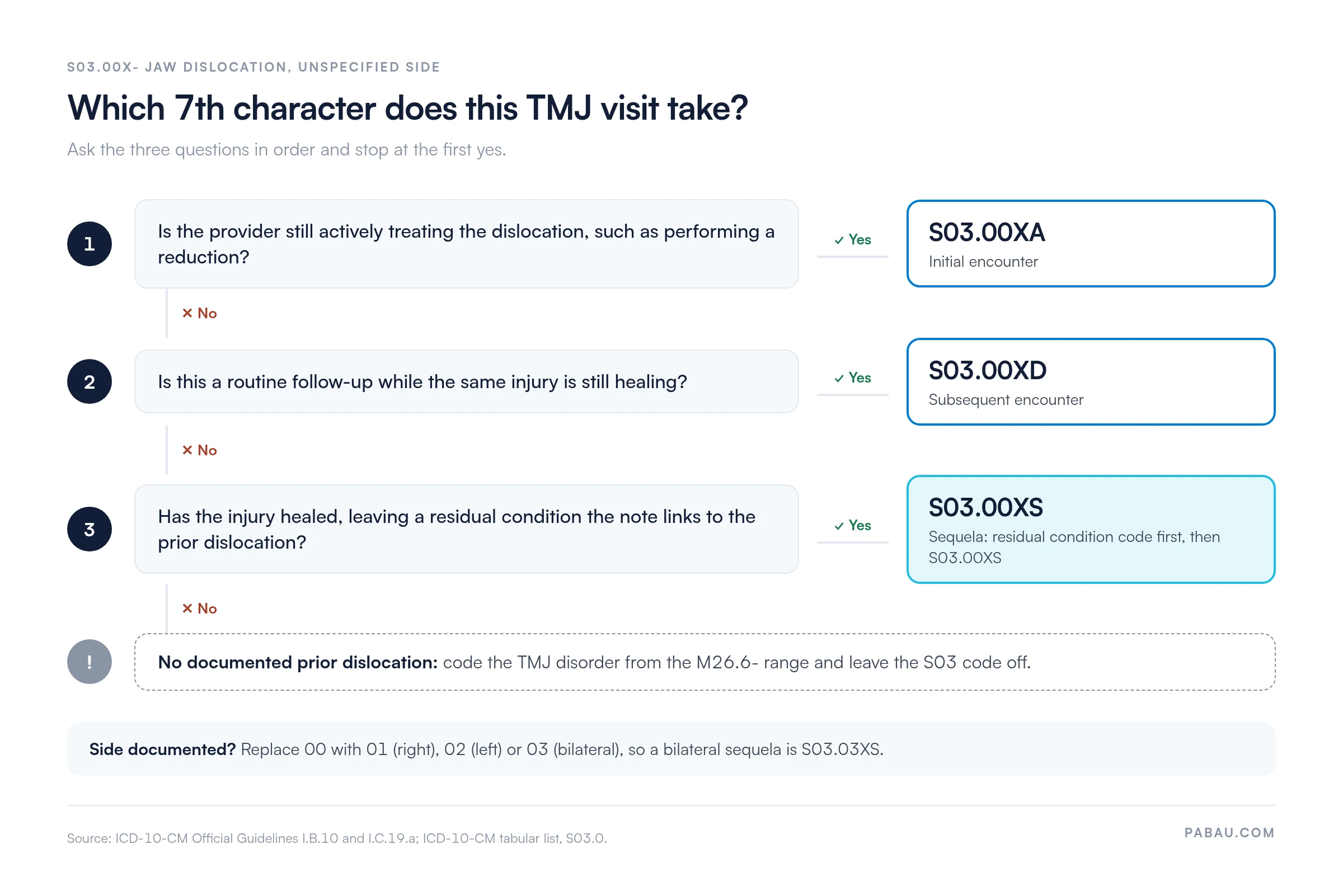
Confusing D and S generates a claim that fails basic edit checks at the clearinghouse level. Take a claim submitted with S03.00XD for a patient whose injury resolved months ago. Its date of service contradicts the healing timeline in the record, which triggers a medical-necessity denial.
S03.00XS sits inside the S03 category block, which covers dislocations and sprains of joints and ligaments of the head. Understanding the surrounding hierarchy helps coders find adjacent codes quickly and confirm they have selected the correct level of specificity.
Laterality matters here. Unspecified side (S03.00) is only for a dislocation whose side the note doesn’t record. ICD-10-CM has separate codes for the right side (S03.01), the left side (S03.02), and a bilateral dislocation (S03.03).
A bilateral sequela is therefore coded S03.03XS, not S03.00XS. Check the current-year table in the CDC/NCHS tool before coding, in case the latest FY update has changed the S03.0 subcategory.
The S03.0 subcategory carries no Excludes1 note that would bar S03.00XS alongside other codes. The code still has clear boundaries, set out below.
What S03.00XS includes:
What S03.00XS does not cover:
The distinction between a sequela-stage dislocation (S03.00XS) and a primary TMJ disorder (M26.6-) matters for both claim routing and medical necessity. Payers have separate coverage policies for traumatic sequelae versus degenerative or idiopathic joint conditions.
A sequela encounter turns on two facts: the original injury has healed, and the current complaint is a residual effect of it. The scenarios below show correct and incorrect use.
Sequela coding lives or dies in the provider note. The coder cannot assign S03.00XS based on clinical inference alone; the documentation must supply an explicit causal link. After the D-versus-S error, missing or vague documentation is the other common reason claims on this code fail.
To support S03.00XS on a claim, the provider note should contain all four of these elements. Building a clean claim from the start means verifying each one before submission.
S03.00XS appears on claims for the management of TMJ sequelae, not for active reduction. Because the original injury has resolved, the paired CPT codes cover evaluation, imaging, physical therapy, and chronic pain management. Acute procedures don’t belong on these claims. Practices that bill through a clearinghouse can send these claims electronically via Claim.MD.
CPT 21480 (closed reduction of TMJ dislocation) is a different case. It covers the active reduction of a displaced joint and belongs with S03.00XA (initial encounter), not with S03.00XS. A sequela encounter documents management of residual effects, not active reduction.
Pairing 21480 with S03.00XS bills a procedure on an injury that no longer exists. Payers flag that medical-necessity mismatch on automated claim review. You can cross-reference valid CPT-to-ICD-10 pairings with the CrossCoder diagnosis-procedure crosswalk tool.
TMJ-related claims sit at the intersection of medical and dental benefits, and that crossover is where coverage disputes concentrate. Practices billing S03.00XS should be aware of three distinct coverage environments, each with different rules.
Medicare: The Medicare Benefit Policy Manual (Chapter 15) generally excludes dental services, so TMJ services billed as dental aren’t covered. Some Local Coverage Determinations (LCDs) do permit coverage when the provider documents a traumatic cause and treats it as a medical condition.
The applicable Medicare Administrative Contractor (MAC) LCD governs, and there is no single national coverage determination. Check the current LCD for your jurisdiction before billing. Coverage is payer-specific and plan-year-specific, so treat this section as a starting point, not a coverage guarantee.
Commercial payers: Most commercial plans cover medically necessary treatment of traumatic TMJ injuries under the medical benefit when a documented traumatic event supports the claim. The sequela character (S) fits this framework, because it shows the visit treats the medical consequence of a prior trauma.
Prior authorization may be required for imaging, specialist referrals, or physical therapy, so confirm requirements with the specific plan. Staying current on medical billing compliance helps practices manage shifting payer requirements.
Medicaid: Coverage for TMJ services varies significantly by state Medicaid program. Some states limit TMJ coverage to oral surgery or omit it entirely from the state plan. Verify eligibility and TMJ coverage at the state-plan level before the visit.
Denials on S03.00XS usually trace to one of five root causes, and each is preventable at the documentation or coding stage. Practices with high denial rates on this code should audit for these patterns first.
Pabau’s claims management software checks required claim details, such as membership numbers and authorization codes, before each submission. For a broader view of denial resolution, the denial management process covers systematic corrective workflows.
Denials on injury sequelae come back with claim adjustment reason codes (CARCs) and remittance advice remark codes (RARCs). Our reference on medical billing denial codes lists the common ones, with a resolution path for each.
Run a monthly audit on all claims submitted with a 7th character S across your S03 code family. Filter for any that were later denied for medical-necessity or invalid-diagnosis reasons. Those denials usually trace to one of two causes: missing causal documentation or incorrect sequencing. Fixing the intake and documentation workflow prevents more denials than correcting claims one by one after they come back.
Coders in oral and maxillofacial surgery, physical therapy, and primary care need to tell S03.00XS apart from several closely related codes. Two errors come up often. One is using the unspecified-side code when the note documents the side. The other is using an M26.6- code when a traumatic dislocation is documented, or an S03 code when it isn’t.
Coders can validate their final code selections against the AAPC Codify ICD-10-CM lookup tool. It includes cross-references, official guideline notes, and medical necessity crosswalk data for each code.
Two sections of the ICD-10-CM Official Guidelines for Coding and Reporting govern sequela coding for injury codes. CMS and the National Center for Health Statistics (NCHS) maintain the guidelines and update them each October 1.
Section I.B.10 – Sequela (Late Effects): Defines a sequela as “a residual effect (condition produced) after the acute phase of an illness or injury has terminated.” It sets the sequencing rule: code the residual condition first, then the injury code that carries the sequela character. Sequela codes carry no time limit, so a patient can present with a TMJ sequela years after the original injury.
Section I.C.19.a – Application of 7th Characters in Chapter 19: Chapter 19 covers injuries, poisoning, and certain other consequences of external causes. This section confirms that each code in Chapter 19 that requires a 7th character must have that character assigned for every encounter. It distinguishes initial encounter (A), subsequent encounter (D), and sequela (S). It also confirms that the injury code with 7th character S follows the residual-condition code.
The CMS ICD-10-CM coding page publishes the full official guidelines and the annual FY tabular list update files. Practices should verify S03.00XS against the current-year release each October to confirm the code remains active and unchanged.
Electronic claims carry this sequencing to the payer. In 837P electronic claims, the residual condition code and S03.00XS travel in the order the coder set. Electronic remittance advice (ERA) responses then flag any denial reason codes tied to sequencing errors. That makes correction faster than reviewing paper claims by hand.
Getting S03.00XS paid depends on two things. The coder has to pick the right 7th character and sequence, and the claim has to reach the payer complete. The first is a coding judgment, and the second is where claims software takes over the checking.
Pabau runs validation checks every time your team sends a claim, so details such as membership numbers and authorization codes are in place first. US practices send claims electronically through Pabau’s Claim.MD integration without leaving the platform.
Each claim then shows its status in one view, from pending and submitted through processing, paid, or error. ERA remittances post against the right invoice, so a rejected sequela claim is easy to spot, correct, and resend.

Pabau checks claim details such as membership numbers and authorization codes before each submission, then sends claims electronically through Claim.MD. Your team tracks every claim’s status from one dashboard.

S03.00XS pays only when three things line up. The injury has healed, the note names the prior dislocation as its cause, and the residual condition is listed first.
Start with the note template. Add a prompt for the causal statement on every TMJ follow-up, and check the documented side before reaching for the unspecified code. Each denied sequela claim costs a resubmission, while a better template prevents the next one.
With the coding settled, Pabau checks payer details before each claim goes out and sends it through Claim.MD. Book a demo to see how Pabau keeps your S03.00XS claims complete from note to payment.

Looking to understand the broader clearinghouse workflow? Medical claims clearinghouse explains how clearinghouses validate ICD-10 codes, manage 837P transactions, and route ERA responses back to your practice.
Want to reduce your practice’s overall denial rate? Revenue cycle management outlines the full claim lifecycle from eligibility verification through payment posting and denial resolution.
ICD-10 Code S03.00XS is the billable ICD-10-CM diagnosis code for dislocation of jaw, unspecified side, sequela. It covers a residual condition arising from a prior, healed temporomandibular joint (TMJ) dislocation. The claim needs two codes: the residual-condition code first, then S03.00XS as the causal injury code.
Use S03.00XA for the initial encounter when the dislocation is current and receiving active treatment. Use S03.00XD for routine follow-up visits while the same injury is still healing. Use S03.00XS only when the original injury has resolved and has left a new residual condition, such as chronic instability or post-traumatic arthritis.
A subsequent encounter (7th character D) describes a visit during the active healing phase of the same injury. A sequela (7th character S) describes a new condition that is a late effect of an injury that has already healed. The original injury no longer exists as an active condition at a sequela encounter. The provider is treating the downstream residual.
The note needs a causal statement linking the current condition to a prior TMJ dislocation, plus the rough date of the original injury. It also needs a description of the residual condition treated today and supporting findings, such as imaging or exam results. Missing any one of these four elements is grounds for a medical-necessity denial.
The most common reasons are a wrong 7th character (D instead of S) and S03.00XS listed alone, without a leading residual-condition code. Others are missing causal documentation and TMJ services routed to a dental benefit that excludes them. A CPT-ICD mismatch, such as an acute-reduction CPT code paired with a sequela code, also triggers denials.
The S03.00X- family also includes S03.00XA (initial encounter) and S03.00XD (subsequent encounter). Side-specific sequela codes are S03.01XS (right), S03.02XS (left), and S03.03XS (bilateral). TMJ disorders without a documented traumatic origin take M26.6- codes instead. Examples are M26.61- for adhesions and ankylosis and M26.69 for other specified disorders. Use S03.00XS only when a prior traumatic dislocation is explicitly documented.