

CCSD code G5100: Bypass of duodenum billing guide
CCSD code G5100 bills a bypass that leaves the duodenum in place CCSD code G5100...

Last Updated: Oct 16, 2026
92550 is the CPT code for tympanometry combined with acoustic reflex threshold measurements, billed as a single bundled service when both components are completed in the same encounter. If only tympanometry is performed, report CPT 92567 instead. If only the reflex thresholds are measured, report CPT 92568.
Medicare pays 92550 under the Physician Fee Schedule, so the rate changes each year with the conversion factor and locality. Most denials trace back to unbundling the two components, a missing modifier -52, or an ICD-10 code that is less specific than the chart supports.
Let Pabau's smart automation suggest the right codes, reduce claim denials, and keep your practice compliant—effortlessly.
Automate repetitive tasks and focus on what matters most—your patients.
Reduce coding errors and ensure compliance with the latest regulations.
Clean claims, fewer denials, and faster reimbursements.
Powerful insights and reporting to help your practice thrive.
HIPAA compliant SOC 2 certified GDPR-compliant Trusted by 4,000+ clinics worldwide

CPT Code 92550 is a bundled code covering both tympanometry and acoustic reflex threshold testing in one visit
Bill CPT 92567 for tympanometry alone and CPT 92568 for acoustic reflex thresholds alone
Medicare pays 92550 under the Physician Fee Schedule, so verify current rates in the CMS PFS Look-Up Tool before billing
Modifier -52 applies when only one component is completed, and modifier -59 marks a distinct same-day service
Pabau’s claims management software standardizes how codes and modifiers are captured at the point of documentation, then routes 92550 claims through electronic clearinghouse submission
CPT Code 92550 is the AMA-defined code for tympanometry with reflex threshold measurements. It covers a combined evaluation of middle ear function, performed in a single clinical session. The code sits within the Audiologic Function Tests section (92550-92700) of the CPT code set.
The procedure has two components. Tympanometry measures middle ear pressure, mobility, and volume by introducing a tone and varying air pressure in the sealed ear canal. Acoustic reflex threshold testing measures the minimum sound level that triggers the stapedial reflex, a protective muscle contraction in response to loud sound.
Together, these tests support diagnosis of middle ear pathology, conductive hearing loss, Eustachian tube dysfunction, and retrocochlear disorders. Use 92550 when both components are completed in the same encounter. If only tympanometry is performed, bill CPT 92567 instead. If only the acoustic reflex threshold is measured, bill CPT 92568, the standalone code for acoustic reflex testing, threshold.
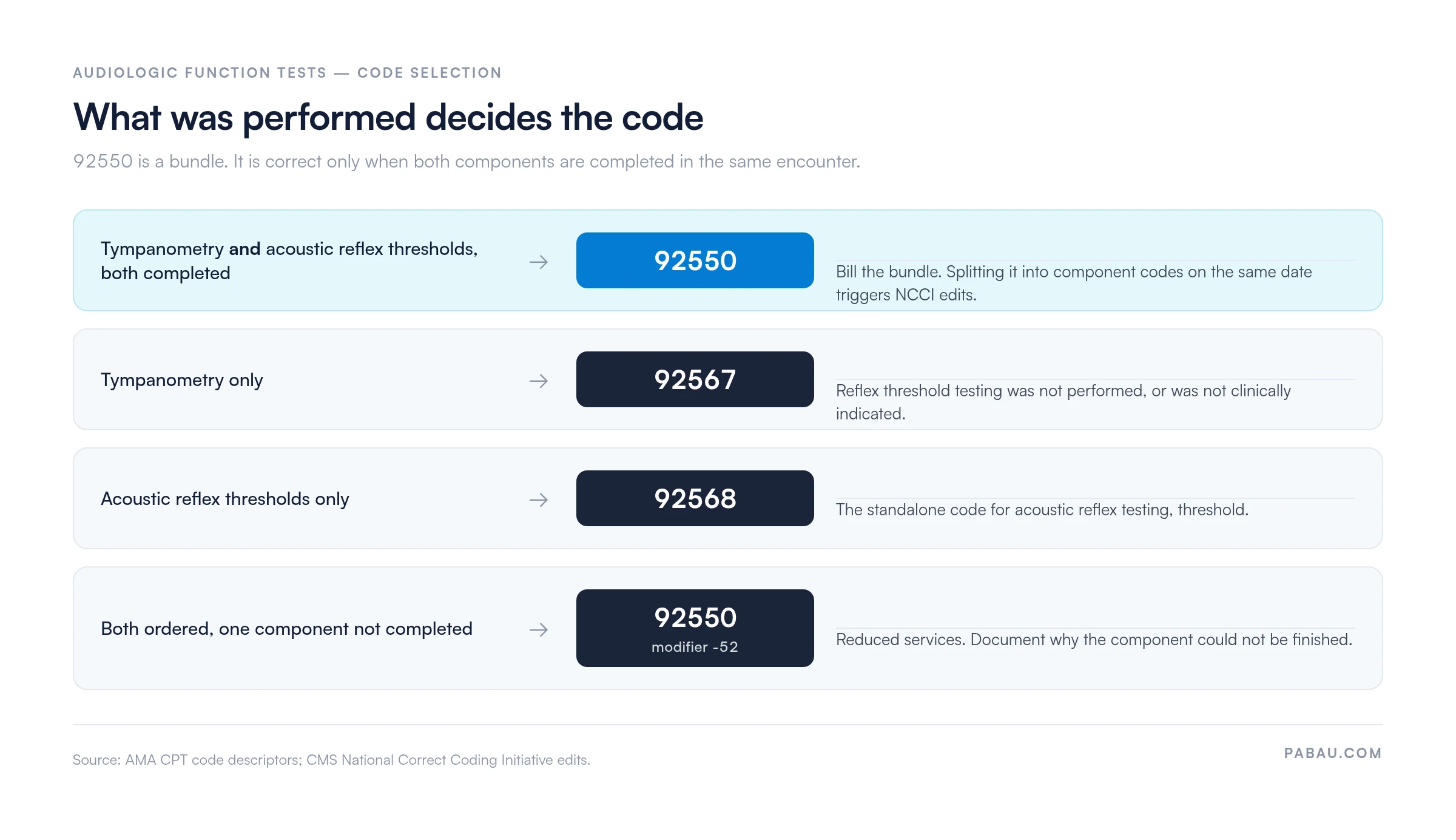
Selecting the correct code from the audiology section prevents both underbilling and NCCI bundling denials. The table below compares 92550 with the codes most frequently confused with it, including their scope, standalone billing status, and common pairing rules.
Before billing 92557 alongside CPT Code 92550 on the same date, verify current NCCI edit tables. The same check applies to 92552 when it shares a date of service with 92550. Payer-specific bundling rules can differ from national NCCI edits, mainly under commercial policies. Always confirm medical necessity is documented for each code billed.
Run that same NCCI check for CPT Code 92540, the basic vestibular evaluation. It is a separate four-test battery, so the 92550 bundle does not cover it.
Tympanometry reports on the middle ear, so an otoacoustic emissions test often follows to assess cochlear function. Billing 92587 on the same date as 92550 is subject to NCCI pairing restrictions, so confirm those first. A DPOAE map covering 12 or more distinct frequencies in each ear bills as CPT 92588 instead.
Medicare reimburses CPT Code 92550 under the Medicare Physician Fee Schedule (MPFS), run by the Centers for Medicare and Medicaid Services. Payment rates are updated each year and vary by geographic locality. Pull current figures from the CMS PFS Look-Up Tool rather than from published benchmarks, which often reflect a prior fee schedule year.
Medicare payment is calculated from Relative Value Units (RVUs) multiplied by the annual conversion factor. The three RVU components for 92550 are work RVU (physician effort and skill), practice expense RVU (overhead), and malpractice RVU. Take the current values from the CMS fee schedule file before you submit.
Non-facility (office) rates for 92550 are often higher than facility rates, because the practice expense RVU accounts for equipment the practice owns and operates. In a hospital outpatient department, the facility carries that overhead instead, so the practice expense component is lower.
Commercial insurers often cover CPT Code 92550 when medical necessity is established, though reimbursement rates vary. Most private payers use Medicare rates as a reference, paying anywhere from 80% to 130% of the MPFS rate depending on contract terms.
Medicaid coverage for 92550 differs by state. Pediatric audiology claims under Medicaid may carry extra authorization requirements. Check your payer’s fee schedule and prior authorization rules before the procedure is scheduled.
Applying the correct modifier prevents denials and audit exposure. The modifiers below are most frequently applicable to tympanometry and acoustic reflex threshold billing.
Modifier -59 requires robust documentation. The clinical record must show that 92550 was performed as a distinct service, with a separate indication from any other same-day procedure. Without that proof, payers will deny the unbundled claim on audit. Confirm the current NCCI edit rules with the AAPC Codify tool before you apply modifier -59 as routine.
Run a quarterly modifier audit on your 92550 claims. Pull every claim billed with modifier -59 or -52 in the prior 90 days and cross-check each one against the matching clinical note. Where the documentation does not explicitly support the modifier, update your note templates to capture that language at the point of service.
Every 92550 claim needs a diagnosis code that establishes medical necessity. The relevant ICD-10-CM codes sit in the H-series, which covers diseases of the ear and mastoid process. Pairing 92550 with a vague or mismatched diagnosis is a frequent denial trigger on first submission.
Code to the highest specificity available. If the patient’s laterality is documented (left, right, or bilateral), use the laterality-specific ICD-10 code rather than the unspecified variant. Payers including CMS follow CMS ICD-10 coding guidelines that require the most specific code the documentation supports.
A post-payment audit tests the chart, not the claim. To support CPT Code 92550, the clinical record must contain each of the following before the claim is submitted.
These are the mistakes most likely to generate a denial or audit flag for 92550. Each one has a specific fix that practices can build into their workflow.
Audiology billing errors cluster at the handoff between the clinical note and the billing system. A clinician completes both tests and writes up the results. A biller then re-keys the code data into a separate system, and that step is where codes get dropped and modifiers get missed.
Practice management software like Pabau removes the re-keying step. Practices configure audiology service templates that pre-populate 92550, the applicable modifiers, and the most frequently used ICD-10 pairings inside the clinical record. When the clinician finalizes the note, the billing detail travels with it.
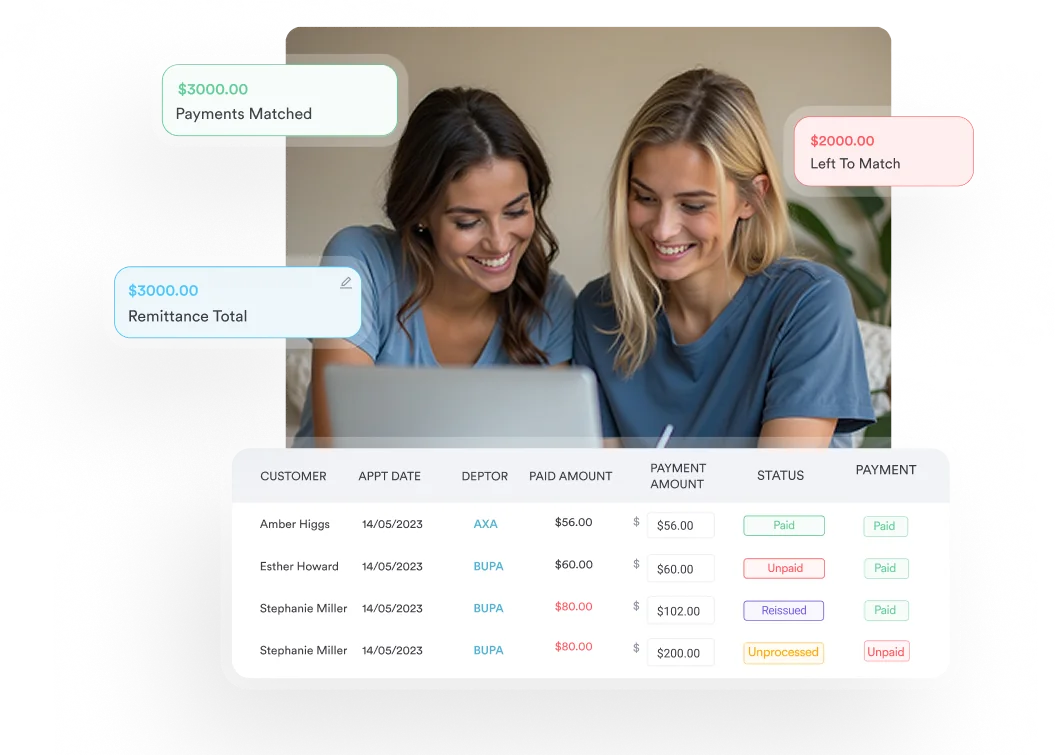
Pabau’s claims software for audiology practices then sends the claim through Claim.MD, our US clearinghouse partner. Claim.MD reaches thousands of payers. It supports real-time eligibility verification, 837P electronic claim submission, and electronic remittance advice (ERA) processing.
Practices on this workflow can spot underpaid 92550 claims by comparing what landed against the expected rate. The alternative is finding the shortfall months later, during a manual reconciliation.
Configure a 92550-specific billing template that requires the audiologist to confirm both tympanogram type and acoustic reflex threshold results before the note can be finalized. That single workflow gate catches missing data before the claim leaves the practice, which cuts denials for incomplete documentation.

Pabau standardizes how codes, modifiers, and diagnosis pairings are captured at the point of documentation, then carries them into the claim. Your billers work from the note instead of rebuilding it.

Most 92550 denials trace back to a question the chart answers too late. Were both components actually completed? Once the note records that answer, the code, the modifier, and the diagnosis all follow from it.
The bundle pays more than either component alone, and it is also the easier claim to lose. A tympanogram documented without reflex thresholds does not meet the descriptor, whatever the order said. That is worth remembering every time a test is cut short.
Build the check into the workflow rather than into the audit. Book a demo to see how Pabau keeps the code, the modifier, and the diagnosis attached to the audiology note that produced them.

Need to understand denial workflows for audiology claims? Denial management in healthcare explains how to spot denial patterns and build a clear appeals process.
Billing other healthcare CPT codes? CPT codes for coaching and health services covers coding considerations for adjacent clinical service types.
Looking for IVF and reproductive medicine CPT references? IVF CPT codes covers the most commonly billed codes in reproductive medicine billing workflows.
Want to verify eligibility before submitting 92550 claims? Insurance eligibility verification outlines how real-time eligibility checks reduce claim rejections before submission.
CPT Code 92550 includes two audiologic tests performed in the same encounter. Tympanometry measures middle ear pressure and mobility. Acoustic reflex threshold measurement finds the minimum sound level that triggers the stapedial reflex. Both components must be completed to bill the code as described. If only one component is performed, a reduced service modifier or a component code should be used instead.
Yes, Medicare covers CPT 92550 when medical necessity is established and documentation supports the services performed. Coverage is governed by the Medicare Physician Fee Schedule and applicable Local Coverage Determinations. Practices should verify coverage under CMS LCD Article A57434. Confirm too that the treating or supervising provider is enrolled in Medicare with the right specialty designation for audiology.
The Medicare national average reimbursement for CPT 92550 varies by geographic locality and changes yearly with each fee schedule update. Pull current rates directly from the CMS Physician Fee Schedule Look-Up Tool rather than relying on figures that may be outdated. The non-facility (office) rate is often higher than the facility rate because of the practice expense RVU component.
Four modifiers come up most often with CPT 92550. Modifier -52 covers reduced services, when one component is not completed. Modifier -59 marks a distinct procedural service on the same date as a code with an NCCI edit. Laterality modifiers -LT and -RT apply to unilateral testing where the payer requires them. Modifier -76 applies when a repeat procedure is performed by the same physician on the same day with documented clinical justification.



