ICD-10 Code R63.4: Abnormal weight loss
ICD-10 code R63.4: Definition, billability and code structure ICD-10 code R63.4 ...

Last Updated: Nov 13, 2026
Billable Code Specific Code
M79.604 is the billable ICD-10-CM code for pain in right leg, which also covers pain in right lower limb NOS. Use it when the provider documents right leg pain and has not yet confirmed a cause or a narrower site.
It sits under M79.60, Pain in limb, unspecified, beside M79.605 for the left leg. Denials tend to follow when the note names the thigh, the lower leg or a joint, or a confirmed diagnosis that has its own code.
Let Pabau's smart automation suggest the right codes, reduce claim denials, and keep your practice compliant—effortlessly.
Automate repetitive tasks and focus on what matters most—your patients.
Reduce coding errors and ensure compliance with the latest regulations.
Clean claims, fewer denials, and faster reimbursements.
Powerful insights and reporting to help your practice thrive.
HIPAA compliant SOC 2 certified GDPR-compliant Trusted by 4,000+ clinics worldwide

M79.604 is the billable ICD-10-CM code for pain in right leg, and it also covers pain in right lower limb NOS.
Use it while the workup is open, then switch to the confirmed diagnosis or a narrower site code such as M79.661 or M79.651.
Pain in a joint belongs to M25.5- under an Excludes2 note at M79.6, so right hip or knee joint pain takes its own code.
M79.60 has no bilateral code, so pain in both legs is reported as M79.604 plus M79.605.
Most denials trace back to the note: a missing side, a vague site, or a confirmed diagnosis left off the claim.
ICD-10 code M79.604 is the billable code for pain in right leg, listed under M79.60. The FY2027 tabular list in the CMS ICD-10-CM code files adds the inclusion term pain in right lower limb NOS. In other words, it covers the leg as a whole.
That makes it a symptom code with a short shelf life. It fits the first visits, when the provider has documented right leg pain but hasn’t pinned down a site or a cause. Once they do, a narrower code takes over.
These are the facts an encoder or a pre-submission audit will check.
To confirm the descriptor yourself, search the code in the CDC’s ICD-10-CM browser tool.
ICD-10-CM accepts a symptom code when the provider hasn’t confirmed a related diagnosis. That rule sits in Section I.B.4 of the FY2027 official coding guidelines, and it’s the whole basis for M79.604.
It fits encounters like these:
Switch codes when the note changes. A confirmed diagnosis replaces M79.604 rather than joining it, because Section I.B.5 says symptoms routinely tied to a confirmed condition aren’t coded separately.
Here is how it plays out over three visits for an illustrative patient. At visit one, the note reads “aching pain, right leg, three weeks, no injury.” The provider orders a lumbar MRI, and M79.604 is correct.
At visit two, the MRI is still pending, and the pain now sits mostly below the knee. The note says so, which moves the claim to M79.661, pain in right lower leg.
At visit three, the provider diagnoses right-sided sciatica, and the MRI shows no disc disorder. M54.31 becomes the diagnosis, and the leg pain code drops off the claim.
M79.604 inherits one Excludes2 note from M79.6 and two Excludes1 notes from category M79. They work in opposite directions.
Day to day, the Excludes2 note is the one that matters. “Right knee pain” in a note usually means the joint, which is M25.561 rather than M79.604.
Most errors on this code come from site choice. Read the note in a fixed order, and stop at the first site or cause it names.
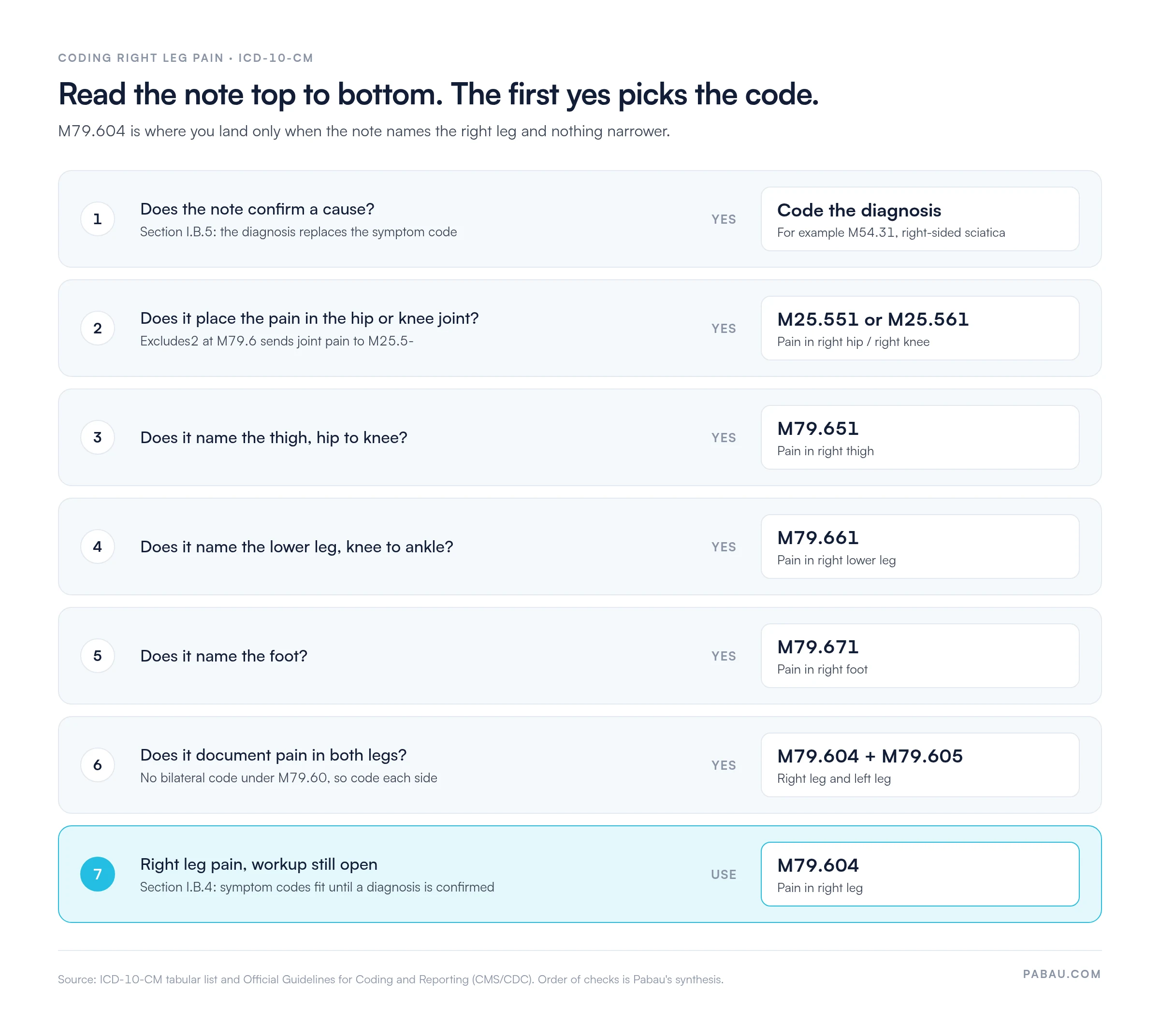
The table lists the neighbors that get swapped with M79.604, and the wording in the note that decides between them.
Use M79.606 sparingly. Section I.B.13 reserves the unspecified-side code for a record that doesn’t identify the side, so query the provider before you settle for it. Our guides to M79.671 for right foot pain and M25.551 for right hip pain cover those neighbors in depth.
M79.60 has no bilateral code. Section I.B.13 says to assign a separate code for each side when no bilateral code exists. Pain in both legs is therefore M79.604 plus M79.605 on the same claim.
Myalgia has its own subcategory, M79.1-, with four codes. They are M79.10 (unspecified site), M79.11 (mastication muscle), M79.12 (auxiliary muscles, head and neck) and M79.18 (other site).
None of them takes a 7th character, and none names the leg. When a provider documents “myalgia, right calf muscle,” the code is M79.18, and the side stays in the note. Plain “right leg pain” stays on M79.604.
Pull last quarter’s M79.604 claims and search the notes for knee, hip, thigh and calf. Each hit is a candidate for a narrower code, so fix the pattern before the next visit is billed.
Encoders sometimes offer M79.60 on its own, and it can’t go on a claim. Pick one of its seven children instead. There is no M79.600, so a claim carrying it will reject.
Each step can stall the claim. The checklist below catches most problems before the payer does.
Payers rarely object to M79.604 itself. They object when the code and the record disagree.
Our list of medical billing denial codes decodes the remark codes on these denials. Once the same denial keeps returning, a structured denial management process stops the repeat work.
M79.604 often appears on therapy claims, because referrals tend to arrive before a cause is named. The code tells the payer where it hurts. It doesn’t show why skilled therapy is needed.
Services billed with it often include the PT evaluations (97161 to 97163), therapeutic exercise (97110), manual therapy (97140) and therapeutic activities (97530). Each needs its own support in the record:
On Medicare claims, therapy above the annual threshold also needs the KX modifier and records that support medical necessity.
Leg pain claims rarely fail on the code alone. They fail when the note, the authorization and the claim drift apart over a run of therapy visits.
Pabau, the practice management and billing platform we build, keeps those pieces on one patient record. For US practices, claims management runs through Claim.MD. Your team checks eligibility, sends CMS-1500/837P claims and receives ERA remittances in one place, secondary claims included.
Prior authorizations are tracked on the case, with the auth code, dates and sessions recorded. Pabau warns staff when an authorization is missing, so the team can chase it before a visit is billed.

Pabau sends 837P claims through Claim.MD, checks eligibility and brings ERA remittances back to the patient record. Prior authorizations are tracked on the case, with a warning when one is missing.

Treat M79.604 as a placeholder with a purpose. It gets the first visits billed honestly while the workup runs, and it should give way once the note names a site or a cause.
The habit that saves the most rework is reading the note for site words before you code. Knee, thigh and calf each point somewhere more precise, and payers notice when a claim ignores them.
Book a demo to see how Pabau keeps eligibility, authorizations and claims on one record for your leg pain patients.

Coding right foot pain instead? ICD-10 code M79.671 covers pain in right foot and how it differs from the leg codes.
Is the pain in the knee joint? ICD-10 code M25.561 explains when right knee pain takes the joint code instead of M79.604.
Documenting leg pain as chronic? ICD-10 code G89.29 covers other chronic pain and how to sequence it with a site code.
Need a denial workflow for symptom codes? Denial management in healthcare covers how to build a repeatable process for resolving denials.
Want to see where coding fits in the bigger picture? What is revenue cycle management explains how diagnosis coding connects to each stage of the billing cycle.
Yes. In outpatient settings, a symptom code can be listed first when the provider hasn’t confirmed a diagnosis. Once a cause is confirmed, that diagnosis leads instead.
Add G89.29, Other chronic pain, when the provider documents the pain as chronic. If the visit is for pain management, G89.29 goes first, followed by M79.604. Otherwise, M79.604 leads.
Code the injury itself, from Chapter 19. Knee and lower leg injuries fall in S80-S89, and hip and thigh injuries in S70-S79, each with a 7th character for the encounter.
Leg cramps code to R25.2, Cramp and spasm. Use it when the note describes cramping rather than ongoing leg pain.
Yes. M79.604 is valid in the current ICD-10-CM code set, FY2027, effective October 1, 2026. Its descriptor is unchanged.