
Pabau Engage inbox

Pabau Engage is here: every patient conversation in one inbox.

Learn more
ICD-10-CM Code

ICD code K92.2 – GI hemorrhage, unspecified

Billable Code Specific Code


Code Definition

K92.2 is the billable ICD-10-CM code for gastrointestinal hemorrhage, unspecified. It covers a GI bleed whose source hasn't been found, including gastric or intestinal hemorrhage with no further detail.

It sits in category K92 within Chapter 11, Diseases of the digestive system (K00-K95), and is valid for fiscal year 2027 claims. Once the chart names the source or how the blood appeared, a more specific code replaces it. Common ones are K92.0 for hematemesis, K92.1 for melena and K62.5 for rectal hemorrhage.

Chapter
K00-K95 Diseases of the digestive system
Category
K92 Other diseases of digestive system
Group
K90-K95 Other diseases of the digestive system
Billable
Yes
Code also known as
GI bleed unspecified source, GI bleeding unspecified, gastrointestinal bleeding unspecified
Save time. Improve accuracy. Get paid faster.
Automate coding with Pabau

Let Pabau's smart automation suggest the right codes, reduce claim denials, and keep your practice compliant—effortlessly.

  • AI-powered code suggestions
  • Real-time compliance checks
  • Faster claims, fewer denials
Why practices choose Pabau
Save hours every week

Automate repetitive tasks and focus on what matters most—your patients.

Improve accuracy

Reduce coding errors and ensure compliance with the latest regulations.

Get paid faster

Clean claims, fewer denials, and faster reimbursements.

Grow with confidence

Powerful insights and reporting to help your practice thrive.

HIPAA compliant SOC 2 certified GDPR-compliant Trusted by 4,000+ clinics worldwide

Key takeaways

Key takeaways

K92.2 is the billable ICD-10-CM code for a GI bleed with no identified source, and it is valid for FY 2027 claims.

K92.0 (hematemesis) and K92.1 (melena) are distinct, more specific codes, reported instead of K92.2 when vomited blood or melena is documented.

The Excludes1 notes on K92.2 are K25–K28, K29.-, K31.811, K57.- and K62.5, so a confirmed source from that list replaces it.

An inpatient “probable” source at discharge is coded as confirmed, but an outpatient one isn’t, so the same bleed can code differently by setting.

Pabau’s claim validation catches missing or invalid claim details before submission, and shows the reason when a payer rejects a claim.

ICD-10 code K92.2 is for a GI bleed with no known source

ICD-10 code K92.2 is the billable ICD-10-CM code for gastrointestinal hemorrhage, unspecified. It’s listed in CMS’s FY 2027 ICD-10-CM files, which apply to discharges from October 1, 2026 to September 30, 2027. Its inclusion terms are gastric hemorrhage NOS and intestinal hemorrhage NOS.

In practice, it’s the code for a bleed the chart can’t place yet. Once the note says how the blood appeared, or where it came from, a more specific code takes over.

FieldDetail
CodeK92.2
Full descriptorGastrointestinal hemorrhage, unspecified
Inclusion termsGastric hemorrhage NOS, intestinal hemorrhage NOS
BillableYes, valid for FY 2027 claim submission
Effective fromOctober 1, 2015, with no revision or deletion through the FY 2027 update
Parent categoryK92 Other diseases of digestive system
ChapterChapter 11: Diseases of the digestive system (K00-K95)
Excludes1 notesK29.- gastritis and duodenitis with hemorrhage (incl. K29.01), K31.811 angiodysplasia of stomach with hemorrhage, K57.- diverticular disease with hemorrhage, K62.5 hemorrhage of anus and rectum, K25-K28 peptic ulcer with hemorrhage

K92.2 fits four situations cleanly:

  • An admitted GI bleed where upper and lower endoscopy didn’t find the source.
  • A mixed picture where both an upper and a lower source are possible, and the workup is inconclusive.
  • A transfer patient with a documented GI hemorrhage and no etiology in the record.
  • An outpatient or ED visit for a GI bleed that hasn’t been scoped yet.

Specific codes and Excludes1 notes push K92.2 aside

Two kinds of code replace K92.2, and they work differently. Excludes1 codes can never share a claim with it. More specific codes simply describe the same bleed better, so you use them instead.

The Excludes1 list is short. Each entry is a confirmed source with the bleed built into the code. Once the chart names one, K92.2 comes off the claim.

CodeDescriptorDocumentation trigger (use this instead of K92.2)
K25-K28Peptic ulcer with hemorrhageEndoscopy confirms a gastric, duodenal, peptic or gastrojejunal ulcer as the source
K29.- (incl. K29.01)Gastritis and duodenitis with hemorrhageThe provider documents gastritis or duodenitis as the bleeding source
K31.811Angiodysplasia of stomach and duodenum with bleedingGastric or duodenal vascular ectasia confirmed as the bleeding lesion
K57.- (e.g., K57.11, K57.31)Diverticular disease with hemorrhageDiverticula confirmed as the source of bleeding
K62.5Hemorrhage of anus and rectumSource confirmed as anorectal

Rectal bleeding is the case coders meet most. When the provider confirms an anorectal source, report K62.5 and drop K92.2.

The second group isn’t Excludes1, but each code beats K92.2 when the note supports it. If the patient vomited blood, report K92.0 instead. If the note describes black, tarry stool, K92.1 is the better fit.

CodeDescriptorMore specific code to use instead (not an Excludes1 note)
K92.0HematemesisThe chart documents vomiting of blood
K92.1MelenaThe chart documents black, tarry stool, or blood in feces
R19.5Other fecal abnormalities (occult blood in feces)A positive occult blood test with no bleed documented
K55.21Angiodysplasia of colon with hemorrhageColonic vascular ectasia confirmed as the source (not on the K92.2 Excludes1 list)

One index entry catches coders out. In the ICD-10-CM index, “blood in feces” leads to K92.1, not K92.2. Occult blood leads to R19.5. So a note that says “blood in stool” is not an unspecified GI bleed.

Put together, the codes form a short decision path. Ask four questions in order, and the first yes picks the code.
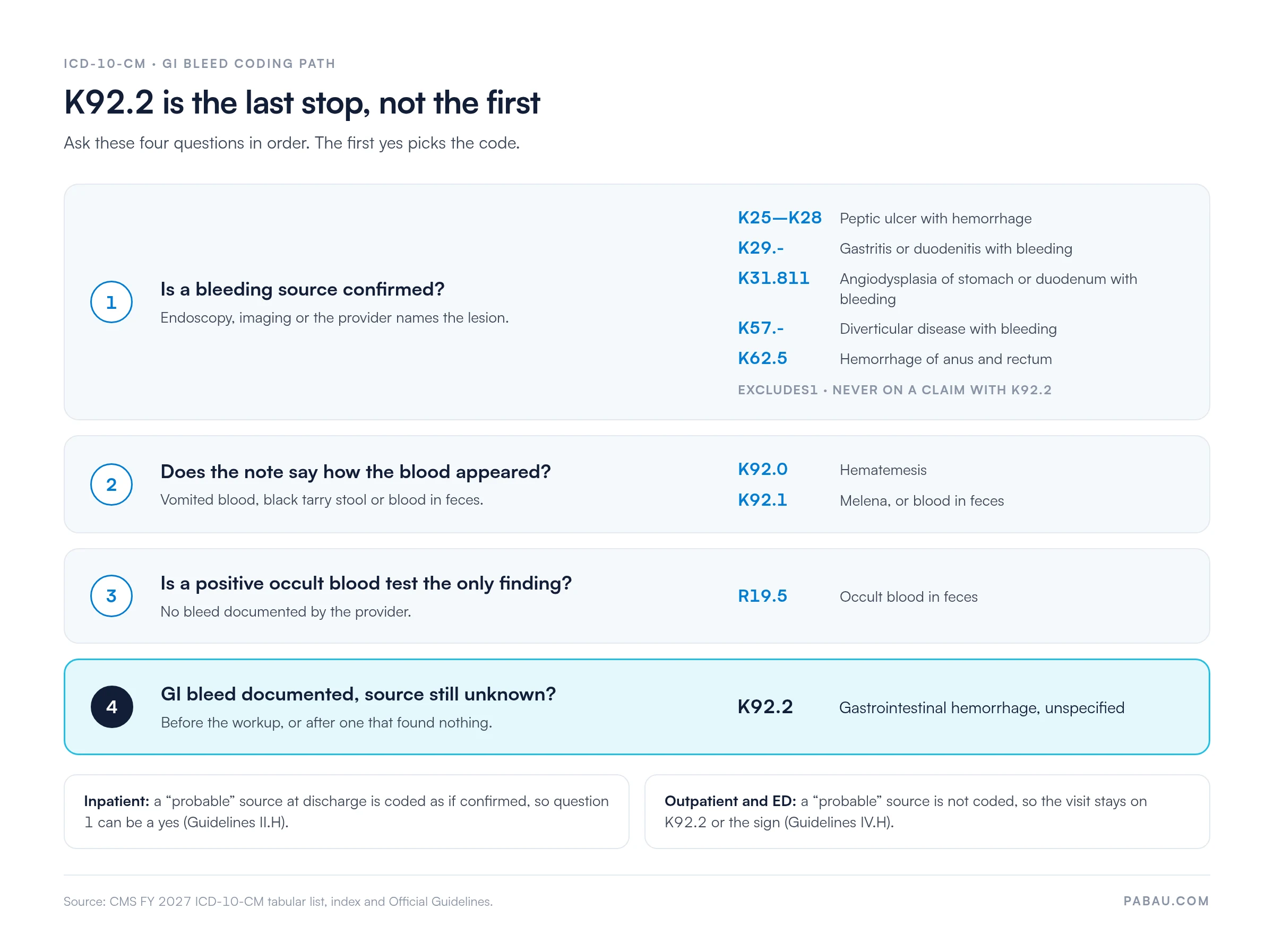
Four-question decision path for coding a GI bleed
K92.2 only applies once a confirmed source, a named manifestation and an occult-only finding have all been ruled out. Codes and rules come from CMS’s FY 2027 ICD-10-CM files.

Sequencing K92.2 turns on the care setting

The same bleed can code two ways, depending on whether the patient was admitted. The difference comes down to how each setting treats an uncertain diagnosis.

Inpatient: A probable source counts

The principal diagnosis is the condition found, after study, to be chiefly responsible for the admission. If no source is confirmed by discharge, K92.2 is the principal diagnosis.

Section II.H of the Official Guidelines adds a twist. A diagnosis documented at discharge as “probable”, “suspected” or “likely” is coded as if it were established. So “probable diverticular bleed” on the discharge summary means a K57.- code, and K92.2 drops off.

Outpatient and ED: Code only what’s certain

Section IV.H says the opposite for outpatient and ED visits. Uncertain diagnoses aren’t coded, so you code to the highest certainty for that visit. A “likely diverticular” bleed in the ED stays on K92.2, or on the sign the note documents.

One bleed, two settings: A worked example

A 72-year-old arrives in the ED with bright red blood per rectum and a falling hemoglobin. The ED note reads “lower GI bleed, likely diverticular”. The ED claim carries K92.2, because “likely” isn’t coded in that setting.

She’s admitted, and colonoscopy shows diverticulosis with no active bleeding. The discharge summary says “probable diverticular bleed”. The inpatient claim carries K57.31, and K92.2 never appears beside it.

Secondary codes that travel with K92.2

Acute blood loss anemia, D62, is the secondary code that matters most on these encounters. Report it when the provider documents anemia caused by the bleed. A low hemoglobin on its own doesn’t support it.

The FY 2027 ICD-10-CM Official Guidelines only let you code an abnormal lab finding when the provider says it’s clinically significant. If the hemoglobin dropped and the note is silent, send a query.

Secondary codeDescriptorWhen to reportMandatory or situational
D62Acute posthemorrhagic anemiaThe provider documents anemia due to the hemorrhageMandatory when documented
Z87.11Personal history of peptic ulcer diseaseThe history is documented and affects current managementSituational
Z79.01Long-term (current) use of anticoagulantsThe patient takes an anticoagulant that may have contributed to the bleedSituational

Pro Tip

Read the discharge summary before you finalize an inpatient K92.2. If the attending names a probable source there, code that source and drop K92.2. If the summary is vague after an endoscopy, query before you code.

Documentation that holds K92.2 up in an audit

An unspecified code draws more scrutiny, not less, because payers know it gets used as a shortcut. Meeting medical billing compliance here means the chart has to show why nothing more specific fits. Look for four things in the note:

  • A clear statement of a GI bleed. “GI bleed” and “GI hemorrhage” both index to K92.2. “Heme-positive stool” or “rule out GI loss” do not.
  • The source status. The note says endoscopy or evaluation didn’t find the source, or that the workup hasn’t happened yet.
  • Clinical indicators. A hemoglobin drop, hemodynamic instability, a transfusion, or endoscopic signs of recent bleeding.
  • Evidence that specific causes were considered. The record should show the clinician looked for a source and ruled the likely ones out.

When the note is ambiguous, a compliant query is the fix. Ask whether a source was identified, and whether the hemoglobin drop reflects acute blood loss anemia. Never lead the provider toward a particular answer.

On endoscopy claims, K92.2 stays only until the source is found

K92.2 is a common indication on diagnostic EGD (CPT 43235) and colonoscopy (CPT 45378) claims, when the scope is looking for the source. It supports medical necessity as long as the record shows the source wasn’t known beforehand.

  • Check your MAC. Applicable MAC LCDs generally accept an unspecified hemorrhage code as a procedure indication when the notes support it. Confirm the current policy before you submit, because it changes.
  • Code the finding. For outpatient procedures, the postoperative diagnosis wins when it differs from the preoperative one. If the scope finds diverticular bleeding, the claim carries the K57.- code, not K92.2.
  • Treat each line on its own. Same-day EGD plus colonoscopy needs the right diagnosis on each claim line. If only the EGD finds the source, the two lines can carry different codes.

How a K92.2 claim moves from chart to payment

Most K92.2 problems start well before the payer sees the claim. Here’s the path a typical claim takes, and where each one stalls.

  1. The provider documents the encounter. A vague note here becomes a query, or a denial, later.
  2. The coder assigns the codes. This is where K92.0, K92.1 or an Excludes1 source should replace K92.2.
  3. The claim is built and scrubbed. Missing secondaries, policy details and prior authorizations surface at this step.
  4. The clearinghouse runs its edits. Format and payer-specific errors bounce back before adjudication.
  5. The payer adjudicates. LCD and plan edits test whether K92.2 supports the procedure billed.
  6. The remittance comes back. The ERA shows payment, or a denial with its adjustment reason code.

Payers also treat K92.2 differently, depending on the plan type and MAC jurisdiction.

Payer typeTypical behavior with K92.2What to have ready
Medicare (MAC-dependent)Accepts K92.2 as a procedure indication when the documentation supports medical necessity. The LCD sets the specifics.Procedure report, H&P and endoscopy findings. Confirm the current LCD with your MAC.
Medicaid (state-specific)Varies. Some state plans want a more specific code, or prior authorization for endoscopy with an unspecified diagnosis.The state provider manual, plus clinical notes showing the source was unknown.
Commercial and managed careMost accept K92.2 for an acute GI bleed. Some apply specificity edits when they scrub the claim.Clinical notes, prior authorization where triggered, and the plan’s edit rules.

Before you submit a K92.2 claim, run this check

  • You coded from the final note or discharge summary, not the admission note.
  • No Excludes1 code (K25-K28, K29.-, K31.811, K57.- or K62.5) sits on the claim beside K92.2.
  • Documented hematemesis or melena is coded as K92.0 or K92.1 instead.
  • D62 is on the claim if the provider documented acute blood loss anemia.
  • Each endoscopy line carries its own indication, using the postoperative diagnosis for outpatient procedures.
  • Eligibility is checked, and any prior authorization the plan needs is on file.

K92.2 denials follow six patterns you can fix

K92.2 denials repeat, which makes them fixable at the source. A good denial management workflow treats each one as a process problem rather than a one-off.

Denial scenarioRoot causeCorrective actionAppeal strategy
Payer rejects K92.2 as too unspecific for the procedureAn LCD or plan edit wants a more specific diagnosisQuery the provider on whether a source was found, and recode if it wasSend the procedure report and H&P showing no source. Cite the LCD’s covered indications.
K92.2 still on the claim after the scope found the sourceThe procedure report names a finding, such as a diverticular bleedRecode to the confirmed etiology, such as K57.31Submit a corrected claim. No appeal is needed if the recode clears the edit.
D62 missing when anemia is documentedThe coder missed the anemia documentationAdd D62 after confirming the provider linked the anemia to the hemorrhageResubmit with D62 and the note that links anemia to blood loss.
K92.2 billed with K62.5 or another Excludes1 codeTwo codes the tabular list says never go togetherKeep the specific code and remove K92.2. Treat Excludes1 conflicts as hard stops.Send a corrected claim. An Excludes1 conflict can’t be appealed on coding grounds.
K92.2 used when hematemesis or melena is documentedA specificity error, since K92.0 or K92.1 fits the note betterRecode to K92.0 or K92.1Send a corrected claim with the more specific code.
Only a positive occult blood test is documentedNo bleed is documented, so K92.2 isn’t supportedReport R19.5, or query if the provider meant a bleedAttach the query response if you appeal.

Most of these come back with adjustment reason codes CO-11 (diagnosis inconsistent with the procedure) or CO-50 (not medically necessary). Knowing the medical billing denial codes lets your team route each one to the right fix without triaging every remittance by hand.

How Pabau’s claim validation keeps K92.2 claims clean

On a busy GI service, K92.2 claims usually go wrong at the handoff. The coder finishes the chart, someone else builds the claim, and a stale policy or missing detail slips through.

Pabau, the practice management platform we build, opens each claim pre-filled from the invoice. Its error-checking claims software scrubs every claim for missing or invalid details before it leaves, so each fix takes seconds.
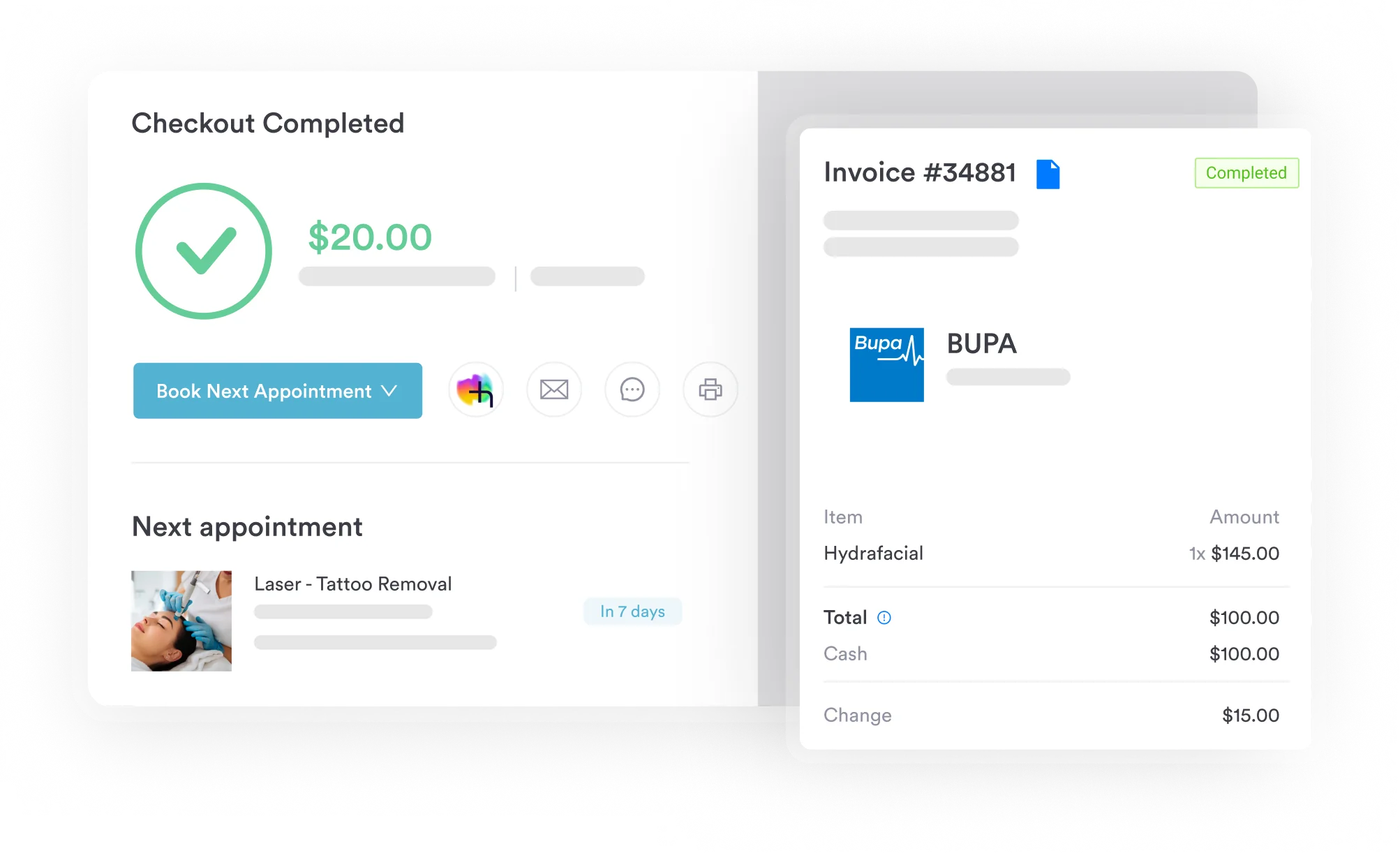
Pabau claims management screen
Pabau’s claim validation checks each claim for missing or invalid details, so an incomplete GI bleed claim gets fixed before submission.

US practices send claims to thousands of payers through the Claim.MD clearinghouse. You can check eligibility before the visit, so a lapsed policy surfaces before the endoscopy rather than after it.

If a claim comes back, Pabau flags it as needing action. ERA files settle payments, and Pabau shows the reason a claim was rejected so you can correct and resubmit.

Catch K92.2 claim errors before the payer does

Pabau validates every claim for missing or invalid details before it leaves. If one comes back rejected, you see the reason and can correct and resubmit.

Pabau claims management dashboard

Conclusion

K92.2 belongs on a claim only when the chart documents a GI bleed and nobody has found the source. Treat it as a holding code. Revisit it whenever a scope, a scan or a discharge summary adds detail.

The habit that pays off most is coding from the last note, not the first. That’s where “probable diverticular bleed” turns K92.2 into K57.31 on an inpatient stay, and where D62 tends to appear.

Book a demo to see how Pabau’s claim validation catches incomplete GI bleed claims before they reach the payer.

Continue your research

Continue your research

Billing the scope that looks for the source? CPT code 43235 covers diagnostic EGD and the documentation that supports it.

Coding the lower half of the workup? CPT code 45378 explains diagnostic colonoscopy billing and its common edits.

Want fewer claims bouncing back? Submitting a clean claim walks through the checks that catch errors before a claim reaches the payer.

Reading denial codes on your remittances? Electronic remittance advice explained breaks down ERA files and how adjustment codes map to fixes.

Frequently asked questions

Is there a separate ICD-10 code for an upper GI bleed?

No. Without hematemesis, melena or a confirmed source, an upper GI bleed codes to K92.2. Gastric hemorrhage NOS is one of its inclusion terms.

What is the ICD-10 code for a lower GI bleed?

There’s no dedicated lower GI bleed code either. Use K92.2 until a source is confirmed, then switch to the source code, such as K62.5 or a K57.- code.

Does the note have to say hemorrhage for K92.2?

No. The ICD-10-CM index sends gastrointestinal bleeding to K92.2 as well. What matters is that the provider clearly documents a GI bleed.

Which code covers a GI bleed in a newborn?

Use a P54 code, from P54.0 to P54.3. Neonatal gastrointestinal hemorrhage is an Excludes1 note on the whole K92 category.

Which code covers bleeding from a colostomy?

Use K94.01, colostomy hemorrhage. It names the site, so K92.2 doesn’t apply.

Avatar photo
Monika Lazarevska
Content Writer

Monika Lazarevska writes content for owners and healthcare professionals who want clear, no-fluff content that actually helps them run their practice better. With a background in storytelling and SEO, she knows how to make even the driest topics worth reading. Off the clock, you'll find her in a café somewhere in Europe, probably with a good book and an even better coffee.
×


