ICD-10 code E55.9: Vitamin D deficiency, unspecified
ICD-10 code E55.9: Definition and official descriptor ICD-10 code E55.9 is the I...

Last Updated: Nov 10, 2026
Billable Code Specific Code
J45.909 is the billable ICD-10-CM code for unspecified asthma, uncomplicated. It applies when a physician has confirmed asthma but documented no severity level, and the encounter involved no acute exacerbation or status asthmaticus.
The code sits under J45.90, unspecified asthma, alongside J45.901 for an acute exacerbation and J45.902 for status asthmaticus. The choice between the three turns on whether the note describes a flare or a life-threatening attack.
Let Pabau's smart automation suggest the right codes, reduce claim denials, and keep your practice compliant—effortlessly.
Automate repetitive tasks and focus on what matters most—your patients.
Reduce coding errors and ensure compliance with the latest regulations.
Clean claims, fewer denials, and faster reimbursements.
Powerful insights and reporting to help your practice thrive.
HIPAA compliant SOC 2 certified GDPR-compliant Trusted by 4,000+ clinics worldwide

J45.909 is the billable ICD-10-CM code for physician-confirmed asthma with no documented severity, no exacerbation and no status asthmaticus.
Parent code J45.90 has three children: J45.909 (uncomplicated), J45.901 (acute exacerbation) and J45.902 (status asthmaticus).
Exacerbation language anywhere in the note moves the code to J45.901, and missing it is a common cause of asthma claim denials.
Biologics such as dupilumab and omalizumab usually need a severity-specific asthma code, so J45.909 rarely supports them on its own.
Pabau, the practice management platform we build, submits claims through Claim.MD and tracks prior authorizations on the patient’s case.
ICD-10 Code J45.909 is a valid, billable ICD-10-CM diagnosis code with the official descriptor “Unspecified asthma, uncomplicated.” It has been effective since October 1, 2015, and remains valid through the current fiscal year under the CMS ICD-10-CM annual update files.
“Unspecified” means the physician’s documentation does not indicate a severity classification (mild intermittent, mild persistent, moderate persistent, or severe persistent). “Uncomplicated” means the encounter did not involve an acute exacerbation or status asthmaticus. Both conditions must be true simultaneously for J45.909 to be the correct choice.
J45.909 applies when a physician has confirmed an asthma diagnosis and the encounter is routine, stable, or not associated with a flare. Asthma NOS is the inclusion term the CDC/NCHS ICD-10-CM coding tool lists under J45.909. These documented terms also lead to the code when no severity or complication is recorded:
The code fits outpatient preventive follow-ups and refill visits where the patient is stable. It also fits initial workups where severity has not yet been formally classified. It is also the correct choice when a patient transfers care and the previous severity documentation is unavailable.
The ICD-10-CM tabular list attaches two types of excludes notes to the J45 category. Misreading these is a reliable path to a denied claim or an audit flag.
These conditions cannot be reported alongside J45.909. ICD-10-CM treats each as a distinct entity that replaces the asthma code.
J45 carries an Excludes2 note for asthma with chronic obstructive pulmonary disease, chronic obstructive asthma, and chronic asthmatic bronchitis, all coded to J44.89. Excludes2 means the conditions are separate, so a patient can carry J45.909 and a J44 code on the same claim.
Both conditions must be documented and addressed at the encounter. Check the current fiscal year tabular list before submitting, because annual updates can refine Excludes2 wording.
The J45.90x family splits into exactly three billable codes, and the note’s wording on complications decides between them. The table below sets the full J45 severity spectrum beside the J45.90x sub-choices.
The same split repeats in every severity subgroup: .x0 for uncomplicated, .x1 for an acute exacerbation and .x2 for status asthmaticus. If you know the severity but not the complication status, pick the .x0 code for that severity. If the record states neither, three questions about the note settle the code, as the chart below shows.
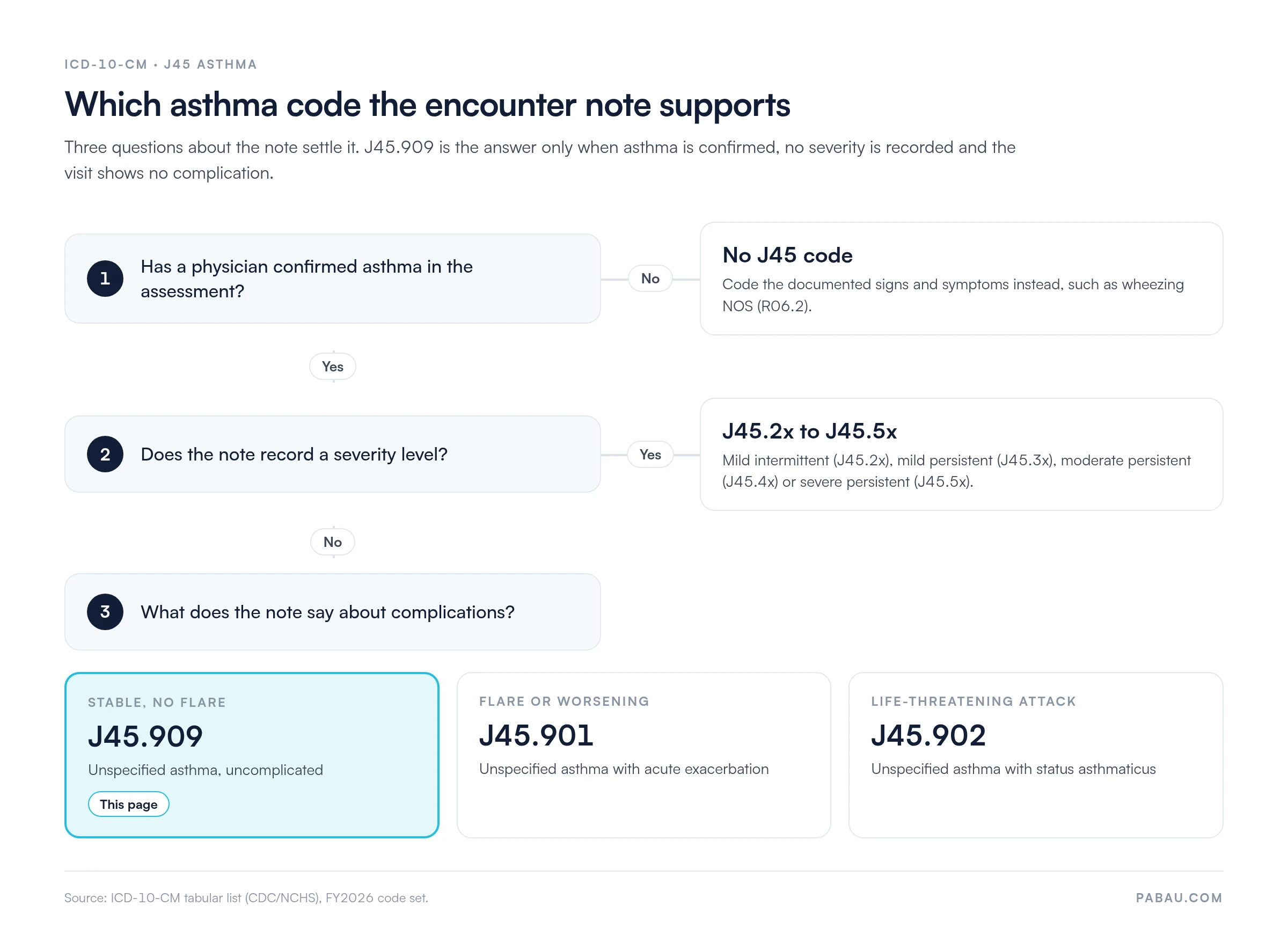
J45.909 is correct only at the end of that path, and only when the physician has confirmed the diagnosis.
Query the provider before defaulting to J45.909. Trigger a provider query when the note mentions an inhaler increase, nighttime symptoms, or an emergency department visit in the past 30 days. Query too when the patient is on a biologic or high-dose ICS/LABA, or the note references GINA severity steps. Any of these is strong circumstantial evidence of a more specific code.
Errors with ICD-10 Code J45.909 follow a few repeat patterns. Check an asthma encounter against each one before the claim goes out.
Payers reviewing claims for ICD-10 Code J45.909 expect the medical record to contain specific elements. Missing any one of them is enough to trigger a medical necessity denial.
Treat the five elements below as a checklist before a J45.909 claim goes out. They are also what an auditor tests under wider medical billing compliance rules.
J45.909 itself is not a prior authorization trigger for routine office visits. Prior authorization comes into play when an associated procedure or treatment needs a more specific asthma diagnosis.
Pairing a diagnosis with the procedures it supports is one of the medical billing fundamentals, and asthma has a short list. The CPT codes below commonly appear alongside J45.909 in pulmonology and primary care claims. Flag any procedure that needs a severity-specific asthma diagnosis, because billing it with J45.909 is a denial risk.
Asthma claim denials tied to J45.909 cluster around four root causes, each with its own fix. Sound denial management workflows and a working grasp of denial codes in medical billing shorten the appeal when one does land.
An asthma claim usually fails on something the note says and the claim does not, such as a flare coded as J45.909. A biologic billed without a severity code fails the same way. When the encounter note and the billing system live apart, the coder works from a summary and misses it.
Pabau keeps the encounter note and the claim on the same patient record. Its claims management software submits CMS-1500 and 837P claims through the Claim.MD clearinghouse, runs eligibility checks and posts ERA remittances back to that record.
Prior authorizations sit on the patient’s case with the auth code, dates and sessions, and Pabau warns when one is missing. A biologic visit with no authorization on file is flagged before the claim goes out, while the coder can still query the provider for severity.

Pabau’s claims management software sends claims through Claim.MD, checks eligibility and tracks prior authorizations on the patient’s case. Asthma claims go out with the documentation that supports them.

J45.909 belongs on a claim only when the physician has confirmed asthma and the note describes a stable visit. Treat it as a finding the record supports, never as the code you fall back on when severity is missing.
The habit that pays back fastest is a standing provider query on two kinds of encounter. The first is any visit with exacerbation language, and the second is any visit tied to a biologic or a high-step regimen. Those are the claims where J45.909 is most likely wrong and a payer is most likely to look.
The trade-off is a little more friction at coding for far fewer appeals later, which shortens the whole revenue cycle management loop. Book a demo to see how Pabau keeps asthma notes, prior authorizations and claims on one patient record.

Looking for clean claim submission guidance? Clean claim best practices explains what makes a claim pass payer edits on first submission and how to build a pre-submission checklist.
Want to understand what happens after a claim is paid? Electronic remittance advice (ERA) walks through reading 835 remittance files, reconciling payments, and acting on CARC denial codes.
ICD-10 Code J45.909 is the billable diagnosis code for unspecified asthma, uncomplicated. The physician has confirmed asthma but documented no severity classification, and the encounter involves no acute exacerbation or status asthmaticus. It sits under parent code J45.90 within the J45 (Asthma) category of Chapter 10 (Diseases of the respiratory system).
Yes, J45.909 is a fully billable ICD-10-CM code, effective since October 1, 2015, and valid through the current fiscal year. It is a six-character code with a valid code flag in the CMS tabular list and can be submitted on CMS-1500 or 837P claims.
J45.901 is used when the physician’s note documents an acute exacerbation. Words like “flare,” “worsening,” or “acute attack” push the code from J45.909 to J45.901. Both codes share the unspecified severity classification under J45.90, so the choice turns on whether the encounter note documents an active complication.
Only when a physician has explicitly confirmed the diagnosis as asthma. If the chart records “reactive airway disease” without a formal asthma diagnosis, ICD-10-CM coding guidelines require coding the presenting signs and symptoms instead. Never assign J45.909, or any J45 code, solely on the basis of the informal term “reactive airway disease.”
The four leading denial reasons are a lack of documented medical necessity and payer code-specificity flags when records suggest a severity code is determinable. CPT/ICD mismatches follow when a biologic or procedure needs a severity-specific code, and legacy billing systems sometimes submit an outdated code year. Each has a defined appeal path in the denial table above.
The most common pairings are E/M codes (99202-99215) for office visits, spirometry (94010, 94060), vital capacity testing (94150), and nurse-level asthma education visits (99211). Biologic administration codes carry a high denial risk when J45.909 is the only supporting diagnosis. Those procedures typically require a severity-specific code such as J45.41 or J45.51.
J45.909 alone does not trigger prior authorization for routine office visits. Prior authorization becomes relevant when the associated procedure needs a severity-specific asthma diagnosis to meet the payer’s clinical criteria. A biologic injection, pulmonary rehabilitation, or a specialty spirometry series are the usual examples. Check the relevant MAC LCD or commercial plan policy for each procedure code.