ICD-10 code S90.475A: Other superficial bite of left great toe
What is ICD-10 code S90.475A? ICD-10 code S90.475A is the billable diagnosis cod...

Last Updated: Nov 18, 2026
Billable Code Specific Code
E87.1 is the billable ICD-10-CM code for hypo-osmolality and hyponatremia. It covers low serum sodium, below 135 mEq/L, with reduced serum osmolality, and it is also the code for sodium deficiency.
The code sits in category E87, Other disorders of fluid, electrolyte and acid-base balance. Its Excludes1 note bars SIADH, which is coded E22.2 instead. When a documented condition such as heart failure causes the hyponatremia, that condition usually leads the claim.
Let Pabau's smart automation suggest the right codes, reduce claim denials, and keep your practice compliant—effortlessly.
Automate repetitive tasks and focus on what matters most—your patients.
Reduce coding errors and ensure compliance with the latest regulations.
Clean claims, fewer denials, and faster reimbursements.
Powerful insights and reporting to help your practice thrive.
HIPAA compliant SOC 2 certified GDPR-compliant Trusted by 4,000+ clinics worldwide

E87.1 is the billable ICD-10-CM code for hypo-osmolality and hyponatremia, valid for HIPAA-covered transactions.
SIADH is excluded from E87.1, so when the physician documents SIADH, use E22.2 instead.
Documentation needs a physician-attested diagnosis, serum sodium below 135 mEq/L, and serum osmolality findings.
When heart failure or cirrhosis causes the hyponatremia, that condition is coded first and E87.1 follows as an additional code.
Pabau, the practice management platform we build, sends claims through the Claim.MD clearinghouse, which reaches thousands of US payers.
ICD-10 Code E87.1 is a billable, fully specified ICD-10-CM diagnosis code for hypo-osmolality and hyponatremia, reported as one combined condition.
It is valid for HIPAA-covered transactions and listed as billable in the CDC/NCHS ICD-10-CM tabular list. Its sibling in category E87 is E87.0, hyperosmolality and hypernatremia.
Hyponatremia is clinically defined as serum sodium below 135 mEq/L. Hypo-osmolality refers to reduced serum osmolality, typically below 275 mOsm/kg. The two conditions are coded together under E87.1 because low sodium is the principal driver of reduced plasma osmolality in most clinical presentations.
The tabular list gives E87.1 one Excludes1 note, and it decides whether E22.2 can share the claim. An Excludes1 note means the two codes never appear together. An Excludes2 note would allow both codes, but E87.1 carries none.
Why it matters for billing: Excludes1 means “not coded here,” so SIADH is never reported with E87.1. A claim that carries both codes for one encounter fails code-pair edits and comes back denied. Before choosing, confirm that the physician’s note states SIADH as a confirmed diagnosis.
Coders often confuse E87.1 with four nearby codes, in category E87 and elsewhere in the endocrine chapter. The table below shows when each one applies instead. Check current-year status for any of them in the CMS ICD-10 code files before submitting.
SIADH (E22.2) and hyponatremia (E87.1) look the same on a lab report. Both show low serum sodium and low osmolality, yet the Excludes1 note keeps them off the same claim. The physician’s documentation decides which one you report.
Use the criteria below, drawn from the physician’s note, to tell them apart. The AAPC ICD-10-CM code lookup confirms the current descriptor wording for both codes.
When a physician uses the term ‘dilutional hyponatremia’ without further specifying SIADH, default to E87.1. Query the physician for clarification before assigning E22.2: SIADH requires documented workup including urine osmolality, urine sodium, and clinical exclusion of thyroid and adrenal causes. Coding E22.2 without that workup documented invites medical necessity denials.
Sequencing is where E87.1 claims most often go wrong in medical billing. The ICD-10-CM Official Guidelines set the rules for principal versus secondary diagnosis.
E87.1 as principal diagnosis: Use E87.1 as the first-listed code when hyponatremia itself is the reason for the encounter or admission. That holds only when no documented underlying cause should take precedence.
E87.1 as secondary diagnosis: Use E87.1 as an additional code when hyponatremia complicates another documented condition. With heart failure, a code such as I50.9 goes first and E87.1 follows. Hepatic cirrhosis and hypothyroidism work the same way.
Put together, two questions decide where E87.1 lands on the claim: is SIADH documented, and is there a documented cause?
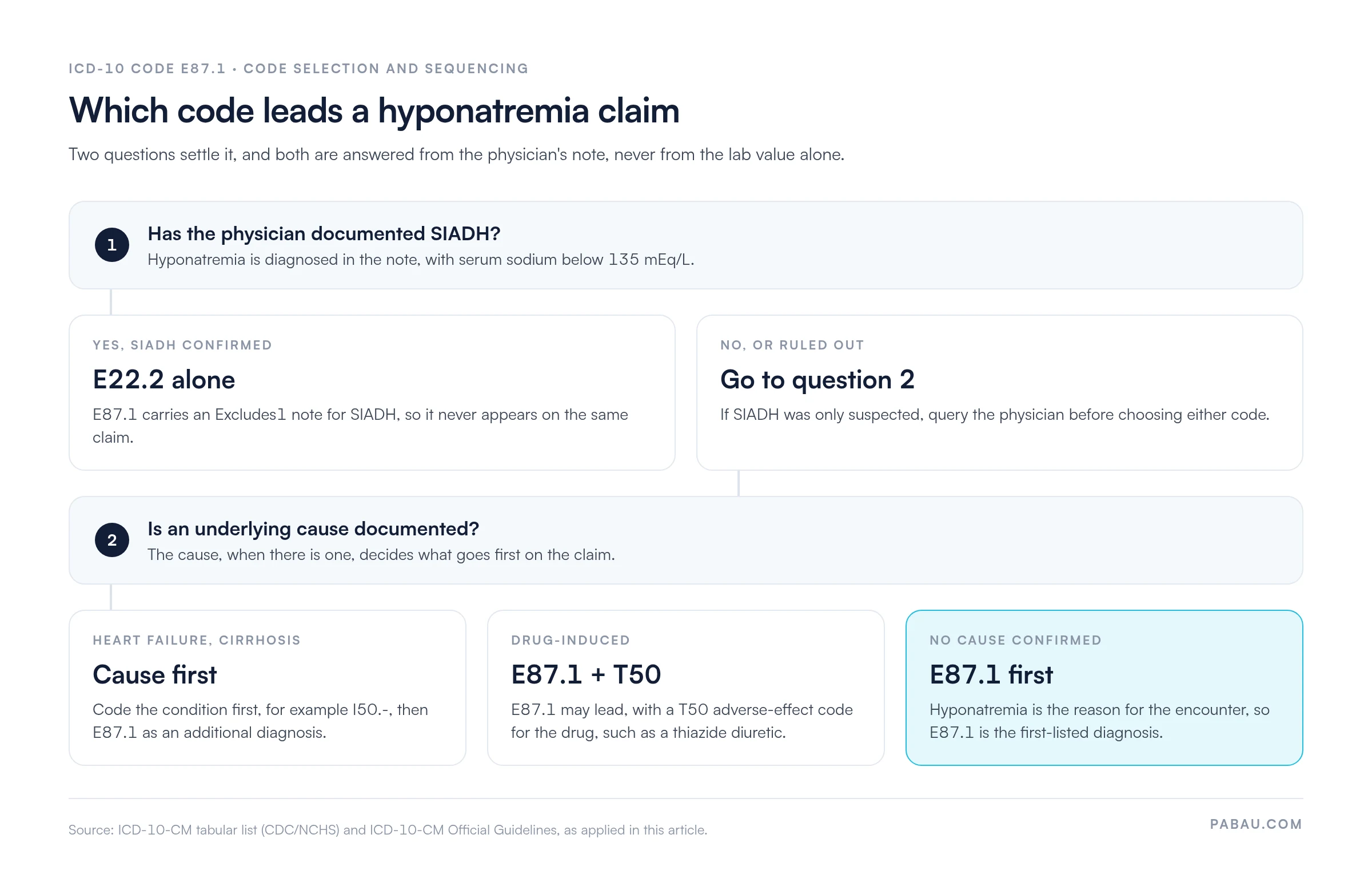
Most E87.1 denials trace back to the chart note. A clean claim starts with knowing what that note must contain before the coder assigns the code.
The following documentation elements are required or strongly recommended to support medical necessity and avoid payer audits:
Many hyponatremia presentations have a documented underlying cause that also requires a separate ICD-10-CM code. The ICD-10-CM Official Guidelines allow, and in some cases require, coding etiology alongside E87.1. Sequencing follows the same principal versus secondary logic described above. A documented hypomagnesemia is coded separately as E83.42, alongside E87.1.
Denials on E87.1 claims follow predictable patterns, and a denial management routine catches most of them before submission. These five come up again and again.
When a denial does arrive, start with the denial codes on the remittance advice. CARC 50 (not deemed a medical necessity by the payer) and CARC 11 (the diagnosis is inconsistent with the procedure) point to a diagnosis problem. Each one leads back to something specific the original chart note left out.
No national coverage determination exists for hyponatremia as a standalone condition. Coverage of services billed with E87.1 rests on Local Coverage Determinations (LCDs) from each Medicare Administrative Contractor (MAC). The CMS ICD-10-CM coding resources and your MAC’s coverage database are the references for your jurisdiction.
For revenue cycle management on E87.1 encounters, watch these payer-specific pressure points:
Run a quarterly denial audit specifically for E87.1 claims. Filter your remittance data by this code and sort by CARC. If CARC 50 (medical necessity) appears on more than 15% of E87.1 claims from one payer, request their LCD for electrolyte disorders. Then check that your documentation template matches its coverage criteria.
The E87.1 denials above share a cause. The claim left the practice without the physician’s interpretation, in the wrong order, or next to E22.2. A biller working from a re-keyed summary rarely spots any of those.
Pabau keeps the encounter note, the diagnosis codes and the claim in one record, so the biller checks sequencing against the physician’s own words. Claims go out as 837P files through the Claim.MD clearinghouse, which reaches thousands of US payers.
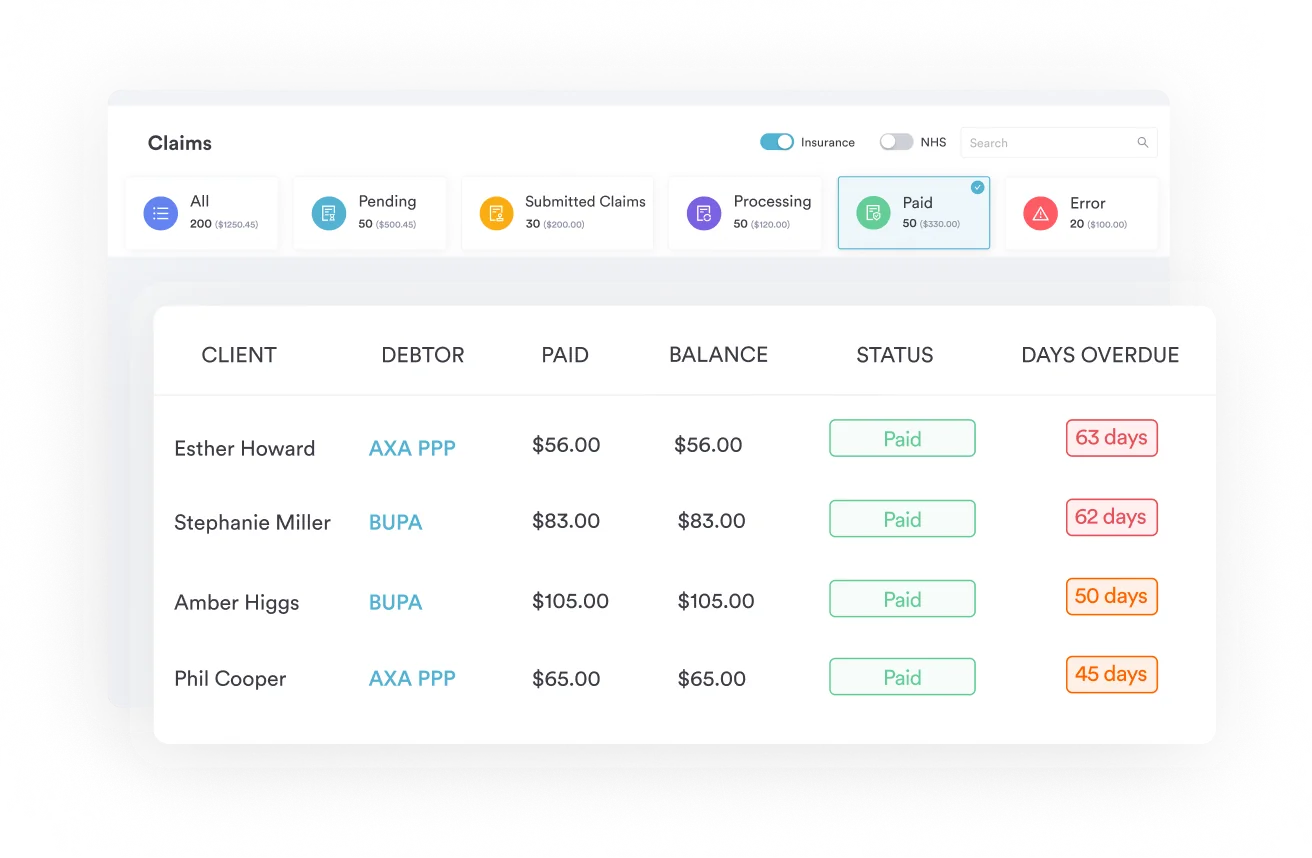
Eligibility checks, claim status and ERA remittances come back against the same patient record. With Pabau’s claims management software, you can track E87.1 denials by payer and catch a MAC-specific pattern before it becomes steady underpayment.

Pabau sends claims through the Claim.MD clearinghouse to thousands of US payers and posts remittances against the patient record. Your team spends less time on rework and more on care.

E87.1 itself is rarely the problem. The denials come from what surrounds it. A SIADH diagnosis should have replaced it, a heart failure code should have gone first, or the sodium value was never interpreted.
So put the coding question to the physician before the claim goes out, not after the denial comes back. A one-line query about SIADH or the underlying cause takes minutes, while an appeal against CARC 50 or CARC 11 can take weeks.
Book a demo to see how Pabau keeps the chart note and the E87.1 claim in one record, from coding through to remittance.

Low potassium on the same encounter? ICD-10 code E87.6 covers hypokalemia, which can be coded alongside E87.1 when both are documented.
Is volume depletion the main finding? ICD-10 code E86.0 covers dehydration, the code to check before reaching for E87.1.
Seeing recurring denial codes on electrolyte claims? Understanding electronic remittance advice walks through reading ERA files and tracing CARC codes back to the chart note.
Want to benchmark your billing compliance practices? Medical billing compliance guide covers documentation standards that support ICD-10-CM diagnosis codes across payer types.
ICD-10 Code E87.1 is the billable ICD-10-CM diagnosis code for hypo-osmolality and hyponatremia. It covers low serum sodium and low serum osmolality when SIADH is not the confirmed diagnosis. It belongs to category E87 (Other disorders of fluid, electrolyte, and acid-base balance) in Chapter 4 of the ICD-10-CM classification.
E87.1 covers hyponatremia when the physician has not confirmed SIADH as the etiology, while E22.2 is used exclusively when the physician explicitly documents SIADH. The two codes are Excludes1 to each other and cannot appear on the same claim. When documentation is ambiguous, the physician must be queried before the coder assigns E22.2.
A serum sodium below 135 mEq/L and serum osmolality below 275 mOsm/kg support E87.1, but lab values alone are insufficient for code assignment. A physician must document a clinical interpretation of these findings and explicitly diagnose hyponatremia in the assessment or impression section of the encounter note.
Either designation is appropriate depending on the encounter. E87.1 is the principal diagnosis when hyponatremia is the primary reason for the visit with no confirmed underlying etiology leading the encounter. It is a secondary diagnosis when it complicates a documented condition such as heart failure, cirrhosis, or hypothyroidism.
The most frequent reasons are an uninterpreted sodium value, E87.1 listed ahead of the underlying condition, and E87.1 billed with E22.2 (SIADH). That last pairing breaks the Excludes1 rule. A physician-attested diagnosis and correct sequencing prevent most of these denials.
Yes. E87.1 (hyponatremia) and E87.6 (hypokalemia) are sibling codes in category E87 with no Excludes note between them. When a patient has documented low sodium and low potassium, assign both codes. That reflects the full clinical picture and supports accurate MS-DRG grouping on inpatient claims.