ICD-10 Code M85.80: Other specified disorders of bone density
ICD-10 Code M85.80: Definition and official classification ICD-10 Code M85.80 is...

Last Updated: Nov 16, 2026
Billable Code Specific Code
I50.9 is the billable ICD-10-CM code for heart failure, unspecified. It applies when the provider documents heart failure or CHF without stating whether it is systolic, diastolic, or combined.
The code sits in category I50 (Heart failure) of Chapter 9, Diseases of the circulatory system. It is valid for FY2027 inpatient and outpatient claims and needs no further characters.
Let Pabau's smart automation suggest the right codes, reduce claim denials, and keep your practice compliant—effortlessly.
Automate repetitive tasks and focus on what matters most—your patients.
Reduce coding errors and ensure compliance with the latest regulations.
Clean claims, fewer denials, and faster reimbursements.
Powerful insights and reporting to help your practice thrive.
HIPAA compliant SOC 2 certified GDPR-compliant Trusted by 4,000+ clinics worldwide

ICD-10 Code I50.9 is a billable FY2027 code for heart failure when the provider documents no systolic, diastolic, or combined type.
If an echocardiogram or ejection fraction result sits in the chart without a stated type, query the provider rather than default to I50.9.
When hypertension and heart failure coexist, ICD-10-CM guidelines sequence I11.0 (hypertensive heart disease with heart failure) first, with I50.9 as an additional code.
MS-DRG 291 or 292 applies when a qualifying MCC or CC is documented. A more specific I50 code as principal does not move the DRG on its own.
Pabau, the practice management software we build, records the diagnosis codes your practitioner selects and submits claims through Claim.MD with a full audit trail.
ICD-10 Code I50.9 is the billable ICD-10-CM code for heart failure, unspecified. Coders use it when the provider does not say whether the failure is systolic, diastolic, or combined. The CDC’s FY2027 ICD-10-CM tabular list carries I50.9 as a complete code with no further subdivision, which is what makes it billable. The table below gives the core reference data at a glance.
Check the tabular list for the fiscal year of the discharge or encounter before you assign the code. The FY2027 code set took effect on October 1, 2026, and annual updates can restructure I50 subcategories. Neighboring circulatory system codes are listed in our ICD-10-CM code library.
I50.9 covers heart failure when the provider’s documentation does not specify the type. The FY2027 tabular lists three inclusion terms under the code:
“Unspecified” says nothing about severity. It means the provider’s note lacks the type descriptor a coder needs for a more precise code. Biventricular heart failure has its own code, I50.82, so it never lands on I50.9. Never infer a systolic or diastolic type from clinical context without provider documentation or a completed query.
Category I50 carries no Excludes1 note in the FY2027 tabular. Its instructions are two Excludes2 notes, a code-first list, and one more Excludes2 note at I50.9 itself.
An Excludes2 note means the excluded condition is not part of I50, but a patient can have both, so both codes may be reported. A code-first note works the other way. The underlying cause, such as hypertensive heart disease, is sequenced ahead of the I50 code.
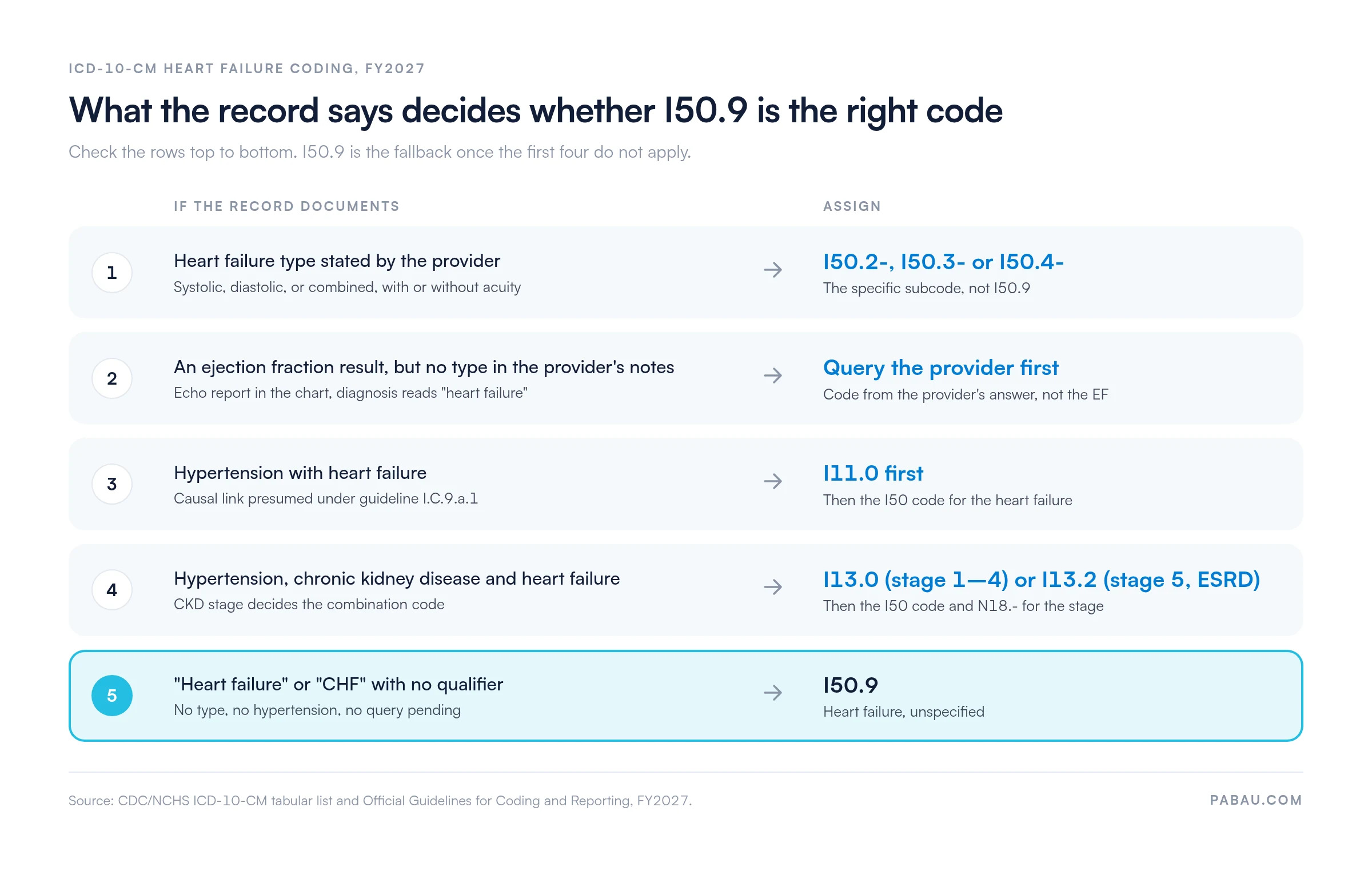
I50.9 should be the code of last resort within the I50 family. The table below maps the main I50 codes to the documentation that justifies each.
When the record names the type but not the acuity, the unspecified-acuity codes apply: I50.20 for systolic failure and I50.30 for diastolic failure.
Take a patient admitted with “acute on chronic heart failure” and an echocardiogram showing an EF of 35%. The EF alone does not set the type, so the coder queries the provider. If the provider answers “systolic,” the claim carries I50.23, and leaving I50.9 on it would be a specificity error.
Check the echo report before you assign ICD-10 Code I50.9. An ejection fraction result alone cannot set the heart failure type, but it is grounds for a provider query. A query answered before billing prevents the denial afterward.
I50.9 is supported when the provider documents heart failure without a type qualifier and no study result prompts further specificity. The ICD-10-CM Official Guidelines base code assignment on the provider’s diagnostic statement and call for a query when documentation conflicts. In practice, the threshold works like this:
Physician queries must be non-leading under AHIMA and ACDIS standards. Never ask “Does the patient have systolic heart failure?” Frame it as an open clarification instead: “The record documents heart failure and an echocardiogram with LVEF of 35%. Can you clarify the type of heart failure (systolic, diastolic, or other) for coding purposes?” Building medical billing compliance into documentation costs far less than working denials after the claim.
ICD-10-CM Official Guidelines Section I.C.9.a presumes a causal link between hypertension and heart failure. When both appear in the same record, code them as hypertensive heart disease even if the provider never writes that phrase. The exception is documentation stating the two are unrelated.
The correct sequencing when hypertension co-exists with unspecified heart failure:
Common comorbidity sequencing scenarios are summarized below.
Put together, these rules give a short check to run before I50.9 goes on any claim.
The setting changes how uncertain heart failure documentation is coded. The ICD-10-CM Official Guidelines treat “probable” heart failure one way for inpatient admissions and another for outpatient encounters.
Outpatient rules: Code only confirmed diagnoses. If the provider documents “probable heart failure” or “possible CHF,” do not code I50.9. Code the presenting symptom instead, such as R06.09 for dyspnea or R60.0 for localized edema, per Section IV of the ICD-10-CM Official Guidelines.
Inpatient rules: Section II.H of the Official Guidelines codes a diagnosis documented at discharge as “probable” or “suspected” as if it were established. So I50.9 can be the principal diagnosis when the discharge documentation still reads “probable heart failure.” That rule covers short-term, acute, long-term care and psychiatric hospital admissions only.
Present on Admission (POA) indicator: Medicare requires a POA indicator on all IPPS inpatient claims. For I50.9, the indicator is typically “Y” (yes, present on admission) for patients admitted for heart failure management. Critical access hospitals and certain facility types are exempt from POA reporting requirements. Ensuring a clean claim submission means verifying the POA indicator is populated correctly before submission to avoid edits.
MS-DRGs 291, 292 and 293 split heart failure and shock admissions by the severity of the secondary diagnoses, not by which I50 code is principal. I50.9 as principal groups to DRG 293 only when no qualifying CC or MCC is coded. With an MCC or a CC on the claim, the same principal diagnosis groups to DRG 291 or 292.
Verify the current MS-DRG grouper version at the time of billing, because CMS updates the grouper every fiscal year. Moving I50.9 to a more specific principal code does not change the DRG on its own. Specificity matters when heart failure is a secondary diagnosis, because several specific I50 codes count as a CC or MCC and I50.9 does not.
The gap between DRG 291 and DRG 293 varies with the hospital’s payment adjustments, but it can reach thousands of dollars per admission. Tracking it through revenue cycle management reporting helps CDI teams measure what documentation work returns. Medicare remittance files also carry the DRG that was paid, which makes reconciliation straightforward.
Payers and RAC contractors target unspecified diagnosis codes, and ICD-10 Code I50.9 appears on many payer audit lists for inpatient claims. The most common denial patterns and their prevention strategies are listed below.
Heart failure management generates a consistent set of CPT codes paired with I50.9 across both outpatient and inpatient settings. Payer policies on medical necessity for each pairing vary, so confirming Local Coverage Determinations (LCDs) before billing is good practice. The table below lists commonly accepted pairings, not a coverage guarantee.
Some payers apply claim edits when echocardiography (93306 or 93308) is billed with I50.9 and the echo report contains an EF measurement. The edit asks why no more specific I50 code was assigned. This pairing is a known audit focus. Having the physician query on file is the clearest defense. To confirm the current tabular entry for I50.9, use the CDC/NCHS ICD-10-CM web tool.
Run a quarterly internal audit of all claims submitted with I50.9 as principal diagnosis where CPT 93306 or 93308 also appears on the claim. If the echo report contains an EF value and no physician query is documented in the chart, those claims carry heightened RAC audit risk. Retrospective CDI review on this subset can either confirm the code is correct or identify accounts to flag for query and potential rebilling.
Most heart failure denials start before the claim is built. A query sits unanswered, an echo report never reaches the coder, or I10 goes out where I11.0 belonged. Each one costs a resubmission and a delay.
Pabau’s claims management software keeps the note, the diagnosis codes your practitioner selects, and the claim on one patient record. Through the Claim.MD integration, claims go to the payers Claim.MD supports, with eligibility checks and electronic remittance processing.
When a payer questions code specificity, the CARC reason codes on the returned ERA show whether the denial is about coding or coverage. Your billing staff can then prioritize appeals for denial management instead of reworking every rejected claim by hand.

Pabau’s claims management software and Claim.MD integration give billing teams real-time eligibility checks, ERA-based denial tracking, and ICD-10 diagnosis entry in one workflow. See how practices submit cleaner claims and resolve denials faster.

Treat I50.9 as the code the documentation earns, not a default. Before a heart failure claim leaves, check two points. Does an EF result in the chart still need a provider query? Does hypertension, or hypertension with CKD, mean I11.0 or an I13 code goes first?
Those two checks prevent most of the specificity audits and sequencing edits this code attracts. The trade-off is a short delay while a query is answered, which costs far less than a denied admission.
Pabau records the diagnosis codes the practitioner selects, submits claims through Claim.MD, and tracks denial reason codes from returned ERAs. Book a demo to see how your team can catch heart failure coding errors before the claim goes out.

Need to understand how clearinghouse claim submission works for ICD-10 diagnoses? Our Claim.MD clearinghouse guide explains how EDI routing, payer enrollment, and real-time eligibility interact on a live claim.
Getting denials without clear reason codes? Denial codes in medical billing breaks down CARC and RARC codes so your team knows exactly what each denial means and how to respond.
Want to reduce rework on outpatient heart failure encounters? How superbill workflows reduce billing errors covers how structured superbill design prevents diagnosis-code mismatches before the claim goes out.
ICD-10 Code I50.9 is the billable diagnosis code for heart failure, unspecified. It covers congestive heart failure, cardiac failure, and heart failure NOS when the provider does not specify a systolic, diastolic, or combined type. It is valid for FY2027 inpatient and outpatient claims.
Yes. I50.9 is a valid, billable ICD-10-CM code in the FY2027 tabular list, where it has no further subdivision. It may be reported on outpatient and inpatient claims when documentation lacks type specificity.
Use I50.9 only when the provider documents heart failure, CHF, or cardiac failure with no systolic, diastolic, combined, acute, or chronic qualifier. The chart should also hold no echocardiogram or EF result that would prompt a physician query. If diagnostic results suggest a subtype, query the provider rather than defaulting to I50.9.
No. When hypertension and heart failure coexist, ICD-10-CM guidelines presume they are linked. Code I11.0 (hypertensive heart disease with heart failure) first, with I50.9 as an additional code. Coding I10 and I50.9 together without I11.0 violates the mandatory presumed-causation rule in Section I.C.9.a of the Official Guidelines.
For most inpatient admissions where heart failure is the reason for admission, the POA indicator for I50.9 is “Y” (present on admission). Medicare requires POA indicators on IPPS inpatient claims. Critical access hospitals and certain other facilities are exempt. Missing the POA indicator triggers a claim edit before adjudication.
As the principal diagnosis, I50.9 groups to MS-DRG 293 only when no qualifying CC or MCC is documented. DRG 291 applies when an MCC is documented, and DRG 292 when a CC is. A more specific I50 code as principal does not move the DRG on its own.
Common CPT pairings include outpatient E&M codes 99213-99215 and inpatient E&M codes 99221-99223 and 99231-99233. Echocardiography codes 93306 and 93308 and the BNP lab code 83880 also appear often. If the echo report billed with I50.9 contains an EF value, payers may apply claim edits asking why no more specific I50 code was used.