Pabau Engage inbox

Pabau Engage is here: every patient conversation in one inbox.

Learn more
Book a demo Book a demo
☰
CPT Code

CPT code 82166 – Anti-Müllerian hormone serum assay


Code Definition

82166 is the CPT code for an anti-Müllerian hormone (AMH) assay, a blood test that measures ovarian reserve. Practices order it in infertility workups, PCOS evaluations and suspected premature ovarian insufficiency.

The code sits in the Chemistry subsection of the CPT Pathology and Laboratory section. Medicare pays it from the Clinical Laboratory Fee Schedule, with a 2026 national limit of $38.62. Estradiol (82670) and FSH (83001) have their own codes, so each analyte in a fertility panel bills on its own line.

Section
80047-89398 Pathology and laboratory
Subsection
82009-84999 Chemistry
Code range
82166 Anti-Mullerian hormone (AMH)
Billable
No
Code also known as
AMH test, anti-mullerian hormone test, ovarian reserve test, AMH blood test
Save time. Improve accuracy. Get paid faster.
Automate coding with Pabau

Let Pabau's smart automation suggest the right codes, reduce claim denials, and keep your practice compliant—effortlessly.

  • AI-powered code suggestions
  • Real-time compliance checks
  • Faster claims, fewer denials
Why practices choose Pabau
Save hours every week

Automate repetitive tasks and focus on what matters most—your patients.

Improve accuracy

Reduce coding errors and ensure compliance with the latest regulations.

Get paid faster

Clean claims, fewer denials, and faster reimbursements.

Grow with confidence

Powerful insights and reporting to help your practice thrive.

HIPAA compliant SOC 2 certified GDPR-compliant Trusted by 4,000+ clinics worldwide

Key takeaways

Key takeaways

CPT code 82166 describes an assay for anti-Müllerian hormone, a marker of ovarian reserve distinct from estradiol (82670) and FSH (83001).

Accepted ICD-10 pairings include N97.x (female infertility), E28.2 (polycystic ovary syndrome), and Z31.41 (fertility testing encounter).

Medicare pays for CPT code 82166 when the test is reasonable and necessary for a documented condition, but routine screening without a diagnosis is excluded.

Medicare pays 82166 from the Clinical Laboratory Fee Schedule, which sets a 2026 national limit of $38.62.

Pabau, a practice management platform with US claims billing, records the diagnosis on the patient and claim and tracks prior authorization on the case.

CPT code 82166: Quick reference

CPT code 82166 reports an anti-Müllerian hormone (AMH) assay, a blood test that gauges ovarian reserve in fertility, PCOS and premature ovarian insufficiency workups. CMS’s 2026 lab fee schedule lists the code as Anti-Mullerian hormone (AMH), with a national limit of $38.62.

The table below sums up the core facts billers need before they submit a claim for CPT code 82166.

FieldDetail
Code82166
Official descriptorAnti-Mullerian hormone (AMH)
Test typeSerum immunoassay
SpecimenBlood (serum)
Code typeCPT Category I laboratory
Primary clinical useOvarian reserve assessment, PCOS workup, fertility treatment planning, male testicular function evaluation
Cycle-dependent?No. AMH stays relatively consistent within and between menstrual cycles, per ASRM’s 2020 committee opinion
Medicare payment basisClinical Laboratory Fee Schedule, national limit $38.62 (2026)

What does CPT code 82166 cover?

CPT code 82166 covers a single assay for anti-Müllerian hormone, a glycoprotein secreted mainly by primary, preantral and early antral follicles. Because those small follicles make up the pool a patient has left, the result works as a direct measure of ovarian reserve. That is the position of ASRM’s committee opinion on ovarian reserve testing.

Accepted clinical applications billed under this code include:

  • Ovarian reserve assessment: Quantifying remaining follicle pool before assisted reproduction or chemotherapy that may impair fertility.
  • Polycystic ovary syndrome workup: Elevated AMH correlates with PCOS. It supports the diagnosis when combined with clinical and ultrasound findings.
  • Fertility treatment planning: Guides ovarian stimulation protocols in IVF cycles by predicting hyper- or hypo-response.
  • Premature ovarian insufficiency evaluation: Low AMH supports a diagnosis of diminished ovarian reserve (DOR) or early menopause.
  • Pediatric male assessment: AMH is a marker of testicular function in boys evaluated for cryptorchidism or intersex conditions. Payer coverage for male indications varies, so verify it per plan.

AMH stays relatively consistent within and between menstrual cycles, so the draw can be ordered on any cycle day. ASRM’s 2020 committee opinion puts this down to AMH being gonadotropin independent. It also notes that hormonal contraceptives may lower AMH levels, which is worth recording on the order.

What CPT 82166 does not cover

Several scenarios fall outside the scope of CPT 82166 and will trigger denials if billed incorrectly.

  • Urine AMH: CPT 82166 applies to serum specimens only. Urine-based AMH testing does not map to this code under current AMA descriptors.
  • NCCI edits: No standard CPT panel code includes AMH. National Correct Coding Initiative (NCCI) edits can still apply when 82166 shares a claim with other codes, so check the current edit tables.
  • Routine fertility screening without documented indication: Ordering AMH as a preventive wellness screen with no clinical indication does not meet the reasonable-and-necessary standard. The claim needs an ICD-10 code that reflects a specific condition, not a general wellness encounter.
  • Procedures using a different analyte: Inhibin B, FSH, estradiol, and LH are each billed under their own codes. CPT 82166 cannot stand in for a test that measures a different analyte.

Clinical indications and ICD-10 codes for CPT 82166

Every CPT 82166 claim needs at least one ICD-10-CM code that establishes medical necessity. The table below lists the pairings payers accept most widely. Confirm coverage criteria with the MAC or commercial plan before submitting, because requirements vary by payer.

ICD-10-CM CodeDescriptionClinical context
N97.0Female infertility associated with anovulationAMH supports ovarian reserve evaluation in anovulatory infertility
N97.1Female infertility of tubal originAMH ordered as part of comprehensive infertility workup
N97.9Female infertility, unspecifiedUse when specific cause not yet determined
E28.2Polycystic ovarian syndromeElevated AMH is a diagnostic marker; pairs with clinical and ultrasound findings
E28.310Symptomatic premature menopauseLow AMH supports diminished ovarian reserve evaluation
Z31.41Encounter for fertility testingAppropriate for pre-conception fertility workup encounters
Q53.xUndescended and ectopic testicleMale pediatric use; payer coverage varies, verify per plan

A PCOS workup pairs 82166 with E28.2, backed by the clinical and ultrasound findings in the note. In Pabau’s claims management software, the practice records the diagnosis against the patient and the claim. The biller can then check the ICD-10 code beside 82166 before the claim goes out.
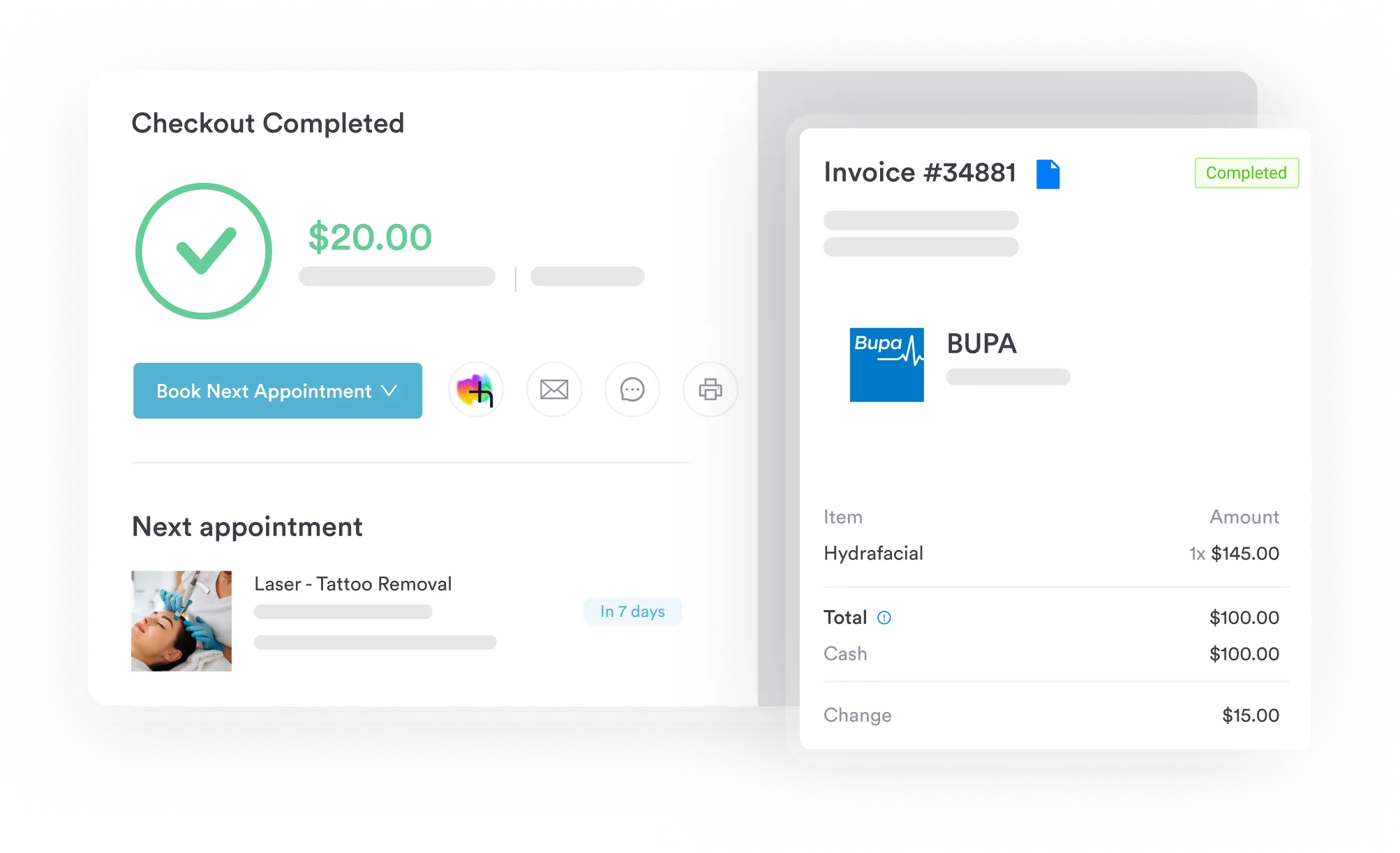
Pabau checkout screen showing a completed invoice and payment
Pabau’s checkout records the invoice and payment against the patient, so any patient-owed share of an 82166 claim is collected at the desk.

How the AMH test is performed and documented

Documentation is where most CPT 82166 denials originate. The chart note must show that the ordering provider established a clinical reason for the test, not simply that the test was ordered.

  1. Document the clinical indication: Record the patient’s presenting symptom, diagnosis, or clinical concern in the visit note. Examples include irregular cycles with suspected diminished ovarian reserve, an infertility workup, or a PCOS evaluation. Generic “lab work” language does not satisfy medical necessity.
  2. Order the test with supporting diagnosis codes: The order must reference the ICD-10-CM code(s) that justify the assay. Orders lacking a diagnosis code trail create downstream denial risk.
  3. Collect the specimen: A serum blood draw is performed. No specific cycle day is required, as AMH is relatively cycle-independent.
  4. Laboratory processing: The specimen is analyzed via immunoassay. The laboratory bills 82166 directly if it performs the test. The ordering practice bills it when the analysis runs in-house.
  5. Result and interpretation in the chart: Record the result in the patient record with the clinical interpretation. For example: “AMH 0.8 ng/mL consistent with diminished ovarian reserve, proceeding with stimulated IVF cycle.” This documentation supports the medical necessity argument on appeal if the claim is denied.

Pro Tip

Audit CPT 82166 claims before billing. Confirm that every order has an ICD-10 code, the visit note states the clinical indication, and the chart interprets the result. These three elements together are what a MAC medical reviewer checks first when a claim is flagged for medical necessity review.

CPT code 82166 vs. similar lab codes

AMH is one of several reproductive hormone analytes ordered in a fertility workup. Each has its own CPT code, so substituting 82166 for a different analyte is a coding error.

CPT CodeAnalyteClinical useUse instead of 82166 when…
82166Anti-Müllerian hormone (AMH)Ovarian reserve, PCOS, fertility planningN/A – this is the correct code for AMH
82670EstradiolFollicular development monitoring, menopausal evaluationThe analyte being measured is estradiol, not AMH
83001Follicle-stimulating hormone (FSH)Ovarian reserve, menopause evaluation, pituitary functionFSH is ordered; FSH and AMH are often co-ordered but billed separately
83002Luteinizing hormone (LH)Ovulation timing, pituitary axis evaluationLH is the analyte being measured
84403Testosterone, totalMale hypogonadism, PCOS androgen excessTotal testosterone is the specific analyte ordered

When the same draw also measures LH or total testosterone, bill 83002 or 84403 on its own line beside 82166.

Medicare and payer coverage for CPT 82166

Medicare pays for CPT code 82166 when the test is reasonable and necessary for a documented condition. Routine screening with no symptom or diagnosis is excluded, so the note and the ICD-10 code carry the claim.

Key coverage rules to understand before billing Medicare:

  • No national coverage determination for AMH: No NCD addresses AMH testing, so your MAC applies the reasonable-and-necessary standard. Check its coverage articles for local guidance before billing.
  • Infertility is not excluded outright: The Medicare Benefit Policy Manual, chapter 15 states that reasonable and necessary services associated with treatment for infertility are covered. AMH ordered in an infertility workup can qualify when the note documents why.
  • ABN requirement: When coverage is uncertain, obtain an Advance Beneficiary Notice of Noncoverage (ABN) before the draw. Without an ABN, the practice cannot bill the patient if Medicare denies.
  • Commercial payer variation: Many commercial plans cover AMH more broadly than Medicare, particularly for fertility workups. Prior authorization requirements vary significantly by plan and by clinical indication. Verify each plan’s current policy before ordering.

The CMS Clinical Laboratory Fee Schedule files list the national limit for 82166. The CLFS is a national limit table rather than a lookup by MAC, so one figure applies across jurisdictions.

Prior authorization requirements for CPT code 82166

Prior authorization for CPT 82166 is payer-dependent and indication-specific. There is no universal rule, so practices should verify requirements at the time of ordering.

  • Medicare: Prior authorization is not typically required for lab tests under Medicare Part B, but coverage criteria must be met. An ABN is the appropriate risk-mitigation tool when coverage is uncertain.
  • Commercial managed care plans: Many require prior auth for fertility-related lab work, including AMH. Some plans require auth only when AMH is ordered as part of an IVF preparation protocol rather than as a standalone diagnostic test.
  • Documentation for PA requests: Include the clinical indication and the supporting ICD-10 codes. Name the ordering provider’s specialty, such as reproductive endocrinology, OB/GYN, or primary care with a fertility focus. Add the relevant history, including previous cycle results, duration of infertility, and prior treatments.
  • PA denial appeals: When a PA is denied, appeal using ASRM clinical guidelines that describe AMH as a standard component of ovarian reserve assessment. Document peer-reviewed evidence supporting the clinical necessity for the specific patient presentation.

Pabau’s Claim.MD integration runs real-time eligibility checks before the encounter, so the team sees the patient’s benefits before the draw. The authorization itself still comes from the payer, and the practice records it on the patient’s case.

Reimbursement rates for CPT 82166

CMS updates the Clinical Laboratory Fee Schedule (CLFS) each quarter. The 2026 national limit for CPT code 82166 is $38.62, and the CLFS sets one national figure rather than a locality-adjusted rate. Commercial and self-pay figures below are market ranges, not CMS amounts.

Payer typeApproximate rateNotes
Medicare CLFS$38.62 (2026 national limit)Check the current quarter’s CLFS file at CMS.gov
Commercial payersVaries by contractContracted rates often exceed the CLFS, so check each payer contract
Self-pay / cashMarket rate (typically $50-$150)Retail lab pricing varies widely and is not set by CMS

Use the CMS CLFS quarterly files or the AAPC Codify CPT lookup to confirm the current CLFS national limit for CPT 82166.

Common denial reasons for CPT code 82166 and how to appeal

AMH claims fail for predictable reasons, and each one traces back to the order, the note or the payer’s rules. ERA remittances posted in Pabau show the denial reason on each claim, so the biller can match it to a row in the table below.

Denial reasonRoot causeCorrective action
Medical necessity not establishedVisit note lacks documented clinical indication for AMH testingAdd clinical reasoning to chart note; appeal with supporting ASRM/ACOG guidelines
Unsupported ICD-10 pairingDiagnosis code submitted does not meet the payer’s coverage criteria for AMHUse an ICD-10 code the payer accepts for AMH, then resubmit with the corrected diagnosis
Missing prior authorizationPayer requires PA for fertility lab work and it was not obtainedAppeal with documentation showing clinical urgency or the payer’s own criteria, and obtain PA before future draws
Non-covered indicationAMH ordered for routine screening without a qualifying diagnosisConfirm the indication meets the payer’s criteria before ordering, and issue an ABN to Medicare patients when coverage is uncertain
NCCI edit82166 billed with other codes on the same claim that trip a current NCCI editCheck the current NCCI edit tables before billing 82166 with other lab codes
Fertility workup without a documented conditionAMH billed in a fertility context with no reasonable-and-necessary documentation in the noteDocument the condition, such as anovulation or PCOS, and issue an ABN when coverage is uncertain

Billers can look up each CARC on the remittance in our denial codes reference. Four of these denials trace back to a check that can happen before the draw, which is where denial management pays off most.
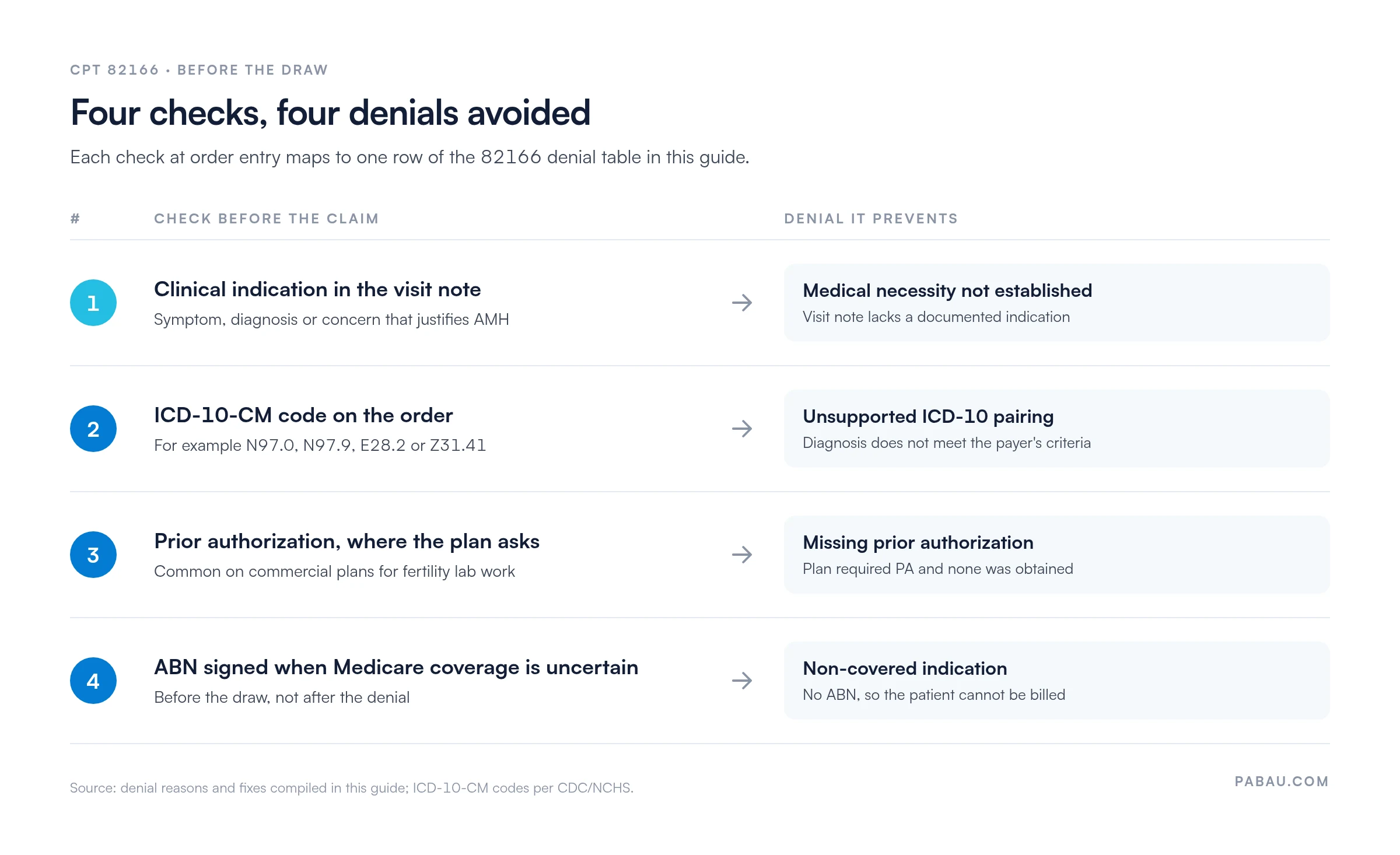
Four checks before a CPT 82166 claim and the denial each prevents
Four of the six denial reasons above can be headed off before the blood draw, from the visit note to the ABN. Compiled from the denial table in this guide.

Pro Tip

Watch your CPT 82166 remittances for CARC 50 (non-covered service) and CARC 197 (precertification or authorization absent). If either shows up on more than 5% of them in 30 days, audit the ordering workflow. Appealing claim by claim will not fix the cause.

CPT 82166 rarely ships alone. A standard fertility or ovarian reserve workup includes several companion codes, each billed separately.

CPT CodeAnalyteTypical role in reproductive panel
82166Anti-Müllerian hormoneOvarian reserve marker
83001FSHOvarian reserve, pituitary axis function
83002LHOvulation timing, LH surge detection
82670EstradiolFollicular development, stimulation monitoring
84403Testosterone, totalAndrogen excess evaluation (PCOS, male fertility)

No standard CPT panel code includes AMH, so each analyte above bills on its own line. NCCI edits can still apply when 82166 is billed with other codes on the same claim, so check the current edit tables. The same clean claim checks apply to a fertility lab panel as to any other claim.

How Pabau supports CPT 82166 billing

Most 82166 denials start at the order, so the fix starts there too. Today, the order, the diagnosis and the authorization often sit in three places, and the biller pieces them together after the remittance. Pabau keeps them on one patient record, so the claim leaves with its reason attached.

  • Diagnosis on record: Pabau, which supports US lab ordering and Claim.MD claims, lets the practice record the diagnosis against the patient and claim.
  • Lab orders from the record: Practices can switch on Labs to order Quest tests from the patient record, with results imported automatically. Labcorp orders are placed in Labcorp Link, and results sync back.
  • Prior authorization on the case: The practice records the authorization code, dates and sessions on the case, and Pabau warns when one is missing.
  • Real-time eligibility via Claim.MD: Eligibility checks return the patient’s benefits before the draw. Claims go out through Claim.MD to thousands of US payers, and ERA remittances come back into Pabau.
  • Denial reasons on each claim: ERA remittances posted in Pabau show the denial reason on each claim, so the biller knows which check failed.

Reduce CPT 82166 denials before they happen

Pabau keeps the diagnosis, the prior authorization and the Claim.MD eligibility check for lab claims like CPT 82166 on one patient record. Your team spends less time on appeals.

Pabau claims management dashboard

Conclusion

CPT code 82166 is a simple lab code to bill once the order carries its reason. The claim succeeds or fails on what the ordering provider writes before the draw: the indication, the diagnosis code, and any authorization the plan needs.

For Medicare patients, document the condition behind an infertility workup and keep the ABN for cases where coverage is uncertain. For commercial plans, check prior authorization at the order rather than after the remittance.

Book a demo to see how Pabau keeps the diagnosis, the authorization and the claim for each 82166 order on one patient record.

Continue your research

Continue your research

Billing LH from the same draw? CPT code 83002 covers the luteinizing hormone assay that often sits beside AMH in a fertility panel.

Unfamiliar with how clearinghouses process lab claims? Our medical claims clearinghouse guide explains how 837P files, eligibility checks, and remittance processing work in practice.

Getting CARC denial codes on remittances and not sure what they mean? Our denial codes in medical billing reference maps the most common CARC and RARC codes to corrective actions.

Frequently asked questions

What is CPT code 82166 used for?

CPT code 82166 is a serum immunoassay for anti-Müllerian hormone (AMH), used primarily to assess ovarian reserve in women undergoing fertility evaluation or infertility workup. It is also ordered in polycystic ovary syndrome workups, premature ovarian insufficiency assessment, and selected pediatric male cases involving testicular function evaluation.

Does Medicare cover CPT code 82166 for AMH testing?

Medicare covers CPT code 82166 when the test is reasonable and necessary for a documented condition, and it excludes routine screening. No national coverage determination addresses AMH, so the MAC applies that standard to the note and the diagnosis code. Issue an ABN when coverage is uncertain.

What ICD-10 codes should be used with CPT 82166?

Commonly accepted infertility pairings are N97.0 (female infertility associated with anovulation), N97.1 (female infertility of tubal origin) and N97.9 (female infertility, unspecified). E28.2 (polycystic ovarian syndrome), E28.310 (symptomatic premature menopause) and Z31.41 (encounter for fertility testing) are also common. The codes accepted depend on the MAC and the commercial payer’s coverage policy.

What are common denial reasons for CPT code 82166?

The most frequent denial reasons are an undocumented indication in the visit note and an ICD-10 code the payer does not accept for AMH. Missing prior authorization and routine screening without a qualifying diagnosis follow close behind. NCCI edits can still apply when 82166 is billed with other codes on the same claim, so check the current edit tables.

Is prior authorization required for CPT code 82166?

Prior authorization requirements vary by payer and indication. Medicare Part B does not typically require PA for lab tests, though coverage criteria must be met. Many commercial managed care plans require prior auth for AMH when ordered in a fertility treatment context. Verify each plan’s current policy at the time of ordering.

What is the Medicare reimbursement rate for CPT code 82166?

The 2026 Medicare Clinical Laboratory Fee Schedule sets a national limit of $38.62 for CPT 82166. CMS updates the CLFS each quarter, so confirm the current file at CMS.gov before billing.
Avatar photo
Despina Petrushevska
Content Writer

Despina Petrushevska is a content writer covering aesthetics, dermatology, and clinic operations, known for making detailed clinical concepts clear and engaging. Outside of work, she enjoys photography, weekend getaways, and finding inspiration in everyday experiences.
×