CRM for chiropractors: how to manage patients, bookings and marketing
A CRM for chiropractors is a patient relationship management system built around...

Last Updated: Oct 13, 2026

A welcome letter confirms the appointment, lists what to bring, and states the policies you intend to enforce.
One academic quality improvement project rewrote its letter for readability and saw patient-rated value rise from 3.79 to 4.63 out of 5.
Sending the letter does not satisfy HIPAA, because your Notice of Privacy Practices is due by the first date of service.
Uninsured and self-pay patients who book three or more business days out are owed a good faith estimate.
Practice management software like Pabau sends the letter when the appointment is booked and files it on the patient record.
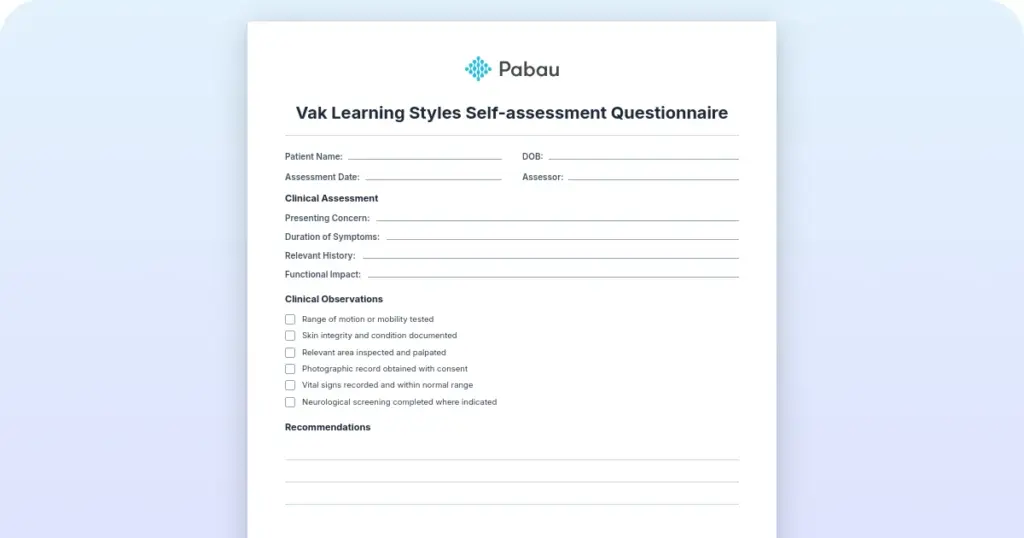
A two-page letter with fields for the appointment, a what-to-bring checklist, and your contact details and hours. It also carries short policy sections on cancellations, payment, refills, privacy, and reminders, plus a page for the patient to send questions back.
Download templateA new patient welcome letter is the first document your practice sends after someone books. It confirms the appointment, tells the patient what to bring, and sets out the policies you plan to enforce.
That last job carries more weight than the warm tone. Whatever the letter says about cancellation notice and fees is the version a patient will quote back to your front desk in three months.
This page gives you the letter and the reasoning behind each section. It also covers the reading level worth writing to, and two federal notices that come due in the same week.
It has three jobs, and warmth is only one of them.
The third job is the one practices skip. A fee you never disclosed is a fee you will end up waiving at the desk, in front of a waiting room.
The template follows the order below. Keep that order if you rewrite it, because it moves from what the patient needs first to what they need to know eventually.
Name the date, the time, and the provider in the first two sentences. Then give the arrival window and say why it exists.
Fifteen minutes early is standard. Say that the buffer is for check-in, so the patient reads it as protecting their appointment rather than wasting their afternoon.
Make it a list, not a paragraph. A patient scanning on a phone will read seven bullets and skip a block of prose that says the same thing.
The template asks for photo ID, an insurance card, a medication list, and other providers’ contact details. It also asks for prior records or imaging, a payment method, and completed intake forms.
Trim the list to what you will genuinely use. Asking for records you never open teaches patients that your instructions are optional.
Give the address, phone, email, portal link, office hours, and an after-hours route. The after-hours line is the one patients look for at 9pm, and its absence is what sends them to an emergency room.
Write the address the way a person would say it out loud. Add a sentence on parking and the entrance to use.
Five short paragraphs cover most practices. Each one gets a heading and two or three sentences, never a page.
Keep the fee figures in brackets in your master copy. A stale number in a letter you send hundreds of times a year is worse than no number.
End by inviting a question before the visit. The template gives the patient space to say what they want their provider to know in advance.
That box earns its place. A patient who writes down a concern beforehand arrives having already framed it, which shortens the first ten minutes of the consultation.
A short “how did you hear about us” question sits alongside it. Front-desk staff rarely ask it consistently, and the letter does.
Aim for an eighth-grade reading level or lower, and check it before the letter goes out. Readability is the one edit with measured evidence behind it.
A quality improvement project at the University of Florida tested this in a neurology practice. The team surveyed patients on the existing welcome letter, rewrote it with input from a patient and family advisory council, then surveyed again.
The rewrite targeted an eighth-grade level and a Flesch reading-ease score of 60 or higher. It also added practical content the original left out, including fees, parking, portal activation, and the cancellation policy.
Patients rated the revised letter 4.63 out of 5 for overall value, against 3.79 for the original. Across 74 patients, that difference reached statistical significance.
Treat the size of that jump with care. This was a single practice, and only the overall-value question moved. Five other survey items, including comprehension and satisfaction, did not shift.
The practical takeaway holds anyway. Run your draft through a readability checker, cut the multisyllabic institutional wording, and put the reading-ease score in your review checklist.
US practices owe new patients two documents around the time the welcome letter goes out. Neither one is the letter, and confusing them is a compliance risk.
Under the HIPAA Privacy Rule, a provider with a direct treatment relationship owes the patient its notice by the first date of service. That is 45 CFR 164.520(c)(2)(i).
The same rule asks for more than delivery. Except in an emergency, you must make a good faith effort to get written acknowledgment of receipt. If you cannot, document the effort and the reason.
You also have to post the notice at any physical site, where patients can reasonably be expected to read it. Keep copies available for them to take away.
So the welcome letter flags that the notice is coming. It does not discharge the obligation, and a line in it is not an acknowledgment.
Under the No Surprises Act, uninsured and self-pay patients are owed a written good faith estimate of expected charges. The deadlines in 45 CFR 149.610 run from the date of scheduling.
| How far ahead the visit is booked | When the estimate is due |
|---|---|
| At least 3 business days | Within 1 business day of scheduling |
| At least 10 business days | Within 3 business days of scheduling |
| Patient asks for an estimate | Within 3 business days of the request |
Two details catch practices out. A patient who merely asks about cost counts as having requested an estimate. And a visit booked less than three business days ahead does not trigger one at all.
For most bookings, the estimate is due before the welcome letter would normally arrive. If you batch your new patient mail weekly, the estimate needs its own faster route.
Confirm the current wording with your own counsel before you rely on it. Both rules have been amended since they took effect.
Four things belong somewhere else.
One more habit worth breaking. A letter that opens with a list of rules reads like a notice board, and patients respond to it that way.
Send it the way the patient booked, and send it within a day of booking. A letter that arrives after the appointment has cost you postage and nothing else.
Delivery is a weak point worth auditing. In the Florida project, some patients surveyed in the waiting room reported never receiving the original letter.
Whichever route you pick, log the send against the patient record. A letter you cannot prove you sent is a policy you cannot enforce.
The structure holds across specialties. What changes is the middle, and the study above suggests specialty-specific detail is what patients value.
Multi-provider practices should keep one master letter with a swappable middle section. Separate letters per provider drift apart within a year.
In most practices this letter is a Word file on a shared drive. Someone remembers to send it, edits the appointment details by hand, and nobody records that it went.
Practice management software like Pabau moves that onto the booking. When the appointment is created, the letter goes out with the date, time, and provider already filled in.
The intake forms travel with it, so the patient completes them before arriving. Their answers land on the patient record instead of a clipboard, and the send is logged with a timestamp.
So you can see who was told what, and when. That is the difference between a cancellation policy you hope patients read and one you can point to.

Pabau sends your welcome letter and intake forms automatically when the appointment is created, with the date, time, and provider filled in. Every send is timestamped on the patient record, so your policies are documented before the first visit.

Most practices treat this letter as a courtesy and write it once. It is closer to a contract that happens to be friendly.
So do three things with the template. Write it at an eighth-grade level and send it within a day of booking. Keep it separate from the privacy notice and the good faith estimate.
Then log the send. A warm letter nobody can prove you sent will not help you the day a patient disputes a missed-visit fee.
Customize the wording for your practice, and have counsel review the policy sections. Book a demo to see how Pabau sends the welcome letter and intake forms as soon as a patient books.

Need the privacy notice the letter refers to? Notice of privacy practices template covers what the notice has to say and when you have to hand it over.
Still collecting history on paper at the desk? New patient questionnaire template gives you the intake form this letter asks patients to complete in advance.
Writing the cancellation terms for the first time? Appointment cancellation policy template sets out notice periods and fees you can actually enforce.
Mapping the whole first-visit sequence? Patient onboarding software walks through the steps between booking and arrival.
Want the tone right across every message? Patient communication covers how to write to patients without sounding like a policy manual.
It should confirm the appointment date, time, and provider, then list what to bring. Add your address, hours, and after-hours route. Close with short policy notes on cancellations, payment, refills, privacy, and reminders.
Within one business day of booking. Send it the way the patient booked, so an online booker gets an email or text and a phone booker gets mail.
No. A provider with a direct treatment relationship owes the patient a Notice of Privacy Practices by the first date of service. You also need a good faith effort to obtain written acknowledgment of receipt.
Yes, under the No Surprises Act. If the visit is booked at least three business days ahead, the estimate is due within one business day of scheduling.
Two pages at most. Page one covers the appointment, the what-to-bring checklist, and your contact details. Page two holds the policy notes and a space for the patient to reply.
Yes, if you keep a single master letter and vary only the middle section. Separate letters per provider drift apart within a year and start contradicting each other.