Patient reactivation software automatically identifies patients who have lapsed or are overdue for care and re-engages them through targeted SMS, email, and recall campaigns. It can be a standalone tool or built into an all-in-one practice management platform like Pabau, turning your patient database into rebooked appointments and recurring revenue.
Patient reactivation software automates outreach to inactive patients – standalone tools work, but all-in-one platforms like Pabau eliminate the need for a separate subscription
Most practices have roughly 25% of their patient database overdue for care, yet fewer than a third use effective reactivation strategies
Pabau includes built-in recall automation, SMS and email campaigns, and client retention tools as part of its clinic management platform – no additional reactivation tool required
Found our content helpful?
Patient reactivation software compared at a glance
The table below summarises each platform across the five criteria that matter most for reactivation decisions: best-fit clinic type, standout capability, starting price, and published user rating.
Name
Best For
Standout Feature
Starting Price
Rating
Pabau
Aesthetic, wellness, and multi-specialty clinics
Recall and reactivation built into an all-in-one clinic OS
From $65/month
4.7/5 (600+)
Brevium
General medical, optometry, and dental practices
Proprietary data-science patient identification
Contact for pricing
N/A
DoctorConnect
US medical practices needing broad EHR integration
Broad messaging automation across multiple channels
Contact for pricing
3.9/5
Emitrr
Practices prioritising messaging automation and integrations
500+ connections; 4.8/5 Capterra rating
Contact for pricing
4.8/5
mConsent
Dental practices
Dental-specific automated reminder campaigns
Contact for pricing
N/A
ClientRevive
Small clinics wanting quick-start email reactivation
AI-tailored recall emails for small practices
Contact for pricing
N/A
Best patient reactivation software: Comparing your top options in 2026
Most clinics are sitting on a gold mine they never tap. According to estimates cited by Brevium, roughly 25% of a practice’s patient database is overdue for care at any given time, yet fewer than a third of practices deploy effective strategies to bring them back. That’s booked appointments, recurring revenue, and patient relationships quietly bleeding away.
Patient reactivation software exists to close that gap. The question is which kind fits your practice: a dedicated standalone tool, or an all-in-one platform that handles reactivation alongside scheduling, billing, and clinical records?
This guide evaluates seven of the leading patient reactivation software options for 2026, covering automation depth, multi-channel outreach, EHR integration, compliance, pricing, and which clinic types each platform serves best. Platforms reviewed: Pabau, Brevium, DoctorConnect, Demandforce, Emitrr, mConsent, and ClientRevive.
1. Pabau — Best all-in-one patient reactivation software for aesthetic and wellness clinics
Pabau is a full-stack clinic management platform designed for aesthetic practices, medspas, wellness clinics, and multi-specialty private healthcare. Unlike standalone reactivation tools, Pabau handles the entire patient lifecycle in one system: scheduling, clinical records, digital consent forms, billing, and client retention, including recall and reactivation automation.
The reactivation capability is built directly into the platform. You configure rules based on last visit date or treatment type, and Pabau automatically identifies patients who are overdue and sends tailored outreach via SMS or email. There is no separate plan, no third-party sync, and no data mapping required. Everything runs on the same patient record. Reactivated patients who prefer virtual visits can even rebook straight into telehealth software appointments.
For aesthetic clinics, this is particularly valuable. A patient who had dermal fillers eight months ago and has not rebooked triggers a recall campaign automatically. A Botox client due for a top-up in 12 weeks gets a timely nudge before their treatment window closes. That kind of treatment-based recall logic is difficult to replicate with a generic reactivation tool that does not understand your service menu. Pabau’s automated recall workflows handle this natively, triggered by flexible rules within the platform.
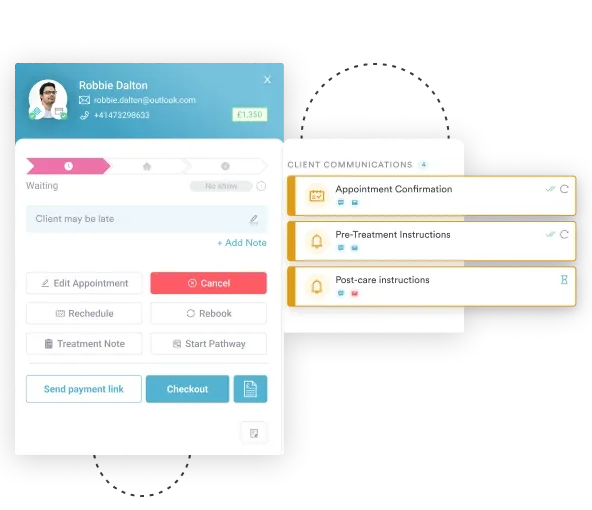
Automated communication in Pabau
Key features
Automated recall and reactivation: Rules-based workflows triggered by last visit date, treatment type, or custom rules
Multi-channel outreach: SMS and email campaigns managed within a single platform
Email and SMS campaign builder: Template library with tokens for patient-specific messaging
Client portal: Patients can self-rebook from recall messages without calling the clinic
Before-and-after photos: Visual treatment history that supports re-engagement conversations
Integrated reporting:Appointment bookings, revenue, and retention trends visible in one dashboard
GDPR and HIPAA framework: Built for both UK/EU private clinics and US healthcare practices
Multi-location support: Central reactivation management across multiple clinic sites
Pricing
Plan / Tier
Price
Details
Starter
From $65/month
Per practitioner; billed monthly
Team / Group
Scales by location and user count
Volume-based pricing
Enterprise
Custom pricing
Contact sales for a quote
Visit pabau.com/pricing for current plan details and regional pricing.
Where Pabau shines
No connection headache: Patient records, recall workflows, and campaign history all live in the same system. No sync errors, no duplicate data.
Treatment-aware reactivation: Recall triggers based on specific treatment types, not just visit dates. A filler patient and a physiotherapy patient get different messages at different intervals.
Built-in email and SMS campaigns: Design and schedule outreach without a separate marketing tool.
Revenue visibility: See which reactivation campaigns generate rebooked appointments through integrated reporting, rather than toggling between systems.
Multi-location ready: Run central recall campaigns across multiple sites from one account.
Where Pabau falls short
Learning curve: As a full platform rather than a single-purpose tool, onboarding takes longer than a lightweight reactivation-only app.
No IVR (Interactive Voice Response): Pabau does not currently offer automated phone call outreach, which some focused reactivation tools provide.
Integration-dependent for non-Pabau users: Practices already on a different PMS would need to consider migrating or using Pabau alongside their existing setup.
Customer reviews
Pabau holds a 4.7/5 rating based on 600+ verified reviews on Capterra. Reviewers frequently highlight the all-in-one convenience and strong scheduling tools as key reasons for choosing and staying with the platform. Some users note the initial setup requires time investment, particularly when migrating from another system.
Who Pabau is best for
Aesthetic clinics, medspas, and skin clinics wanting recall automation without a separate tool
Multi-location practices that need central client retention management
Wellness and private healthcare clinics already using (or evaluating) a full practice management platform
Clinics in the UK, US, and international markets needing GDPR and HIPAA-aligned workflows
See Pabau’s recall automation in action
Book a personalised demo and see how Pabau’s built-in reactivation workflows, SMS and email campaigns, and retention reporting work together as part of a complete clinic management platform.
2. Brevium — Best dedicated patient reactivation software for general medical practices
Brevium is a patient reactivation platform built for one job. It does one thing and focuses on doing it well: identifying overdue patients in your practice management system and automating a multi-step outreach campaign to bring them back.
What distinguishes Brevium from basic reminder tools is its data-science approach to patient identification. Rather than flagging all patients past a set date, Brevium uses custom algorithms to prioritise the highest-value overdue patients first, according to the company’s product pages. It integrates with your existing EHR or PMS to pull patient data, runs automated contact campaigns, and provides focused reporting on campaign performance and patient return rates.
Key features
Data-science patient identification: Custom algorithms prioritise highest-value overdue patients (as described on Brevium’s website)
Multi-step outreach campaigns: Automated chains across multiple contact attempts
EHR/PMS connection: Connects to existing practice management systems to access patient records
Appointment reminders integration: Works alongside recall attempts to catch patients who missed earlier outreach
Pricing
Plan
Price
Who It’s For
Key Features
Custom
Contact Brevium for pricing
Medical, dental, and optometry practices
Full reactivation platform, EHR integration, campaign reporting
Where Brevium shines
Focused approach: Built specifically for reactivation, with deeper campaign logic than a general-purpose tool
Focused ROI reporting: Campaign metrics show exactly which patients returned and when, giving practice managers clear attribution data
Strong call-center fit: Reviewers in call-center environments praise the platform for making it easy to work through large lists of overdue patients efficiently
Where Brevium falls short
Requires a separate PMS plan: Brevium is a layer on top of your existing system, not a replacement. Smaller practices pay for two tools.
Pricing not published: No public pricing available, making budget comparisons difficult without a sales call.
Limited review data: No verified Capterra, G2, or Trustpilot scores publicly available at time of writing.
Customer reviews
Brevium does not have verified third-party review listings on Capterra or G2 at time of writing. Testimonials on the Brevium website highlight strong results for practices in optometry and general medicine, with staff in call-center roles noting the platform makes working through overdue patient lists straightforward.
Who Brevium is best for
General medical, optometry, and dental practices with large overdue patient lists
Practices with a focused call-center or care coordination team for patient outreach
Clinics already satisfied with their PMS that want to add a specialist reactivation layer
3. DoctorConnect — Patient reactivation software with broad EHR integration
DoctorConnect is a long-established patient engagement and reactivation platform with a track record spanning more than 30 years. Its primary selling point is breadth of connectivity: the platform advertises integration with 150+ EHR systems, according to its product pages, making it a good choice for practices locked into a legacy or niche EHR that other reactivation tools cannot reach.
The platform offers automated patient reminders, reactivation campaigns, and two-way messaging, with messages sent via text, email, and phone. Its long history in the US healthcare market means it has experience across a wide range of practice types and compliance settings.
Key features
150+ EHR connections: Connects with a broad range of practice management and EHR systems (vendor-stated figure)
Multi-channel outreach: Text, email, and phone-based automated messaging
Automated reactivation campaigns: Identifies overdue patients and sends sequenced outreach
Two-way messaging: Patients can reply directly to appointment or recall messages
HIPAA compliance emphasis: Long-running focus on healthcare data privacy (note: zero-violation claim is vendor self-reported)
Pricing
Plan
Price
Who It’s For
Key Features
Custom
Contact DoctorConnect for pricing
US medical practices, particularly those with complex EHR setups
Reactivation campaigns, 150+ EHR integrations, multi-channel messaging
Where DoctorConnect shines
Integration breadth: 150+ EHR connections means fewer practices get left out due to incompatible systems
Long track record: 30+ years serving US healthcare practices gives the platform solid setup experience
Phone outreach capability: Automated phone-based recall attempts alongside text and email, useful for older patient demographics
Where DoctorConnect falls short
UX age concerns: Some users report an older interface compared to newer patient engagement tools
US-centric: Limited documented suitability for UK, EU, or international clinic environments
No published third-party ratings: No verified Capterra or G2 scores available at time of writing
Customer reviews
DoctorConnect does not have verified third-party review listings on Capterra or G2 at time of writing. The platform’s HIPAA compliance claims (including a stated record of zero HIPAA violations in 30+ years) are vendor self-reported marketing statements and have not been independently verified.
Who DoctorConnect is best for
US medical practices with an existing EHR that DoctorConnect supports
Practices in general medicine, dental, and optometry needing multi-channel outreach
Clinics wanting established market experience over cutting-edge features
4. Demandforce — Patient reactivation software for SMB healthcare marketing
Demandforce positions itself as a marketing and communication platform for small-to-medium healthcare businesses. Beyond reactivation, it covers online reputation management, appointment reminders, and patient communication automation, making it a broader engagement tool rather than a focused reactivation tool.
Its approach to patient reactivation starts with defining what “inactive” means for your practice, then automating targeted outreach based on those criteria. Per-feature pricing tiers mean costs can escalate as practices add capabilities, which is worth factoring into budget planning.
Key features
Automated reactivation messaging: Targeted campaigns based on patient activity thresholds
Reputation management: Review generation and monitoring tools alongside reactivation
Appointment reminders: Automated text and email reminders for existing appointments
Multi-channel communication: Email, text, and social media outreach tools
Broader feature set: Covers reputation management, social media, and communication tools alongside reactivation, useful for practices wanting one marketing tool
SMB focus: Designed for smaller healthcare businesses rather than enterprise health systems
Where Demandforce falls short
Mixed support reviews: Capterra reviewers give it a 3.9/5 rating, with recurring feedback around customer support responsiveness
Cost escalation: Per-feature pricing tiers mean adding capabilities increases the monthly bill, which some reviewers flag as frustrating
Not specialist-built: Serves multiple service industries, not exclusively healthcare or clinic workflows
Customer reviews
Demandforce holds a 3.9/5 rating on Capterra. Reviewers highlight the broad feature set as a positive but note mixed experiences with customer support. Per-feature pricing is a recurring concern among users who find costs higher than expected once multiple features are activated.
Who Demandforce is best for
SMB healthcare practices wanting a broader marketing automation platform that includes reactivation
Practices where reputation management and review generation are as important as recall campaigns
5. Emitrr — Patient reactivation software with high user satisfaction and wide integrations
Emitrr is a patient communication and engagement platform that covers automated appointment reminders, reactivation campaigns, two-way texting, and digital intake forms. Its standout metric is user satisfaction: a 4.8/5 rating on Capterra, placing it among the highest-rated tools in this comparison. If onboarding new patients is your bigger bottleneck, dedicated patient intake software may be a better starting point.
The platform’s range of integrations is a genuine strength. Emitrr claims connections with 500+ external tools and software, including practice management systems, EHRs, and communication platforms, according to the company’s product pages. For practices with complex technology stacks, this reduces hassle when adding a patient reactivation layer.
Key features
Automated reactivation campaigns: Identifies and contacts overdue patients through configurable workflows
Two-way texting: Patients can reply directly, enabling staff to handle responses efficiently
500+ connections: Broad connectivity with EHRs and practice management systems (vendor-stated figure)
Digital intake forms: Paperless intake alongside patient communication workflows
No-show follow-up: Automated messages to patients who missed appointments
Pricing
Plan
Price
Who It’s For
Key Features
Custom
Contact Emitrr for pricing
Healthcare practices needing messaging automation
Reactivation campaigns, two-way texting, 500+ integrations, digital forms
Where Emitrr shines
Top-rated by users: 4.8/5 on Capterra and 4.7/5 on G2 reflect strong user satisfaction across the board
Responsive support: Customer service is consistently highlighted as a strength in user reviews
Integration breadth: Wide EHR and PMS connections mean most practices can connect without custom development
Where Emitrr falls short
Not a full PMS: Strong on messaging and engagement, but does not replace scheduling, billing, or clinical documentation
Setup complexity: Practices with large or complex integration requirements report a more involved initial configuration process
Customer reviews
Emitrr holds a 4.8/5 rating on Capterra and 4.7/5 on G2. Reviewers consistently praise the ease of use, the quality of customer support, and the breadth of integration options. Some users note that larger or more complex integration setups take time to configure initially.
Who Emitrr is best for
Practices that already have a PMS and need a high-quality messaging and reactivation layer on top
Healthcare businesses where two-way patient texting is a core workflow requirement
6. mConsent — Patient reactivation software built for dental practices
mConsent is a dental-specific patient engagement platform covering digital consent forms, automated recall reminders, and reactivation campaigns. It is built for dental workflow, meaning its features, templates, and outreach logic reflect the treatment schedules and record requirements of a dental practice rather than a generic healthcare setting.
For dental clinics, that specificity is an advantage. Recall intervals, hygiene appointment triggers, and treatment follow-up logic all match how dental practices actually operate. For any clinic outside dentistry, however, the narrow focus becomes a significant limitation.
Key features
Dental-specific recall and reactivation: Automated campaigns built around hygiene intervals and dental treatment cadences
Digital consent forms: Paperless consent collection within the same platform
Automated reminder campaigns: Text and email reminders for upcoming and overdue appointments
Pricing
Plan
Price
Who It’s For
Key Features
Custom
Contact mConsent for pricing
Dental practices
Dental recall automation, digital consent forms, automated reminders
Where mConsent shines
Dental-native logic: Recall intervals and treatment follow-up workflows match how dental practices actually schedule and communicate
Consent and reactivation in one platform: Avoids a separate consent management tool for dental workflows
Where mConsent falls short
Dental-only: No meaningful use outside dental practices
Limited third-party reviews: No verified Capterra or G2 ratings at time of writing, making independent review difficult
Customer reviews
mConsent does not have verified third-party listings on Capterra or G2 at time of writing. Independent review relies on vendor-provided testimonials and direct demos.
Who mConsent is best for
Dental practices wanting recall and consent management in a dental-specific platform
Dental clinics already evaluating dedicated patient communication tools for their workflow
7. ClientRevive — Lightweight patient reactivation software for small clinics
ClientRevive is a newer entrant in the patient reactivation software market, focused on AI-personalised recall emails for small clinics, dentists, physios, and wellness practices. The pitch is speed to setup: smaller practices can launch reactivation email campaigns without a lengthy onboarding process or technical integration work.
The trade-off is scope. ClientRevive is email-focused, without the multi-channel outreach, clinical integration depth, or reporting sophistication of more established platforms. For a small practice with a modest budget that needs to start reactivating patients quickly, it may be a workable starting point. For any practice with more than a few hundred patients or complex reactivation needs, the limitations surface quickly.
Key features
AI-personalised recall emails: Automated, tailored email campaigns for inactive patients
Quick setup: Positioned for small clinics wanting fast deployment without extensive onboarding
Clinic and wellness focus: Designed for clinics, dentists, physios, and wellness practices
Pricing
Plan
Price
Who It’s For
Key Features
Custom
Contact ClientRevive for pricing
Small clinics and solo practitioners
AI email tailoring, quick-start recall campaigns
Where ClientRevive shines
Low friction entry: Quick setup appeals to small practices without a dedicated operations or IT resource
AI email personalisation: Automated personalisation without manual template writing per patient
Where ClientRevive falls short
Email-only outreach: No SMS, phone, or IVR channel, limiting reach to patients who do not regularly check email
Emerging product: Limited review history makes independent evaluation difficult; long-term product roadmap and support are less established
No EHR integration depth: Not designed for practices needing clinical record integration alongside reactivation
Customer reviews
ClientRevive does not have verified third-party listings on Capterra, G2, or Trustpilot at time of writing. As an emerging product, independent review data is limited.
Who ClientRevive is best for
Small solo or single-location practices wanting a quick-start email reactivation tool
Clinics in an early stage of building a patient retention strategy who need a low-cost starting point
How to choose the right patient reactivation software for your practice
The right patient reactivation software depends on what your practice already has, how your team works, and which patients you are trying to reach. Five questions narrow the decision quickly.
Do you already have a practice management system? If yes, a standalone reactivation tool (Brevium, Emitrr, DoctorConnect) can layer on top. If you are evaluating your PMS at the same time, an all-in-one platform like Pabau removes the need for two plans.
What clinic type are you running? Dental practices get the most value from dental-specific tools like mConsent. Aesthetic clinics, medspas, and multi-specialty wellness practices are Pabau’s primary audience, with treatment-aware recall logic that general tools cannot replicate.
Which outreach channels do you need? SMS and email cover the majority of patients in most clinic demographics. IVR (automated phone) is available through DoctorConnect and Promptly for practices serving older patient populations where phone contact rates are higher.
How important is reporting to your team? If reactivation ROI attribution matters, Brevium’s focused campaign reporting is more detailed than a general practice dashboard. Pabau’s integrated reporting covers full practice performance, with filtering for campaign-specific data.
What does compliance look like for your market? US practices need HIPAA alignment. UK and EU clinics need GDPR compliance. Pabau is built for both. Most US-only tools address HIPAA but have limited GDPR documentation. Review vendor compliance documentation directly and verify independently before signing up.
For most aesthetic, wellness, and multi-specialty private clinics, an all-in-one platform that includes patient reactivation software as part of its broader feature set is the practical choice. Understanding how robust healthcare CRM software functions as a retention system, and how it overlaps with dedicated patient communication software, helps clarify why integrated platforms tend to outperform standalone tools for clinics managing ongoing client relationships. The same logic applies to patient experience software: retention improves when feedback and outreach share one record.
A free feedback form template produces the first half of that record. It pairs a 1 to 5 rating scale with an open comment box patients fill in after the visit.
Conclusion
Standalone patient reactivation software solves one problem well. But most clinics need that problem solved inside the same system that manages appointments, clinical notes, billing, and patient communications. Paying for two tools when one handles both is a cost your practice does not need.
Pabau includes automated recall workflows, multi-channel outreach via SMS and email, and retention reporting as part of its full clinic management platform. For aesthetic, wellness, and multi-specialty private practices, it is designed around the way those clinics actually operate, including treatment-based recall triggers that generic reactivation tools cannot replicate. If you want to see how the recall and reactivation features work in your clinic’s context, book a demo with the team.
Continue your research
Want to understand how retention fits into your broader clinic strategy?Patient care management software covers the operational framework for keeping patients engaged between visits.
Want the communication skills behind reactivation?Patient communication guide covers the clinical skills and systems that keep patients from drifting away quietly.
Wondering if patients retain your aftercare instructions?Patient education strategies shows why patients forget up to 80% of medical advice and how to fix it.
Frequently Asked Questions
What is patient reactivation software?
Patient reactivation software automatically identifies patients who haven’t visited in a set period and sends tailored outreach via SMS, email, or phone to bring them back.
How does patient reactivation software work?
It connects to your patient records, flags anyone who meets your inactive rules, and triggers a sequence of automated messages. Once a patient rebooks, they’re removed from the campaign.
What is the difference between patient recall and patient reactivation?
Recall is a routine reminder for patients due for a follow-up. Reactivation targets patients who didn’t respond to recall — using more touchpoints and a longer outreach window.
Is patient reactivation software HIPAA compliant?
Most tools built for the US market include HIPAA compliance. UK and EU clinics need GDPR alignment instead. Check each vendor’s documentation and request a Business Associate Agreement before committing.
What features should patient reactivation software have?
Look for: automated patient identification, SMS and email outreach, tailored templates, PMS integration, and campaign reporting that ties outreach to rebooked appointments.