Pabau Engage inbox

Pabau Engage is here: every patient conversation in one inbox.

Learn more
Practice Management Tips

QuickBooks invoice template: Free download and setup steps

A QuickBooks invoice template is a reusable invoice layout with set fields for patient details, line items, tax, payment terms and your logo. It makes every bill your practice sends consistent and complete, which cuts billing errors and gets you paid faster.

You can download the free PDF below and fill it in, or rebuild the same layout inside QuickBooks. This guide covers both, with step-by-step setup for QuickBooks Online and QuickBooks Desktop.

Download your free QuickBooks invoice template

A one-page invoice with practice and bill-to details, dated line items with a code column, and subtotal, discount, tax, amount paid and balance due. Fill it in as a PDF, or copy its layout into your QuickBooks template.

Download template
Key takeaways

Key takeaways

A QuickBooks invoice template standardizes billing with patient details, line items, subtotal, tax, payment terms and your branding in one reusable form.

QuickBooks Online and QuickBooks Desktop both ship customizable templates, and the free PDF above works as a fill-in form or a layout to copy.

Editing a template in QuickBooks requires company admin permissions. Past invoices keep their old layout, and only invoices created after the edit change.

Default payment terms live outside the template editor in both versions, so set them separately or every invoice goes out without a due date.

Pabau, the practice management platform we build, starts each invoice from the appointment and patient record, so staff stop re-typing visit details.

Found our content helpful?

What to include on the invoice

Every invoice your practice sends needs the fields below. Leave one out and payment slows down, or your books stop reconciling.

FieldPurposeNotes
Invoice numberUnique identifier for tracking and reconciliationSequential or date-based; must be unique per invoice
Invoice dateWhen the invoice was issuedAffects payment due date calculation
Practice detailsBusiness name, logo, address, phone, emailIdentifies the invoicing entity
Patient detailsPatient name, address, contact informationEssential for payment routing and records
Line itemsService/product description, quantity, unit priceThe core billing data; must be itemized for clarity
Subtotal, tax, totalCalculated financial summaryVerify tax calculation is correct for your jurisdiction
Payment termsDue date, payment method, late payment termsExample: Net 30, 2/10 Net 30, due on receipt
Notes or memoOptional space for special instructions or thanksHelpful for patient communication

The downloadable invoice template above covers most of these fields. It has practice and bill-to details, dated line items with a code column, and a summary of subtotal, discount, tax, amount paid and balance due. Add your logo and a memo line when you rebuild the layout in QuickBooks.

Setting up a template in QuickBooks Online

QuickBooks Online comes with invoice styles you can customize in the browser. Six steps take you from a stock style to one that’s ready to send:

  1. Access settings: Click the gear icon (top right) and select “Custom form styles” under Settings.
  2. Choose or create a template: Pick an existing invoice style and click “Edit” to modify it, or click “New style” to create one.
  3. Customize layout: Upload your practice logo. Then adjust the form title, column headers and footer text to match your branding.
  4. Add custom fields: Need a treatment code or provider name on the invoice? Add line-item columns or extra header fields in the style editor.
  5. Set default payment terms: Terms aren’t part of the style editor. Go to the gear icon, then Account and settings, then Sales, and choose your preferred invoice terms (for example, Net 30). Every new invoice then starts with the same due date.
  6. Save and test: Click “Save” and create a test invoice to check the layout before it reaches patients. To use the style for every new invoice, select “Make default” in its Action column.

Mobile app limitation: The QuickBooks Online mobile app has limited template editing options. For full customization, use the desktop browser version.

Setting up a template in QuickBooks Desktop

QuickBooks Desktop handles templates through its own set of windows. To set up and use an invoice template in Desktop:

  1. Open the Templates list: From the main menu, select “Lists” → “Templates” to view your invoice templates. Stock options include Intuit Service Invoice, Intuit Product Invoice and Intuit Professional Invoice.
  2. Open a template for editing: Select the template you want, then choose “Edit Template” from the Templates drop-down. The Basic Customization window opens.
  3. Set your branding: In Basic Customization, tick “Use logo” to add your practice logo. Then adjust fonts, colors and the contact details that print on the invoice.
  4. Choose your fields: Click “Additional Customization” to add or remove items in the header, columns and footer. Typical columns are Item, Qty, Rate, Amount and a service date.
  5. Fine-tune the layout: Click “Layout Designer” to move or resize fields on the form, then click “OK”.
  6. Preview and use it: Check the result in Print Preview. Then pick the template from the Template drop-down at the top of a new invoice and send a test before using it with patients.

Key difference from QBO: Desktop templates are stored locally on your computer, while QBO templates are cloud-based and accessible from any device with internet access. The menus differ too, and the grid below maps each setting to where it lives in both versions.
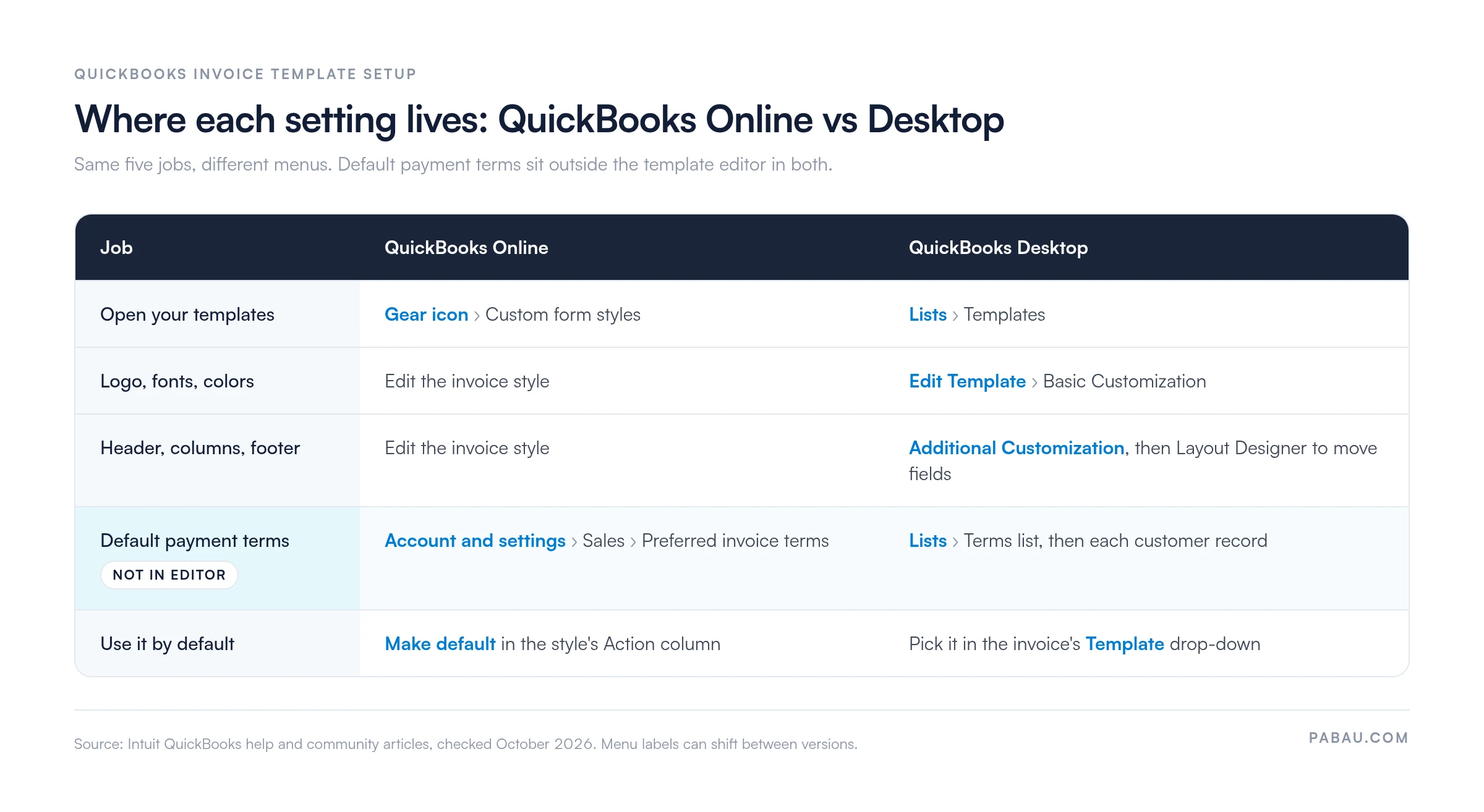
Comparison grid of where QuickBooks invoice template settings live.
Payment terms sit outside the template editor in both versions, which is why invoices often go out without a due date. Menu paths come from Intuit’s QuickBooks help and community articles.

Customization tips that get invoices paid

Once the base template is in place, these habits keep your invoicing clear and quick to pay:

  • Brand consistency: Upload your logo and use your practice’s brand colors in headers and footer text. Patients recognize the invoice as yours at a glance.
  • Payment method clarity: Include a clear payment method line (e.g., “Checks payable to [Practice Name]” or “Pay online at [link]”). The easier you make payment, the faster patients pay.
  • Default payment terms: Set a standard due date (e.g., Net 30 or Net 45) so every invoice includes it automatically. This prevents disputes over when payment was due.
  • Column customization: Add or remove columns based on what matters to your business. A consulting practice might want “Hours Worked” and “Hourly Rate”; a medical practice might want “Service Date” and “Procedure Code.”
  • Memo or notes section: Reserve space for special terms, a thank-you message or next-appointment details. A short personal note keeps the invoice from reading like a demand.
  • Protected health information: If HIPAA applies to your practice, an invoice that pairs a patient’s name with a treatment is protected health information (PHI). Use generic service descriptions in QuickBooks unless you have a business associate agreement in place with Intuit.
  • Know the retroactive rule: Template changes do not update invoices you’ve already sent. Changes apply only to new invoices created after the edit, so old invoices stay as they were for audit accuracy.

QuickBooks templates vs. other invoice formats

A QuickBooks template works best for practices already using QuickBooks. Depending on your workflow, you might pair it with other formats:

FormatBest forPros / cons
QuickBooks templateIntegrated billing for existing QB usersPro: Syncs with accounting. Con: Limited design flexibility in some versions.
Word or PDF templateOne-off invoices or practices not using QBPro: Simple, widely compatible. Con: Manual data entry; no integration.
Excel templateSmall practices wanting formula-based calculationsPro: Auto-calculates totals. Con: No live sync; prone to version control errors.
FreshBooks or Zoho templatePractices seeking cloud-based invoicing beyond QBPro: Cloud access, recurring invoice automation. Con: Separate subscription cost.
Practice management software (e.g., Pabau invoicing)Healthcare practices wanting appointment-linked billingPro: Auto-populates from patient records and treatment history. Con: Requires separate PMS subscription.

For a one-off invoice outside QuickBooks, our commercial invoice template is a Word-format alternative. Healthcare practices such as med spas, clinics and therapy offices can go further. Practice management software builds the invoice from the appointment and clinical record, which removes the manual entry step.

Adapting the layout to your type of practice

Different practice types need different invoice structures. Adjust the template to match how you bill:

  • Consulting and freelance: Highlight hourly rate, hours worked, and project name. Add a line for retainer or deposit applied.
  • Medical spa or salon: Include treatment type (e.g., Botox, laser hair removal), provider name and date of service, keeping the PHI tip above in mind.
  • Therapy or counseling: List session dates, session type (individual, group), and session fees. Add insurance claim information for practices submitting to payers.
  • Product-based (retail, lab services): Emphasize quantity discounts, bulk pricing, and shipping costs. Include SKU or product code for inventory tracking.
  • Retainer-based practices: Add a line for retainer fee, amount applied, and remaining balance. This prevents confusion about monthly recurring charges.

Save each variant as its own custom form style in QuickBooks Online, or its own template in Desktop. You can then switch between them depending on the invoice you’re creating that day.

💡 Pro tip: Run a test invoice through your customized template before rolling it out practice-wide. Print it and ask your team if any fields are confusing or missing. A five-minute test saves hours of invoice confusion later.

How Pabau builds the invoice from the appointment

With a QuickBooks template, someone at the front desk copies each visit into an invoice by hand. The patient’s name, the treatment, the provider and the price get typed twice, once in the booking system and once in QuickBooks.

Pabau, the practice management platform we build, keeps the appointment, the patient record and the invoice in one system. The invoice starts from the booking rather than a blank form. Patients who book through online booking arrive with their details already on file.

Details patients enter through Pabau’s intake software for practices land in that same record, so the bill-to fields are filled before checkout. The result is fewer typos, faster checkout, and one place to look when a patient queries a charge. Book a demo to see integrated invoicing inside a full practice management platform.

Turn every appointment into an accurate invoice

Pabau keeps appointments, patient records and invoices in one system, so treatment details and prices carry onto the bill without re-typing. Take payment at checkout and keep every charge tied to the visit it came from.

Pabau clinic management dashboard

Conclusion

Start with the free PDF if you send a handful of invoices a week and already keep your books in QuickBooks. Set the layout once, set your payment terms in the right menu, and every invoice after that goes out complete.

The trade-off shows up as you grow. Each extra provider or location adds more appointment details to copy into QuickBooks by hand, and that copying is where billing errors start.

When re-typing costs more staff time than the template saves, move invoicing into the system that already holds the appointment. Book a demo to see how Pabau turns a finished appointment into an invoice ready for payment.

Continue your research

Continue your research

Need proof of payment once the invoice is settled? Receipt template for medical practices gives you a printable receipt and explains how it differs from an invoice.

Working outside QuickBooks? Commercial invoice template in Word walks through every field and how to fill it out.

Want to see how a trade-specific invoice is structured? Invoice template for builders shows what each invoice must show and which format fits the contract.

Frequently asked questions

How do I build a QuickBooks Online invoice template I can reuse?

Go to the gear icon → Custom Form Styles → Invoice → Edit. Customize the layout, logo, columns, and footer, then click Save. Future invoices created from this template will automatically pull in your branding and default fields.

Can I download a QuickBooks invoice template for free?

Yes. QuickBooks offers free downloadable invoice templates. The template at the top of this guide is also free, as a PDF you can fill in or copy into your own software.

Does editing a QuickBooks invoice template change past invoices?

No. Template changes apply only to new invoices created after you save the edit. All previously sent invoices keep their original formatting and data. This protects your audit trail and past patient records.

What is the difference between QuickBooks Online and Desktop invoice templates?

QuickBooks Online templates are cloud-based and customized via a web interface (Custom Form Styles). QuickBooks Desktop templates are customized in the Basic Customization, Additional Customization and Layout Designer windows on your computer. QBO templates are accessible from any device, while Desktop templates are local to one computer.

Do I need admin permission to edit a QuickBooks invoice template?

Yes, in QuickBooks Online. Full company admin access is required to modify Custom Form Styles. In QuickBooks Desktop, admin-level user permissions are also required to edit templates via the Layout Designer.

Can I edit a QuickBooks invoice template from my mobile app?

Limited. The QuickBooks Online mobile app does not support full template customization. You can view and use templates, but editing requires the desktop browser version or QuickBooks Desktop application.
Found our content helpful?
Avatar photo
Despina Petrushevska
Content Writer

Despina Petrushevska is a content writer covering aesthetics, dermatology, and clinic operations, known for making detailed clinical concepts clear and engaging. Outside of work, she enjoys photography, weekend getaways, and finding inspiration in everyday experiences.
×