GLP-1 diet plan
A GLP-1 diet plan is a structured eating framework for patients taking semagluti...

3
Last Updated: Oct 13, 2026
A black box medication list is a clinical reference of drugs that carry an FDA boxed warning. That warning is the most serious safety alert a prescription label can hold. This template groups those drugs by class, from antidepressants and opioids to anticoagulants and fluoroquinolones, and names the specific warning attached to each.
Prescribers use it as a check before they sign a prescription. Front-desk and nursing staff use it at intake to spot patients already taking a high-risk drug. Below, you’ll find the full list by drug category and how it differs from the ISMP high-alert list. You’ll also find five steps to build it into your workflow.
A printable reference of FDA boxed warning medications, grouped by drug category. Each entry covers the warning, monitoring requirements, contraindications and the counseling points to raise with the patient.
Download template
A black box medication list collects the drugs that carry an FDA boxed warning, the most serious safety alert on a prescription label.
Antidepressants carry a suicidality warning for patients under 25, and opioids and benzodiazepines carry a shared warning against combined use.
Warfarin’s boxed warning covers bleeding, while apixaban, rivaroxaban and dabigatran warn of clots if stopped early and of spinal or epidural hematoma.
The FDA boxed warning list and the ISMP high-alert list overlap but are not the same, so a practice needs to track both.
Recording each counseling discussion in the patient record supports your own documentation and audit trail.
A black box warning, formally a boxed warning, is the strongest warning the FDA puts on a drug label. The FDA adds one when evidence shows a medication carries a serious or life-threatening risk. The warning sits in a black-bordered box at the top of the prescribing information, where prescribers see it first.
A boxed warning differs from a standard warning in three ways:
The FDA keeps the box for risks it judges serious enough to need special attention. A drug can still carry one when its benefit outweighs the risk for the patients who take it.
The FDA can require a boxed warning when it approves a drug, or add one later through a safety labeling change. Later additions usually start with post-market data. Clinicians, patients and manufacturers send adverse event reports to the FDA’s MedWatch program, and FDA safety reviewers investigate when a pattern emerges.
The agency may consult an external advisory committee of independent experts, but it doesn’t have to. If the evidence supports a boxed warning, the FDA requires the manufacturer to update the label. The new warning then applies to every prescription going forward.
Boxed warnings change over time. The FDA can add, modify or, rarely, remove one as new evidence emerges. In 2007, for example, it expanded the antidepressant suicidality warning to cover young adults aged 18 to 24.
The table below groups the main drug classes that carry FDA boxed warnings. Grouping by class lets staff find a drug quickly during prescribing or intake. The same structure works as one section per class in patient intake software.
The antidepressant suicidality warning is the boxed warning most clinicians know. In 2004, the FDA required all antidepressants to carry a boxed warning for increased suicidal thoughts and behavior in children and adolescents. That covers SSRIs like sertraline and paroxetine, SNRIs like venlafaxine and duloxetine, and tricyclics. In 2007, the FDA extended the warning to young adults aged 18 to 24.
What the warning asks of prescribers: Monitor patients closely for worsening mood, new suicidal thoughts or unusual behavior. The risk is highest in the first few months of treatment and after dose changes, so patients and caregivers need to know the signs too. An AI medical scribe can draft the consultation note, so the counseling discussion reaches the record without retyping.
The warning doesn’t mean antidepressants cause suicide. For most adult patients, the benefit outweighs this risk. The FDA still judged the risk large enough that prescribers should screen for it at every review.
In 2016, the FDA added a boxed warning to both opioid analgesics and benzodiazepines about taking them together. Both are central nervous system depressants, and combined use can cause profound sedation, respiratory depression, coma and death.
Clinical implication: Reserve combined prescribing for patients whose other treatment options are inadequate. A chronic pain patient already on a benzodiazepine for anxiety is a common example. Limit doses and duration to the minimum, record the reasoning, counsel the patient on overdose signs and consider prescribing naloxone.
Both drug classes also affect fitness to drive. For patients who hold a commercial driver’s license, check the DOT medication restrictions list as well.
Fluoroquinolone antibiotics such as ciprofloxacin and levofloxacin carry a boxed warning for tendon rupture, peripheral neuropathy and worsening myasthenia gravis. These effects can be permanent, and tendon problems can appear weeks after the course ends. For uncomplicated infections such as acute sinusitis, the FDA advises using them only when no alternative treatment exists.
Anticoagulants carry two different boxed warnings. Warfarin’s warning covers major or fatal bleeding, so patients need regular monitoring and clear advice on the signs of bleeding. Apixaban, rivaroxaban and dabigatran warn of increased thrombotic events if a patient stops them early. They also warn of spinal or epidural hematoma in patients having neuraxial anesthesia or a spinal puncture.
Montelukast (Singulair), an asthma and allergy medication, received a boxed warning in March 2020 for serious neuropsychiatric events. These include suicidal behavior, depression and anxiety. The drug had been on the market for more than 20 years. A boxed warning can arrive at any point in a drug’s life.
High-alert medications and black box warning medications are two separate lists, though they overlap.
Black box medications carry an FDA boxed warning on their label. It’s a regulatory classification based on serious risks found in trials or after launch.
High-alert medications are drugs the Institute for Safe Medication Practices (ISMP) identifies as more likely to cause serious harm when used in error. A high-alert list is a patient safety inventory, not a regulatory label.
Warfarin sits on both lists. A dosing error can cause serious bleeding, and its boxed warning covers that bleeding risk at the correct dose too. Oxycodone also appears on both. Concentrated potassium chloride and injectable insulin are high-alert but carry no boxed warning.
The reverse also happens. Fluoroquinolones, montelukast and antidepressants carry boxed warnings but sit outside ISMP’s high-alert lists, because their main risk is an adverse effect at the correct dose. The chart below sorts these examples into three groups.
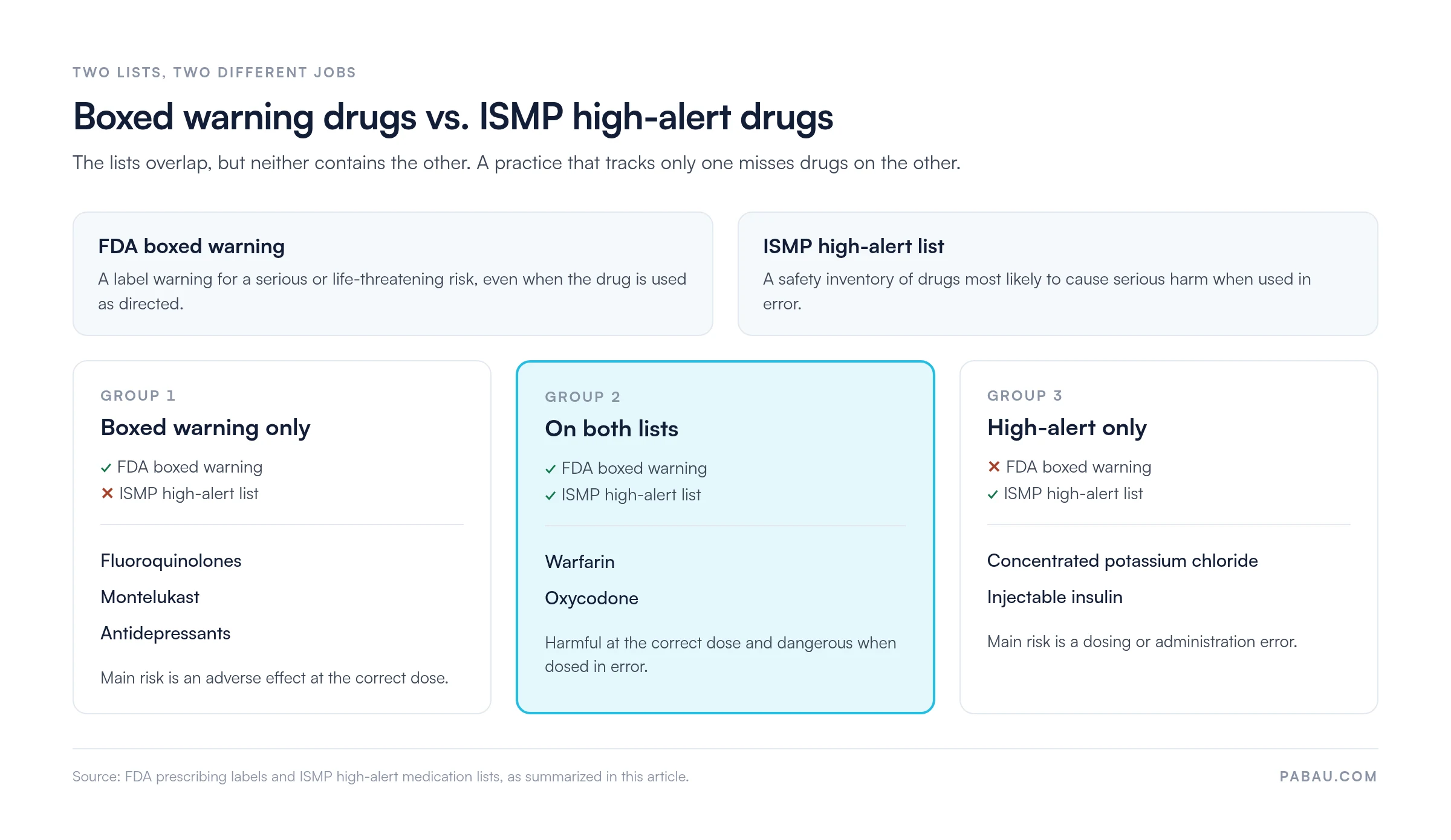
Your practice’s medication safety plan should track both lists. Use the FDA boxed warning list to guide counseling and monitoring, and the ISMP high-alert list to prevent prescribing and dosing errors.
The template does three jobs in a practice:
The format depends on practice size and specialty. A solo prescriber may need only a one-page PDF checklist. A multi-location practice might keep the list beside its e-prescribing software, so prescribers check the warning before they sign.
The downloadable PDF holds the full list by drug category. Add your practice’s logo, prescriber names and local policies, then print it for staff or attach it to your medication safety policy.
Building the list into your workflow takes five steps:
Many e-prescribing systems pull label data from a commercial drug database. When a prescriber selects a drug with a boxed warning, the system shows an alert on screen. Where your system does this, the alert replaces a manual check against a printed list.
Where it doesn’t, the template does the same job. Add the list to your intake forms and ask prescribers to record the counseling discussion in the treatment note. Practices that already log policies and audits in compliance management software can file the quarterly list review there too.
A boxed warning list protects a practice in three ways:
More practices now build boxed warning questions into their standard digital intake forms. That way, the patient’s answer is already in their record when the consultation starts.
Many practices still track boxed warning counseling on paper. The printed list sits at the front desk, the patient ticks a box, and someone scans the form into a file days later.
Pabau’s digital forms put your boxed warning questions into the medical history form patients complete before their visit. Their answers save to the patient record, next to their prescriptions and treatment notes.
Prescribers then record the counseling discussion in the treatment note, or let Pabau Scribe, our AI scribe, draft it from the consultation. When an auditor or a colleague asks what the patient was told, the answer is in one file. Book a demo to see how the forms and notes fit your prescribing workflow.

Pabau’s digital forms, prescribing and treatment notes keep medication history and counseling records in one patient file, ready when an auditor asks.

A boxed warning list only protects patients if someone checks it at the moment of prescribing and records what was said. Start with the drug classes your prescribers use most. Then put the list where your team already works, whether that’s the intake form, the prescribing screen or the treatment note.
The trade-off is upkeep. The FDA keeps adding and revising boxed warnings, so a list nobody reviews each quarter drifts out of date within a year. Book a demo to see how Pabau keeps medication history, counseling notes and consent forms in one patient record.

Treating commercial drivers? DOT medication restrictions list shows which medications can affect a driver’s medical certification.
Watching for hearing damage? Ototoxic medication list groups drugs linked to hearing and balance loss by class and risk level.
Giving medications in the practice? Medication administration record for nursing tracks every dose given, by whom and when.
Need consent before the first dose? Medication administration form captures the medication order, prescriber authorization and consent in one signed record.
Managing lupus patients on immunosuppressants? SLE medication list tracks each drug’s dose, monitoring schedule and review date.
A black box warning, or boxed warning, is the FDA’s most serious drug safety alert. It appears in a black-bordered box on the prescribing label and signals a risk of serious or life-threatening harm. Prescribers are expected to counsel patients and monitor for that risk. Documenting the discussion is good practice, and it’s required where a REMS program or state rule applies.
Yes. A boxed warning doesn’t ban a drug. It means the FDA found the benefit still outweighs the risk, but the risk needs special precautions. Prescribers counsel the patient on the warning and monitor for the specific adverse event. Recording that decision in the patient’s record is good practice, and some REMS programs or state rules require it.
Approximately 400 to 500 medications currently carry FDA black box warnings. The exact count changes as the FDA adds new warnings or, rarely, removes outdated ones based on new evidence. Major drug classes with boxed warnings include antidepressants, opioids, benzodiazepines, anticoagulants and immunosuppressants.
A regular warning appears as text in the standard warnings and precautions section of the prescribing information and alerts prescribers to a known risk. A black box warning sits in a black-bordered box at the top of the label and reflects a more serious risk. Some boxed warning drugs also need active monitoring or enrollment in a REMS program.
Black box medications are safe when used appropriately, with prescriber monitoring, patient counseling and documentation. The FDA doesn’t ban them. It requires the warning so prescribers and patients can make informed, shared decisions about the risk. Many patients benefit significantly, and antidepressants, for example, work well for depression despite the suicidality warning for young people.