HD Brows consultation form: Free template and guide
HD Brows is a seven-step brow treatment that combines consultation, tinting, wax...

1
Last Updated: Oct 13, 2026
This list of the top aesthetic doctors UK patients ask about covers 11 named practitioners, what each one treats, and the regulator that holds them. It opens with Dr Leah Totton, a cosmetic doctor best known for non-surgical face and neck lifting and for campaigning on patient safety. These profiles help patients pick a practitioner, while our medical spa systems ranking helps practices pick their software.
Every profile names where the practitioner works, the treatments they are known for, and the statutory register their name sits on. Underneath the list sits the Five-Minute Register Check. The check is a five-step sequence you can run on any UK practitioner, including the ones who never appear in a roundup.
Read it as a starting shortlist rather than a ranking. These leading aesthetics experts work in very different disciplines. The right aesthetic experts for a tear-trough filler are rarely the right ones for a thread lift or an eyelid procedure.

1. Dr Leah Totton — non-surgical face and neck lifting, and a vocal campaigner for tighter regulation in UK aesthetics.
2. Dr Jonquille Chantrey — former surgeon whose work centers on facial shaping and complex revision cases.
3. Dr Tijion Esho — lip augmentation and corrective non-surgical work, with a charity arm for botched procedures.
4. Dr Uliana Gout — chemical peels and evidence-led aesthetic medicine, with senior roles in the specialty’s professional bodies.
5. Dr Tracy Mountford — one of the UK’s longest-practicing injectors, known for conservative, low-dose results.
6. Dr Rosh — full-face rejuvenation across a multi-site practice, from a cardiology background.
7. Dr James Olding — dual-qualified doctor and dental surgeon who trains other injectors at Interface Aesthetics.
8. Dr Sophie Shotter — facial rejuvenation combined with hormone and longevity medicine.
9. Dr Nina Bal — cosmetic dental surgeon working in full-face shaping and dental aesthetics.
10. Dr Anna Hemming — dermal fillers and skin work, with an anesthetics and general practice background.
11. Dr Elizabeth Hawkes — oculoplastic surgeon specializing in eyelid surgery and under-eye rejuvenation.
We last reviewed this shortlist of UK aesthetic experts in September 2026.
| Practitioner | Based in | Background and primary regulator | Known for | Also registered with |
|---|---|---|---|---|
| Dr Leah Totton | London and Essex | Medical doctor (GMC) | Non-surgical face and neck lifting, thread lifts, medical skincare | — |
| Dr Jonquille Chantrey | Cheshire | Medical doctor, former surgeon (GMC) | Facial shaping with fillers, revision and scarring work | — |
| Dr Tijion Esho | London and Newcastle | Medical doctor (GMC) | Lip augmentation, corrective non-surgical work | — |
| Dr Uliana Gout | London (Harley Street) | Medical doctor (GMC) | Chemical peels, botulinum toxin, evidence-led protocols | British College of Aesthetic Medicine |
| Dr Tracy Mountford | Buckinghamshire and London | Medical doctor (GMC) | Conservative toxin dosing, dermal fillers and volumizers | — |
| Dr Rosh | Cheshire, London and Manchester | Medical doctor, GP and cardiology background (GMC) | Full-face rejuvenation, threads, skin tightening, laser | — |
| Dr James Olding | London | Medical doctor and dental surgeon (GMC and GDC) | Facial trauma background, injector training | — |
| Dr Sophie Shotter | Kent and London | Medical doctor (GMC) | Facial rejuvenation with hormone and longevity medicine | — |
| Dr Nina Bal | London | Cosmetic dental surgeon (GDC) | Full-face shaping, cosmetic dentistry, skin | — |
| Dr Anna Hemming | Twickenham, London | Medical doctor (GMC) | Dermal fillers, lasers, polynucleotide therapy | — |
| Dr Elizabeth Hawkes | Chelsea, London | Consultant ophthalmologist and oculoplastic surgeon (GMC) | Blepharoplasty, tear trough and under-eye work | Royal College of Ophthalmologists |
An em dash in the last column means we could not confirm a voluntary register listing while writing, not that one does not exist. Search the JCCP and Save Face registers yourself before you book.
Dr Leah Totton is a GMC-registered medical and cosmetic doctor who founded Dr Leah Clinics and Skincare after winning The Apprentice in 2013. Her focus is non-surgical facial and neck work rather than surgery.
She specializes in non-surgical face and neck lifting, dermal filler facelifts and thread lifts. She also treats thread lift complications referred from other practitioners, which is a useful signal of how experienced an injector is.
Dr Leah campaigns for patient safety and tighter regulation of the UK cosmetic sector. Dr Leah Clinics has won Best Cosmetic Clinic London for two consecutive years.
Dr Jonquille Chantrey is a GMC-registered doctor and former surgeon with more than 16 years in plastic and cosmetic surgery. She founded ØNE aesthetic studiø in Cheshire.
She lectures on aesthetics and facial anatomy internationally and has published in peer-reviewed journals. Allergan selected her to present its filler techniques to other doctors and surgeons at international congresses.
Her practice centers on facial shaping with dermal fillers, alongside anti-aging and scarring work. She takes on complex rebuild and revision cases that need that surgical background.
Dr Tijion Esho is a GMC-registered medical doctor known for lip augmentation and corrective non-surgical work. He has appeared as resident doctor on E4’s Body Fixers and ITV’s This Morning.
He developed his own methods for lip augmentation and for low-dose botulinum toxin, and works extensively in non-surgical correction. He also writes and comments on non-surgical procedures for national press and magazines.
In 2016 he launched the ESHO Initiative, a charity providing reconstructive treatment for people harmed by botched cosmetic procedures. He also helped establish the Black Aesthetics Advisory Board, which examines the experience of Black and ethnic minority doctors and patients in aesthetics.
Dr Uliana Gout is a GMC-registered aesthetic medicine doctor who founded London Aesthetic Medicine on Harley Street. She has served as President of the British College of Aesthetic Medicine.
She is known for chemical peels and botulinum toxin, and for building treatment protocols around published evidence rather than trend. She has co-authored medical textbooks and papers in aesthetic medicine.
Her committee and director roles across national and international congresses make her one of the more visible medical aesthetics experts in UK education. For a patient, that matters because teaching roles are publicly checkable.
Dr Tracy Mountford is a GMC-registered doctor and founder of The Cosmetic Skin Clinic, with practices in Buckinghamshire and London. She has more than 28 years in aesthetic medicine.
She was among the first fully trained advanced cosmetic practitioners in the UK, and she built her reputation on conservative dosing. Tatler’s Beauty and Cosmetic Surgery Guide named her London’s top doctor for cosmetic fillers.
Her work covers her own botulinum toxin techniques plus dermal fillers and volumizers. She also teaches other healthcare professionals, which is worth knowing if you want a practitioner other injectors learn from.
Dr Roshan Ravindran, known as Dr Rosh, is a GMC-registered doctor with more than 20 years in medicine. His background is in general practice and cardiology. He founded and is medical director of KLNIK.
KLNIK runs from Cheshire with sites on Harley Street and at Manchester Harvey Nichols. Dr Rosh works in full-face rejuvenation, dermal fillers, botulinum toxin, threads, skin tightening and laser resurfacing.
He is credited with pushing the UK’s natural-results approach, and he argues publicly for tighter control of who can inject. His awards include Best Facial Filler Result 2021 and a MyFaceMyBody award.
Dr James Olding is dual-qualified as a medical doctor and dental surgeon, so his name sits on both the GMC and GDC registers. He founded Interface Aesthetics and is its clinical director.
His route into aesthetics came through treating facial trauma and disease, where he saw what non-surgical work could do for appearance and confidence. He now combines facial surgical experience with injectable techniques.
Interface Aesthetics trains other practitioners, so much of his work is teaching rather than treating. He won Medical Aesthetic Practitioner of the Year 2025 at the Aesthetics Awards, and Best Independent Training Provider 2024.
Dr Sophie Shotter is a GMC-registered aesthetic doctor with over a decade of medical practice behind her. She runs Illuminate Skin Clinic in Kent and London.
She combines non-surgical facial rejuvenation with hormone optimization and women’s health, so her consultations tend to cover more than the face. That suits patients who want the aging conversation handled medically.
The Aesthetics Awards named her Medical Practitioner of the Year 2023. She also trains practitioners, speaks at industry events and contributes to national media on patient safety.
Dr Nina Bal is a cosmetic dental surgeon on the GDC register who has worked in facial aesthetics for more than 12 years. She runs Facial Sculpting in London.
Her practice covers skin consultations, non-surgical facial rejuvenation, cosmetic dentistry and advanced injectable work. The dental background is relevant, because the lower face and lips sit inside a dentist’s anatomical training.
She works to a conservative, full-face brief rather than treating single features in isolation. In 2024 her team won the Digital Awareness and Outreach Award at the Safety in Beauty Awards.
Dr Anna Hemming is a GMC-registered doctor who started in aesthetics in 2008 and now runs Thames Skin Clinic in Twickenham. Her background runs from anesthetics to general practice, including a post at Buckingham Palace.
She is best known for dermal filler work, alongside lasers, polynucleotide therapy and skin lesion removal. Her practice has won multiple awards for natural results and standard of care.
She was Highly Commended for Best Aesthetic Doctor at the Safety in Beauty Awards 2023. She is also a key opinion leader for device and skincare brands including Cutera and ZO Skin Health.
Dr Elizabeth Hawkes is a GMC-registered consultant ophthalmologist and oculoplastic surgeon who specializes in eyelid surgery and under-eye rejuvenation. She practices at Cadogan Clinic in Chelsea.
She trained at Imperial College London, Harvard Medical School and Moorfields Eye Hospital, and has more than 20 years of experience. Her list runs from blepharoplasty to tear trough filler, polynucleotides and anti-wrinkle injections.
She examines for the Royal College of Ophthalmologists and trains other surgeons. The eye area carries the highest vascular risk in non-surgical aesthetics, so a surgical specialist is a reasonable preference there.
Check an aesthetics practitioner in five steps: statutory register, accredited register, the practice’s CQC registration, indemnity insurance, then experience in that treatment.
We call that sequence the Five-Minute Register Check. It works on any UK practitioner, whether or not they appear on a list like this. You need only their full name and their base profession to start.
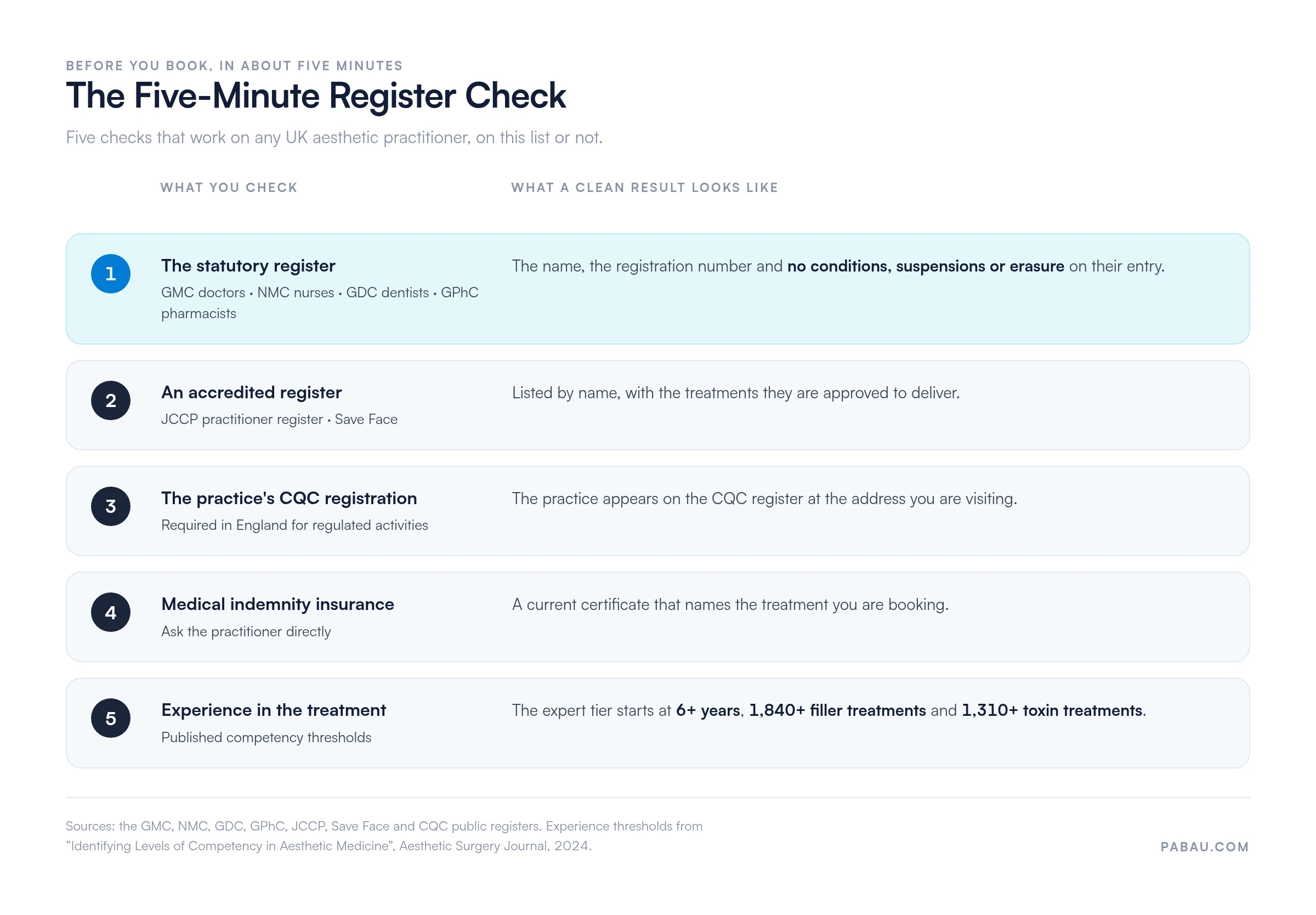
Those last figures come from Identifying Levels of Competency in Aesthetic Medicine, a 2024 study in the Aesthetic Surgery Journal. Professor Sebastian Cotofana led the work with Harley Academy. Treat them as a benchmark for a conversation, not a pass mark.
Step one takes about 60 seconds once you know which register to open. This table maps the professions you will meet in an aesthetic practice to the body that holds their license.
| Base profession | Statutory regulator | What the entry tells you |
|---|---|---|
| Doctor | General Medical Council (GMC) | License to practice, specialist register entry, any restrictions |
| Nurse or midwife | Nursing and Midwifery Council (NMC) | Current registration, and whether they hold an independent prescriber annotation |
| Dentist or dental care professional | General Dental Council (GDC) | Registration type and any conditions on practice |
| Pharmacist | General Pharmaceutical Council (GPhC) | Registration, and prescriber annotation where they hold one |
| Beauty therapist or non-medic | None | No statutory register exists, so the accredited registers and insurance carry the weight |
That last row is the whole reason this check exists. Open the register before you book, not after a treatment goes wrong.
In practices we onboard, credentials are usually scattered across a certificate on the wall, a website footer and an insurer’s portal. Practitioners who keep those three in step are the ones who answer a patient’s question in seconds.
No licensing scheme for non-surgical cosmetic procedures is in force in England as of September 2026, so anyone can still legally inject filler. That is exactly why the register check matters today.
Section 180 of the Health and Care Act 2022 gave ministers the power to create a licensing scheme. The consultation closed in 2023, and the government published its response on August 7, 2025.
That response set out three commitments, none of which has taken effect yet:
Further consultation on the detail is still expected, so no start date is fixed.
For a patient choosing today, the practical effect is simple. Until the scheme starts, the registers and the insurance certificate are the only checks that carry legal weight behind them.
An aesthetics practitioner counts as an expert on four measures: statutory registration, a Level 7 injectables qualification, current indemnity insurance, and treatment volume.
Treatment volume is the hardest of the four to check, because practitioners rarely publish their numbers. The 2024 Aesthetic Surgery Journal study places a novice under 4 years in practice, with fewer than 790 filler and 550 toxin treatments. The expert tier starts above 6 years, 1,840 filler and 1,310 toxin treatments.
Insurance is the second filter. Medical indemnity insurers price cover by treatment and by qualification. A practitioner insured for your treatment has already passed somebody else’s underwriting check.
Accreditation is the third. The JCCP and Save Face registers both hold Professional Standards Authority accreditation. The Cosmetic Practice Standards Authority sets the clinical standards the JCCP register applies. The best medical aesthetics experts tend to appear on at least one.
None of those job titles is protected in UK law, so anyone can use them. Only the underlying profession is regulated, which is why the title on a website tells you less than the register does.
An aesthetic doctor is a GMC-registered doctor working in aesthetics, and an aesthetic nurse is an NMC-registered nurse doing the same. A cosmetic aesthetic expert may be either, or neither.
Prescribing rights are the sharper distinction. Botulinum toxin is a prescription-only medicine, so a nurse without an independent prescriber qualification works under someone else’s prescription. Our guides on whether nurses can administer Botox and on independent prescribers in aesthetics cover how that works.
Advanced aesthetics training in the UK tops out at a Level 7 qualification in injectables. A Level 7 qualification is postgraduate level, and the highest widely recognized in the field.
Level 4 covers foundation injectables. Level 5 and Level 6 add complexity and anatomy. Level 7 is assessed on supervised cases and covers complication management, which is the part that matters when a filler occlusion happens.
Continuing professional development keeps that qualification current, and every statutory regulator requires it for revalidation. Our breakdown of aesthetic qualifications sets out what each level allows.
Aesthetic professionals stay accountable through two layers: a statutory regulator that can remove their license, and an accredited register that publishes why it removed them.
The statutory layer has teeth. A GMC, NMC, GDC or GPhC fitness-to-practice finding is published, and it follows the practitioner between practices.
The voluntary layer is where complaints about non-surgical treatments usually land. The JCCP works alongside the four statutory regulators and shares fitness-to-practice alerts with them, so a serious complaint rarely stays in one place.
Match the treatment to the practitioner’s base profession first, then run the Five-Minute Register Check. Eye area work suits an oculoplastic surgeon, lower face and lips suit a dentist or a doctor, and prescribing work needs a prescriber.
That ordering matters because it narrows the field before reputation does. The best aesthetic doctor for a tear trough is rarely the best aesthetic doctor for a thread lift. Neither one is necessarily the best-known name in the room.
Lists of reputable aesthetic clinics for celebrities circulate widely, and fame is not a safety signal. What you want from an expert aesthetic provider is a documented complication protocol and a named person who answers the phone out of hours.
Three questions separate the best aesthetics UK practices from the rest at consultation:
A practice that answers all three without hedging has usually thought about the worst day rather than the best photo. Geography matters less than most people assume, because the best aesthetic outcome usually comes from one or two well-judged treatments, not from proximity.
Patients now arrive at consultations having already checked a register, and they expect the practice to produce its paperwork just as quickly. That is a records problem before it is a compliance problem.
In a paper setup, the consent form sits in a folder and the batch number is on a treatment note. The before photos are on a phone, and the insurance certificate is in an email. Answering one patient question means opening four places.
Practice management software like Pabau keeps those together. Consent forms, treatment notes, before-and-after photos and the practitioner who delivered each treatment all attach to one patient record. Any treatment can then be reconstructed from a single screen.
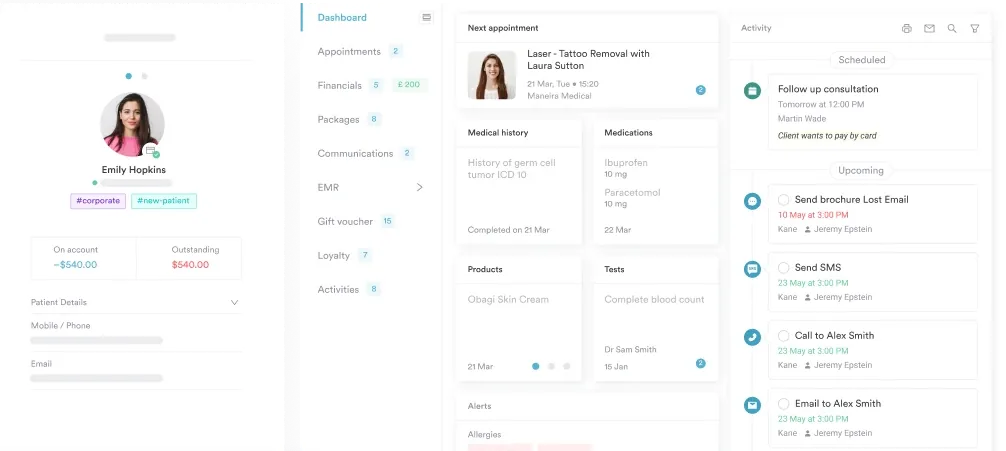
That record is also what an insurer or a CQC inspector asks for. Practices running on all-in-one med spa software can produce a full treatment history in the appointment rather than promising to email it later. Anyone still standardizing that paperwork can start from our dermal filler consent form template.

Pabau keeps consent forms, treatment notes, batch numbers and before-and-after photos on a single patient timeline. Your practice can answer a patient, an insurer or an inspector during the appointment. Book a demo to see how it fits an aesthetic practice.

A name on a list is a starting point. The 11 practitioners above are worth your time because their credentials are public and checkable, not because a roundup says so.
Run the Five-Minute Register Check on whoever you shortlist, including everyone here. Until England’s licensing scheme starts, that check is the difference between choosing on evidence and choosing on a follower count.
Practitioners reading this have the same job in reverse: make your registration, insurance and treatment records easy for a patient to verify. Book a demo to see how Pabau keeps that evidence in one patient timeline.

Wondering which qualification a treatment requires? Aesthetic qualifications sets out what each training level allows a practitioner to do.
Can a nurse inject botulinum toxin? Can nurses do Botox explains the prescribing rules and where supervision is required.
Need to understand prescribing rights? Independent prescriber in aesthetics covers the qualification and what it changes day to day.
Curious what aesthetic nurses earn? How much does an aesthetic nurse make breaks down UK salaries by experience and setting.
Planning your own practice? How to start an aesthetics business walks through registration, insurance and setup in order.
Experienced facial aesthetics practitioners in the UK include Dr Leah Totton, Dr Jonquille Chantrey, Dr Tracy Mountford and Dr Elizabeth Hawkes. Each holds a statutory registration you can verify, and each works in a different part of the face.
No new licensing law is in force in England yet. Section 180 of the Health and Care Act 2022 created the power to make one. The government’s August 2025 consultation response promised CQC regulation of the highest-risk procedures, local authority licensing for the rest, and an age limit.
A Level 7 qualification in injectables is the highest widely recognized aesthetics qualification in the UK. The Level 7 qualification is postgraduate, assessed on supervised cases, and covers complication management rather than technique alone.
Aesthetic specialist has no legal definition in the UK, so the phrase on its own is not evidence. What counts is the person’s base profession and their entry on the GMC, NMC, GDC or GPhC register.
Reputable UK aesthetic practices include Dr Leah Clinics, The Cosmetic Skin Clinic, Illuminate Skin Clinic and Thames Skin Clinic. All four are led by practitioners profiled above. Reputation aside, check the practice on the CQC register and the practitioner on their statutory register.
Dr Leah Totton is a medical and cosmetic doctor specializing in non-surgical aesthetics, with expertise in botulinum toxin, fillers, thread lifts and neck treatments. She campaigns for patient safety and improved regulation, and her practice has won Best Cosmetic Clinic London twice.
Expertise matters more because England’s licensing scheme is not yet in force, so the market still admits untrained injectors. Until it starts, a practitioner’s register entry, insurance and treatment volume are the only reliable evidence a patient has.