Health and wellness marketing: Strategies that actually work
Health and wellness marketing is how a practice promotes its treatments and clin...

Last Updated: Oct 2, 2026
How to get more therapy clients comes down to six levers you already control: directory profiles, referrals, local search, niche positioning, intake speed, and retention. The order you work them in matters more than any single tactic.
People are looking for therapists. The 2024 APA Practitioner Pulse Survey found that 53% of psychologists had no openings for new patients. When a practice still has empty hours, its inquiries are usually stalling between the first message and the first session.
For a solo therapist, each lost inquiry is an empty, unpaid hour. Below, we show which lever to pull first at each caseload stage, then walk through all six.

Your caseload stage sets the order of the six levers, so a new practice and a nearly full one start in different places.
Psychology Today, Zencare, and the insurance platforms bring the fastest new inquiries when every profile field is complete.
Referrals from PCPs and psychiatrists arrive with trust already built, so they tend to book faster than cold traffic.
Most inquiries are won or lost at intake, where a same-day reply, online booking, and digital forms decide who books.
Longer episodes of care and recall messages to paused patients fill hours without a single new inquiry.
Therapists under half capacity should fix directory profiles, referrals, and intake before touching niche positioning or retention. Therapists near capacity should flip that order.
We call this the capacity-stage priority order. Tactic lists usually present the six levers flat, as though a brand-new practice and a nearly full one should work them in the same sequence.
Not sure which row you are in? Divide last month’s booked sessions by the number you want to run. Below half puts you in one of the first two rows, and turning anyone away puts you in the third.
The order flips because the two ends of the range have opposite constraints. A therapist with eight patients is short on inquiries. A therapist with 28 is short on hours, so another directory listing adds admin rather than income.
In the practices we onboard, the ones stuck around half capacity are usually strong on positioning and slow on first response. They have a clear specialty and a good bio. The inquiry still sits unanswered until the end of the clinical day.
Directory listings are the fastest route to new patients, because people search them by insurance, specialty, and location before they try Google. Psychology Today is the most widely used of them.
A Private Practice Skills analysis of therapist marketing channels ranks an optimized Psychology Today profile among the top referral sources for private practice.
A listing only pays off when the profile persuades, so run this checklist before you pay for one:
One decision shapes directory results more than any other. That is whether to accept insurance panels. Practices carrying at least one widely used insurer often fill faster, particularly on state-funded plans that few private practitioners accept.
One therapist in an Alma provider discussion accepted three insurances in their first year, including a state Medicaid plan. They filled their caseload within the year and started turning patients away. Insurance acceptance does not suit every practice. For a new therapist, it buys visibility while private pay referrals build in parallel.
The insurance-based platforms differ more than their marketing suggests. Headway charges providers no subscription, Alma charges a flat membership, and Zocdoc charges only when a new patient books.
Figures come from each platform’s own site. A Headway therapist competes inside Headway’s own search results, not in Google’s. Therapists asking how to get more clients on Headway usually find the answer sits in the profile.
Complete insurance panels, open availability, and a bio written for the patient rather than the payer all move you up those results. One naming point saves confusion. Headway’s legal name is TherapyMatch, Inc., so a search for TherapyMatch lands on Headway’s contracts rather than a separate directory.
A paid listing pays for itself when it produces one retained patient a quarter, which is a low bar at Psychology Today’s $29.95 a month. Psychology Today charges that fee with no contract, and TherapyDen keeps a basic profile free while charging $30 a month for premium placement.
Weigh the fee against your private pay therapy rates rather than against your monthly overheads. Take a $150 session fee as an example. One patient who stays eight sessions returns $1,200, against $359 for a full year of Psychology Today membership.
Start with the two or three directories that dominate your local search results, then expand.
Once your directory profiles are working, referrals become the second source that steadies the week.
Relationships with primary care physicians, psychiatrists, and other therapists generate some of the highest-converting leads in private practice. A patient referred by their physician arrives with trust already established, ready to book.
Building this network takes consistent, low-pressure outreach. Introduce yourself to PCPs in your area to establish who you are and what you specialize in, rather than to pitch.
Psychiatrists who prescribe medication frequently need a therapist to co-manage their patients’ care. To get more psychology referrals in particular, ask what each psychologist’s waitlist is longest for, then say plainly that you take those cases.
Therapists outside your niche make natural referral partners too. They regularly meet people who are not a fit for them but would be a fit for you.
The discipline that matters is tracking which sources produce booked patients. One therapist reviewed their referral data and found they had been spending energy on sources that felt productive but rarely converted. Their highest-volume source, a single PCP, had received almost no attention.
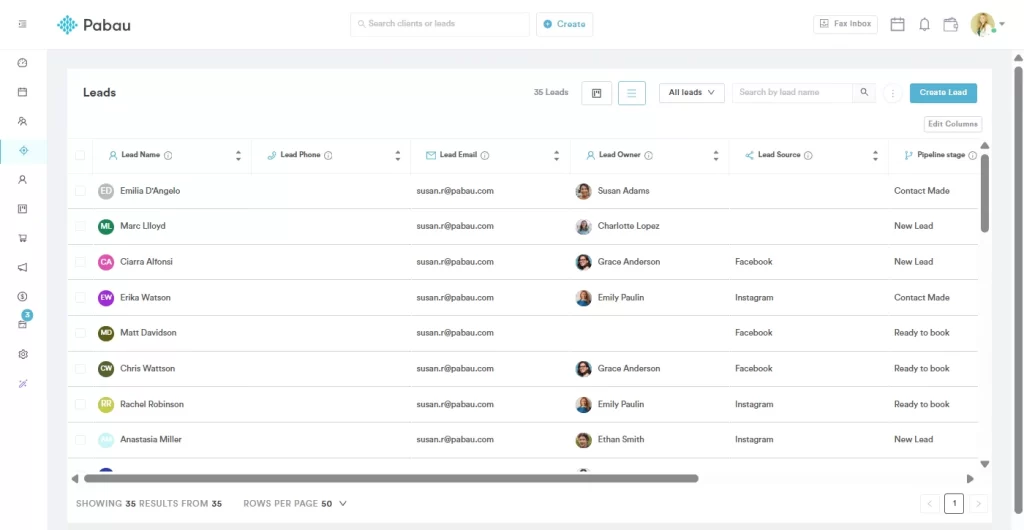
Practice management software like Pabau records where each new patient came from. Pabau’s lead management tools attach a source and a pipeline stage to every inquiry, so you can see which relationships deserve your time.
A busy PCP refers to whoever is easiest to refer to. Keep two assets ready to share. The first is a link to your booking page or intake form. The second is a one-page summary of your specialty, availability, and session format.
Follow up warmly when a referral converts, within HIPAA-appropriate boundaries, so referrers know their patients landed well. That confirmation encourages more referrals.
Getting found online comes down to three assets: a claimed Google Business Profile, a city-specific website, and a current telehealth license list. Telehealth widens the map, because a license in three states makes you a local result in three markets rather than one.
When someone searches “therapist near me” or “CBT therapist [city]”, Google’s local results appear before organic listings.
A Google Business Profile (GBP) puts your practice in those results. Many therapists have never claimed or optimized their GBP, which leaves them invisible to a substantial slice of local search traffic.
Your practice website reinforces local SEO. Include the city and state in your page titles, headings, and meta descriptions. A page titled “Anxiety therapist in Austin, TX” ranks differently than one titled “Services”. If you offer telehealth, specify which states you are licensed in.
UK practitioners have one extra consideration. The BACP’s ethical framework sets out guidance on ethical self-promotion, and it governs your online presence as much as your print advertising.
Audit your Google Business Profile every quarter. Update your availability, refresh your description with your current specialties, and check that your booking link works. An outdated or broken profile pushes patients to the next result on the page.
Visibility brings inquiries, and a niche decides which ones you get. Generalist therapists compete on price, while specialists compete on fit.
Private Practice Skills notes that people looking for a specialist are “less focused on shopping for the lowest rate.” What matters more is “their relief in finding someone who specializes in exactly what they’re looking for.”
Start by identifying the population you already serve best. Review your last 20 patients and look for patterns in diagnosis, demographics, and referral source. That review is also the most direct answer to how psychologists can get more clients without dropping their rate.
A therapist whose caseload is half perinatal mood disorders already has a niche. They just have not marketed it yet. Specializing in complex trauma among first-generation immigrants, or anxiety in high-achieving professionals, works the same way.
Your niche should grow out of the cases you already handle well. A specific modality can carry one too, which is why some therapists lead with ART trauma therapy when trauma work is their strength.
Once you have a niche, update every patient-facing touchpoint to lead with it. Rewrite your Psychology Today bio to open with your specialty and the outcomes you help patients reach. Use the same language on your website homepage and service pages.
Then tell your referral sources exactly who you are the best fit for. A PCP who knows you specialize in health anxiety refers differently than one who thinks you see everyone.
You can still see people outside your niche. Those who find you through it simply arrive more motivated, convert faster, and stay longer, because the work resonates.
A niche also settles four practical decisions:
The last one is worth a filter. A podcast whose audience is other therapists builds your reputation. A local parenting podcast, or a slot at a hospital’s grand rounds, builds referrals instead.
Every lever so far brings people to your door, and intake decides whether they walk through it. A prospective patient finds your profile, feels ready to reach out, then hits a wall.
Sometimes that wall is a contact form nobody answers for 48 hours. Sometimes it is a voicemail box, or a PDF intake form sent by unencrypted email.
Each friction point is a drop-off event. The Group Practice Exchange identifies five failure points where prospective patients stop progressing toward a booked appointment.
The stages below map each one against the fix that closes it.
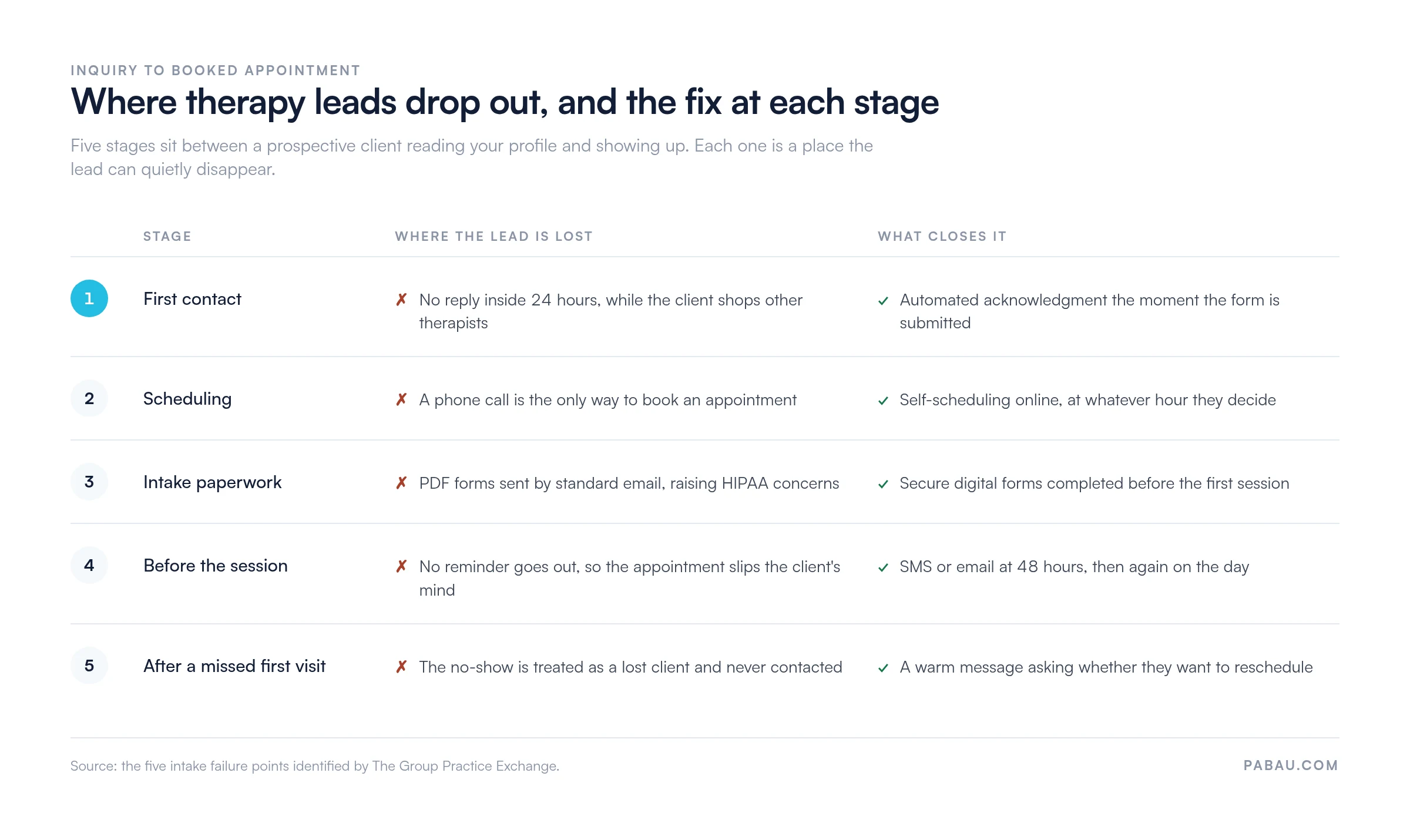

How fast is fast enough? Aim to reply the same business day. Treat 24 hours as the outer limit, and let an automated acknowledgment cover the hours you spend in session.
Before you change your intake, test it as a stranger would. Submit your own contact form on a weekday evening and try to book from your phone. Then time how long the intake form takes to reach you. Whichever step takes longest is the one to fix first.
A therapist whose patients average twelve sessions needs roughly half the inquiry volume of one whose patients leave after six. So in psychotherapy, more bookings often come from the caseload already on your books.
Retention starts with the therapeutic alliance, and systems support it. Framing care as a defined arc with milestones keeps patients engaged. That is the same logic behind coaching programs clients finish.
Repeat bookings in therapy are mostly a question of rhythm. Consistent scheduling, session reminders, and between-session check-ins reinforce the patient’s sense of being held in the therapeutic relationship. Patients who keep coming back are usually the ones who hear from the practice between appointments.
When a patient is tempted to skip a session, a timely reminder shifts the decision back toward attending. For a mix of in-person and remote patients, video sessions that run off the same calendar cut the friction of remote care. That keeps patients who would otherwise cancel over travel or a schedule clash.
Retention also means reaching out to inactive patients. Someone who paused therapy three months ago may be ready to return. A recall campaign can fill more hours than a new directory listing, because those patients already know you.
An automated recall sequence, sent at intervals you define, keeps your practice in mind without manual effort. Recall campaigns are standard in therapy practice management software, which can run them by email and SMS across a larger caseload.
In a group practice, the constraint shifts from finding patients to matching each one to the right clinician quickly. Acquisition scales with the roster. Each new clinician brings new availability, new specialty areas, and new referral relationships.
Software that tracks clinician availability, specialty, and caseload across the team makes that matching consistent. Our roundup of the best therapy software compares the platforms on exactly that.
Most of the five friction points above come down to timing. A prospective patient submits a form, and whether they ever book depends on what happens in the next few hours. Handling that by hand works until the caseload grows.
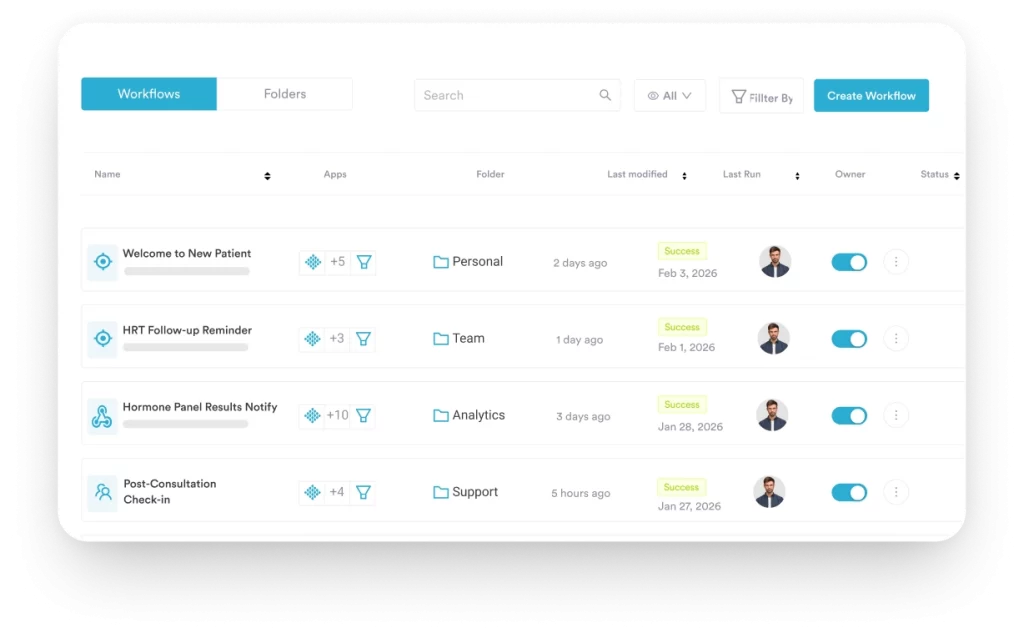
Pabau runs the sequence for you. An inquiry triggers an acknowledgment, an online booking link, and a digital intake form the patient completes before the first session. Reminders go out at 48 hours and again on the day. A missed first appointment triggers a reschedule message instead of silence.
Each step is logged in the patient’s Client record, lead source included. Over a few months, those records show which referral partners keep your calendar full, so your outreach goes there. Your admin time goes to clinical notes instead of chasing forms.

Pabau handles scheduling, digital intake, automated reminders, and Client records, so your time goes to clinical work instead of administration. Book a demo to see the full workflow.

Filling a therapy caseload is mostly an operations job. Directory profiles, a claimed Google Business Profile, a named niche, and a same-day reply are all under your control. None of them needs a bigger budget.
So use the capacity-stage priority order to pick your starting point. Under half capacity, fix the directory profiles and the 24-hour reply first. Near capacity, leave the listings alone and give that hour to niche positioning and recall.
The trade-off is patience. Referral and niche work pay back over months, while a faster reply can lift bookings the same week. If slow intake is costing you first sessions, book a demo to see how Pabau runs the inquiry-to-first-session sequence for a therapy practice.

Planning your wider marketing? Mental health practice marketing sets out seven strategies for promoting a therapy practice beyond directories and referrals.
Growing a multi-clinician practice? Behavioral health marketing covers the strategies that keep a larger behavioral health practice full.
Still setting up on your own? How to start a private therapy practice is a complete guide to launching a practice before you start marketing it.
Joining insurance panels? Insurance billing for therapists is a step-by-step guide to getting in-network sessions paid.
Need an intake form to send before session one? Adult counseling intake form gives you a ready-made template for new mental health patients.
Many do, and a 15-minute phone consult works well as a screening step. It lets you check fit, explain fees, and answer insurance questions before anyone books. Run it from your online calendar, and end every call with a booked session or a referral elsewhere.
Check your ethics code first. APA Ethical Standard 5.05 bars psychologists from soliciting testimonials from current therapy patients, and other professional codes set similar limits. Unprompted reviews are fine, but replying to one can confirm that someone is your patient. Keep any reply general, or leave it unanswered.
Yes, because a directory profile belongs to the directory. Your own site carries your city pages, your niche, and your booking link, which is what ranks in local search. It also keeps inquiries coming if a directory changes its fees or its ranking.
Usually not at first. Directories already rank for the terms you would bid on, so they reach the same searchers for less. Ads make sense in a crowded metro, or when you launch a new specialty. Set a monthly cap and measure booked sessions rather than clicks.
A full-time private practice therapist usually plans around 20 to 25 sessions a week. Paperwork sets the ceiling, since notes, billing, and correspondence sit on top of each session hour. Group practices grow by adding clinicians rather than stretching each caseload.