GLP-1 diet plan
A GLP-1 diet plan is a structured eating framework for patients taking semagluti...

2
Last Updated: Oct 13, 2026

Accelerated resolution therapy (ART) was developed by Laney Rosenzweig in 2008 and pairs bilateral eye movements with voluntary image replacement.
Clinical studies, primarily from the University of South Florida, indicate ART may resolve PTSD and trauma symptoms in one to five sessions.
ART shares its core mechanism with EMDR, but the client rather than the therapist chooses the replacement image.
ART has been studied in veterans, first responders, and sexual trauma survivors, with evidence of effect across several trauma presentations.
Practices offering ART need longer appointment slots, a protocol-shaped note template, and outcome scores captured at intake and discharge.
Roughly 3.6% of US adults experience PTSD in any given year, and 6.8% meet the diagnostic criteria at some point in their lifetime. Those figures come from the National Institute of Mental Health. Traditional trauma protocols often run 8 to 16 sessions of detailed verbal recounting. That length fuels dropout among veterans, first responders, and survivors of sexual trauma.
Accelerated resolution therapy (ART) compresses that timeline into one to five focused sessions. Laney Rosenzweig developed it in 2008, and the University of South Florida has researched it since. The protocol pairs bilateral eye movements with client-directed image replacement. It also never asks the client to describe the trauma aloud.
Accelerated resolution therapy is a directive, protocol-based intervention built on three moves. The therapist first helps the client identify a distressing memory or image. Sets of horizontal eye movements follow while the client holds that image in mind. The client then swaps the distressing image for a neutral or positive one they pick themselves. That step is called voluntary image replacement, or imagery rescripting.
The eye movements are bilateral. The client follows the therapist’s hand as it travels left and right across their visual field. Eye Movement Desensitization and Reprocessing (EMDR) uses the same mechanism. Researchers believe bilateral stimulation loads working memory in a way that dulls the emotional intensity of a traumatic image. The theory draws on sensory information processing models, and the precise neurological mechanism is still under study.
What separates ART from related modalities is the voluntary image replacement step. Once the eye movements have processed the distressing image, the client chooses what replaces it, not the therapist. That agency matters clinically. It preserves autonomy, lowers retraumatization risk, and sends the client home with a resource they generated themselves. Practitioners trained through the Rosenzweig Center for Rapid Recovery describe it as the benefit clients report most consistently. The center is the official training and certification body for ART.
Skipping the narrative also lowers the cognitive and emotional load in the room. Clients disclose as much or as little as they choose, and the therapist follows the protocol either way. That makes ART workable for people who have disengaged from exposure-based treatment before, or refused it outright.
The clinical evidence for accelerated resolution therapy centers on PTSD. The most rigorous published research comes from the University of South Florida’s ART research program. Trials in journals including Military Medicine and Frontiers in Psychiatry report significant reductions in PTSD symptom severity after ART. Reported effect sizes are comparable to established trauma therapies such as Prolonged Exposure Therapy and Cognitive Processing Therapy (CPT).
ART has been studied specifically in veteran and active military populations. Trauma prevalence runs high in that group, and engagement with traditional psychotherapy runs low. Results across multiple trials show clinically meaningful symptom reduction. Some participants scored below the clinical threshold for a PTSD diagnosis after a short ART course. Similar findings have been reported for first responders and survivors of sexual trauma.
SAMHSA’s National Registry of Evidence-Based Programs and Practices (NREPP) listed ART as an evidence-based practice for PTSD in 2015. SAMHSA decommissioned NREPP in 2018, so the designation now rests on the peer-reviewed literature rather than an active federal registry. ART also lacks the formal endorsement that the American Psychological Association (APA) and the National Institute for Health and Care Excellence (NICE) give longer-established therapies. Present ART to clients as an effective option with a growing evidence base. It is not yet a first-line treatment named in national guidelines, and that distinction matters when you discuss options with insurers.
Beyond PTSD, research points to possible benefit for depression, anxiety disorders, grief, phobias, and substance use disorder. The evidence for those applications is thinner than the trauma evidence, so treat them as promising rather than established indications. For a psychology or counseling practice widening its trauma offering, ART is a credible addition to the treatment menu. Clinical oversight and documentation standards have to hold either way.
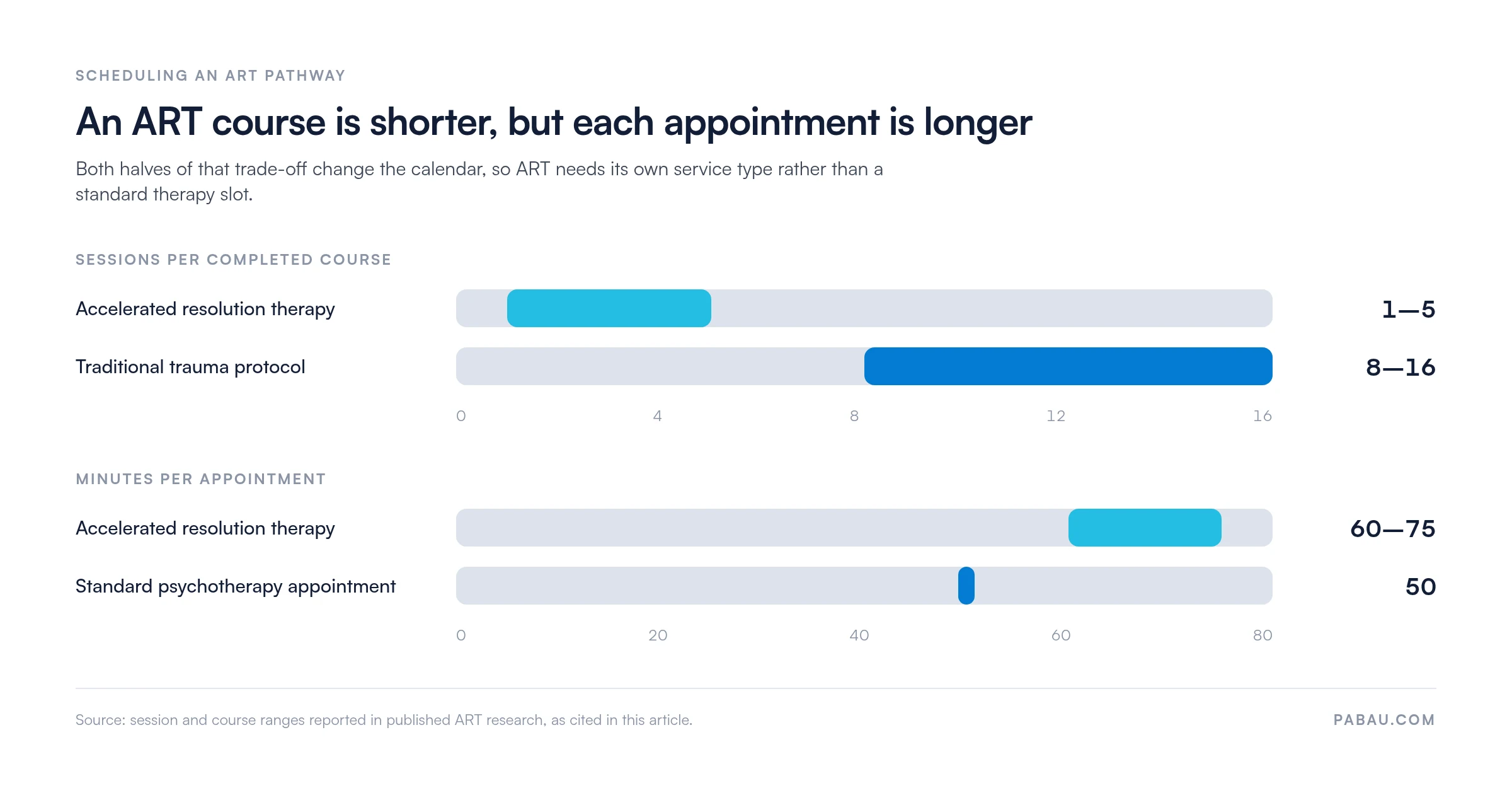
A standard ART session runs 60 to 75 minutes, longer than a conventional therapy hour. A therapist seeing five ART clients in a day needs different calendar blocking than one running 50-minute appointments. Practices using therapy practice management software should set ART up as its own service type, with an extended slot and a buffer for clinical notes. The two ranges below show the trade-off. Each client needs fewer appointments, but each appointment needs more minutes.
The session itself follows a consistent sequence. The therapist opens with a brief check-in and identifies the target memory or image. Eye movement sets follow while the client holds focus on that image. After each set the therapist checks in, not to prompt disclosure, but to gauge distress and readiness to continue. Voluntary image replacement comes next, with the client generating and installing their preferred alternative. Stabilization exercises close the session so the client leaves regulated.
Documentation after an ART session differs from a standard narrative therapy note. Clinicians typically record the target image, the number of eye movement sets, and the replacement image the client chose. Distress ratings from the start and end of the session go in as well. Some also note somatic responses observed during the session. Structured session records support continuity when the client returns. They also give licensing boards and payers the audit trail they expect.
Published research suggests ART may resolve trauma symptoms in one to five sessions for many clients. That range reflects study populations rather than a guaranteed trajectory. Presentation complexity, the breadth of the trauma history, and comorbid conditions all move the number. A single-incident trauma with no significant comorbidity may resolve in two sessions. Complex PTSD, developmental trauma, or concurrent depression usually calls for more structured input.
Tell clients up front that ART is designed to be brief, but not uniform. Setting that expectation at the first consultation protects the therapeutic alliance. It also lets whoever manages the schedule forecast appointment volume with some confidence, which matters most where a waiting list is already long.

Clinicians asking about ART almost always ask how it differs from EMDR. Both use bilateral eye movements and both target trauma memories. Both are also brief next to conventional psychodynamic or cognitive behavioral therapy (CBT) trauma work. If the acronym itself is new, start with what EMDR stands for and come back to the comparison below. Past those shared foundations, the two diverge in ways that change how you staff and schedule them.
Both therapies rest on the same premise. Bilateral sensory stimulation, here horizontal eye movements, can reduce the emotional charge attached to a traumatic memory. The likely route is working memory, loaded during active recall. Both are structured and protocol-based, which makes them more teachable and more consistently delivered than looser approaches. Neither requires prolonged verbal exposure to the trauma narrative. Research suggests both produce clinically significant PTSD symptom reductions in relatively few sessions.
EMDR uses a structured eight-phase protocol developed by Francine Shapiro. It covers detailed history-taking, preparation, and desensitization phases spread across multiple sessions. ART is designed to complete within each session, so the client leaves every appointment regulated, having addressed and rescripted the target image. ART also gives the client explicit authorship of the replacement image. EMDR leads to cognitive reprocessing without asking the client to generate a specific replacement.
Training requirements differ too. EMDR certification involves multi-day training, supervised practice hours, and ongoing consultation that varies by professional body. ART credentialing through the Rosenzweig Center for Rapid Recovery runs as a three-day Basic training, with Advanced and Enhanced three-day trainings available afterward. Supervised case documentation is required for certification through IS-ART, the International Society of Accelerated Resolution Therapy. Neither modality wins in every clinical context. The choice depends on the client presentation, the therapist’s training background, and the practice model, and plenty of clinicians hold both.
A third eye-based option, brainspotting therapy, shares those foundations but works through a fixed gaze rather than movement. Practices weighing which brief trauma therapy to add should factor in trainer availability and supervision structures. The other question is whether their note templates can carry each modality’s session format.

If your practice offers both ART and EMDR, configure them as separate appointment types with distinct session lengths and note templates. A single ‘trauma therapy’ service type creates scheduling and documentation friction, especially when you audit treatment outcomes across the caseload.
ART has been studied most extensively in adults with PTSD, and the published evidence is strongest there. Veterans, first responders, and people who have experienced sexual trauma have been the main trial populations. The short course and the absence of required verbal disclosure suit groups whose engagement with traditional trauma therapy has historically been low.
Beyond trauma, ART-trained clinicians report using the modality for anxiety disorders, depression, phobias, grief, and obsessive-compulsive disorder (OCD). The evidence for those applications sits at an earlier stage than the PTSD evidence, and clients deserve that distinction stated plainly. ART is not contraindicated for these presentations. Exercise standard clinical judgment about fit, and document your reasoning.
The conditions clinicians most often treat with accelerated resolution therapy are:
ART is not a replacement for comprehensive psychiatric assessment. Clients with active psychosis, severe dissociative disorder, or significant suicidal ideation need careful evaluation before ART is considered. The American Mental Health Counselors Association and similar bodies recommend that clinicians practicing trauma therapies keep clinical supervision in place, particularly with complex presentations.
For a practice evaluating service expansion, ART adds a credible brief-intervention option alongside existing CBT or talk therapy. Tracking outcomes across the caseload gives you a dataset for service development decisions, and evidence to show referrers what the pathway achieves. Score a standardized measure at intake and again at discharge. The PCL-5 checklist is the usual choice for PTSD, and it takes a client about five minutes.

Fitting ART into a multi-disciplinary team takes coordination. An ART-trained clinician whose client also sees a psychiatrist for medication management needs clear communication channels and shared records. Remote delivery has widened the modality’s reach, which matters most for veterans and rural clients with little access to in-person specialist care.

Most practices bolt ART onto a calendar built for 50-minute appointments. The slot runs short, and the note template asks for a narrative the protocol never produces. Distress ratings end up in a spreadsheet nobody opens twice.
Practice management software like Pabau handles it differently. You set ART up as its own service type, with a 75-minute slot and a documentation buffer after it. The session note uses a template shaped by the protocol, capturing the target image, the eye movement sets, the replacement image, and distress ratings. Pabau’s mental health EMR keeps that note in the same client record as the appointment, the consent form, and the invoice.
The payoff shows up when you compare pathways. Reporting ties session counts to symptom scores, so a two-session ART course and a 16-session CBT course sit side by side. You can see which pathway clears clients fastest, what each one costs to deliver, and where the waiting list actually moves.

Pabau gives mental health practices the scheduling, clinical notes, and client records to run short-course therapies like ART. Set the slot length once, and the documentation follows the protocol from there.

ART earns its place when the operational scaffolding matches the clinical protocol. That means extended session slots, credentialed practitioners, trauma-specific note templates, and outcome reporting that survives an audit. Practices that design for those needs up front get clean data on what works for which clients, instead of an averaged score.
The trade-off worth remembering is evidence maturity. ART’s research base is credible but younger than the base behind Prolonged Exposure or CPT. So put it on the menu as an option you can defend, not as a first-line claim. Book a demo to see how a mental health practice runs ART, EMDR, and longer-format trauma work on one platform.

Need a scored PTSD measure for intake and discharge? PCL-5 checklist gives you the 20-item instrument plus guidance on scoring and interpreting the totals.
Running EMDR alongside ART? EMDR worksheets template covers the eight-phase protocol with worksheets you can hand a client between sessions.
Mapping a client’s trauma history before treatment starts? Trauma timeline worksheet structures the assessment conversation without asking for a full narrative account.
Wondering how the therapeutic relationship shifts in a directive protocol? Transference in therapy explains the relational dynamics that longer-term talk therapy leans on and brief protocols do not.
Adding a group program next to your one-to-one work? Group therapy informed consent sets out what the form has to cover before you enroll anyone.
Accelerated resolution therapy is primarily used for post-traumatic stress disorder (PTSD), trauma, and distressing intrusive imagery. Clinicians also apply it to anxiety disorders, depression, phobias, grief, and substance use disorder. The evidence base is strongest for trauma-specific presentations. It suits clients who find verbal disclosure in traditional therapy difficult.
Clinical trials, primarily from the University of South Florida, have shown significant reductions in PTSD symptom severity after ART. Effect sizes are comparable to established trauma therapies such as Prolonged Exposure Therapy. Results have been replicated in veterans, first responders, and sexual trauma survivors. SAMHSA’s NREPP listed ART as an evidence-based practice for PTSD in 2015, and NREPP was decommissioned in 2018. ART does not yet carry full APA or NICE endorsement.
Published research suggests accelerated resolution therapy may resolve trauma symptoms in one to five sessions for many clients. Single-incident trauma presentations often resolve more quickly. Complex PTSD, or a presentation with significant comorbidities, may require additional sessions. Set expectations at intake that course length varies by individual presentation, not by a fixed protocol.
ART and EMDR share similar mechanisms, including bilateral eye movements and trauma-focused processing. They differ in protocol structure, training requirements, and the client’s role in imagery replacement. Neither is universally superior, so the choice depends on the client presentation, clinician training, and clinical context. Some practitioners are trained in both and select the approach per client.
An ART session typically lasts 60 to 75 minutes. The therapist identifies a target distressing memory or image, then applies sets of horizontal eye movements while the client focuses on it. Voluntary image replacement follows, where the client selects and installs a preferred alternative image. Sessions close with stabilization exercises. Clients are never required to narrate their trauma aloud.
Accelerated resolution therapy is used clinically for anxiety disorders and depression, particularly presentations involving intrusive imagery or a trauma component. The published evidence for those applications is thinner than the PTSD evidence, so discuss that distinction openly with clients. ART is not contraindicated here, but document your clinical rationale for using it with a non-trauma presentation.