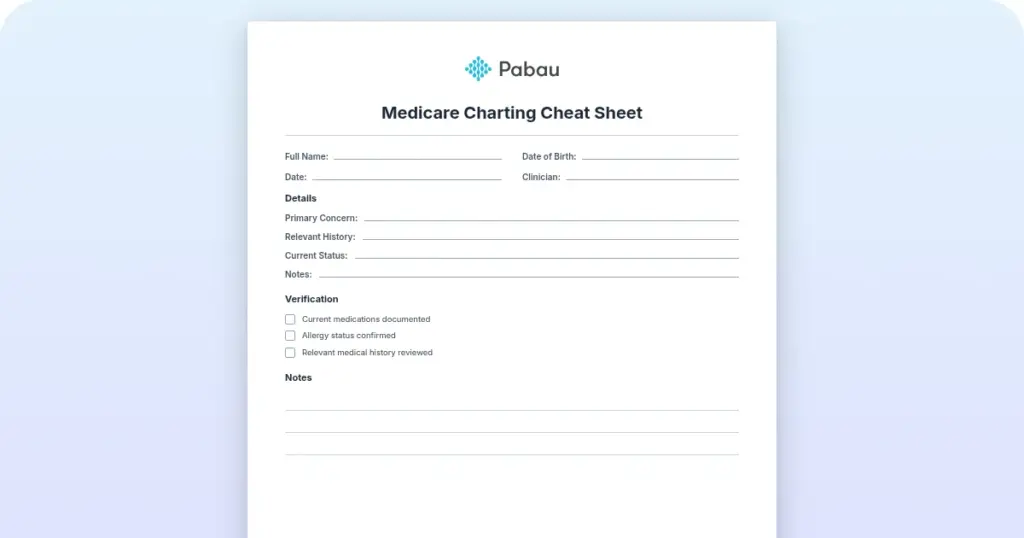
Medicare charting cheat sheet
A Medicare charting cheat sheet is a one-page reference that lists what Medicare...

2
Last Updated: Oct 21, 2026
The best therapy practice management software for a solo US mental health practice is SimplePractice, or TherapyNotes if insurance claims drive your revenue. Practices running several disciplines under one roof should shortlist practice management software like Pabau, Zanda, or TheraPlatform instead.
The choice bites hardest where admin already does. No-shows eat into revenue, insurance claims sit unsubmitted for weeks, and session notes get typed at midnight. A platform matched to your discipline mix and billing model takes that work off the clinician. A mismatched one stacks a second layer on top of it.
Every platform below is judged on scheduling, clinical records, billing, telehealth, the client portal, and HIPAA compliance. Prices come from each vendor’s own pricing page, quoted per clinician rather than per practice. The Five-Criteria Fit Check later in this guide turns those judgments into a score you can run against your own practice.

1. SimplePractice — Fastest setup for a solo mental health practice, though extra clinicians cost $74 a month each.
2. TherapyNotes — Strongest US insurance billing, with each session note attached to its claim before submission.
3. Pabau — Best fit for multi-discipline practices running psychology, OT, physio, and counseling together.
4. TheraNest — Lowest-cost route into a working mental health practice, at $29 per therapist a month.
5. Zanda — Gentlest per-seat curve for allied health teams, at $19 per extra practitioner.
6. TheraPlatform — Only pick here with whiteboards and therapy apps inside its HIPAA-compliant remote sessions.
7. Upheal — Deepest AI session documentation, billed at $1 a session and capped at $69 a month.
The table below ranks the best therapy practice management software on the criteria that decide the purchase. Every price comes from the provider’s own pricing page.
The fastest route to a working solo practice, as long as your team stays small.
SimplePractice is the best pick for solo and small group therapists, because a single clinician can be booking, charting, and billing within hours. SimplePractice serves over 250,000 therapists and health and wellness professionals, according to its own website. That reach rests on ease of use rather than clinical depth.
The scheduling interface, client self-booking, and built-in HIPAA-compliant telehealth are all genuinely polished for individual practitioner workflows. That polish is the reason it keeps winning the solo segment.
According to Capterra reviewers, SimplePractice holds a 4.5 out of 5 rating based on over 2,800 reviews. SimplePractice is one of the most-reviewed platforms in this category. “Incredibly intuitive from day one,” one reviewer noted. “For a solo practice, it covers what I need without overwhelming me with features I’ll never use.”
| Plan / Tier | Price | Details |
|---|---|---|
| Starter | $49/month | Promo $24.50/mo first 3 months; 30-day free trial |
| Essential | $79/month | Promo $39.50/mo first 3 months |
| Plus | $99/month | Promo $49.50/mo first 3 months |
| Add-on: ePrescribe | $49/month | + $89 one-time setup fee |
The published tiers cover a single clinician. Group practices pay the tiered per-clinician fee on top, which is where the cost of this platform really gets decided.
The most dependable behavioral health documentation and claims workflow in this comparison.
TherapyNotes is the strongest choice for US behavioral health billing, because every DAP, SOAP, or psychotherapy note attaches to its claim automatically. The documentation suite sits inside the billing workflow rather than beside it. Submit a claim and the supporting note is already there.
For US mental health practices navigating complex insurance billing, that integration cuts denial rates and documentation errors. TherapyNotes is not the most flexible platform here, but inside behavioral health it is extremely reliable.

According to Capterra reviewers, TherapyNotes holds the highest rating of any platform in this comparison, at 4.7 out of 5 across over 900 verified reviews. One reviewer, six years in, captured the sentiment well: “This is the best practice management and EHR system for behavioral health, hands down.”
Group pricing is what matters past a solo caseload. At six clinicians it works out at $329 a month, which is the number to compare against a per-seat rival.
One system for a practice that runs psychology, OT and physio side by side.
Pabau is the best fit for multi-discipline practices, because psychology, occupational therapy, physiotherapy, and speech pathology all run from one client record. Pabau is an all-in-one therapy practice management platform, so a psychology group that also offers OT or physio does not need four separate systems.
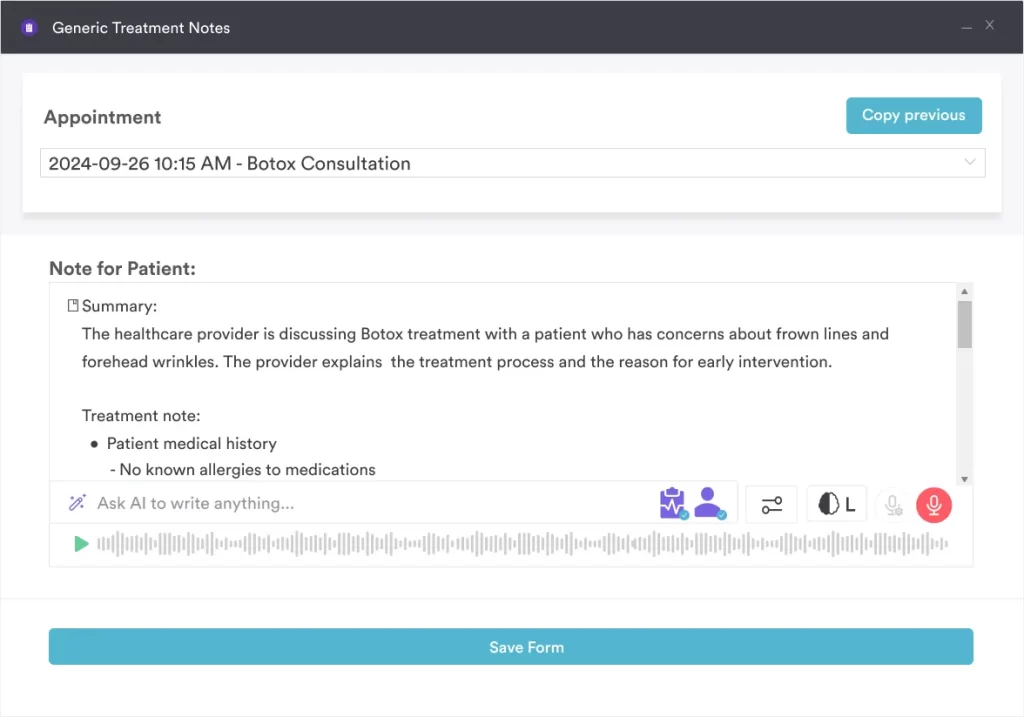
Pabau centralizes scheduling, clinical documentation, billing, telehealth, and client communication in one place. Role-based access controls mean every clinician sees only the records their role allows.
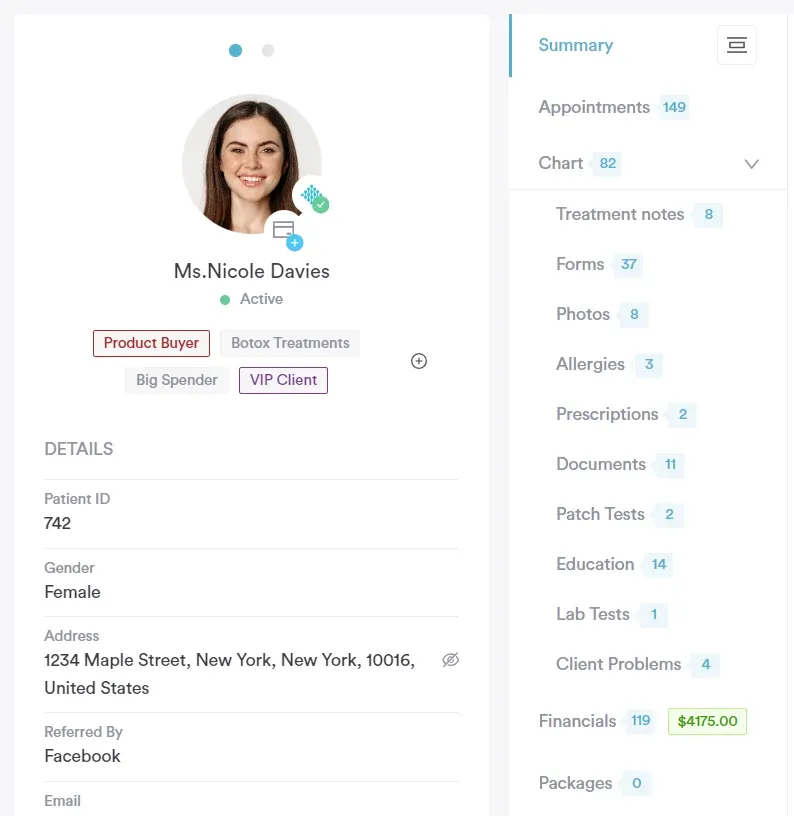
Where Pabau differentiates most sharply is clinical documentation. Pabau Scribe, our AI scribe, listens during sessions and generates structured clinical notes, treatment summaries, and follow-up instructions.
For therapists who spend 45 to 60 minutes per client on post-session documentation, that changes the shape of the working day. The custom form builder then lets a practice create discipline-specific templates for intake, consent, and progress notes across counseling, OT, and physio.
According to Capterra reviewers, Pabau holds a 4.7 out of 5 rating based on over 600 verified reviews. Positive themes include onboarding support, the customizable form builder, and the all-in-one nature of the platform. One reviewer noted: “Moving from three separate systems to Pabau cut our admin time significantly. The forms builder alone was worth the switch.”
Pabau prices by user count and region rather than per clinician add-on. Every subscription includes every feature, so a lower tier never locks functionality away.
The cheapest way into a working mental health practice, with a roadmap question attached.
TheraNest is the cheapest route into a working mental health practice, at $29 per therapist a month for scheduling, notes, and billing. TheraNest now sits inside Ensora Health, and the core product still covers billing automation and group practice workflows without the investment bigger platforms ask for.
That price makes TheraNest a practical option for practices not yet generating the revenue to justify a higher tier. The product roadmap under Ensora Health ownership is the one thing worth monitoring.

TheraNest sits in a useful middle tier, between bare-bones scheduling tools and full practice platforms. TheraNest’s telehealth works, but it is less capable than a dedicated teletherapy platform or Pabau’s integrated video.
According to Capterra reviewers, TheraNest holds a 4.4 out of 5 rating across around 900 verified reviews. Users consistently praise its affordability and ease of setup. One reviewer noted: “TheraNest makes running my small private practice easy. It’s simple, affordable, and covers what I need in one place.”
TheraNest charges per therapist rather than per practice, so the entry price only holds while the team stays small.
Built for allied health teams that mix OT, physio, speech and counseling.
Zanda is built for allied health teams, so occupational therapy, physiotherapy, speech pathology, and counseling share one calendar and one set of notes. Zanda was formerly Power Diary, and the rename came with a harder push into therapy documentation.
Zanda’s AI assistant targets the same post-session burden Pabau Scribe addresses, from a different architectural direction. Telehealth runs through a HIPAA-compliant Zoom integration, so clients need no logins or downloads.

For practices weighing Pabau against Zanda, the differences come down to international reach and billing flexibility. Zanda’s US insurance billing integrations are less established than TherapyNotes or SimplePractice. Pabau’s multi-currency support gives it broader applicability, while Zanda has stronger regional relevance for Australian and UK allied health teams.
According to Capterra reviewers, Zanda holds a 4.7 out of 5 rating. Users highlight the allied health focus and the AI assistant as standout features. One reviewer from a multi-discipline practice commented: “Zanda offers tools to streamline your productivity and free up more time for patient care.”
At $19 per extra practitioner, Zanda has the gentlest per-seat curve of the platforms that publish one. That is what keeps it viable for a large allied health team.
The only platform here whose remote sessions come with therapy tools built in.
TheraPlatform is the best pick for teletherapy-first practices, because whiteboards, therapy apps, and activity libraries sit inside the video session itself. TheraPlatform built its practice management layer around a teletherapy-first architecture, rather than bolting telehealth onto an existing system.
For speech therapists and OT practitioners working remotely, those tools do something a standard video call cannot. A structured articulation or sequencing activity runs inside the session window, rather than over an improvised screen share.

TheraPlatform’s billing capability is more limited than TherapyNotes or SimplePractice. Practices with complex US insurance workflows will find its claims handling less sophisticated. TheraPlatform is, however, among the more affordable entry points in the market. Practices comparing speech therapy software should treat those interactive tools as a genuine advantage for remote delivery.
Capterra reviewers give TheraPlatform a 4.6 out of 5 rating. They consistently highlight the interactive teletherapy tools and ease of client access as its primary strengths. Its billing depth draws more mixed feedback from practices with complex insurance requirements.
The therapy app library is the reason to move up to Pro, since that is where the interactive session tools stop being a sample.
The most capable AI documentation here, on the youngest platform here.
Upheal is the AI-native pick here, turning a recorded session into a structured progress note, a treatment plan update, and an outcome summary. Where other platforms added AI features to existing architectures, Upheal built its whole workflow around AI from day one.
Upheal’s session recording and automated note generation are among the most sophisticated in this comparison. For therapists losing hours to documentation, that changes the shape of an evening. Outcome tracking sits in the same record, so progress measurement stops being a separate spreadsheet.

The trade-off is depth elsewhere. Upheal’s billing features are less developed than TherapyNotes or SimplePractice for complex insurance workflows, and it is a newer platform with a shorter track record. For practices weighing AI documentation generally, its approach is worth understanding even if it does not win the evaluation.
Upheal does not yet have enough review volume on G2 to produce a meaningful overall rating. Feedback sits mainly on Trustpilot, where the platform scores in the 4.7 to 5.0 range. Reviewers there single out the AI note generation as transformative for documentation-heavy practices. The thin public review volume is worth factoring into any evaluation.
The usage-based model suits a part-time caseload well. Past roughly 69 sessions a month the cap makes it flat-rate, so a full-time therapist pays the same as a busy one.
Sessions Health does not make the seven above, but its published pricing undercuts most of them, so it belongs on a shortlist. Sessions Health charges $39 a month for the first practitioner and $29 for each additional one, according to its own pricing page. A free tier covers one practitioner and up to three active clients.
Telehealth and AI note assistance are priced separately, at $10 and $35 per practitioner a month. That unbundling makes Sessions Health cheap for a mental-health-only group that bills claims, and pricier once you add the extras the all-in-one platforms already include.
Before you commit to any therapy platform, run a live trial with your hardest workflow. That usually means a group scheduling scenario with insurance billing and telehealth in the same session. Most platforms look strong in a demo built around one clinician. The cracks show when you add a second location, a billing rule exception, and a clinical form submission to the same workflow.
The Five-Criteria Fit Check scores your practice on discipline breadth, insurance billing, size, telehealth needs, and AI documentation, then points you at a shortlist. A solo CBT therapist in New York runs a different operation from a 12-clinician allied health practice in London. The matrix below shows how the seven platforms cover those five criteria.
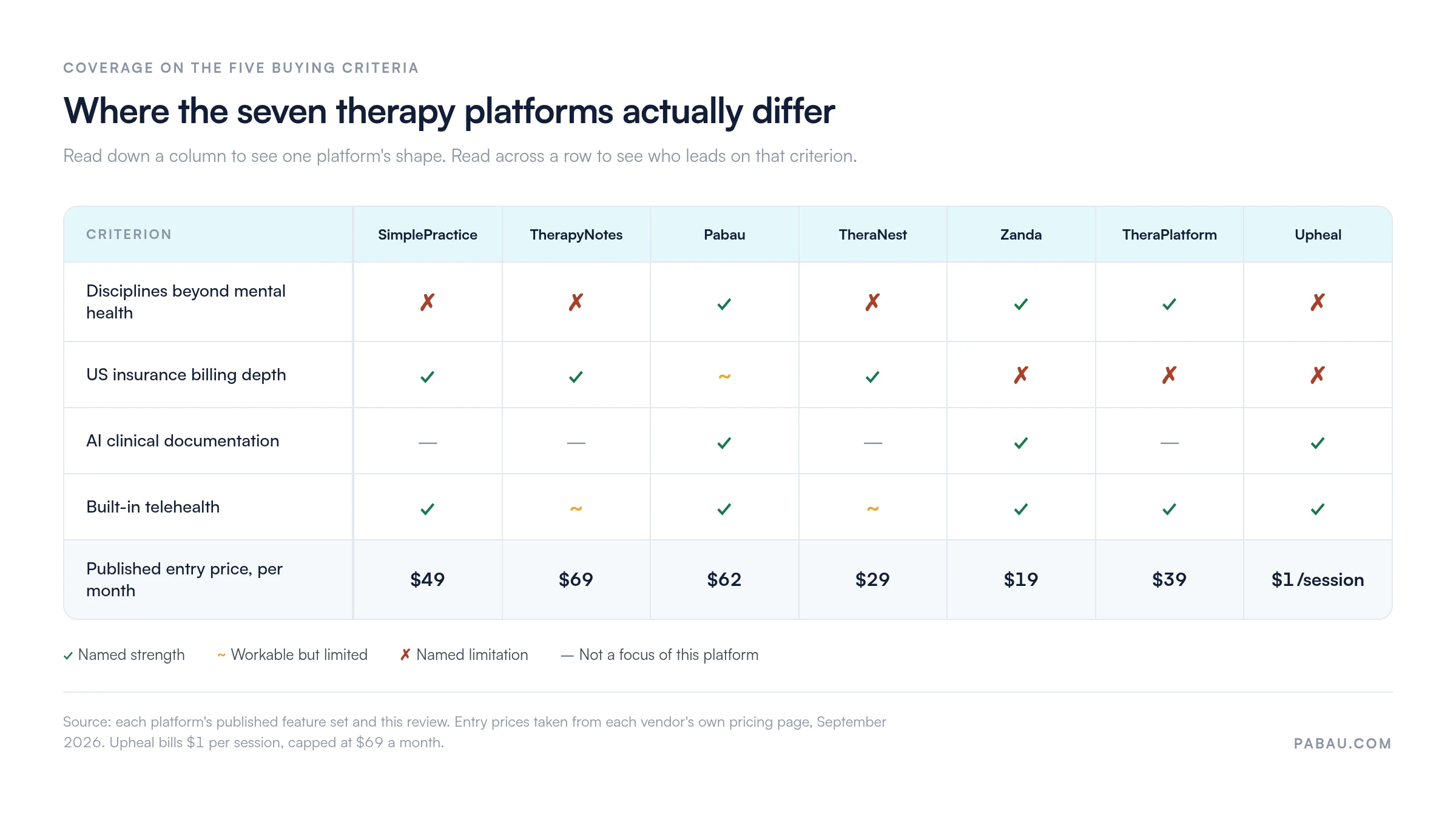
Work through the Five-Criteria Fit Check before you book a single demo.
Two checks before you sign. Read your shortlist’s HIPAA documentation properly, because BAA coverage, audit trails, and access controls vary a lot across these seven platforms. Our guide to compliance management software covers what to look for.
Then budget honestly for the switch. In practices we onboard, a single-site migration runs over several weeks rather than a weekend, and the client-record export is rarely the slow part. Rebuilding note templates, re-testing billing rules, and retraining reception take longer. Plan to run both systems in parallel through one full billing cycle.
Then score the five answers. Give your practice one point for every criterion whose answer points toward a multi-discipline platform. Three points or more, and you should shortlist Pabau, Zanda, and TheraPlatform ahead of the mental-health-only tools. Two or fewer, and SimplePractice or TherapyNotes will almost certainly serve you better.
A practice running psychology, OT, and physiotherapy usually ends up with three systems. Each discipline gets its own note templates, its own calendar, and its own way of storing consent. Reception then reconciles them by hand, and nobody has a single view of a client.
Pabau holds all of it in one client record. You build discipline-specific intake, consent, and progress note templates in the form builder, and role-based permissions keep each clinician to their own scope. One calendar covers every site, room, and practitioner.
Pabau Scribe, our AI scribe, drafts the clinical note during the session, so documentation stops following clinicians home. Billing, invoicing, and multi-currency payments sit in the same system. Every subscription includes every feature, so no capability sits behind a higher tier.
The outcome is one system to train new staff on, and one place to look when a client calls. Reporting covers the whole practice rather than one discipline at a time.

Pabau brings cross-discipline forms, AI session notes, automated reminders, and integrated telehealth into one platform. Book a personalized demo and see it mapped to your own practice type and clinician count.

Run the Five-Criteria Fit Check before you run demos, because the score settles the argument faster than a feature list does. Where insurance billing is the bottleneck, TherapyNotes and SimplePractice are built for exactly that, and TherapyNotes is the stronger of the two on claims. Where documentation across several disciplines is the bottleneck, neither will stretch far enough.
Price the shortlist at the size you expect to be in two years, not the size you are today. Every extra clinician on SimplePractice adds $74 a month in the 2 to 5 band, against $50 on TherapyNotes and $19 on Zanda. That difference compounds fast.
For a multi-discipline practice, or one heading past five clinicians, Pabau usually wins on total cost and admin time. The single client record and user-based pricing are what get it there. Book a demo and bring your messiest scheduling or documentation scenario with you.

Exploring mental health EMR options in depth? Pabau’s mental health EMR guide breaks down the documentation, billing, and compliance requirements specific to mental health practitioners.
Worried about burnout from admin overload? Therapist burnout: signs, causes and prevention covers the warning signs and the practical ways to recover from them.
Thinking about launching your own LCSW practice in California? Starting a private LCSW practice in California walks new practices through the steps to launch and stay compliant.
Need note templates that standard SOAP formats don’t fit? Brainspotting therapy explains how the modality works and what a session record needs to capture.
Building a pediatric speech caseload? Therapy for speech delay covers the assessment and treatment path, and the records that go with it.
For a solo US mental health therapist, SimplePractice is the most accessible choice and TherapyNotes the strongest on insurance billing. Practices running several disciplines under one roof get more from Pabau, which covers cross-discipline forms, AI documentation, and telehealth in one system. The Five-Criteria Fit Check in this guide scores which of those two shapes your practice fits.
An EHR handles clinical documentation: session notes, treatment plans, diagnosis codes, and history. Practice management software covers the operational layer: scheduling, billing, insurance claims, and client communication. Most modern therapy platforms, including Pabau, SimplePractice, and TherapyNotes, combine both in one system. Combining both removes the double entry between clinical and billing records.
For a single clinician, published entry prices run from $19 to $69 a month. Zanda starts at $19, TheraNest at $29 per therapist, TheraPlatform at $39, SimplePractice at $49, Pabau at $62, and TherapyNotes at $69. Group pricing then adds per-clinician fees. SimplePractice charges $74 for each extra clinician in the 2 to 5 band, and TherapyNotes $50 on top of a $79 base. Upheal bills $1 per session, capped at $69 a month.
Yes, but the free tiers are narrow. Upheal publishes a perpetual free plan covering unlimited AI notes and HIPAA-compliant telehealth. Sessions Health offers a free tier limited to one practitioner and three active clients. No full practice management platform in this comparison is free at practice scale. Zanda’s $19 a month is the lowest paid entry point.
TherapyNotes is cheaper per additional clinician, at $50 against SimplePractice’s $74 in the 2 to 5 band. TherapyNotes is also narrower outside behavioral health documentation. SimplePractice has the more polished interface and the stronger client-facing features. Practices with more than six clinicians, or several disciplines, should price up platforms like Pabau or Zanda instead.
Every therapy platform needs HIPAA-compliant data handling, scheduling with automated reminders, and clinical note templates suited to your discipline. You also need billing and invoicing, telehealth, and a client portal for forms and messages. Growing practices should also look for AI-assisted documentation, multi-location calendar management, group permissions, and a form builder that adapts as the service mix changes.