Patient financing: How to offer it and stay compliant
Patient financing lets patients spread the cost of treatment over weeks or month...

Last Updated: Oct 7, 2026

Florida has no corporate practice of medicine statute, so a non-physician can legally hold equity in a med spa’s LLC or corporation.
Owning the entity, clearing the state’s clinic-license exemption, and being allowed to treat are three separate questions.
A PA, nurse practitioner, or CRNA owner clears the exemption in Fla. Stat. §400.9905(4)(g). A registered nurse or esthetician owner does not.
A licensed health care clinic must appoint a medical director in writing. An exempt practice still needs a physician behind the medicine.
Non-clinical investors usually own the management company rather than the professional entity, and the management fee has to reflect fair market value.
Florida has no corporate practice of medicine statute, so a physician, PA, nurse, esthetician, or an outside investor can each hold equity. Practices led by a medical director get their own pick in our ranking of med spa management software.
Your license decides two harder questions. One is whether the practice needs a clinic license from the state, and the other is who may deliver the treatment.
A practice can end up buying a license it never budgeted for, or billing for care nobody was cleared to authorize. Below is what each license type can own, what it clears, and how investors structure around the difference.
No Florida statute reserves ownership of a medical business for licensed physicians. There is no minimum physician stake to hit, and no aesthetic-medicine carve-out that changes it.
Compare that with California and Texas. California’s Business and Professions Code §2400 denies corporations any professional rights in the practice of medicine. Texas requires a physician to hold majority ownership, which is why Texas med spa ownership starts from a different structure.
Some guides still claim Florida bars non-physicians from owning a business that provides medical services. Florida law does not say that. Instead, the state regulates ownership at two later points.
The first point is clinic licensure. Part X of chapter 400, the Health Care Clinic Act, decides who needs a license from the Agency for Health Care Administration, or AHCA. The second is delegation, which decides who may perform or authorize each treatment.
Setting up the entity is ordinary. A Florida med spa is usually an LLC or a corporation formed through the Division of Corporations. Chapter 621 also lets licensed practitioners form a professional corporation or PLLC.
All seven owner types below can hold equity. Florida law shuts none of them out.
The equity column is identical for all seven. The next two columns are where a license starts to matter.
That exemption column reads straight off Fla. Stat. §400.9905(4)(g). The paragraph exempts an entity wholly owned by practitioners licensed under a fixed list of chapters. Check the list against your own license before you file.
Read the table down the columns rather than across the rows. Column two never moves. The third splits the seven types into two groups. The fourth leaves one type standing alone.
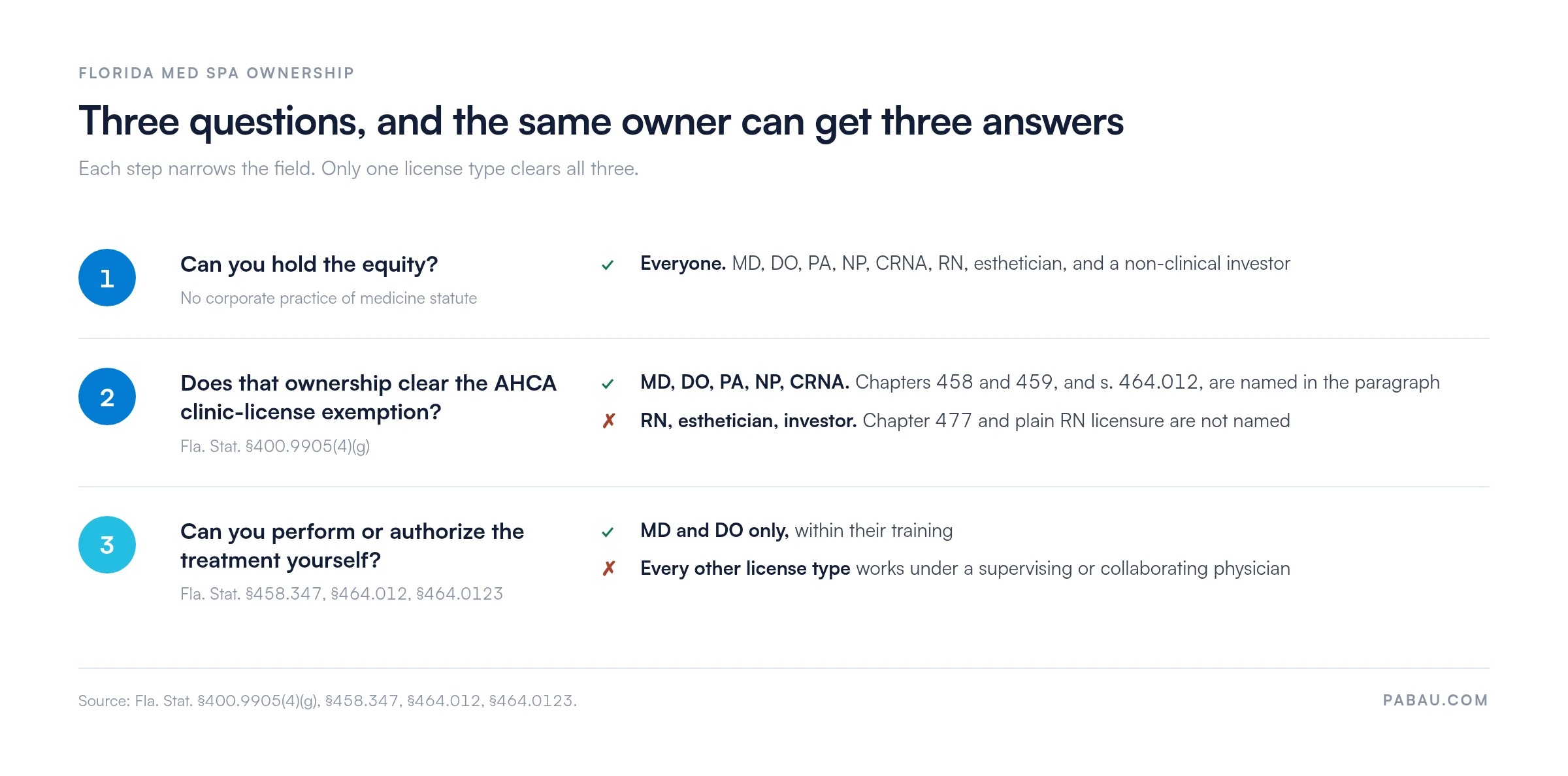
AHCA does not require an exempt practice to register, but it will issue a certificate of exemption on Form 3110-0014. That certificate has to be renewed every two years.
A practice that fits no exemption needs a health care clinic license before it charges for health care services. That means a licensure application, an inspection regime, and a medical director named in writing.
Yes, a nurse can open a med spa in Florida, and the license type behind that ownership decides what happens next.
A nurse practitioner clears the state’s ownership exemption outright, the same as a physician assistant. An RN can also own the entity, but usually needs a health care clinic license instead of the exemption.
Ownership and treatment authority stay separate either way. A nurse-owner still works within their license’s scope, backed by a prescriber or collaborating physician for anything beyond it. The sections below break down what each license type can own, treat, and sign off on.
A nurse practitioner is one of the license types whose ownership also clears the AHCA exemption, with no physician co-owner needed.
The mechanism is worth reading closely. Section 400.9905(4)(g) exempts an entity wholly owned by practitioners licensed under a listed set of chapters. That list includes s. 464.012, which licenses advanced practice registered nurses. So an APRN-owned med spa sits inside the exemption.
Treatment authority is a separate matter, and it does not follow the shares. Since 2020, Florida has let qualifying APRNs register for autonomous practice under s. 464.0123. That registration reaches primary care only, named in the statute as family medicine, general pediatrics, and general internal medicine.
Injectables, lasers, and hormone therapy are not primary care. An NP who offers them works under the established protocol required by s. 464.012(3), with a collaborating physician behind it. So the ownership answer is a clean yes, and the treatment answer still involves a physician.
That split holds for every license type below the physician line. Ownership never stretches a scope of practice, in Florida or anywhere else. Next door, Georgia med spa ownership is less settled, since the Georgia Composite Medical Board has never ruled on NP majority ownership.
PA ownership clears the AHCA exemption too. PAs are licensed under chapter 458, one of the chapters s. 400.9905(4)(g) names.
One detail matters if your supervisor is an osteopathic physician. A PA supervised by a DO is licensed under chapter 459, through s. 459.022. Both chapters appear in the exemption paragraph, so the answer does not change either way.
Supervision survives the purchase. Section 458.347 requires a PA to practice under a supervising physician, and equity changes none of that. One physician may not supervise more than 10 currently licensed PAs at one time.
Supervision is also looser than it sounds. The statute defines it as the easy availability or physical presence of the physician, and easy availability expressly includes telecommunication. Your supervising physician doesn’t have to stand in the treatment room.
Picture a PA who owns 100% of the LLC and then hires the supervising physician. The org chart and the supervision chart now point in opposite directions.
One line in the exemption is worth reading before you sign. A practitioner-owner may not supervise services beyond their own license. So a PA owner cannot be the clinical backstop for a procedure a PA could not perform.
An RN can own the entity outright. RN ownership is also the one case where equity and the clinic-license exemption come apart.
Look at what s. 400.9905(4)(g) lists. It names s. 464.012, which licenses advanced practice registered nurses, rather than chapter 464 as a whole. An RN who is not an APRN therefore falls outside that paragraph.
The consequence is a licensing step, not a bar on ownership. A wholly RN-owned med spa has to fit another exemption or hold an AHCA health care clinic license. That license brings a medical director appointed in writing. Confirm which route applies with a Florida healthcare attorney before you sign a lease.
Treatment scope is narrower still. An RN administers injectables on a prescriber’s order, after that prescriber has evaluated the patient. An RN cannot prescribe the product or add a new treatment to the menu.
So a nurse can open a med spa on an RN license alone. Just plan around two relationships from day one. You need a prescriber who evaluates patients, and a physician who carries the medical side.
A non-clinical investor can own 100% of a Florida med spa’s entity, and almost nobody does it that way. Direct ownership pulls the practice out of the practitioner exemption, and it leaves no owner with clinical authority.
Splitting the business into two companies is the standard answer. A professional entity holds the clinical side and stays wholly owned by a qualifying practitioner. A separate management services organization, or MSO, holds the business side and can be owned entirely by investors. A management services agreement joins the two.
Smaller deals have a second option worth knowing. The same paragraph lets a practitioner’s spouse, parent, child, or sibling hold equity alongside them.
One practitioner-owner has to supervise the business activities and take legal responsibility for compliance. A family investor can therefore sit on the professional entity without an MSO at all.
Florida law reaches the fee directly. Section 456.054 prohibits paying or receiving a kickback for referring or soliciting patients, and it treats a violation as patient brokering. Patient brokering is punished under s. 817.505.
Penalties then scale with patient count. A violation starts as a third-degree felony carrying a $50,000 fine. It becomes a second-degree felony at 10 patients, and a first-degree felony with a $500,000 fine at 20.
Fair market value is the test that keeps a fee clean. The fee has to reflect services the MSO genuinely delivers, such as space, equipment, staffing, marketing, and administration. A fee that moves with treatment revenue or patient volume reads as a split fee, whatever the agreement calls it.
Most investors arrive with capital and no license, which is exactly what the two-entity structure exists for. Our guide on how to start a med spa covers the steps that come before the entity work.
Three mistakes come up again and again. Owners tie the management fee to treatment revenue. Practitioner-owners supervise procedures their own license does not cover. And nobody writes down who authorized the product a nurse injected.
Four bodies matter, and which ones you deal with depends on your license and your structure.
Those three boards sit under the Florida Department of Health. AHCA is a separate agency, which is why an ownership question and a licensing question get answered in two different buildings.
Two more bodies matter if your team includes non-medical staff. The Board of Cosmetology licenses estheticians under chapter 477 and reports to the Department of Business and Professional Regulation. Chapter 477 appears nowhere in the AHCA exemption list.
The Electrolysis Council, a Department of Health body, licenses electrologists and electrolysis facilities under chapter 478. In Florida, that is the license route for laser and light-based hair removal outside a medical provider’s own hands.
Our med spa compliance guide covers the records and policies each of these bodies expects.
That appointment is a statutory duty, not a formality. Section 400.9935 requires each licensed clinic to name a medical director or clinic director who accepts legal responsibility for the practice in writing.
The role carries work. Your director confirms that every practitioner holds a current, active Florida license, and serves as the clinic’s records owner. They also run a systematic review of billing, to confirm the practice is not charging for services it never provided.
An exempt practice has no equivalent statutory appointment, and it still needs a physician behind the medicine.
Injectables are prescription drugs, so a prescriber has to evaluate the patient first. Laser hair removal by an electrologist runs under a supervising physician who reviews techniques and equipment twice a year. A physician supervising by telehealth has to be within 150 miles.
Whether an RN may inject Botox in Florida is a delegation question for the Board of Nursing and the prescriber. Ownership does not settle it. Scope and equity are decided by different rules, and by different bodies.
Every structure above produces paperwork somebody has to find again later. The protocol, the supervising physician’s name, the prescriber’s evaluation, the treatment note, and the medical director’s chart review are five records about one appointment. They usually live in five places.
Practice management software like Pabau keeps them on one client record. Each treatment note carries the provider who performed it and the prescriber who authorized the product.
Your delegation chain becomes a field rather than a memory. Consent forms and before-and-after photos attach to the same timeline.
A medical director can then review a day’s charts on one screen instead of chasing paper between rooms. When a group runs a professional entity alongside a management company, records stay tied to the entity that provided the service. That’s the version an AHCA inspector or a Board complaint asks for.
Pabau’s medical spa software brings the calendar, client records, consent, payments, and reporting into one system. The audit trail then builds itself while your team works.
If you’re still comparing platforms, our guide to medical spa EMR software lines up the options aesthetic practices use.

Pabau ties every treatment note to the provider who performed it and the prescriber who authorized it. Medical director reviews, consent forms, and photos sit on the same client record.

Florida’s ownership rules are open, and that part is safe to trust. The license you bring decides the other two questions. It decides whether your ownership alone clears the AHCA paperwork, and who is allowed to deliver the treatment.
If you’re a PA, a nurse practitioner, or a CRNA, the exemption is yours and the treatment authority is not. If you’re an RN, an esthetician, or an investor, plan for a clinic license and a medical director. Either way, build a delegation chain a stranger could follow.
Have a Florida healthcare attorney draft the management services agreement before any money moves. Fair market value is a judgment call, and s. 817.505 can turn a bad one into a felony.
A structure only holds if the records behind it do. Book a demo to see how Pabau ties every treatment to the provider who performed it and the prescriber who authorized it.

Need the wider Florida picture? Med spa laws by state: What Florida requires for ownership and compliance covers treatment scope, supervision, and how other states compare.
Structuring in Texas instead? Who can legally own a med spa in Texas? explains the majority-ownership rule Florida does not have.
Building out the compliance side? Med spa compliance for owners walks through the policies, records, and checks an owner is responsible for.
Choosing the system that holds the records? 8 best medical spa EMR software solutions compares the platforms aesthetic practices run on.
Working out what ownership pays? Med spa owner salary: what you can actually earn breaks down the revenue and cost side of owning one.
Yes, and dentist ownership clears the AHCA exemption. Section 400.9905(4)(g) names chapter 466, which licenses dentists in Florida. Ownership does not widen a dental scope of practice, so injectables and lasers still need a prescriber and a supervising physician.
Yes. Section 400.991(1)(a) licenses each clinic location separately, even when two sites share one business name and one management company. A second location means a second application, a second inspection, and its own medical director.
The revenue becomes uncollectible. Under s. 400.9935(3), a charge made by a clinic that should be licensed but is not is unlawful, noncompensable, and unenforceable. That covers care already delivered, which is why owners confirm their exemption before opening.
Yes, an out-of-state physician can hold equity, because Florida sets no license condition on ownership. The exemption in s. 400.9905(4)(g) counts Florida licenses only. So a practice owned by a physician licensed elsewhere still needs an AHCA clinic license.