Scapular assistance test: Procedure, interpretation and free template
The scapular assistance test is a manual examination in which the clinician supp...

1
Last Updated: Oct 19, 2026

The cervical extensor endurance test asks a prone patient to hold a neutral chin-tuck position with the head unsupported beyond the table edge.
Two different protocols share the name. One is a fixed 20-second pass or fail screen, and the other is an open-ended hold timed to fatigue.
Published norms for the timed hold are short. Healthy adults average roughly 38 to 43 seconds, not the several minutes often quoted online.
Reliability is contested. Published ICC values run from 0.14 to 0.88, depending on the protocol and on how the raters were tested.
The test cannot separate deep extensor endurance from superficial extensor endurance, so read it alongside the compensations you see during the hold.
Practice management software like Pabau lets physical therapy teams record hold times, the exact protocol used, and re-test dates on one patient record.
Look up normative values for the cervical extensor endurance test and you will find hold times of two or three minutes. The published data disagrees. Healthy young adults hold the unloaded position for a median of 43 seconds.
The discrepancy has a cause. Two separate protocols carry the same name, and a third research variant adds weight to the head. Their numbers don’t transfer, so a norm borrowed from the wrong protocol can make a healthy patient look impaired.
That makes protocol choice your first clinical decision, not an afterthought. Pair each protocol with the reference values and reliability figures that belong to it, and the score starts to mean something.
The cervical extensor endurance test (CEET) measures the isometric endurance of the posterior cervical muscles. Your patient lies prone with the head and neck beyond the end of the treatment table. They hold a neutral chin-tuck position against gravity while you record what happens.
The muscles under load are the posterior cervical group as a whole. That includes semispinalis cervicis, semispinalis capitis, splenius capitis, cervical multifidus, and the suboccipital group. The test loads them together rather than in isolation, which matters when you interpret the result.
Cervical motor control is mostly a physical therapy concern, so the test shows up most often in physical therapy practices. In a session it belongs in the motor control block, after range of motion and before your flexor tests.
Run it before resisted extensor testing, never after, so the hold starts from a rested muscle.
The name traces to Sebastian, Chovvath and Malladi, who published a reliability study in 2015. Their protocol is not a timed hold to failure, which is where most secondary sources go wrong.
In that study, 30 patients with neck pain were asked to sustain a neutral chin-tuck for a fixed 20 seconds. Two physical therapists watched an inclinometer and recorded how the position failed.
Chin length increasing with neck extension indicated deep extensor weakness and superficial dominance. The head dropping into flexion indicated weakness in both groups.
A separate family of studies uses the same starting position with no time limit. The patient holds until the neutral position is lost, and you record the elapsed seconds.
This version is usually called the deep neck extensor endurance test, or NEET. It is the one with published normative hold times.
A third group of research protocols adds external load to the head, commonly 2 kg, 4 kg, or 6 kg. Loaded holds run into the hundreds of seconds. Those figures belong to the loaded protocol alone.
Quoting them as norms for the unloaded clinical test is the most common error in online guides.
Use the CEET when extensor weakness or fatigability is a plausible contributor to the presentation. It is not a screening tool for the general population, and it is not diagnostic on its own. Read it as one part of a broader head and neck assessment.
Neck pain and sports settings use the same test for different reasons. Symptomatic patients get a baseline to treat against, while sports medicine practices screen a squad before the season starts. The protocol does not change, only the comparison you make afterward.
Two nearby questions are worth settling first. Arm-dominant symptoms may point to thoracic outlet involvement, which the Morley test screens for. A neurological presentation is a different problem again, and brachial neuritis exercises progress on their own timeline.
The CEET also does not replace a full cervical assessment. Read it next to range of motion, pressure pain thresholds, and a flexor endurance measure.
You need almost nothing to run this test, which is one reason it suits routine clinical use. The variables that move a score sit in the setup rather than the kit.
Patient preparation: Position the patient prone with the trunk supported and the head and neck past the table edge. Arms rest alongside the body. Set the cervical spine in relaxed neutral with a gentle chin tuck, neither flexed nor extended. Show them the position rather than describing it, because good patient education at this point saves you a second attempt.
Decide which protocol you are running before the patient lies down, and write that decision into the note. Mixing the two across sessions is what makes a re-test uninterpretable.
This is the protocol Sebastian and colleagues tested, and it answers a different question. You are not measuring capacity in seconds. Instead, you ask whether the patient can hold the position for 20 seconds, and watch how it breaks if they cannot.
No published protocol defines a specific angle threshold for failure. A source quoting a fixed 5-degree drop is inventing precision the literature does not have. The criterion used in the studies is loss of the neutral chin-tuck position, in either direction.
Where teams lose consistency: some clinicians wait for the head to reach the table before stopping, while others stop at the first tremor. Neither is wrong, because no published threshold exists. Write your own visible-deviation rule into your assessment template and apply it across the whole team.
Two large studies provide normative hold times for the unloaded timed protocol. One reports young adult norms, the other covers ages 29 to 60. Both are recent, and both fall well short of the figures circulating in clinical summaries.
Say a 34-year-old office worker with six months of neck pain holds 19 seconds. Against the mean of 38.4 seconds for that age band, the score sits below the lowest quartile. Treat it as a marked deficit and a training target.
Then hold that reading loosely. A 2026 normative study reported a standard deviation of 24 seconds against that mean, so the normal spread is very wide. Both normative studies also came from the same research group and the same regional population.
That combination makes population norms a weak basis for an individual judgment. Compare the patient with their own baseline first, and only then with a matched norm. Tracking patient measurements across the care episode is what makes that first comparison possible.
A low score also changes what you do next. Most teams follow one with extensor endurance work and a set of neck pain exercises. Re-measure at the progress review, not at the next visit.
There is no single ICC for this test, and any source quoting one range across every protocol is overstating the evidence. Three studies frame the picture, and they disagree sharply with each other.
The Juul figures deserve weight rather than a footnote. That team tested cervical muscle performance under everyday clinical conditions. Each rater ran a single trial instead of an averaged best of several. They concluded that the neck extensor test was too unstable for evaluating neck muscle performance.
The Edmondston ICC of 0.88 is the strongest figure available for a timed extensor hold. It arrives with a minimal detectable change of 71.3 seconds. That threshold is larger than the entire normative mean for the unloaded test, so a single re-test cannot confirm improvement in most patients.
Read together, the three studies point the same way. This test flags a marked deficit better than it measures small change. The kappa of 0.800 supports using the 20-second screen as a yes or no question. Nothing in the evidence supports quoting a hold time as proof of week-to-week progress.
Construct validity has partial support. Patients with chronic neck pain show lower global extensor endurance than asymptomatic controls, along with smaller deep extensor muscles on ultrasound.
The same study found almost no correlation between endurance results and muscle size. That limits what a hold time can tell you about the muscles underneath.
No, not reliably, and the best evidence on this question is negative. Kahlaee, Rezasoltani and Ghamkhar tested it directly in The Spine Journal in 2017, and challenged the clinical test’s validity for the job.
Their design compared 30 patients with chronic neck pain against 30 asymptomatic subjects. Extensor endurance was measured with the clinical test, and extensor muscle size with ultrasound. If the clinical test separated deep from superficial endurance, the two sets of measures should have tracked each other.
They did not. Correlations between endurance results and ultrasound measures were absent in both groups, with a single exception for semispinalis capitis. The authors concluded that their findings challenge the validity of the clinical test for separating deep and superficial extensor endurance.
The Sebastian screen does read the direction of failure to infer which group is weak, and its inter-rater agreement was very good. Agreement between raters is not the same as accuracy. Those authors said as much themselves, noting the test has never been compared against a diagnostic gold standard.
Re-test at four to six week intervals, not session by session. The best-supported minimal detectable change for this test is 71.3 seconds, so most short-term differences sit inside measurement noise. Two scores a week apart will not tell you anything you can act on.
Protocol drift is the most likely explanation for the spread in published reliability figures. These are the errors that move a score furthest.
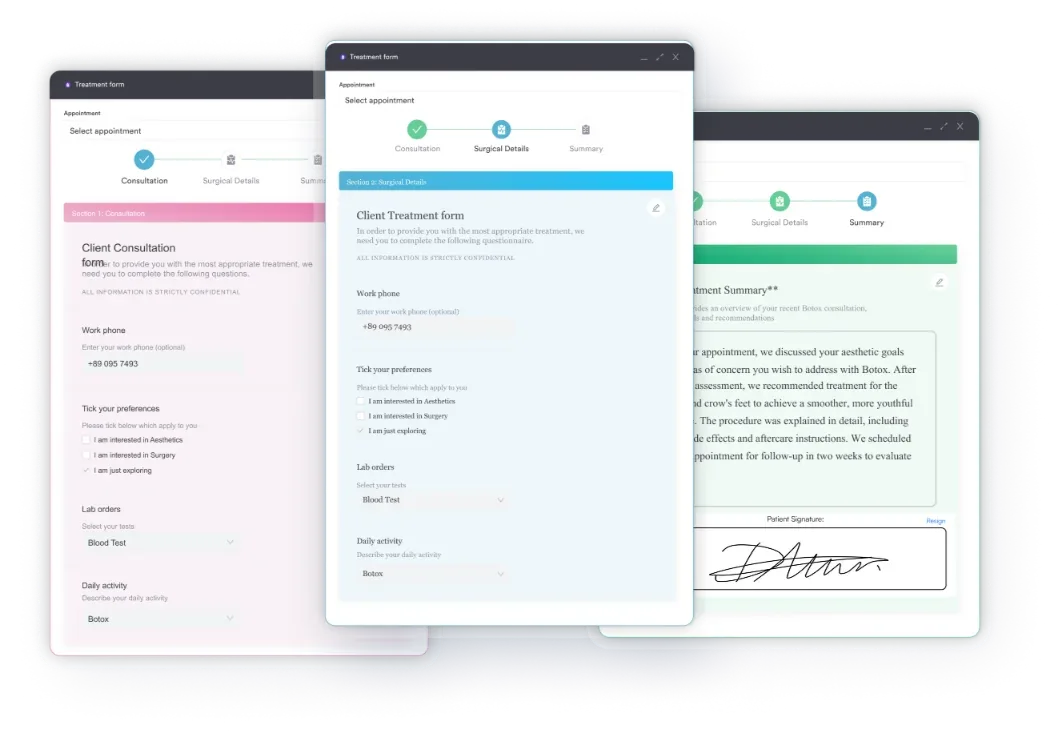
Most of these come down to memory rather than skill. For practices using digital assessment forms, building a standardized CEET field set into the assessment workflow takes memory out of it. Every clinician then captures the same items in the same order.
The CEET does not stand alone. Clinicians working with cervical conditions usually pair it with a flexor-side measure. The deep neck flexor endurance test and the craniocervical flexion test are the two most common companions.
The reliability row is the one worth pausing on. Extensor testing is the weakest link in this battery, which argues for reporting it qualitatively rather than as a precise figure.
Any comparison only helps if you can pull the earlier scores up during the appointment. The right physiotherapy clinic management software keeps every score on one record, so the earlier numbers are a click away.
A CEET score is only as useful as the context stored beside it. Protocol, added load, table overhang, failure reason, and clinician all change how the number should be read. In free-text notes that context is usually gone within three appointments.
Practice management software like Pabau holds the whole set as structured data instead. Your team defines the CEET fields once, and every clinician captures the same items in the same order. Clinical documentation stays searchable, so a re-test score sits next to the baseline it should be compared against.
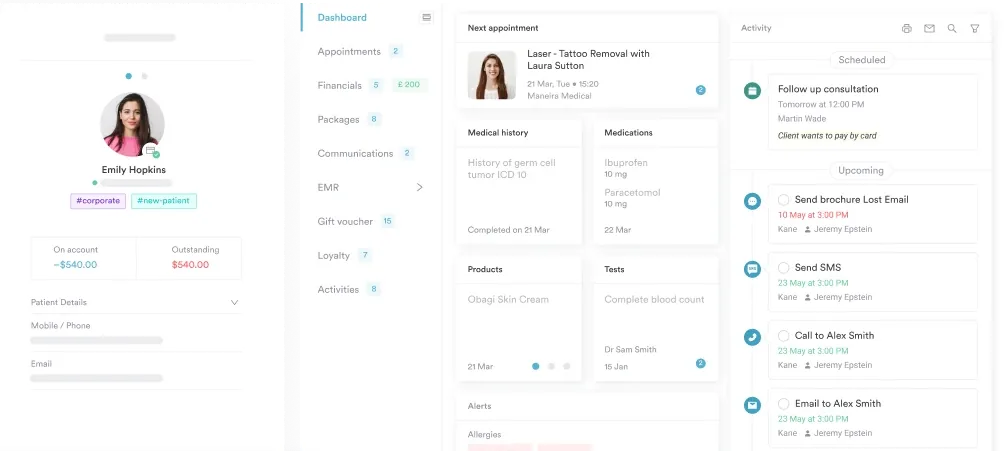
Re-test timing is the other half of the problem. Given a minimal detectable change of 71.3 seconds, four to six weeks is the shortest interval worth measuring. Automated clinical workflows can flag when a patient is due that reassessment, so progress reviews happen on schedule rather than from memory.
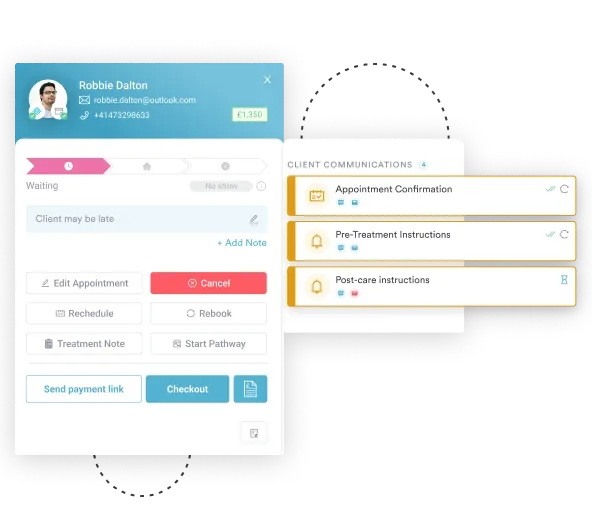
Setting a target gets easier once the record holds a matched norm alongside the baseline. A patient at 18 seconds against a decade-matched mean of 38 seconds has a clear goal. Teams opening a physiotherapy clinic gain most by building those protocol templates in from day one.

Pabau captures CEET hold times, the protocol used, and re-test dates as structured fields on the patient record. Your team compares like with like, and progress reviews stop depending on memory.

The cervical extensor endurance test earns a place in a neck assessment, as long as you ask it the question it can answer. It identifies a marked extensor deficit in under five minutes, with a table and a stopwatch.
Precision is where it falls down. The published norms sit around 40 seconds rather than several minutes, and the reliability evidence runs from poor to good depending on the protocol. Treat a hold time as a flag worth investigating, not a measurement you can defend to the second.
So write down which protocol you ran, compare the patient against their own baseline first, and only then against an age-matched norm. That habit costs nothing, and it is what keeps the number honest. Book a demo to see how Pabau keeps protocols, hold times, and re-test dates on one patient record.

Chasing dizziness alongside neck pain? Smooth pursuit neck torsion test walks through a screen that helps separate cervical from vestibular contributions.
Adding another special test to your assessment? Posterolateral drawer test covers the technique, the grading, and the pitfalls that change a result.
Measuring lumbar spine flexion too? Schober tests template standardizes how you record baseline landmarks and flexion distances across three test variants.
Screening for fear-avoidance behavior? Tampa Scale of Kinesiophobia template scores a patient’s fear of movement, a strong predictor of rehabilitation outcomes.
Tracking trunk control after a stroke? Trunk Impairment Scale template quantifies where trunk control breaks down and tracks improvement over weeks of rehabilitation.
Endurance. The score is a hold time against gravity, not a force reading. Maximal extensor strength needs a dynamometer and a different protocol, so a patient can be strong and still fail this test.
Not from the two normative studies above. Both recruited adults aged 18 to 60. Outside that band, compare the patient against their own baseline rather than a published mean.
Not reliably. The protocol needs a firm surface, with the head clear of the edge and the thorax steady. A bed gives way under the trunk, which changes the load you are measuring.
It gives you a measurable target. Most teams follow a low score with extensor endurance work, then re-measure at the progress review. The number itself does not tell you which muscles to train.
No. The reliability work used a single trial per rater, and a repeat hold carries the fatigue you just produced. Book the re-test for another day instead.