Treatment summary
A treatment summary is a written record of what care was delivered during an epi...

4
Last Updated: Oct 16, 2026
A normal vital signs chart lists the expected resting ranges for blood pressure, heart rate, respiratory rate, body temperature and oxygen saturation. It lets you judge a reading at a glance. For a healthy adult at rest, normal means blood pressure below 120/80 mmHg and a heart rate of 60 to 100 beats per minute. It also means 12 to 20 breaths per minute, a temperature of about 97.8°F to 99.1°F (36.5°C to 37.3°C) and SpO2 of 95% to 100%.
Children run faster than adults, so they need their own age bands. A newborn’s normal awake heart rate reaches 205 beats per minute, about double the adult ceiling.
This chart names the source behind every table, because the age bands shift depending on whose guidance you follow. Pediatric Advanced Life Support (PALS) ranges stop at age 15. The American Academy of Pediatrics switches to adult blood pressure thresholds at 13, and NEWS2 only scores patients aged 16 and over.
These are reference values for orientation. They don’t replace local protocol or clinical judgment, and your own documentation should state which source you follow.
A printable recording form with fields for patient details, date and time, and heart rate and respiratory rate with the counting method. It also records blood pressure with arm and position, the temperature site, and comments on abnormal readings.
Download template
A normal vital signs chart compares blood pressure, heart rate, respiratory rate, temperature and SpO2 against expected resting ranges.
Healthy adults at rest sit below 120/80 mmHg, at 60 to 100 beats per minute and at 12 to 20 breaths per minute.
Children need age bands, and PALS puts a newborn’s awake heart rate at 100 to 205 against 60 to 100 for an adolescent.
The 2025 AHA/ACC guideline kept the 2017 blood pressure categories, and readings above 180/120 are now called severe hypertension.
Early warning scores such as NEWS2 add individual readings together, so several mildly abnormal values can trigger an urgent review.
A normal vital signs chart is a clinical reference that lists expected values for the core measurements taken during an assessment. It gives nurses, physicians and front-line practice staff a fast comparison point when they record a reading.
The five classic vital signs are blood pressure, heart rate, respiratory rate, body temperature and oxygen saturation. Pain is sometimes added as a sixth, though adoption varies by institution.
A reference chart and a recording form do different jobs. The tables on this page tell you what normal looks like, while the downloadable form captures what you measured and how. Using both together means each reading is logged with the context someone needs to interpret it later.
Adult resting values are the reference point most practices use first. The table below sets out the commonly accepted range for each parameter in a healthy adult at rest.
Heart rate and blood pressure follow American Heart Association (AHA) guidance. The temperature range is Cleveland Clinic’s adult reference, and 12 to 20 breaths per minute is the band NEWS2 scores as normal. A trained endurance athlete can rest below 60 beats per minute without any problem. Always read a value against the person in front of you.
Blood pressure is graded rather than simply marked normal or abnormal. The AHA uses five categories, and a reading falls into the highest category that either number reaches.
The 2025 AHA/ACC high blood pressure guideline replaced the 2017 version but kept these thresholds unchanged. What changed is the language at the top of the scale. The AHA now calls a reading above 180/120 without signs of organ damage severe hypertension, and the same reading with organ damage a hypertensive emergency.
Older charts group both under “hypertensive crisis,” so update any laminated copies on the wall. Our normal blood pressure chart covers the categories in more depth.
Heart rate and respiratory rate both fall as children grow, so a single adult band misreads most pediatric patients. The table below uses one source for every pediatric row: The AHA’s Pediatric Advanced Life Support (PALS) reference ranges.
PALS stops at age 15, so the adult row repeats the adult ranges above for comparison. Some reproductions of the PALS table print the infant awake ceiling as 190 rather than 180, so check which figure your protocol uses.
The ranges narrow and slide down with each band, which is easier to see than to read in a table.
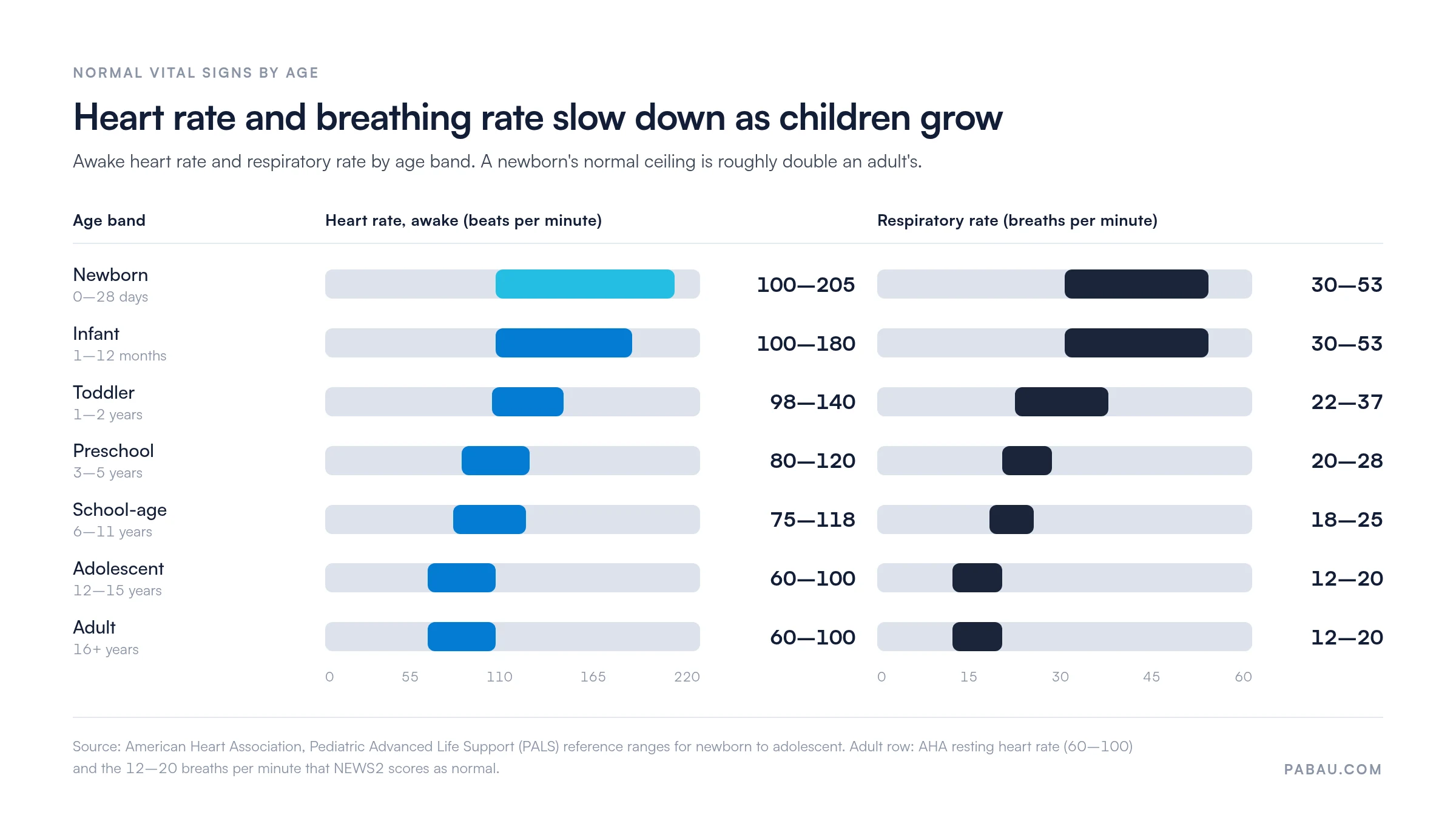
Notice how much the asleep and awake ranges differ. A sleeping infant at 95 beats per minute sits inside the asleep band but below the awake one. Record whether the child was asleep, calm or crying, or the next clinician can’t tell which band you used.
Newborn readings need the most care because normal heart and breathing rates run so much faster than in adults. Under PALS, a newborn’s heart rate is 100 to 205 beats per minute awake and 90 to 160 asleep. Breathing runs at 30 to 53 breaths per minute.
Blood pressure starts low and climbs over the first year. PALS gives a typical systolic of 67 to 84 mmHg at four days old, rising to 72 to 104 mmHg across infancy.
Temperature matters most in the youngest babies. The American Academy of Pediatrics recommends a rectal reading under three months. A rectal temperature of 100.4°F (38°C) or higher in an infant aged two months or younger needs a pediatrician’s attention straight away.
For a fuller pediatric reference with a printable form, see our pediatric vital signs chart.
Heart rate and breathing rate have fixed bands, but children’s blood pressure and temperature need a different approach. Blood pressure depends on height and sex, and temperature depends on where you take it.
The 2017 AAP clinical practice guideline classifies blood pressure in children aged 1 to 12 by percentile for age, sex and height. Each category uses the percentile or the fixed adult-style cut-off, whichever is lower:
From age 13, the AAP uses the same thresholds as the adult AHA table above. That is two years before PALS hands over to adult heart rate ranges, so a 13-year-old sits in two systems at once.
Low blood pressure is the more urgent finding in a sick child. PALS sets the systolic floor at 60 mmHg for newborns and 70 mmHg for infants. From 1 to 10 years, the floor is 70 plus twice the age in years, and from 10 onward it is 90 mmHg.
The average normal oral temperature is 98.6°F (37°C), according to MedlinePlus. Other sites read consistently higher or lower, so the same child can look feverish or normal depending on the thermometer.
A fever is usually a temperature of 100.4°F (38°C) or higher. Always write the site next to the number, because an armpit reading of 99.5°F tells a different story from an oral one. Our body temperature chart lists site-specific ranges in more detail.
Normal SpO2 for most healthy adults is 95% to 100%. Readings can run lower at altitude, and in people with long-term lung disease.
For acutely ill adults, British Thoracic Society guidance targets 94% to 98%. Patients at risk of hypercapnic respiratory failure, such as some people with COPD, have a lower target of 88% to 92%. NEWS2 scores them on a separate scale for that reason.
Pulse oximeter accuracy can be affected by skin pigmentation, poor perfusion, cold fingers, nail polish and movement. Treat an unexpected reading as a prompt to recheck the probe and the patient before acting on the number.
An abnormal vital sign is a reading outside the expected range, and it may signal a problem that needs review. Several readings outside range together carry more weight than any single value.
Our abnormal vital signs chart lists the thresholds and next steps for each parameter.
A single reading can look acceptable while the overall picture worsens. Early warning scores tackle this by adding readings together. The UK’s National Early Warning Score 2 (NEWS2), from the Royal College of Physicians, scores six parameters from 0 to 3:
The total runs from 0 to 20, and the score sets the response:
NEWS2 is designed for adults aged 16 and over and isn’t used in pregnancy. Children are usually scored with a pediatric early warning score (PEWS), which varies between hospitals.
Clinicians use the chart at the point of measurement, not after the notes are written. Pinning a printed copy near the observation station keeps the reference visible during busy shifts.
Vital signs are often the first objective evidence of a change in a patient’s condition. Inaccurate or missing entries make later decisions harder to defend.
A reading is only useful if the next clinician can interpret it. Each entry should capture:
Consistent recording also supports audit and handover. Trends matter more than single values, so store readings where you can compare them across visits. Our vital sign sheets give you a structured layout for repeat observations.
Paper charts work until you need to compare this month’s blood pressure with last spring’s. Then someone digs through folders, and readings taken by different staff use different units and methods.
With practice management software like Pabau, you can turn the fields on this chart into a digital form. Staff record each reading with its method, and the form saves straight to the patient’s Client record.
Previous readings sit alongside clinical notes, so you can spot a creeping blood pressure without a second spreadsheet. See how medical records management works in Pabau.
For family medicine and private GP teams, our primary care practice software brings booking, records and billing into the same system.
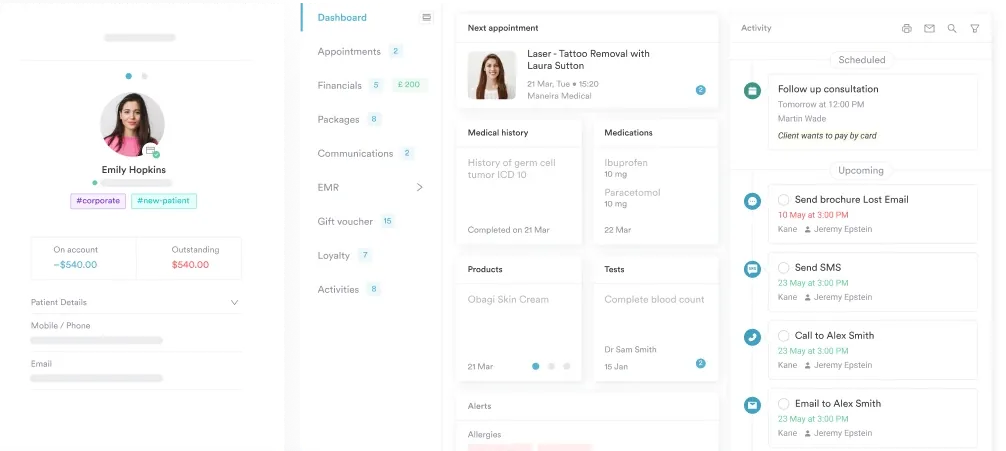

Pabau turns your vital signs chart into a digital form that saves each reading to the patient record. Your team can compare results across visits and spot changes early.

A vital signs chart is only as good as the source behind it. Pick one reference set per age group, write it into your protocol, and make sure every printed chart in the building matches it.
Then focus on what the numbers can’t tell you alone: The trend. A heart rate of 98 is normal, but not if it was 72 an hour ago. Record the method and the state with every reading, and give your team a way to see readings side by side.
Book a demo to see how Pabau helps your practice record vital signs once and track them across every visit.

Treating older patients? Elderly blood pressure chart sets out the targets and readings that matter for patients over 65.
Working with children? Pediatric blood pressure chart covers percentile-based readings for children and adolescents.
Checking a sleeping patient? Sleeping heart rate chart shows how resting heart rate drops overnight by age.
Need to grade a fever? Fever temperature chart breaks down fever thresholds by age and measurement site.
Assessing a head injury or stroke? Neurological vital signs explains the checks that sit alongside standard observations.
A normal vital signs chart is a clinical reference listing expected ranges for blood pressure, heart rate, respiratory rate, temperature and oxygen saturation. It gives staff a quick comparison point when they record a reading.
The five main vital signs are blood pressure, heart rate, respiratory rate, body temperature and oxygen saturation. Pain is sometimes recorded as an additional sixth measure.
Under PALS reference ranges, a newborn’s heart rate is 100 to 205 beats per minute awake and 90 to 160 asleep. Respiratory rate is 30 to 53 breaths per minute. Confirm the band against your local neonatal protocol.
Frequency depends on the setting and the patient’s condition. In hospital, NEWS2 sets a minimum of every 12 hours for a score of 0, with closer monitoring as the score rises. Repeat observations whenever the clinical picture changes.
Older adults use the same resting ranges as younger adults, and the 2025 AHA/ACC guideline applies the same blood pressure categories at every adult age. Baseline temperature can run lower in older people. Infectious Diseases Society of America guidance treats a single oral reading above 100°F (37.8°C) in a long-term care resident as fever.
For an adult at rest, a heart rate above 100 beats per minute is tachycardia and below 60 is bradycardia. Neither is always dangerous, since fit adults often rest below 60. NEWS2 gives the maximum 3 points to a pulse of 131 or more, or 40 or less. Chest pain, fainting or breathlessness alongside an abnormal rate needs urgent care.
The average normal oral temperature is 98.6°F (37°C), and Cleveland Clinic gives an adult range of 97.8°F to 99.1°F (36.5°C to 37.3°C). Rectal and ear readings run 0.5°F to 1°F higher, and armpit readings run lower. A fever is usually 100.4°F (38°C) or higher.
Exercise, pain, anxiety, caffeine, nicotine and a full bladder can all raise blood pressure and heart rate. A recent hot or cold drink skews oral temperature. A poorly sized cuff, talking during measurement, cold fingers and nail polish also distort results, so let the patient rest before you measure.