Scapular assistance test: Procedure, interpretation and free template
The scapular assistance test is a manual examination in which the clinician supp...

1
Last Updated: Oct 19, 2026

The Morley test screens for thoracic outlet syndrome by pressing directly on the brachial plexus in the supraclavicular fossa.
A positive result reproduces the patient’s own arm symptoms, such as radiating paresthesia, rather than plain local soreness.
Neurogenic thoracic outlet syndrome accounts for over 90% of cases, so this test speaks mainly to that subtype.
No single provocative test confirms thoracic outlet syndrome, so pair the Morley test with Adson’s test and the Roos test.
Practice management software like Pabau keeps each special test result, the side tested, and your reasoning in one client record.
Arm tingling with a heavy, aching shoulder is one of the harder patterns to sort out. Nerve roots, the brachial plexus, and the peripheral nerves can all produce it. The Morley test takes about a minute and helps you narrow the field.
Also called the brachial plexus compression test, the Morley test presses on the plexus in the supraclavicular fossa. It counts as positive only when that pressure brings back the patient’s familiar arm symptoms, not just a wince.
Getting that distinction right starts with knowing exactly what sits under your fingers.
That precision matters because the brachial plexus sits unusually close to the surface in the supraclavicular fossa. That fossa is the shallow dip just above the clavicle, lateral to the sternocleidomastoid.
Press there and you load the plexus trunks with very little tissue in the way. That is exactly why a heavy-handed press produces a false wince instead of a true finding.
The plexus forms from the C5 to T1 nerve roots. It then travels through the scalene triangle, bounded by the anterior scalene, the middle scalene, and the first rib. The subclavian artery shares that narrow space. That is why TOS symptoms range from tingling and weakness through to color change and swelling.
Compression at the outlet usually traces back to one of three sources. Scalene hypertrophy is common in overhead athletes. A cervical rib, an extra rib arising from the C7 vertebra, is present in roughly 0.5% to 1% of people. The rest usually come down to a tight costoclavicular space.
An imaging review of neurogenic TOS names the same anatomical culprits, plus post-traumatic callus on the clavicle or first rib. Press into a space that is already crowded and symptoms follow. That is the whole mechanism behind the test.
Consistency matters more than force here. Change your finger placement or your pressure and you change what you are loading, which changes what the result means.
Always test the quiet side as well. Pressure tolerance varies enormously between people, so the asymptomatic side gives you a personal baseline to compare against.
A physical therapy EMR can hold the full TOS battery as one assessment template. The Morley result then arrives with its context attached, rather than as a lone plus or minus in a note.
Ramp the pressure up over five to ten seconds rather than pressing suddenly. An abrupt press triggers guarding and local discomfort, which can mask or mimic a genuine neural response. A slow build gives the patient time to separate ordinary soreness from their own arm symptoms.
The test is positive when compression brings back the symptoms the patient walked in with. Discomfort under your fingers, on its own, does not qualify.
So what counts as positive? Any of the following, as long as the patient recognizes the sensation as their own:
And what counts as negative? Pressure produces nothing beyond mild local tenderness, which the patient describes as different from their own symptoms. That lowers your suspicion. It does not clear TOS when the history still points that way.
Write the finding down while it is fresh. Record which symptom returned and on which side, then file it in the patient records alongside your reasoning. Six weeks later, that one line is what tells you whether the picture is improving.
A positive Morley test raises suspicion for thoracic outlet syndrome. It does not diagnose it. The distinction matters, because the next step is a differential, not a treatment plan.
TOS splits into three subtypes. Neurogenic TOS involves the brachial plexus and accounts for over 90% of cases. Venous and arterial TOS make up the remainder. Because the Morley test loads the plexus directly, it speaks mainly to the neurogenic group.
When the test comes back positive, work through these alternatives before you settle on TOS:
Which one you land on changes the plan. So does how you explain it. Clear patient education at this stage stops a screening finding from hardening into a diagnosis in the patient’s mind.
The Morley test has never been validated as a standalone diagnostic test. Published accuracy data for it is thin, and none of it comes from large studies with confirmed TOS populations. Treat any quoted sensitivity or specificity figure with caution.
Part of the problem sits with the condition rather than the test. TOS has no gold standard reference test, which weakens every accuracy study in the field. Diagnosis stays clinical, built from history, examination, and imaging together.
Compare that with a validated decision rule such as the Ottawa ankle rules, which were built and tested to give a dependable yes-or-no answer. The Morley test was never designed to do that job. Its value is showing you where the symptoms are coming from.
Four limitations are worth keeping in mind:
Repeat testing is where the test earns its keep. Recheck at four to six weeks, and outcome tracking will show whether pressure tolerance and symptom spread are moving in the right direction.
Experienced clinicians rarely run the Morley test alone. The combination of results is what points you toward a subtype, because each test loads a different part of the outlet.
Wright’s test and the costoclavicular maneuver load different spaces. Hyperabduction squeezes the pectoralis minor space under the coracoid, while bracing the shoulders down and back closes the costoclavicular space. Run the battery in the same order every time and the pattern becomes readable. First rib mobility deserves a look in the same session, since a stiff first rib narrows two of these spaces at once.
Overhead athletes are where this pays off most. Swimmers, throwers, and gymnasts build scalene bulk and shift first rib position, so they earn the full battery. Sports medicine software keeps those repeat results side by side across a season.
Use the Morley test when the history already points at the thoracic outlet. Applied to every tingling arm, it generates more noise than signal. These presentations earn it:
Some presentations need imaging before any provocative test. An apical lung mass, a primary bone tumor of the first rib or clavicle, and unexplained cervical lymphadenopathy all sit in that group. Provocative testing adds nothing there, and it can cost the patient weeks.
Refer when a positive test comes with progressive neurological loss, such as motor weakness or thenar and hypothenar wasting. Vascular signs deserve the same response, including color change, swelling, or a temperature difference between the arms.
Failure to improve after six to eight weeks of conservative care also warrants a vascular surgery or neurology opinion. Do not keep a progressive presentation on conservative care without a specialist opinion.
A Morley result tends to end up in three places at once. A tick on a paper assessment sheet, a line buried in the treatment note, and the clinician’s memory of what the patient actually said. Six weeks later, the comparison is guesswork.
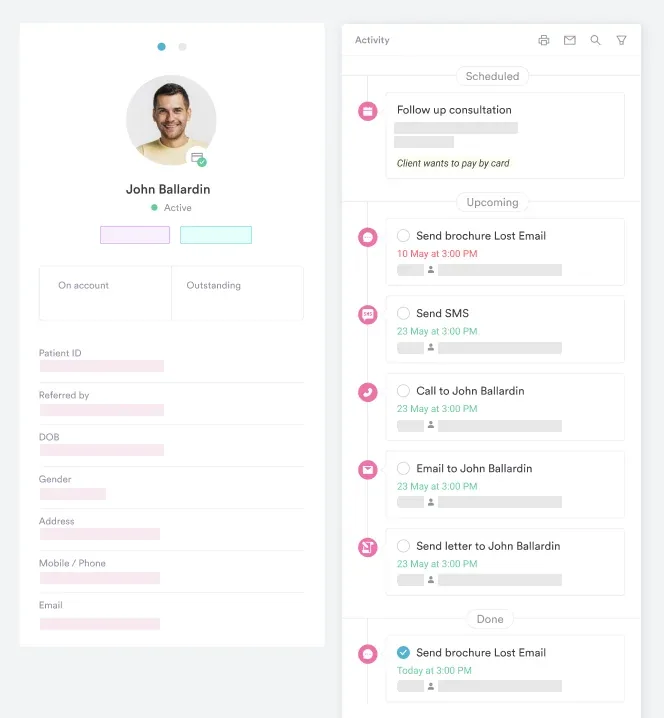
Practice management software like Pabau puts the whole assessment in one place. You can build the TOS battery as a form, so Morley, Adson’s, Roos, and Wright’s are prompted every time. Each result saves straight into the client record, next to your reasoning note and any referral letter.
The payoff arrives on the second visit. You can see what you found last time, on which side, and under how much pressure, so you judge change instead of recalling it. Physical therapy practice software can also flag intake answers that suggest TOS, so the right tests get prompted at the first appointment.

Pabau lets physical therapy and musculoskeletal practices build structured assessment templates, capture special test results, and attach clinical reasoning to the client record. Your six-week review becomes a comparison instead of a fresh guess.

The Morley test is quick, cheap, and anatomically honest. It tells you the brachial plexus is irritable at the outlet, which is genuinely useful information. But it will never hand you the diagnosis, so treat a positive result as a reason to keep looking.
In practice, run it inside a battery and always test the quiet side too. Then record the exact symptom that came back, rather than a bare plus or minus. Do that consistently and your review appointment turns into a real comparison.
Most of that discipline is won or lost in the documentation. Book a demo to see how Pabau keeps special test findings, reasoning notes, and outcome measures together in one client record.

Need to separate neck pain from shoulder pain? Arm squeeze test shows how one quick maneuver helps point to cervical root irritation instead of the shoulder itself.
Examining the shoulder next? Belly press test covers the technique, the positive signs to watch for, and what the accuracy numbers mean in practice.
Looking for conservative options after a positive screen? Neck pain exercises covers the loading and mobility work that often forms the first phase of care.
Need objective numbers to track progress? Range of motion assessment explains how to measure and record movement so repeat visits are comparable.
Building out your special test toolkit? Posterolateral drawer test applies the same interpret-with-caution logic to knee instability testing.
Firm pressure above the collarbone feels uncomfortable for most people, and that alone is normal. What matters is whether it brings back the patient’s own arm symptoms. Stop the test if the pain is severe.
Start with a cervical spine and chest radiograph to look for a cervical rib or an abnormal first rib. Add MRI when you need plexus detail. Use duplex ultrasound when the arm shows swelling, color change, or a temperature difference.
Rarely, and never on its own. Most patients begin with conservative care covering posture, scalene and pectoral loading, and nerve mobility. Surgery is reserved for vascular TOS and for neurogenic cases that fail months of rehabilitation.
No. Self-applied pressure is hard to aim and harder to keep steady, and you cannot judge your own guarding. The test needs an examiner who controls the pressure and watches the response.
Rechecking at four to six weeks is common practice. Compare the side tested, the symptom reproduced, and how much pressure it took, so you can see whether the plexus is settling.