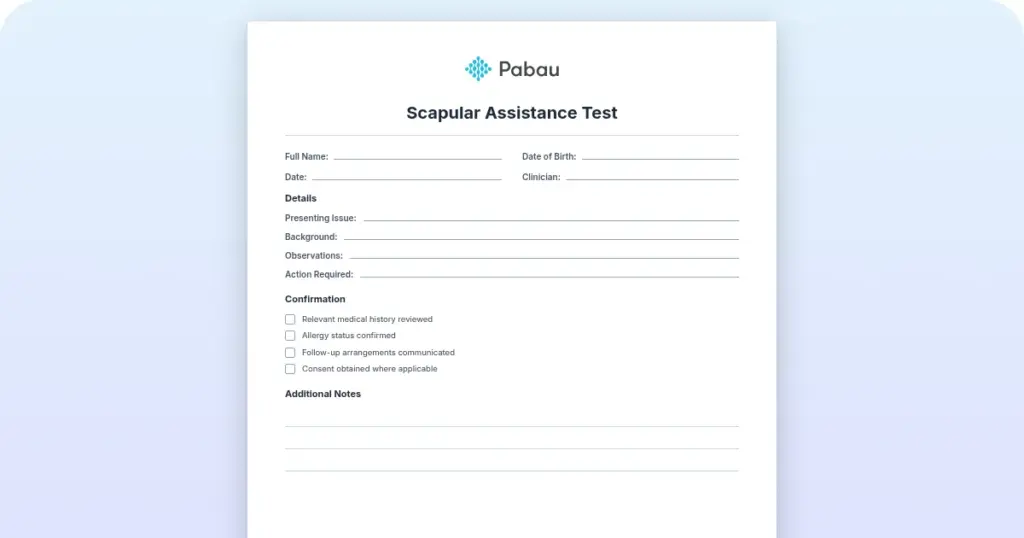
Scapular assistance test: Procedure, interpretation and free template
The scapular assistance test is a manual examination in which the clinician supp...

1
Last Updated: Oct 19, 2026

Brachial neuritis exercises run in phases: passive motion first, active control next, resistance work last.
Nerve gliding helps, but only in the subacute phase and only under a physical therapist’s supervision.
Overhead pressing, pull-ups, and forced end-range stretching set patients back during the first four months.
Strength testing and EMG findings decide when a patient progresses, not the calendar.
Practice management software like Pabau keeps strength grades, home program handouts, and review dates in one record.
A patient sits down in your treatment room with a shoulder that’s stopped burning and a deltoid that’s visibly wasted. Three weeks ago, urgent care called it a rotator cuff strain. What you’re actually looking at is brachial neuritis, and the exercise plan depends entirely on which phase the nerve is in.
Start exercises too early and you aggravate a nerve that’s still inflamed. Wait too long and preventable atrophy sets in. Getting that sequence right, phase by phase, is what decides whether the shoulder comes all the way back.
Brachial neuritis, also called Parsonage-Turner syndrome or neuralgic amyotrophy, is an acute inflammatory condition of the brachial plexus.
It presents as sudden, severe, one-sided shoulder and arm pain. Weakness and muscle atrophy follow within days to weeks, in the distribution of the affected nerves.
NCBI StatPearls puts the reported incidence at approximately 1 in 1,000 individuals, well above older estimates.
The condition is immune-mediated in most cases. Known triggers include viral illness, vaccination, surgery, physical trauma, and periods of intense stress. In many patients, no trigger is ever identified.
The biphasic pattern is the clinical giveaway. Intense pain comes first, often described as burning or stabbing. Weakness then emerges as that pain begins to settle. Wasting can be visible within weeks if rehab has not started.
The presentation follows a predictable sequence, which makes it recognizable once you have seen it:
Electromyography (EMG) and nerve conduction studies confirm the diagnosis. They also localize the lesion and set the baseline you will measure regeneration against later.
Exercise does three different jobs in brachial neuritis, and each one belongs to a different stage.
Those week ranges are a guide, not a rule. Nerve regeneration sets the real pace, so EMG findings and strength testing decide when a patient moves on. Push into Phase 2 before recovery has started and you invite compensatory patterns that take months to unpick.
The goal in the acute stage is a shoulder that stays mobile while the pain settles, so nothing has to be won back twice.
A caregiver or the patient’s unaffected arm guides the affected limb through its range. Pain sets the limit. If pain climbs during a repetition, stop and reassess before continuing.
The Codman pendulum uses gravity to decompress the glenohumeral joint without any active muscle work. Ask the patient to lean forward, rest the good hand on a table, and let the affected arm hang.
Small clockwise and counterclockwise circles come from swaying the body, never from the shoulder muscles. One to two minutes, two or three times a day, suits the acute phase.
Phase 1 lives or dies on what happens at home, so ask at every visit how many sessions the patient completed. Write the number down. Tracking patient compliance this way turns a vague “most days” into something you can act on at the six-week review.
Once the acute pain settles and regeneration begins, the work shifts from mobility to control. This is where the first true exercises start, and where most technique errors creep in.
Loss of serratus anterior function causes winging and breaks the scapulohumeral rhythm that safe overhead movement depends on. Correcting it early also spares the neck and the opposite shoulder from taking over.
Nerve gliding restores the normal movement of the brachial plexus against the tissue around it. It belongs in the subacute phase and needs supervision, because the nerve may still be irritable early on.
The standard brachial plexus flossing sequence runs like this:
Never glide during the acute pain phase. If the technique reproduces the patient’s familiar nerve pain beyond mild awareness, it is too aggressive for their current irritability. Reduce the range and reassess rather than dropping the exercise altogether.
Here is how that plays out in practice. A patient arrives at week eight with 3/5 deltoid strength and no night pain, so retraction and wall slides start immediately. Gliding is added the following week at five repetitions, once daily. When the burning returns at week 10, the range comes down before the exercise comes out.
Most technique errors trace back to how the exercise was handed over. Treat that handover as patient education, not a quick demonstration, and ask the patient to perform each movement back to you before they leave.
Phase 3 starts on evidence, not on a date. Look for EMG signs of reinnervation, or clinical strength of at least 3+/5 in one affected muscle group. Resistance work before that point overloads denervated fibers.
Teams running return-to-sport work, including sports medicine practices, usually plan 12 to 16 week loading blocks. Strength gets retested every two weeks, and those numbers decide the next progression.
That only works if the measurements sit somewhere comparable. Good practice management software stores them as structured fields, because free-text notes hide whether external rotation has moved at all in six weeks.
Knowing what to leave out matters as much as knowing what to prescribe. The activities below risk nerve irritation, delayed healing, or a secondary injury, depending on where the patient sits in their recovery.
Three setbacks show up again and again in the notes:
Hand over the phase-specific instructions in writing at every review, so the copy at home always matches the stage the patient is in. Sending pre- and aftercare instructions automatically after each appointment saves the phone call that usually follows.
Adherence tracks pain almost exactly. A patient sitting at 8/10 will not complete a home program, however well you have written it.
Medication is the treating physician’s call. Clinical reviews of the condition describe three common approaches:
The corticosteroid evidence is observational rather than trial-grade, so prescribing stays a case-by-case judgment.
On the therapy side, a few things buy enough relief to make a session productive. Heat or ice before exercise, transcutaneous electrical nerve stimulation (TENS), and manual work through the neck and rib cage all help. None of them speed up nerve healing, but they do make the exercises possible.
Most patients recover meaningfully within one to three years, according to Medscape’s clinical review, and a minority keep some weakness beyond that. Saying so at the first appointment matters as much as the program itself.
Serial EMG and nerve conduction studies every three to six months track regeneration and inform each phase change. Re-evaluation visits, documented under 97164, are where that decision gets recorded and where the reasoning survives a change of therapist.
Booking those checkpoints is the part that slips. A patient care management workflow with built-in review scheduling keeps the six-month EMG from quietly never happening.
Most patients do not need neurology involved for the whole recovery. A few presentations need it quickly.
Where occupational therapy runs alongside, shared scheduling stops both teams repeating the same assessment.
Occupational therapy software keeps each set of notes against one patient record. Home health occupational therapy is billed in 15-minute units under G0152, so accurate time capture matters for patients who cannot travel to you.
Brachial neuritis rehab runs long, and it rarely involves one clinician. A typical case has three people writing notes:
Without a shared record, each of them documents into a separate silo. The therapist then rebuilds the picture from scratch at every review.
Practice management software like Pabau puts all of that in one file. Structured fields inside its patient records capture strength grades and range of motion in degrees. Every appointment then produces a number you can compare, not a paragraph someone has to interpret.
Automated recall workflows book the three-month and six-month reviews as soon as a patient starts a program. Nobody has to hold a two-year follow-up list in their head, and the checkpoint still happens when the caseload gets busy.
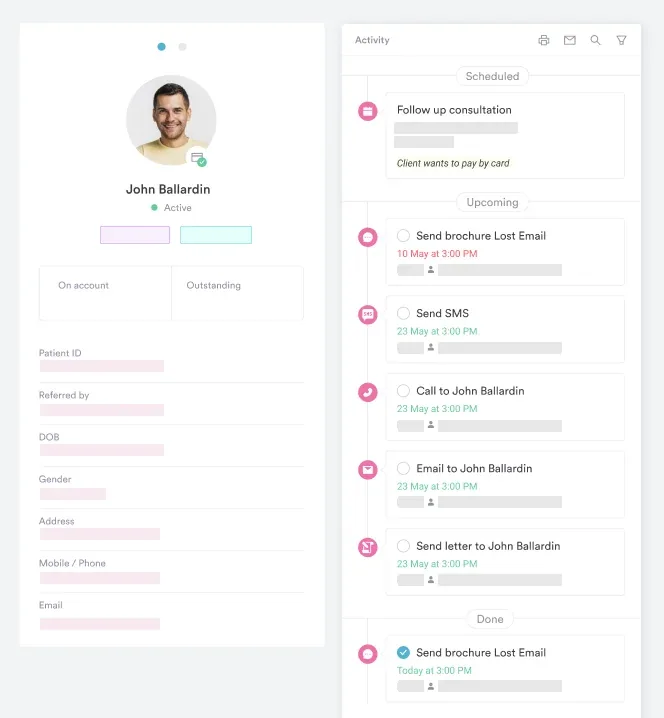
Digital intake forms can carry the same brachial neuritis assessment into every follow-up. The answers line up across the whole recovery, which makes a plateau easy to spot and a repeat EMG easy to justify.
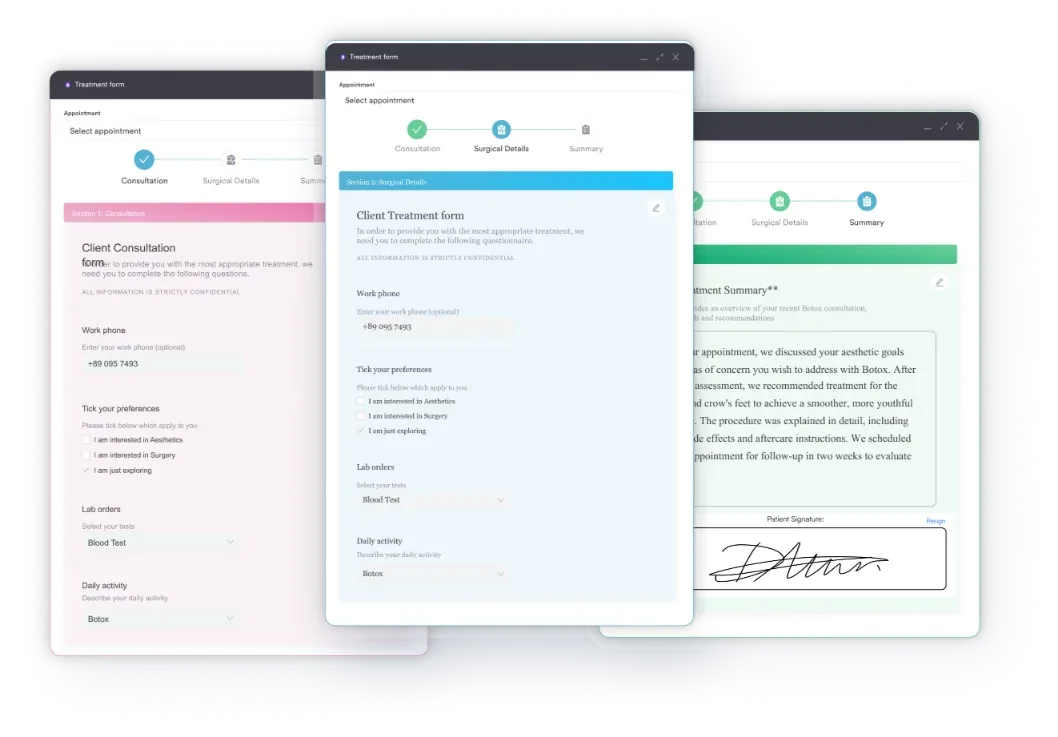
Whether a single therapist carries the caseload or a group practice splits it across sites, the documentation problem is the same. Comparable numbers, recorded on time, in one place.

Pabau records strength grades and range of motion as structured data, books the next review automatically, and keeps every clinician on one patient record. So a two-year recovery stays on schedule without a spreadsheet on the side.

Sequencing is what makes or breaks this rehab. Passive motion while the nerve is still angry, control work as it settles, load only once strength returns. Get that order right and most patients regain useful function, even when recovery takes two years.
The habit worth building is recording the number that justified each progression. When a patient plateaus at month nine, those strength grades and review dates tell you whether to push, hold, or send them back to neurology.
Practices carrying long rehab caseloads lose more time to recall admin than they expect. Book a demo to see how Pabau tracks strength measurements, home program adherence, and review dates across a recovery that runs for years.

Planning a return to sport? Return to running protocol shows how to stage load once strength has come back.
Losing patients mid-program? Patient retention covers what keeps people showing up through a long course of care.
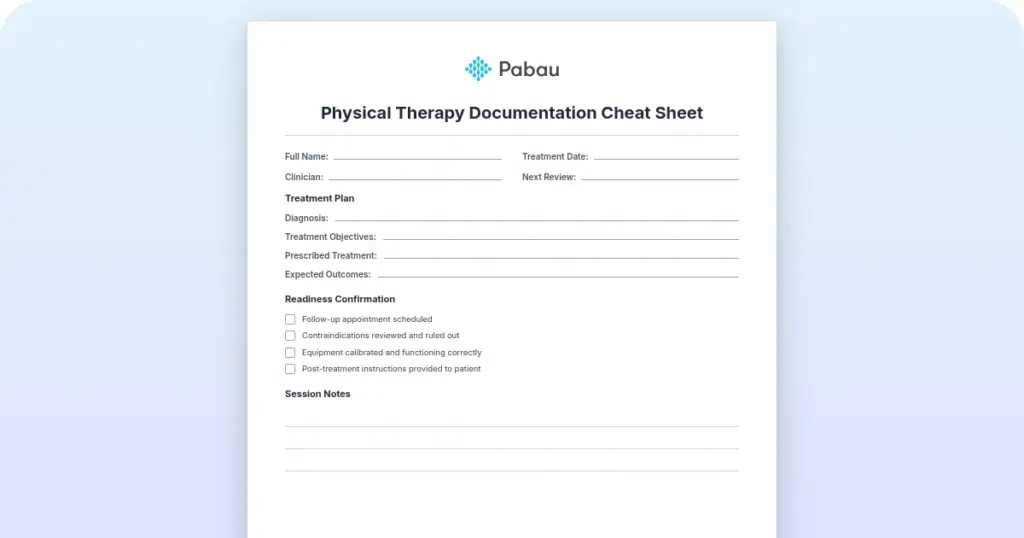
Standardizing your assessments? Physical therapy intake form is a ready-made form you can hand out at the first visit.
Setting up your own practice? Opening a physiotherapy clinic walks through the operational decisions that come first.
Comparing record systems? Physical therapy EMR software explains what to look for in a rehab-focused system.
Most patients sleep better semi-upright, with the affected arm supported on a pillow and the elbow bent. Lying flat on the painful side loads the shoulder and tends to wake people at night. A recliner works well in the first few weeks.
Yes, though a second episode is uncommon in the sporadic form. Recurrence is far more likely in the hereditary form, so repeated attacks warrant a neurology referral and a careful family history.
Brachial neuritis is immune-mediated and arrives without trauma. A brachial plexus injury comes from force, such as a stretch or tear during a collision or birth. Same nerve network, different cause, and a different rehab timeline.
That depends on which arm is affected and how much strength is left. Driving usually returns before overhead work does. Ask about steering, lifting, and reaching at each review rather than clearing the patient once and leaving it there.
Your therapist should give you one that matches your current phase. A generic download cannot know your strength grades or pain level. It often prescribes loading that is too heavy for your current stage.