

Hoffman’s sign test: Technique, interpretation, and referral guide
Hoffman’s sign test is a quick upper motor neuron screen performed during a neurological examination. The clinician flicks the middle finger’s distal phalanx downward and watches for involuntary flexion of the thumb and index finger. According to StatPearls (NCBI Bookshelf), a positive finding points to corticospinal tract dysfunction. Interpretation is where the test goes wrong. […]
Phelps test: How to perform and interpret results

The Phelps test is a prone orthopedic special test that identifies gracilis tightness as the cause of restricted hip abduction. You measure passive hip abduction twice: first with the knee extended, then again with the knee flexed to 90 degrees. If abduction increases in the second phase, the result is positive and the gracilis was […]
Multifidus lift test: Procedure, scoring and clinical interpretation
The multifidus lift test is a clinical assessment of lumbar multifidus function used by physiotherapists and musculoskeletal clinicians. The multifidus is a deep paraspinal stabilizer strongly associated with chronic low back pain. To run the test, the patient lies prone and lifts one arm around 5 cm off the table. The examiner palpates the muscle […]
Hoehn and Yahr Scale
The Hoehn and Yahr scale is an ordinal staging tool for Parkinson’s disease. It rates how far motor symptoms have progressed, from Stage 1 to Stage 5. Stage 1 means signs on one side of the body only. Stage 5 means the patient is wheelchair bound or bedridden unless aided. Margaret Hoehn and Melvin Yahr […]
Exercise motivation inventory-2 (EMI-2) template
The exercise motivation inventory-2 is a validated 51-item questionnaire that measures 14 separate reasons people exercise. Markland and Ingledew published it in 1997 in the British Journal of Health Psychology. Its 14 subscales sit under five themes: psychological, interpersonal, health, body-related and fitness motives. This template gives you the full assessment, the scoring key, and […]
Valsalva test: Technique, phases, and interpretation

The valsalva test asks a patient to bear down against a closed airway, and the pressure that builds does the diagnostic work. That strain raises pressure inside the chest, the abdomen and the spinal canal at once. One fact governs all three. A positive result carries weight, but a negative one does not exclude the […]
Speed’s test: How to perform, interpret, and apply it

Speed’s test is a shoulder provocation test that loads the long head of the biceps tendon to reproduce anterior pain. The arm sits at 90 degrees of flexion, the elbow stays straight, and the palm faces the ceiling. You press down, and pain in the bicipital groove counts as a positive result. One caveat shapes […]
30 Minute Exercise Plan
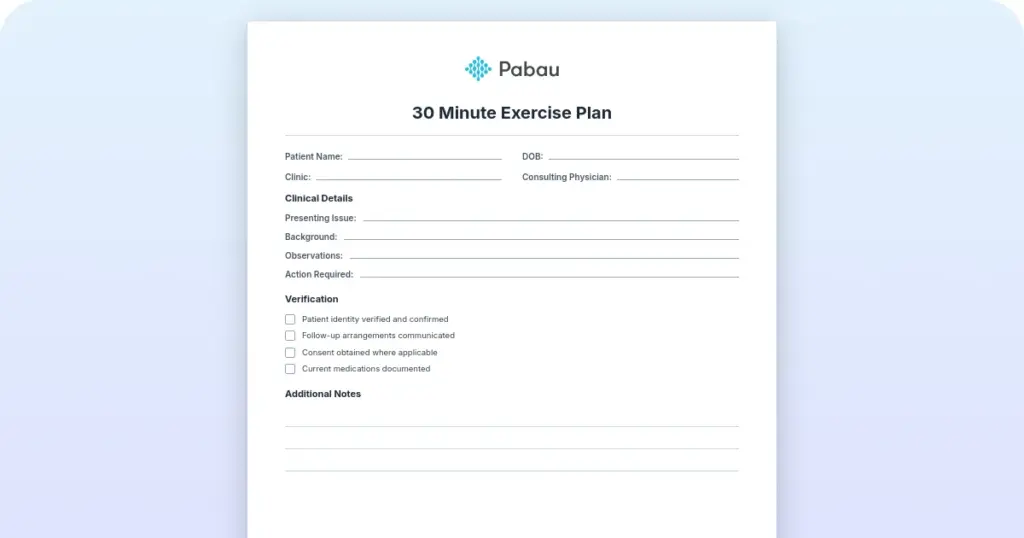
A 30 minute exercise plan template is a clinical form for agreeing exercise goals with a patient and recording the actions behind them. It is a planning and review document, not a workout sheet. It does not prescribe exercises, sets, reps, or rest periods. The two-page form covers patient details, background, up to five goals […]
Royal London Hospital test and arc sign: How to perform both
The Royal London Hospital test is a bedside palpation test for mid-portion Achilles tendinopathy. The examiner finds the most tender point on the tendon with the ankle relaxed in plantarflexion. That same point is then palpated again with the ankle held in maximal dorsiflexion. The test is positive when the tenderness disappears or drops sharply […]
Tinel’s test: Technique, positive signs, and accuracy
Tinel’s test is a light tap over a peripheral nerve that tells you whether that nerve is irritated, compressed, or regrowing after injury. A positive result feels like tingling or an electric shock spreading down the nerve’s own territory. Soreness at the spot you tapped does not count, and that single distinction decides most results. […]