GLP-1 diet plan
A GLP-1 diet plan is a structured eating framework for patients taking semagluti...

2
Last Updated: Oct 13, 2026
Tinel’s test is a light tap over a peripheral nerve that tells you whether that nerve is irritated, compressed, or regrowing after injury. A positive result feels like tingling or an electric shock spreading down the nerve’s own territory. Soreness at the spot you tapped does not count, and that single distinction decides most results.
Score it loosely and you refer the wrong patient for nerve conduction studies. Applied carefully, though, the test earns its minute. It localizes the lesion, needs no equipment, and works at three separate sites. Technique first, then how far you can trust what it tells you.

Tinel’s test provokes tingling along a nerve by tapping over it, which flags irritation or regrowth.
The wrist covers the median nerve, the elbow the ulnar nerve, and the ankle the tibial nerve.
Only paresthesia that radiates into the nerve’s own territory counts, so local tenderness scores as negative.
Sensitivity at the wrist sits near 50 to 60 percent, so a clean tap never rules out carpal tunnel syndrome.
Specificity at the elbow is far higher, which makes a positive result there much harder to dismiss.
A positive Tinel’s sign tells you where a nerve is unhappy, and sometimes how far it has healed. Tapping over a damaged or compressed nerve fires the sensitized axons at that point. They send a signal down the nerve, and the patient feels it as tingling in the skin that nerve supplies.
That mechanism explains both uses of the sign. In a compression picture, the positive point stays put across repeat visits, so it marks the entrapment. After a repair or a crush injury, the point creeps distally as axons regrow, at roughly a millimeter a day.
Chart where that point sits at each visit and you have a rough recovery curve. A sign that stops advancing is worth flagging, because it often means regrowth has stalled.
Jules Tinel described the finding in 1915 while treating nerve injuries in World War I soldiers. Paul Hoffmann reported it independently, which is why some European texts call it the Hoffmann-Tinel sign.
Nearly every Tinel’s test in practice happens at one of three places. Each has a landmark you can find by palpation, and each screens for a named entrapment.
Knowing where each nerve ends matters as much as knowing where it gets squeezed. The result only counts when tingling reaches the territory that nerve supplies.
Light percussion over the right landmark, repeated two or three times, is the whole technique. Tap hard and any patient reports discomfort, which is exactly how false positives happen.
The sequence below holds at all three sites:
Carpal tunnel syndrome is the most common entrapment you will screen for, so this is the version most clinicians run first. Rest the wrist on a flat surface in neutral or slight extension.
Cubital tunnel syndrome ranks second among upper limb entrapments. The nerve is superficial here, which is why technique matters even more than at the wrist.
Tarsal tunnel syndrome is less common than the upper limb entrapments, and it gets missed often because plantar heel pain looks like plantar fasciitis. A quick tap behind the medial malleolus separates the two.
A positive Tinel’s sign means paresthesia radiated into the nerve’s own dermatome when you tapped. Local pain, diffuse tingling across the whole hand, and a feeling of pressure all score as negative. Two clinical pictures produce a genuine positive: an entrapment irritating the nerve, or axons regrowing after an injury.
A negative result carries less weight than clinicians often assume. Roughly half of patients with confirmed carpal tunnel syndrome tap clean, so a quiet wrist never closes the case.
Read the finding alongside the history, the other provocative tests, and any red flags for motor loss.
Accuracy swings hard by site, and that swing changes what you can do with the answer. At the elbow, a positive sign comes close to confirmatory. At the wrist, treat it as one piece of evidence among several.
The reported figures below make the difference obvious.
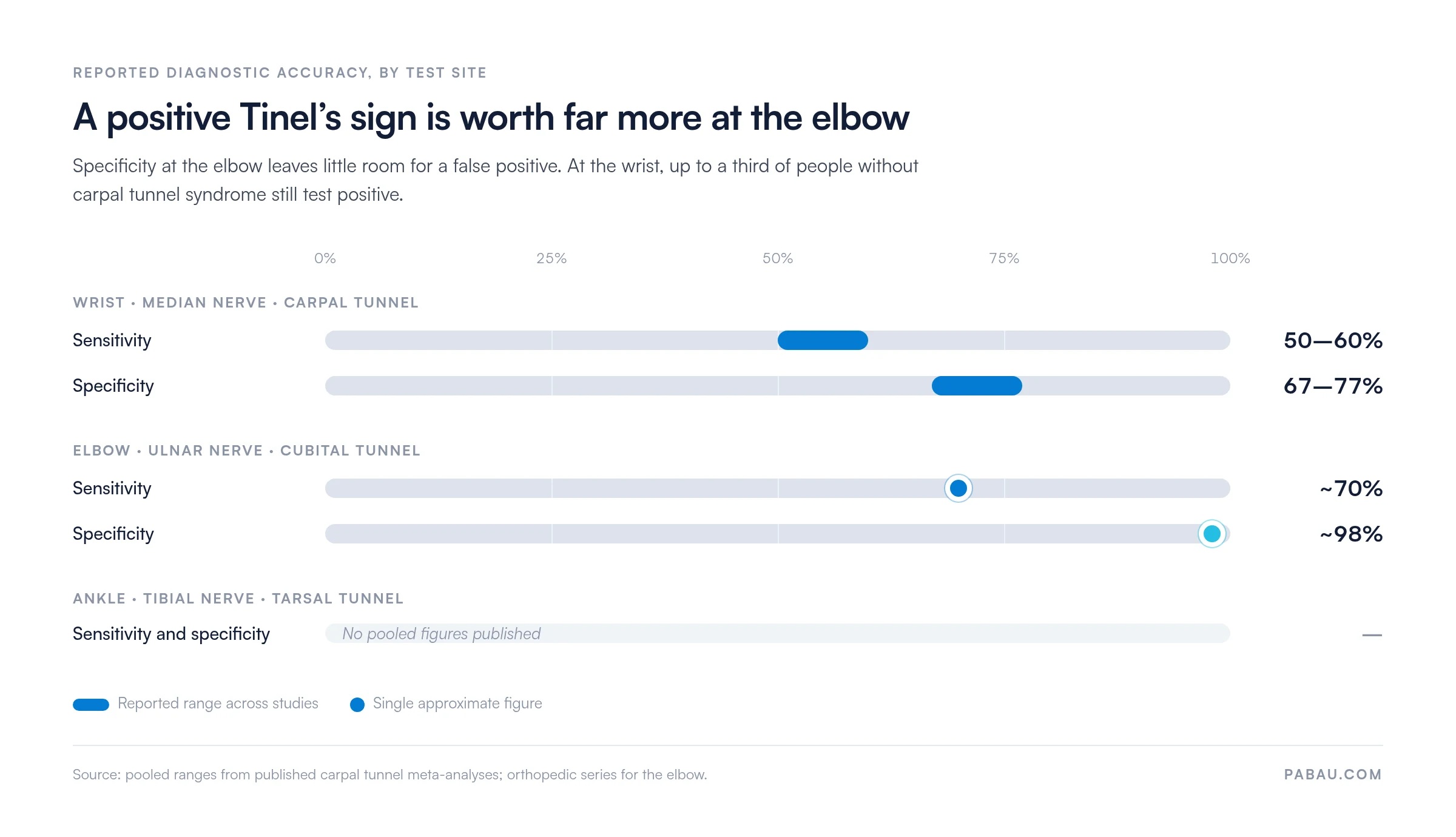
The wrist figures repeat consistently across published meta-analyses, so they are safe to quote. Elbow specificity near 98 percent is corroborated in orthopedic series, though percussion technique and study populations vary between them. Read that number as strong rather than settled.
The ankle has no pooled evidence of comparable quality. Use the tap there to support a picture built from history and imaging, and avoid leaning on it by itself.
Run Tinel’s test before Phalen’s, not after. Phalen’s maneuver holds the wrist in flexion for up to 60 seconds, which sensitizes the median nerve. Tap a nerve that has just been provoked and you inflate your own false-positive rate. Order the two deliberately.
Run both and each one covers the other’s weakness. Phalen’s test catches more true cases at the wrist, while Tinel’s raises fewer false alarms. Together they give you a clearer read than either test alone, and they take under two minutes between them.
Clinical guidance from the AAOS points the same way. When both tests turn positive in a patient whose history fits, confidence in a carpal tunnel diagnosis rises well above either result on its own. Our guide to Phalen’s test walks through the technique and how to time it properly.
Tinel’s test applies wherever a peripheral nerve might be compressed or regrowing. Six presentations account for most of its use in day-to-day practice.
Upper limb presentations dominate that list. A positive tap at the wrist usually leads straight into a fuller screen, and our rundown of hand nerve tests covers the ones worth adding.
Tinel’s test is a screening tool with well-known failure modes. Five of them explain most bad results, and four sit with the examiner rather than the patient.
Order electrodiagnosis when the result will change what you do next. In practice that means an uncertain diagnosis, a motor sign, conservative care that has stalled, or a surgical referral on the table. Outside those four, the study can wait.
Before you act on a positive sign, run four quick checks. They take seconds and they catch the errors that send the wrong patient down a referral pathway.
One tap is a single input. Adding neural tension testing sharpens the picture before you commit to a referral. Our set of upper limb tension tests gives you a sequence to run in the same visit.
Write down the site, the method, the patient’s own words, and the radiation pattern. “Tinel’s positive” on its own gives the next clinician no way to act on it, and it reads badly if the notes are ever reviewed. Six items cover a defensible entry.
Two mistakes turn up again and again in reviewed notes. The first is recording a result without the side tested, which makes serial comparison impossible. The second is writing “tingling in the hand” instead of naming the digits, since digit territory is what separates median from ulnar.
Free text invites both errors. A physical therapy EMR can hold each of those six items as its own field. The choice disappears, and the entry comes out the same shape whoever wrote it.
Most practices record special tests in free text, and free text drifts. One clinician writes “Tinel’s +ve R wrist”, another writes a paragraph, and a third leaves it until the end of the day. Six months on, nobody can say whether the sign advanced.
Practice management software like Pabau handles this with structured clinical forms. You build the special test once, with site, technique, patient response, distribution, and result as separate fields. Every clinician then fills in the same form, so the answers land in the patient record instead of someone’s shorthand.

Because capture forms software stores each answer separately, you can pull a patient’s Tinel’s results across four visits and read the pattern at a glance. That matters most in nerve regeneration, where the question is simply whether the positive level has moved.

That audit trail earns its keep later. When a colleague, an insurer, or a review asks what was found in March, the answer takes seconds rather than a scroll through free text.

Pabau gives physical therapy and sports medicine practices structured clinical forms. Results like Tinel’s land in named fields instead of free text.

Use Tinel’s test for what it does well. It points at a location, it takes under a minute, and at the elbow it carries genuine diagnostic weight. At the wrist, pair it with Phalen’s and let electrodiagnosis settle the question.
The bigger win is consistency. Score the tap the same way every time, and write it up the same way every visit. A soft sign then becomes a trend you can follow. That is a documentation decision as much as a clinical one.
If you want special test results captured the same way across your whole team, book a demo and see how Pabau structures musculoskeletal notes.

Screening a hand that tests positive? Hand nerve tests sets out the wider screen worth running once a tap comes back positive.
Looking for another carpal tunnel provocation test? The hand elevation test is quick to run and useful when Tinel’s and Phalen’s disagree.
Need a structured neurological exam sheet? Cranial nerve examination checklist gives you a printable format you can adapt for peripheral testing.
Running a multi-practitioner physical therapy practice? Clinic management software for physiotherapy explains how structured tools keep workflows consistent across a team.
Wondering what your records have to show? Physiotherapy clinic compliance requirements outlines the documentation standards regulators expect.
It should not be. Light percussion with a fingertip produces a brief tingle at most. If a patient reports sharp pain, you are tapping too hard or over inflamed soft tissue. Ease off and repeat, because pain on percussion is a different finding from paresthesia.
Yes. Mild tingling on firm percussion turns up in people with no nerve pathology, especially at the wrist. That is one reason specificity there sits below 80 percent. Compare both sides, keep the taps light, and treat an isolated finding with caution.
Usually within a few weeks, once regenerating axons reach the repair site. The positive point then advances distally at roughly a millimeter a day. Mark the level at each visit, because a sign that stops moving suggests regrowth has stalled.
No. On its own it supports a diagnosis and no more than that. Surgical decisions rest on symptom severity, motor signs such as thenar wasting, failed conservative care, and nerve conduction findings. A positive tap alone has never justified an operation.
Any clinician trained in musculoskeletal examination, including physical therapists, occupational therapists, physicians, and physician assistants. No equipment is needed beyond a fingertip or a reflex hammer. Who may order the follow-up nerve conduction study varies by state.